GST
( GOODS AND SERVICETAX )
… Biggest tax reform since independence
By – ARPIT SHARMA
ADITYA PRATAP SINGH
ROHIT KUMAR
GST
 GST • Goods and service tax (GST) is a
comprehensive tax levy on manufacture,
sale and consumption of goods and
service at a national level.
 • GST is a tax on goods and services with
value addition at each stage.
 • GST will include many state and central
level indirect taxes.
 • It overcomes drawback present tax
system
TAX STRUCTURE IN INDIA •
 DirectTax :
IncomeTax, CorporateTax, WealthTax
 IndirectTax :
Excise duty, custom duty, ServiceTax, VAT,
etc.
METHOD OFTAXATION
 ProgressiveTax : Increasing rate of tax
for IncreasingValue orVolume.
 RegressiveTax : Decreasing rate tax for
IncreasingValue
 Volume ProportionalTax : Fixed rate
of tax for every level of income or
production
Short comings in currentTax
System
 Tax Cascading (Tax on Tax)
 Complexity
 Taxation at Manufacturing Level
 Exclusion of Services
 Tax Evasion
 Corruption
WHAT IS GST
 GST is a comprehensive value added tax on goods and
services
 It is collected on value added at each stage of sale or
purchase in the supply chain
 No differentiation between goods and services as GST
is levied at each stage in the supply chain
 Seamless input tax credit throughout the supply chain
 At all stages of production and distribution, taxes are a
 Pass through and tax is borne by the final consumer
 All sectors are taxed with very few exceptions /
exemptions
HISTORY OF GST
IMPLEMENTATION IN INDIA
 Feb, 2006 : First time introduced concept of
GST and announced the date of its
implementation in 2010
 Jan. 2007: First GST study by ASSOCHAM
released by Dr. Shome
 Feb. 2007: F.M.Announced introduction of GST
from 1 April 2010 in Budget
 The Government came out with a First
Discussion Paper on GST in November, 2009
 Introduced the 115th Constitution
Amendment (GST) Bill in the year 2011.
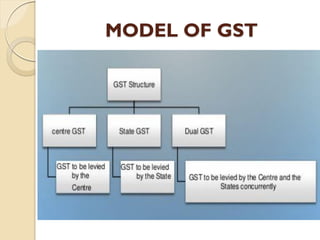
MODEL OF GST
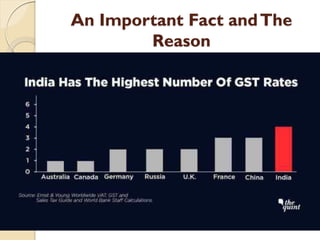
An Important Fact andThe
Reason
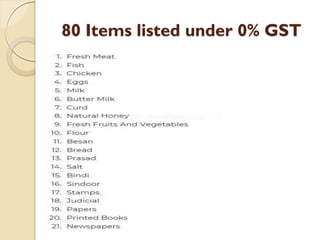
80 Items listed under 0% GST
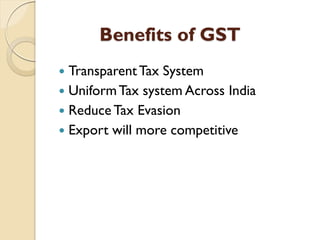
Benefits of GST
 TransparentTax System
 UniformTax system Across India
 Reduce Tax Evasion
 Export will more competitive
Hurdles in Implementation
 Dispute between centre and Tax over Tax
Sharing
 Highly sophisticated IT infrastructure
required .
 Issue of taxing financial services and e-
commerce is to be appropriately
addressed and integrated.
 Political Imbalace
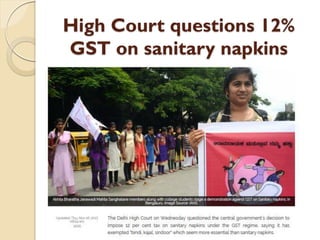
High Court questions 12%
GST on sanitary napkins
GST Global Scenario
 More than 140 countries have already
introduced GST/NationalVAT.
 France was the first country to introduce
GST system in 1954.
 Typically it is a single rate system but
two/three rate systems are also prevalent.
Canada and Brazil alone have a dualVAT.
 Standard GST rate in most countries
ranges between 15-20%
References :
 https://gstindiaguide.com/gst-zero-rate-item-list/
 http://www.zeebiz.com/india/news-high-court-
questions-12-gst-on-sanitary-napkins-31510
 http://www.business-
standard.com/article/economy-policy/why-12-gst-
on-sanitary-pads-asks-pil-delhi-hc-issues-notice-
to-centre-117071801313_1.html
 https://www.moneycontrol.com/news/business/ec
onomy/india-joins-global-league-heres-the-list-of-
gst-rates-across-the-world-2283941.html
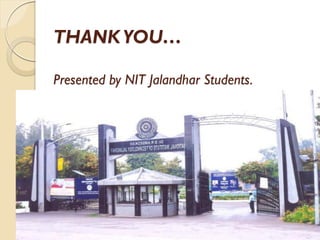
THANK YOU…
Presented by NIT Jalandhar Students.

Indian GST analysis

  • 1.
    GST ( GOODS ANDSERVICETAX ) … Biggest tax reform since independence By – ARPIT SHARMA ADITYA PRATAP SINGH ROHIT KUMAR
  • 2.
    GST  GST •Goods and service tax (GST) is a comprehensive tax levy on manufacture, sale and consumption of goods and service at a national level.  • GST is a tax on goods and services with value addition at each stage.  • GST will include many state and central level indirect taxes.  • It overcomes drawback present tax system
  • 3.
    TAX STRUCTURE ININDIA •  DirectTax : IncomeTax, CorporateTax, WealthTax  IndirectTax : Excise duty, custom duty, ServiceTax, VAT, etc.
  • 4.
    METHOD OFTAXATION  ProgressiveTax: Increasing rate of tax for IncreasingValue orVolume.  RegressiveTax : Decreasing rate tax for IncreasingValue  Volume ProportionalTax : Fixed rate of tax for every level of income or production
  • 5.
    Short comings incurrentTax System  Tax Cascading (Tax on Tax)  Complexity  Taxation at Manufacturing Level  Exclusion of Services  Tax Evasion  Corruption
  • 6.
    WHAT IS GST GST is a comprehensive value added tax on goods and services  It is collected on value added at each stage of sale or purchase in the supply chain  No differentiation between goods and services as GST is levied at each stage in the supply chain  Seamless input tax credit throughout the supply chain  At all stages of production and distribution, taxes are a  Pass through and tax is borne by the final consumer  All sectors are taxed with very few exceptions / exemptions
  • 7.
    HISTORY OF GST IMPLEMENTATIONIN INDIA  Feb, 2006 : First time introduced concept of GST and announced the date of its implementation in 2010  Jan. 2007: First GST study by ASSOCHAM released by Dr. Shome  Feb. 2007: F.M.Announced introduction of GST from 1 April 2010 in Budget  The Government came out with a First Discussion Paper on GST in November, 2009  Introduced the 115th Constitution Amendment (GST) Bill in the year 2011.
  • 8.
  • 10.
    An Important FactandThe Reason
  • 11.
    80 Items listedunder 0% GST
  • 12.
    Benefits of GST TransparentTax System  UniformTax system Across India  Reduce Tax Evasion  Export will more competitive
  • 13.
    Hurdles in Implementation Dispute between centre and Tax over Tax Sharing  Highly sophisticated IT infrastructure required .  Issue of taxing financial services and e- commerce is to be appropriately addressed and integrated.  Political Imbalace
  • 14.
    High Court questions12% GST on sanitary napkins
  • 15.
    GST Global Scenario More than 140 countries have already introduced GST/NationalVAT.  France was the first country to introduce GST system in 1954.  Typically it is a single rate system but two/three rate systems are also prevalent. Canada and Brazil alone have a dualVAT.  Standard GST rate in most countries ranges between 15-20%
  • 16.
    References :  https://gstindiaguide.com/gst-zero-rate-item-list/ http://www.zeebiz.com/india/news-high-court- questions-12-gst-on-sanitary-napkins-31510  http://www.business- standard.com/article/economy-policy/why-12-gst- on-sanitary-pads-asks-pil-delhi-hc-issues-notice- to-centre-117071801313_1.html  https://www.moneycontrol.com/news/business/ec onomy/india-joins-global-league-heres-the-list-of- gst-rates-across-the-world-2283941.html
  • 17.
    THANK YOU… Presented byNIT Jalandhar Students.