GOODS AND SERVICES TAX, INDIA
PREPARED BY:
ANKITA MAHAJAN
PRESENT TAXATION SYSTEM
LIMITATIONS OF PRESENT SYSTEM
PROPOSED GST TAXATION SYSTEM
CURRENT STATUS
CONCLUSION
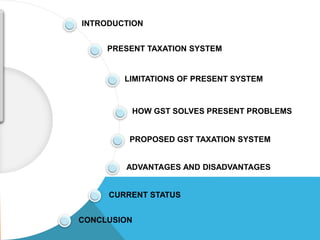
INTRODUCTION
A
G
E
N
D
A
ADVANTAGES AND DISADVANTAGES
HOW GST SOLVES PRESENT PROBLEMS
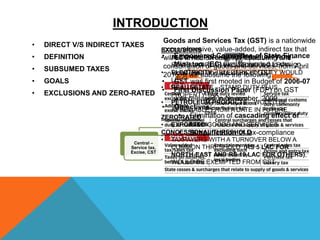
• DIRECT V/S INDIRECT TAXES
• DEFINITION
• SUBSUMED TAXES
• GOALS
• EXCLUSIONS AND ZERO-RATED
Tax
Indirect
A tax levied on the
price of a good or
service
Central –
Service tax,
Excise, CST
State – VAT,
Entry tax
Town/Municipal
- Octroi
Direct
A tax levied
directly on
personal or
corporate income
Income Tax
EXCLUSIONS
• ALCOHOL FOR HUMAN CONSUMPTION –
STATE VAT PLUS EXCISE WOULD LEVY
• ELECTRICITY – ELECTRICITY DUTY WOULD
LEVY
• REAL ESTATE – STAMP DUTY PLUS
PROPERTY TAX
• PETROLEUM PRODUCTS – WOULD BE
APPLICABLE FROM A DATE IN FUTURE
ZERO-RATED
• EXPORTED GOODS AND SERVICES
CONCESSIONAL THRESHOLD
• TAXPAYERS WITH A TURNOVER BELOW A
COMMON THRESHOLD, (RS 5 LAC FOR
NORTH-EAST AND RS 10 LAC FOR OTHERS),
WOULD BE EXEMPTED FROM GST
• Empowered Committee of State Finance
Ministers (EC) was requested to design
road-map and structure of GST
• GST was first mooted in Budget of 2006-07
• First Discussion Paper (FDP) on GST
was released in November, 2009
• Objectives:
 Elimination of cascading effect of
taxes
 Simplification of tax-compliance
INTRODUCTION
Goods and Services Tax (GST) is a nationwide
comprehensive, value-added, indirect tax that
will be levied on sale, manufacturing and
consumption of goods and services, from April
2016. It will subsume the following:
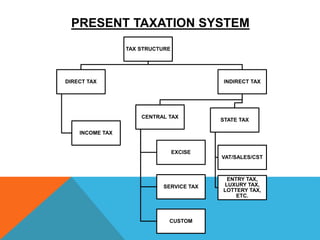
PRESENT TAXATION SYSTEM
TAX STRUCTURE
DIRECT TAX
INCOME TAX
INDIRECT TAX
CENTRAL TAX
EXCISE
SERVICE TAX
CUSTOM
STATE TAX
VAT/SALES/CST
ENTRY TAX,
LUXURY TAX,
LOTTERY TAX,
ETC.
PRESENT TAXATION SYSTEM
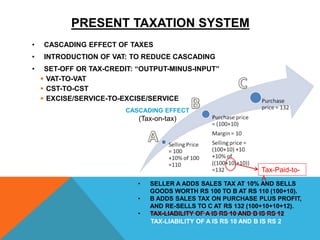
• CASCADING EFFECT OF TAXES
• INTRODUCTION OF VAT: TO REDUCE CASCADING
• SET-OFF OR TAX-CREDIT: “OUTPUT-MINUS-INPUT”
 VAT-TO-VAT
 CST-TO-CST
 EXCISE/SERVICE-TO-EXCISE/SERVICE
• SELLER A ADDS SALES TAX AT 10% AND SELLS
GOODS WORTH RS 100 TO B AT RS 110 (100+10).
• B ADDS SALES TAX ON PURCHASE PLUS PROFIT,
AND RE-SELLS TO C AT RS 132 (100+10+10+12).
• TAX-LIABILITY OF A IS RS 10 AND B IS RS 12
CASCADING EFFECT
(Tax-on-tax)
Tax-Paid-to-
A
TAX-LIABILITY OF A IS RS 10 AND B IS RS 2
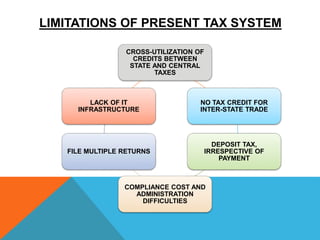
LIMITATIONS OF PRESENT TAX SYSTEM
CROSS-UTILIZATION OF
CREDITS BETWEEN
STATE AND CENTRAL
TAXES
NO TAX CREDIT FOR
INTER-STATE TRADE
DEPOSIT TAX,
IRRESPECTIVE OF
PAYMENT
COMPLIANCE COST AND
ADMINISTRATION
DIFFICULTIES
FILE MULTIPLE RETURNS
LACK OF IT
INFRASTRUCTURE
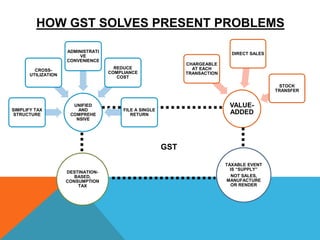
HOW GST SOLVES PRESENT PROBLEMS
UNIFIED
AND
COMPREHE
NSIVE
SIMPLIFY TAX
STRUCTURE
CROSS-
UTILIZATION
ADMINISTRATI
VE
CONVENIENCE
REDUCE
COMPLIANCE
COST
FILE A SINGLE
RETURN
VALUE-
ADDED
CHARGEABLE
AT EACH
TRANSACTION
DIRECT SALES
STOCK
TRANSFER
DESTINATION-
BASED,
CONSUMPTION
TAX
TAXABLE EVENT
IS “SUPPLY”
NOT SALES,
MANUFACTURE
OR RENDER
GST
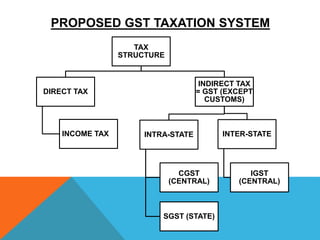
PROPOSED GST TAXATION SYSTEM
TAX
STRUCTURE
DIRECT TAX
INCOME TAX
INDIRECT TAX
= GST (EXCEPT
CUSTOMS)
INTRA-STATE
CGST
(CENTRAL)
SGST (STATE)
INTER-STATE
IGST
(CENTRAL)
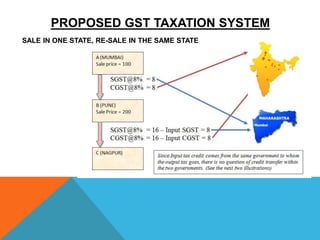
PROPOSED GST TAXATION SYSTEM
SALE IN ONE STATE, RE-SALE IN THE SAME STATE
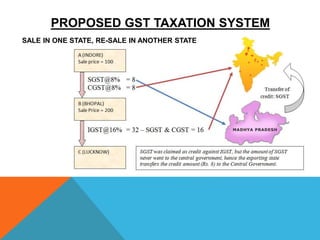
PROPOSED GST TAXATION SYSTEM
SALE IN ONE STATE, RE-SALE IN ANOTHER STATE
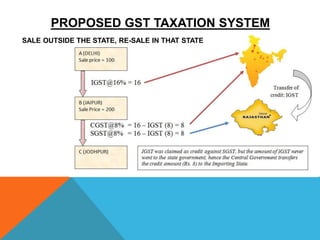
PROPOSED GST TAXATION SYSTEM
SALE OUTSIDE THE STATE, RE-SALE IN THAT STATE
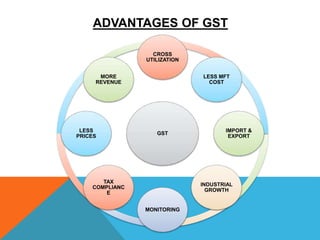
ADVANTAGES OF GST
GST
CROSS
UTILIZATION
LESS MFT
COST
IMPORT &
EXPORT
INDUSTRIAL
GROWTH
MONITORING
TAX
COMPLIANC
E
LESS
PRICES
MORE
REVENUE
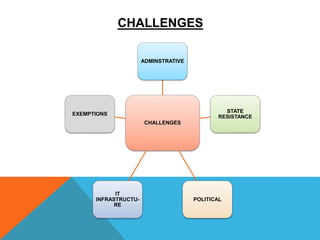
CHALLENGES
CHALLENGES
ADMINSTRATIVE
STATE
RESISTANCE
POLITICAL
IT
INFRASTRUCTU-
RE
EXEMPTIONS
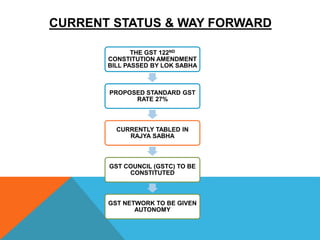
CURRENT STATUS & WAY FORWARD
THE GST 122ND
CONSTITUTION AMENDMENT
BILL PASSED BY LOK SABHA
PROPOSED STANDARD GST
RATE 27%
CURRENTLY TABLED IN
RAJYA SABHA
GST COUNCIL (GSTC) TO BE
CONSTITUTED
GST NETWORK TO BE GIVEN
AUTONOMY
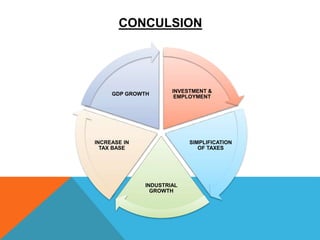
CONCULSION
INVESTMENT &
EMPLOYMENT
SIMPLIFICATION
OF TAXES
INDUSTRIAL
GROWTH
INCREASE IN
TAX BASE
GDP GROWTH
THANK YOU

Understanding Goods & Services Tax (GST), India

  • 1.
    GOODS AND SERVICESTAX, INDIA PREPARED BY: ANKITA MAHAJAN
  • 2.
    PRESENT TAXATION SYSTEM LIMITATIONSOF PRESENT SYSTEM PROPOSED GST TAXATION SYSTEM CURRENT STATUS CONCLUSION INTRODUCTION A G E N D A ADVANTAGES AND DISADVANTAGES HOW GST SOLVES PRESENT PROBLEMS
  • 3.
    • DIRECT V/SINDIRECT TAXES • DEFINITION • SUBSUMED TAXES • GOALS • EXCLUSIONS AND ZERO-RATED Tax Indirect A tax levied on the price of a good or service Central – Service tax, Excise, CST State – VAT, Entry tax Town/Municipal - Octroi Direct A tax levied directly on personal or corporate income Income Tax EXCLUSIONS • ALCOHOL FOR HUMAN CONSUMPTION – STATE VAT PLUS EXCISE WOULD LEVY • ELECTRICITY – ELECTRICITY DUTY WOULD LEVY • REAL ESTATE – STAMP DUTY PLUS PROPERTY TAX • PETROLEUM PRODUCTS – WOULD BE APPLICABLE FROM A DATE IN FUTURE ZERO-RATED • EXPORTED GOODS AND SERVICES CONCESSIONAL THRESHOLD • TAXPAYERS WITH A TURNOVER BELOW A COMMON THRESHOLD, (RS 5 LAC FOR NORTH-EAST AND RS 10 LAC FOR OTHERS), WOULD BE EXEMPTED FROM GST • Empowered Committee of State Finance Ministers (EC) was requested to design road-map and structure of GST • GST was first mooted in Budget of 2006-07 • First Discussion Paper (FDP) on GST was released in November, 2009 • Objectives:  Elimination of cascading effect of taxes  Simplification of tax-compliance INTRODUCTION Goods and Services Tax (GST) is a nationwide comprehensive, value-added, indirect tax that will be levied on sale, manufacturing and consumption of goods and services, from April 2016. It will subsume the following:
  • 4.
    PRESENT TAXATION SYSTEM TAXSTRUCTURE DIRECT TAX INCOME TAX INDIRECT TAX CENTRAL TAX EXCISE SERVICE TAX CUSTOM STATE TAX VAT/SALES/CST ENTRY TAX, LUXURY TAX, LOTTERY TAX, ETC.
  • 5.
    PRESENT TAXATION SYSTEM •CASCADING EFFECT OF TAXES • INTRODUCTION OF VAT: TO REDUCE CASCADING • SET-OFF OR TAX-CREDIT: “OUTPUT-MINUS-INPUT”  VAT-TO-VAT  CST-TO-CST  EXCISE/SERVICE-TO-EXCISE/SERVICE • SELLER A ADDS SALES TAX AT 10% AND SELLS GOODS WORTH RS 100 TO B AT RS 110 (100+10). • B ADDS SALES TAX ON PURCHASE PLUS PROFIT, AND RE-SELLS TO C AT RS 132 (100+10+10+12). • TAX-LIABILITY OF A IS RS 10 AND B IS RS 12 CASCADING EFFECT (Tax-on-tax) Tax-Paid-to- A TAX-LIABILITY OF A IS RS 10 AND B IS RS 2
  • 6.
    LIMITATIONS OF PRESENTTAX SYSTEM CROSS-UTILIZATION OF CREDITS BETWEEN STATE AND CENTRAL TAXES NO TAX CREDIT FOR INTER-STATE TRADE DEPOSIT TAX, IRRESPECTIVE OF PAYMENT COMPLIANCE COST AND ADMINISTRATION DIFFICULTIES FILE MULTIPLE RETURNS LACK OF IT INFRASTRUCTURE
  • 7.
    HOW GST SOLVESPRESENT PROBLEMS UNIFIED AND COMPREHE NSIVE SIMPLIFY TAX STRUCTURE CROSS- UTILIZATION ADMINISTRATI VE CONVENIENCE REDUCE COMPLIANCE COST FILE A SINGLE RETURN VALUE- ADDED CHARGEABLE AT EACH TRANSACTION DIRECT SALES STOCK TRANSFER DESTINATION- BASED, CONSUMPTION TAX TAXABLE EVENT IS “SUPPLY” NOT SALES, MANUFACTURE OR RENDER GST
  • 8.
    PROPOSED GST TAXATIONSYSTEM TAX STRUCTURE DIRECT TAX INCOME TAX INDIRECT TAX = GST (EXCEPT CUSTOMS) INTRA-STATE CGST (CENTRAL) SGST (STATE) INTER-STATE IGST (CENTRAL)
  • 9.
    PROPOSED GST TAXATIONSYSTEM SALE IN ONE STATE, RE-SALE IN THE SAME STATE
  • 10.
    PROPOSED GST TAXATIONSYSTEM SALE IN ONE STATE, RE-SALE IN ANOTHER STATE
  • 11.
    PROPOSED GST TAXATIONSYSTEM SALE OUTSIDE THE STATE, RE-SALE IN THAT STATE
  • 12.
    ADVANTAGES OF GST GST CROSS UTILIZATION LESSMFT COST IMPORT & EXPORT INDUSTRIAL GROWTH MONITORING TAX COMPLIANC E LESS PRICES MORE REVENUE
  • 13.
  • 14.
    CURRENT STATUS &WAY FORWARD THE GST 122ND CONSTITUTION AMENDMENT BILL PASSED BY LOK SABHA PROPOSED STANDARD GST RATE 27% CURRENTLY TABLED IN RAJYA SABHA GST COUNCIL (GSTC) TO BE CONSTITUTED GST NETWORK TO BE GIVEN AUTONOMY
  • 15.
  • 16.

Editor's Notes

  • #5 Other State taxes: Entertainment Tax: Taxable event is sale of tickets to movies, large commercial shows and large private festival celebrations. Luxury Tax: Tax on sale of luxury goods (non-essential products). Purchase Tax: Tax paid to VAT department on purchase of goods from an unregistered dealer.
  • #7  Cross-utilization of credits between state and central taxes is not allowed The credit of VAT is not available against excise and vice versa. No tax credit is allotted for inter-state trade CENVAT credit is not allowed on the VAT paid on the input of raw material. Deposit taxes at the event of sale/service or removal of goods, irrespective of receipt of payment. Complexity of compliance: Each tax, except service tax, is a law and has rules stated in a separate Act of Constitution Tax payer needs to file multiple returns, to all different departments. Multiplicity of taxes: Taxes such as Entry Tax, Luxury Tax, Entertainment Tax etc., have not been subsumed under VAT scheme. Compliance Burden: High cost and administration difficulties. Lack of proper IT infrastructure The credit of Input VAT is available against Output VAT. In the same manner, the credit of input excise/service tax is available for set-off against output liability of excise/service tax. However, the credit of VAT is not available against excise and vice versa. We all know that VAT is computed on a value which includes excise duty and Tax on tax. 17. In the same manner, CENVAT credit is not allowed on the VAT paid on the input raw material, but only for the Excise duty paid on inputs. This shows that there is a tax on tax. 18. Excise duty and service tax are levied by the Central Government, while the VAT is levied by the State Government, which is one of the reasons why such a cross-utilization of credits could not be allowed. Consumers have to pay a VAT on excise. 19. Several indirect taxes on Goods and Services, such as Entry Tax, Luxury Tax, Entertainment Tax etc., have not been subsumed in the VAT scheme, which goes against the basic premise of VAT, which is, to have uniformity in tax structure. 20. The fact that no tax credit is allotted for inter-state trade seriously undermines the basic benefit of enforcing a VAT system. 21. As discussed above (Page 4), the manufacturer, seller or service provider has to deposit taxes at the time of sale or removal of goods, irrespective of receipt of payment for the sale or order. 22. A taxpayer, for whom all four laws, (service tax, excise, VAT and CST), apply, has to file four returns, to four different departments. 23. Multiplicity of taxes. 24. High cost of compliance and difficult to administer. 25. Lack of proper IT infrastructure.
  • #9 CGST and SGST would be legislated, levied and administered, by the centre and states respectively. As shown in Fig 6, for an intra-state transaction, CGST and SGST, charged on the manufacturing cost, would be collected at the point/place of supply, by the centre and state respectively. For inter-state transactions of goods and services, such as direct sales and stock transfer, center would levy and collect an Integrated GST (IGST), at the point of supply, and share its proceeds with consumer states. IGST would also apply to import of goods and services. IGST is basically SGST plus CGST and its proceeds are shared by the Center and the consumer state. The same taxable base would be applicable for both CGST and SGST. The centre would “legislate” CGST Act and states would “legislate” SGST Act. Both centre and states would have the power to “administer” the taxes. Fig 7 differentiates between inter and intra state transaction taxes in the existing old system and the proposed new system of taxes. VAT is value added tax on goods only. GST is like VAT but applies to Services also. India levies VAT on goods, and Service Tax on services, whereas most countries only have a single GST that applies to both products and services. Though cascading has significantly reduced, it is not eliminated completely as inter-state transactions are not covered under VAT. Also, under present VAT, multiple other state and central taxes apply at various levels, unlike GST, which subsumes all other taxes.