GST
TANVEER AHM
Introduction :
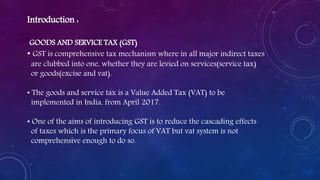
GOODS AND SERVICE TAX (GST)
• GST is comprehensive tax mechanism where in all major indirect taxes
are clubbed into one, whether they are levied on services(service tax)
or goods(excise and vat).
• The goods and service tax is a Value Added Tax (VAT) to be
implemented in India, from April 2017.
• One of the aims of introducing GST is to reduce the cascading effects
of taxes which is the primary focus of VAT but vat system is not
comprehensive enough to do so.
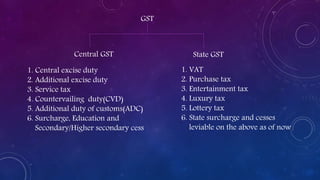
GST
Central GST State GST
1. Central excise duty
2. Additional excise duty
3. Service tax
4. Countervailing duty(CVD)
5. Additional duty of customs(ADC)
6. Surcharge, Education and
Secondary/Higher secondary cess
1. VAT
2. Purchase tax
3. Entertainment tax
4. Luxury tax
5. Lottery tax
6. State surcharge and cesses
leviable on the above as of now
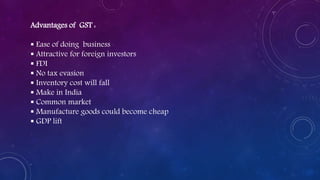
Advantages of GST :
 Ease of doing business
 Attractive for foreign investors
 FDI
 No tax evasion
 Inventory cost will fall
 Make in India
 Common market
 Manufacture goods could become cheap
 GDP lift
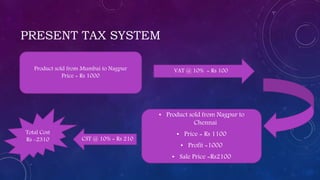
PRESENT TAX SYSTEM
• Product sold from Nagpur to
Chennai
• Price = Rs 1100
• Profit =1000
• Sale Price =Rs2100
Product sold from Mumbai to Nagpur
Price = Rs 1000
VAT @ 10% = Rs 100
CST @ 10% = Rs 210
Total Cost
Rs -2310
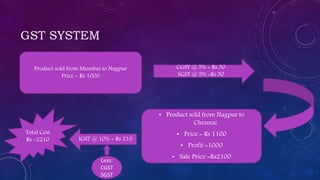
GST SYSTEM
• Product sold from Nagpur to
Chennai
• Price = Rs 1100
• Profit =1000
• Sale Price =Rs2100
Product sold from Mumbai to Nagpur
Price = Rs 1000
CGST @ 5% = Rs 50
SGST @ 5% =Rs 50
IGST @ 10% = Rs 210
Total Cost
Rs -2210
Less:
CGST
SGST
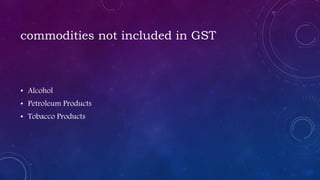
commodities not included in GST
• Alcohol
• Petroleum Products
• Tobacco Products
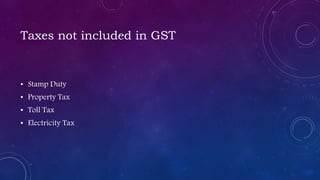
Taxes not included in GST
• Stamp Duty
• Property Tax
• Toll Tax
• Electricity Tax
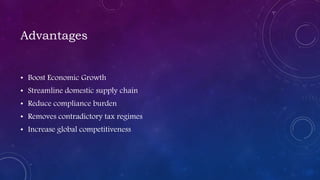
Advantages
• Boost Economic Growth
• Streamline domestic supply chain
• Reduce compliance burden
• Removes contradictory tax regimes
• Increase global competitiveness
Government
• Increases GDP
• Enhanced Revenue
• Improved Ranking
Trade and Industry
• Reduction in cost
• Enhanced Margins
• Reduction of Litigations
Consumers
• Same quality and Reduced price
Slabs
• 5%
• 12%
• 18%
• 28%
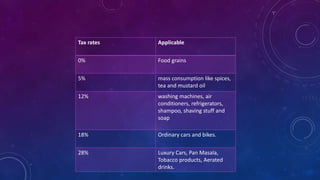
Tax rates Applicable
0% Food grains
5% mass consumption like spices,
tea and mustard oil
12% washing machines, air
conditioners, refrigerators,
shampoo, shaving stuff and
soap
18% Ordinary cars and bikes.
28% Luxury Cars, Pan Masala,
Tobacco products, Aerated
drinks.
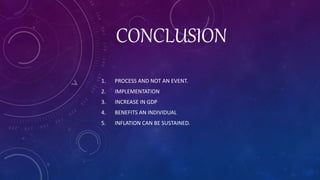
CONCLUSION
1. PROCESS AND NOT AN EVENT.
2. IMPLEMENTATION
3. INCREASE IN GDP
4. BENEFITS AN INDIVIDUAL
5. INFLATION CAN BE SUSTAINED.
THANK YOU

Gst (2017)

  • 1.
  • 2.
    Introduction : GOODS ANDSERVICE TAX (GST) • GST is comprehensive tax mechanism where in all major indirect taxes are clubbed into one, whether they are levied on services(service tax) or goods(excise and vat). • The goods and service tax is a Value Added Tax (VAT) to be implemented in India, from April 2017. • One of the aims of introducing GST is to reduce the cascading effects of taxes which is the primary focus of VAT but vat system is not comprehensive enough to do so.
  • 3.
    GST Central GST StateGST 1. Central excise duty 2. Additional excise duty 3. Service tax 4. Countervailing duty(CVD) 5. Additional duty of customs(ADC) 6. Surcharge, Education and Secondary/Higher secondary cess 1. VAT 2. Purchase tax 3. Entertainment tax 4. Luxury tax 5. Lottery tax 6. State surcharge and cesses leviable on the above as of now
  • 4.
    Advantages of GST:  Ease of doing business  Attractive for foreign investors  FDI  No tax evasion  Inventory cost will fall  Make in India  Common market  Manufacture goods could become cheap  GDP lift
  • 5.
    PRESENT TAX SYSTEM •Product sold from Nagpur to Chennai • Price = Rs 1100 • Profit =1000 • Sale Price =Rs2100 Product sold from Mumbai to Nagpur Price = Rs 1000 VAT @ 10% = Rs 100 CST @ 10% = Rs 210 Total Cost Rs -2310
  • 6.
    GST SYSTEM • Productsold from Nagpur to Chennai • Price = Rs 1100 • Profit =1000 • Sale Price =Rs2100 Product sold from Mumbai to Nagpur Price = Rs 1000 CGST @ 5% = Rs 50 SGST @ 5% =Rs 50 IGST @ 10% = Rs 210 Total Cost Rs -2210 Less: CGST SGST
  • 7.
    commodities not includedin GST • Alcohol • Petroleum Products • Tobacco Products
  • 8.
    Taxes not includedin GST • Stamp Duty • Property Tax • Toll Tax • Electricity Tax
  • 9.
    Advantages • Boost EconomicGrowth • Streamline domestic supply chain • Reduce compliance burden • Removes contradictory tax regimes • Increase global competitiveness
  • 10.
    Government • Increases GDP •Enhanced Revenue • Improved Ranking
  • 11.
    Trade and Industry •Reduction in cost • Enhanced Margins • Reduction of Litigations
  • 12.
    Consumers • Same qualityand Reduced price
  • 13.
  • 14.
    Tax rates Applicable 0%Food grains 5% mass consumption like spices, tea and mustard oil 12% washing machines, air conditioners, refrigerators, shampoo, shaving stuff and soap 18% Ordinary cars and bikes. 28% Luxury Cars, Pan Masala, Tobacco products, Aerated drinks.
  • 15.
    CONCLUSION 1. PROCESS ANDNOT AN EVENT. 2. IMPLEMENTATION 3. INCREASE IN GDP 4. BENEFITS AN INDIVIDUAL 5. INFLATION CAN BE SUSTAINED.
  • 16.