Page 1 of 8
Good Morning, Respected chairman, ICAI members & my dear
friends. Today I, Mukesh kumar sah is here to present my paper
on the topic “GST-a broad overview” i.e. Goods & Service Tax in
India.
India is a diverse country in terms of religion, caste, color, biodiversity, then how can
taxes be an exception. That’s why have sales tax, excise duty, customs laws, service tax
and many more. To avoid various taxes levied on goods & service, we thought of
introducing GST in India.
Page 2 of 8
We have been talking about GST since 2004 when Dr. Vijay Kelkar mooted the idea of
national GST. During 2006-07, the then Finance Minister Mr. P. Chidambaram set 1st
April,2010 as the date for introducing GST and asked the Empowered Committee of
state Finance Ministers to prepare a road map and work with central Government for
this purpose and in March 2011, Finance Minister Mr. P. Chidambaram had introduced
in Parliament 115th Constitutional Amendment Bill i.e. GST Bill. But, on account of lack
of adequate preparedness the implementation of GST further postponed and finally, In
May 2014 due to change of Government at center 115th Constitutional Amendment Bill
was lapsed.
But, after changing of Government at center, the new Finance Minister Mr. Arun Jetley
has introduced 122nd Constitutional Amendment Bill in Dec-2014 and finally, in May
2015 122nd Constitutional Amendment Bill was passed in Lok Sabha and proposes to
introduced on 1st April,2016 but pending in Rajya Sabha.
Today, even an Astrologer can’t answer the question on date of introduction of GST.
Having said the above, following important steps show government is actively working
on GST.
 122nd Constitutional Amendment Bill for GST is already passed by Lok Sabha
and pending in Rajya Sabha.
 Contract to manage IT infrastructure already awarded to Infosys
 GST law is already drafted and available in public domain.
Our Prime Minister Shri Narendra Modi and Finance Minister Mr. Arun Jetley have
repeatedly assured that the new proposed date i.e. 1st april 2016 will be followed.
Page 3 of 8
What is GST?
GST i.e. Goods & Service Tax is a comprehensive tax levy on manufacture, sale and
consumption of goods and service at a National level.
Under GST, the taxation burden will be divided equitably between manufacturing and
services, through a lower tax rate by increasing the tax base and minimizing
exemptions.
It is expected to help build a transparent and corruption free tax administration. GST
will be levied only at the destination point and not various points.
Taxes that will be subsumed in GST
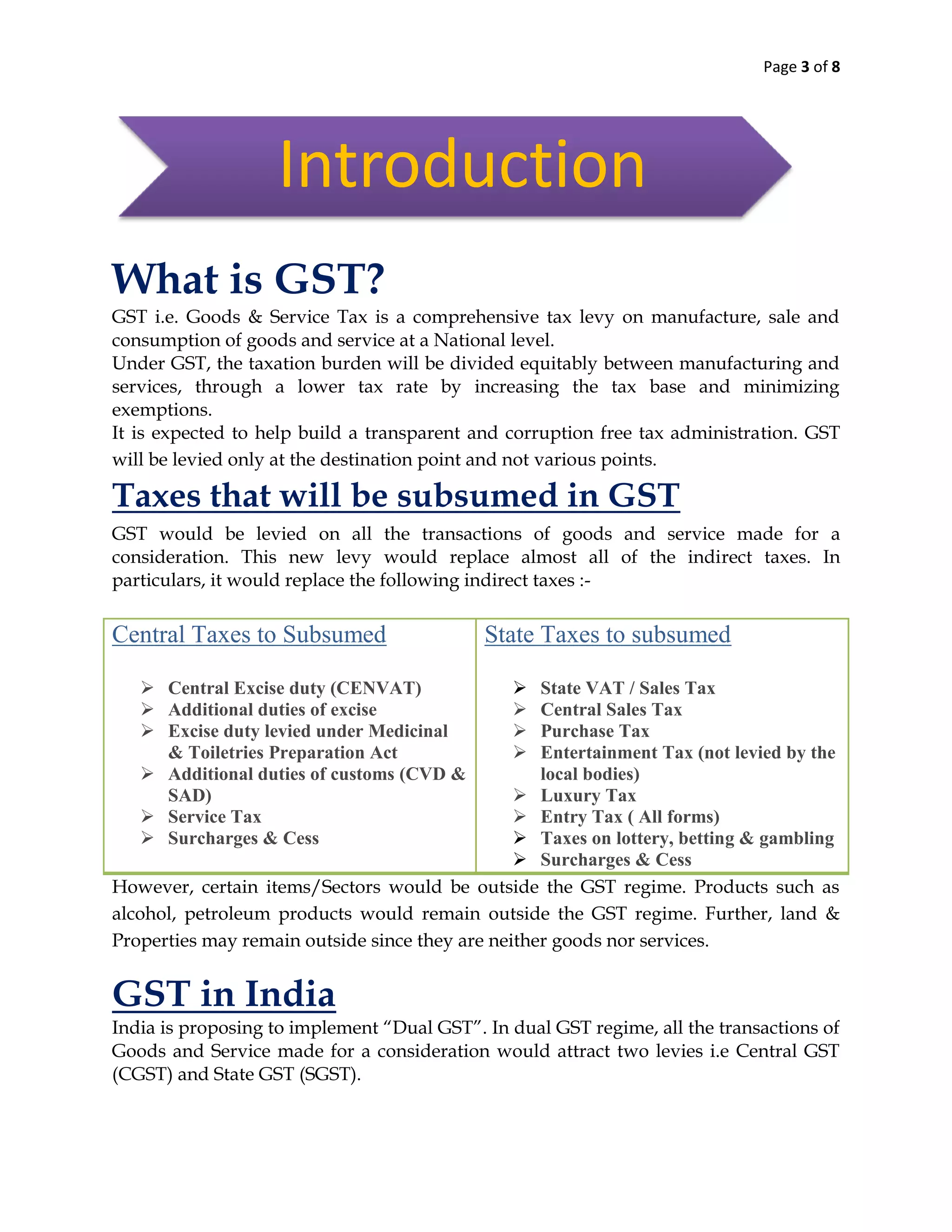
GST would be levied on all the transactions of goods and service made for a
consideration. This new levy would replace almost all of the indirect taxes. In
particulars, it would replace the following indirect taxes :-
Central Taxes to Subsumed
 Central Excise duty (CENVAT)
 Additional duties of excise
 Excise duty levied under Medicinal
& Toiletries Preparation Act
 Additional duties of customs (CVD &
SAD)
 Service Tax
 Surcharges & Cess
State Taxes to subsumed
 State VAT / Sales Tax
 Central Sales Tax
 Purchase Tax
 Entertainment Tax (not levied by the
local bodies)
 Luxury Tax
 Entry Tax ( All forms)
 Taxes on lottery, betting & gambling
 Surcharges & Cess
However, certain items/Sectors would be outside the GST regime. Products such as
alcohol, petroleum products would remain outside the GST regime. Further, land &
Properties may remain outside since they are neither goods nor services.
GST in India
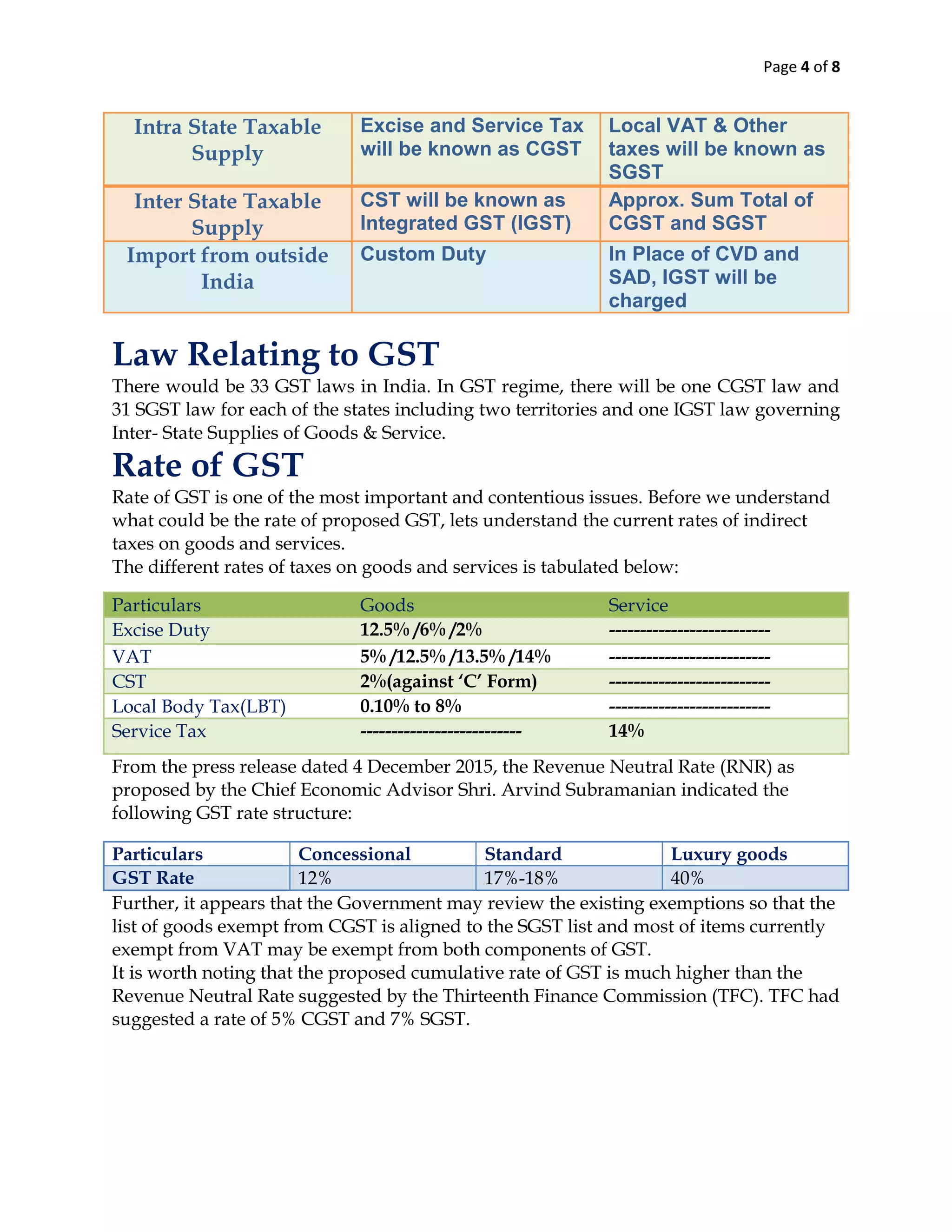
India is proposing to implement “Dual GST”. In dual GST regime, all the transactions of
Goods and Service made for a consideration would attract two levies i.e Central GST
(CGST) and State GST (SGST).
Introduction
Page 4 of 8
Intra State Taxable
Supply
Excise and Service Tax
will be known as CGST
Local VAT & Other
taxes will be known as
SGST
Inter State Taxable
Supply
CST will be known as
Integrated GST (IGST)
Approx. Sum Total of
CGST and SGST
Import from outside
India
Custom Duty In Place of CVD and
SAD, IGST will be
charged
Law Relating to GST
There would be 33 GST laws in India. In GST regime, there will be one CGST law and
31 SGST law for each of the states including two territories and one IGST law governing
Inter- State Supplies of Goods & Service.
Rate of GST
Rate of GST is one of the most important and contentious issues. Before we understand
what could be the rate of proposed GST, lets understand the current rates of indirect
taxes on goods and services.
The different rates of taxes on goods and services is tabulated below:
From the press release dated 4 December 2015, the Revenue Neutral Rate (RNR) as
proposed by the Chief Economic Advisor Shri. Arvind Subramanian indicated the
following GST rate structure:
Further, it appears that the Government may review the existing exemptions so that the
list of goods exempt from CGST is aligned to the SGST list and most of items currently
exempt from VAT may be exempt from both components of GST.
It is worth noting that the proposed cumulative rate of GST is much higher than the
Revenue Neutral Rate suggested by the Thirteenth Finance Commission (TFC). TFC had
suggested a rate of 5% CGST and 7% SGST.
Particulars Goods Service
Excise Duty 12.5% /6% /2% --------------------------
VAT 5% /12.5% /13.5% /14% --------------------------
CST 2%(against „C‟ Form) --------------------------
Local Body Tax(LBT) 0.10% to 8% --------------------------
Service Tax -------------------------- 14%
Particulars Concessional Standard Luxury goods
GST Rate 12% 17%-18% 40%
Page 5 of 8
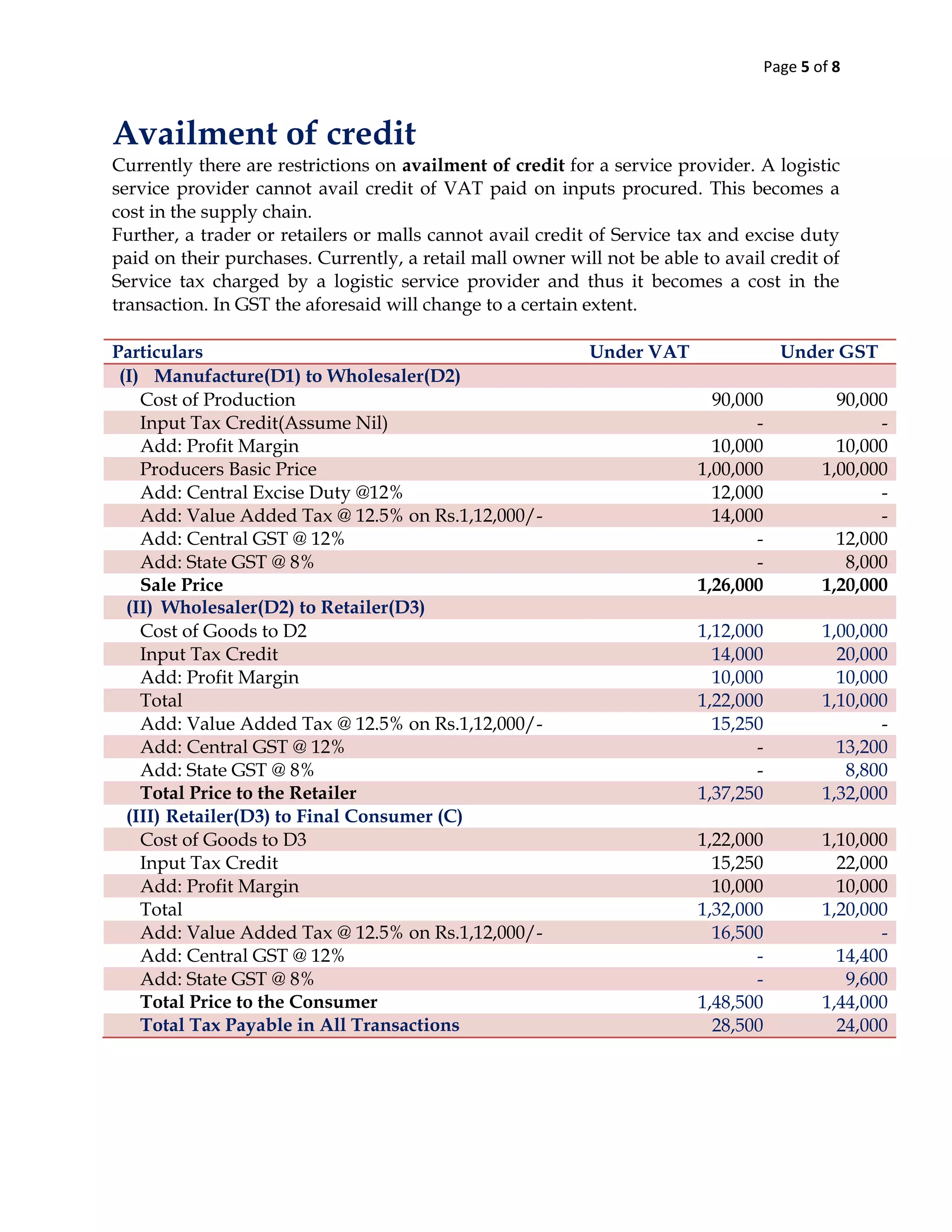
Availment of credit
Currently there are restrictions on availment of credit for a service provider. A logistic
service provider cannot avail credit of VAT paid on inputs procured. This becomes a
cost in the supply chain.
Further, a trader or retailers or malls cannot avail credit of Service tax and excise duty
paid on their purchases. Currently, a retail mall owner will not be able to avail credit of
Service tax charged by a logistic service provider and thus it becomes a cost in the
transaction. In GST the aforesaid will change to a certain extent.
Particulars Under VAT Under GST
(I) Manufacture(D1) to Wholesaler(D2)
Cost of Production 90,000 90,000
Input Tax Credit(Assume Nil) - -
Add: Profit Margin 10,000 10,000
Producers Basic Price 1,00,000 1,00,000
Add: Central Excise Duty @12% 12,000 -
Add: Value Added Tax @ 12.5% on Rs.1,12,000/- 14,000 -
Add: Central GST @ 12% - 12,000
Add: State GST @ 8% - 8,000
Sale Price 1,26,000 1,20,000
(II) Wholesaler(D2) to Retailer(D3)
Cost of Goods to D2 1,12,000 1,00,000
Input Tax Credit 14,000 20,000
Add: Profit Margin 10,000 10,000
Total 1,22,000 1,10,000
Add: Value Added Tax @ 12.5% on Rs.1,12,000/- 15,250 -
Add: Central GST @ 12% - 13,200
Add: State GST @ 8% - 8,800
Total Price to the Retailer 1,37,250 1,32,000
(III) Retailer(D3) to Final Consumer (C)
Cost of Goods to D3 1,22,000 1,10,000
Input Tax Credit 15,250 22,000
Add: Profit Margin 10,000 10,000
Total 1,32,000 1,20,000
Add: Value Added Tax @ 12.5% on Rs.1,12,000/- 16,500 -
Add: Central GST @ 12% - 14,400
Add: State GST @ 8% - 9,600
Total Price to the Consumer 1,48,500 1,44,000
Total Tax Payable in All Transactions 28,500 24,000
Page 6 of 8
Mechanism of input tax credit in GST
Input tax credit of CGST would be available for payment of CGST and input tax credit
of SGST would be available for payment of SGST. However, cross utilization of tax
credit between the Central GST and the State GST would be allowed in the case of inter-
State supply of goods and services under the IGST model.
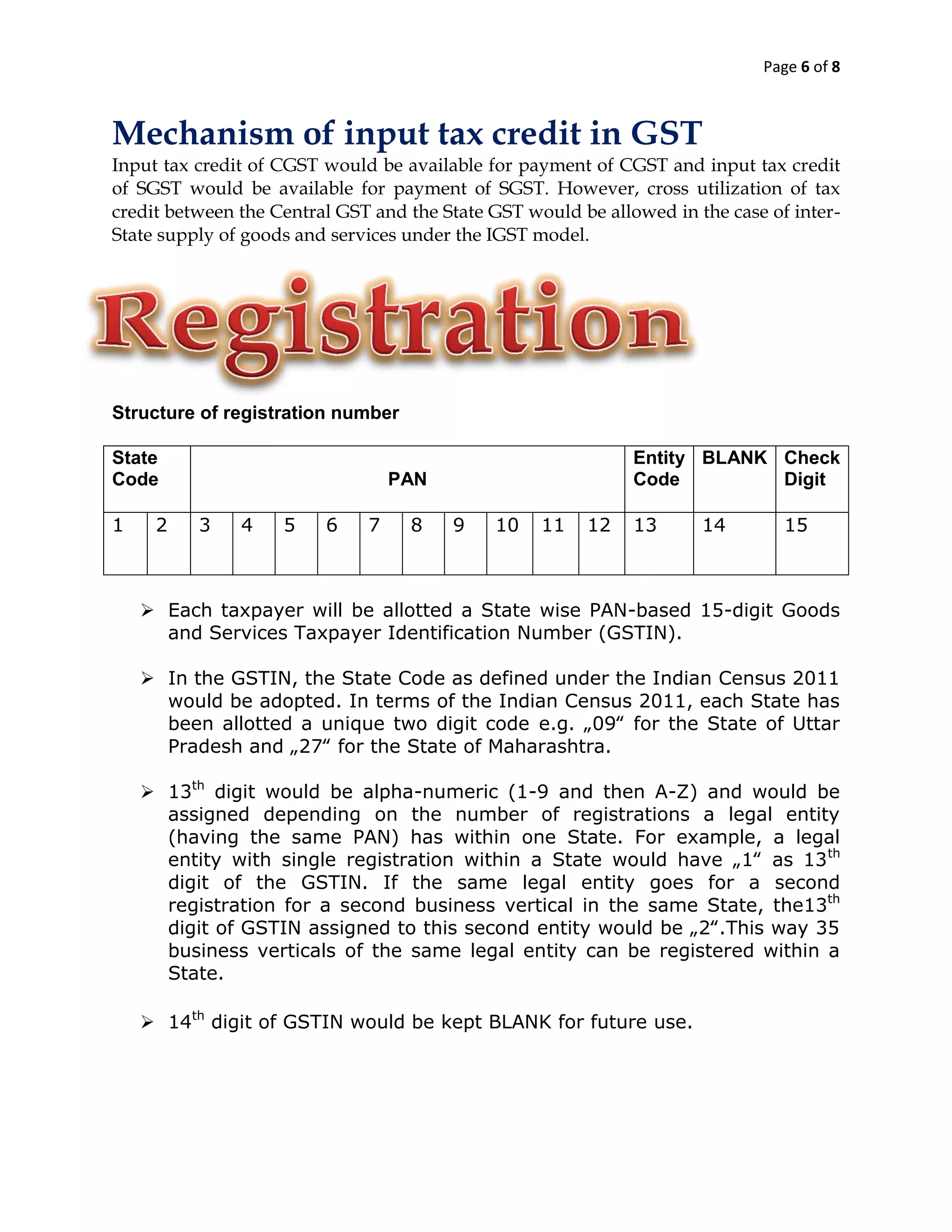
Structure of registration number
State
Code PAN
Entity
Code
BLANK Check
Digit
1 2 3 4 5 6 7 8 9 10 11 12 13 14 15
 Each taxpayer will be allotted a State wise PAN-based 15-digit Goods
and Services Taxpayer Identification Number (GSTIN).
 In the GSTIN, the State Code as defined under the Indian Census 2011
would be adopted. In terms of the Indian Census 2011, each State has
been allotted a unique two digit code e.g. „09‟ for the State of Uttar
Pradesh and „27‟ for the State of Maharashtra.
 13th
digit would be alpha-numeric (1-9 and then A-Z) and would be
assigned depending on the number of registrations a legal entity
(having the same PAN) has within one State. For example, a legal
entity with single registration within a State would have „1‟ as 13th
digit of the GSTIN. If the same legal entity goes for a second
registration for a second business vertical in the same State, the13th
digit of GSTIN assigned to this second entity would be „2‟.This way 35
business verticals of the same legal entity can be registered within a
State.
 14th
digit of GSTIN would be kept BLANK for future use.
Page 7 of 8
 In GST regime, multiple registrations within a State for business
verticals of a taxable person would be allowed. This provision should
be subject to following specific stipulations –
(1) Input Tax Credit across the business verticals of such taxable
persons shall not be allowed unless the goods or services are
actually supplied across the verticals.
(2) For the purpose of recovery of dues, all business verticals,
though separately registered, will be considered as a single legal
entity. (Final view needs to be taken by the GST Law drafting committee)
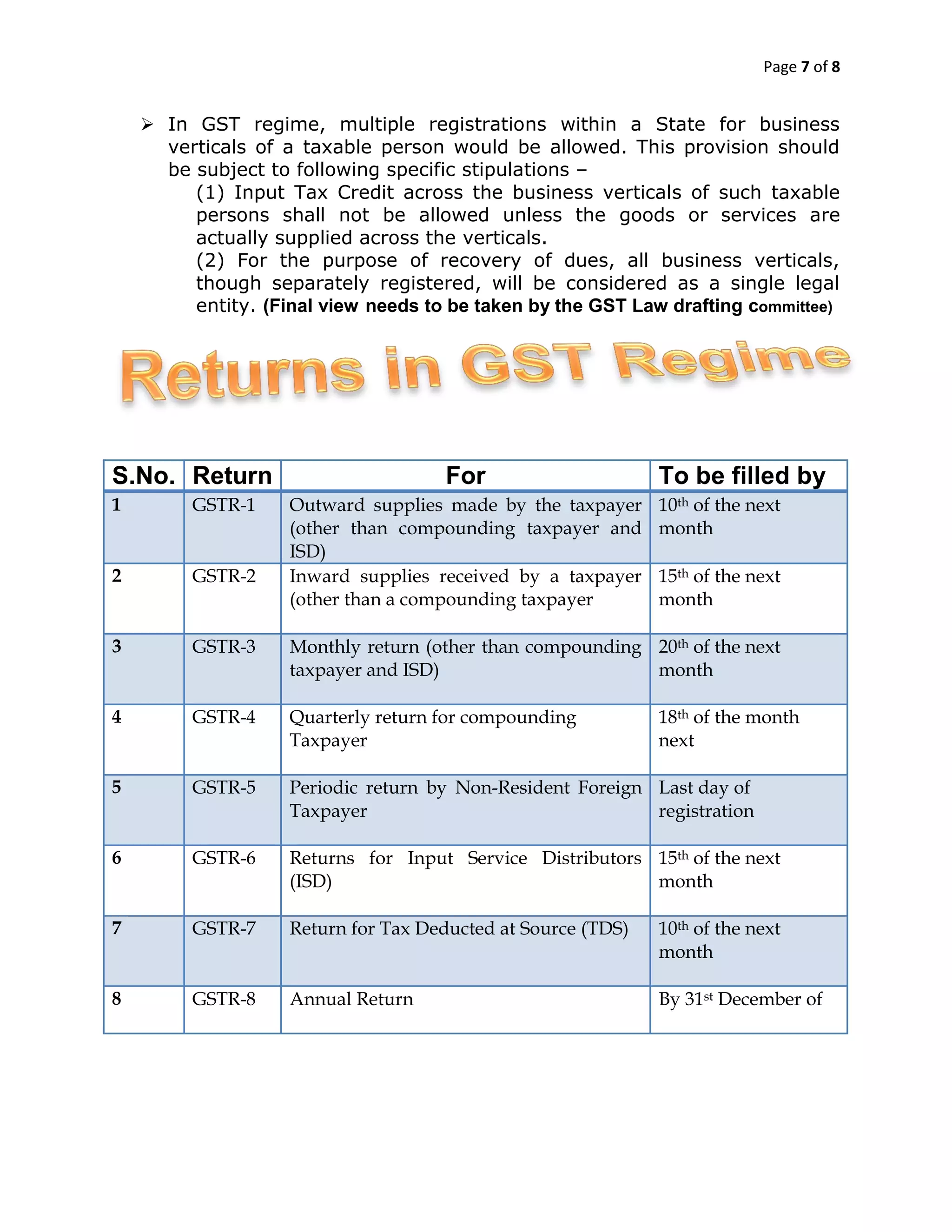
S.No. Return For To be filled by
1 GSTR-1 Outward supplies made by the taxpayer
(other than compounding taxpayer and
ISD)
10th of the next
month
2 GSTR-2 Inward supplies received by a taxpayer
(other than a compounding taxpayer
15th of the next
month
3 GSTR-3 Monthly return (other than compounding
taxpayer and ISD)
20th of the next
month
4 GSTR-4 Quarterly return for compounding
Taxpayer
18th of the month
next
5 GSTR-5 Periodic return by Non-Resident Foreign
Taxpayer
Last day of
registration
6 GSTR-6 Returns for Input Service Distributors
(ISD)
15th of the next
month
7 GSTR-7 Return for Tax Deducted at Source (TDS) 10th of the next
month
8 GSTR-8 Annual Return By 31st December of
Page 8 of 8
Every registered assessee will be required to file returns (including NIL returns).
However, persons exclusively dealing in exempted / Nin-rated or non-GST goods or
services would neither obtain registration nor file returns. It is pertinent to note that
there could be 8 GST returns as under:
- 3 returns - Outward supplies (GSTR 1), Inward supplies (GSTR 2) and
Monthly return (GSTR 3)
- Return for compounding dealers (GSTR 4)
- Return by non-resident tax payer (GSTR 5)
- Input Service Distributor (ISD) return (GSTR 6)
- Tax deducted at Source (GSTR 7)
- Annual return (GSTR 8)
It is pertinent to note that GSTR-3 would be entirely auto-populated through GSTR-1
(of counterparty suppliers), own GSTR-2, ISD return (GSTR-6) (of Input Service
Distributor), TDS return (GSTR-7) (of counterparty deductor), own ITC Ledger, own
cash ledger, own Tax Liability ledger. However, the taxpayer may fill the missing
details to begin with.
As there are multiple returns, for most of the organisations, in GST regime, compliances
are expected to increase dramatically. Take example of a service tax assessee, who
currently files 2 returns on an annual basis. Now, in GST regime, Service tax assessee
could be required to file as many as 61 returns (5 returns per month plus 1 annual
return)!!! Thus, in Human Resource(HR) department and Chartered Accountants will
have to anticipate the increase (and decrease in certain cases) in the manpower and plan
accordingly.
A legal thanks to one and all….!!

GST a broad overview

  • 1.
    Page 1 of8 Good Morning, Respected chairman, ICAI members & my dear friends. Today I, Mukesh kumar sah is here to present my paper on the topic “GST-a broad overview” i.e. Goods & Service Tax in India. India is a diverse country in terms of religion, caste, color, biodiversity, then how can taxes be an exception. That’s why have sales tax, excise duty, customs laws, service tax and many more. To avoid various taxes levied on goods & service, we thought of introducing GST in India.
  • 2.
    Page 2 of8 We have been talking about GST since 2004 when Dr. Vijay Kelkar mooted the idea of national GST. During 2006-07, the then Finance Minister Mr. P. Chidambaram set 1st April,2010 as the date for introducing GST and asked the Empowered Committee of state Finance Ministers to prepare a road map and work with central Government for this purpose and in March 2011, Finance Minister Mr. P. Chidambaram had introduced in Parliament 115th Constitutional Amendment Bill i.e. GST Bill. But, on account of lack of adequate preparedness the implementation of GST further postponed and finally, In May 2014 due to change of Government at center 115th Constitutional Amendment Bill was lapsed. But, after changing of Government at center, the new Finance Minister Mr. Arun Jetley has introduced 122nd Constitutional Amendment Bill in Dec-2014 and finally, in May 2015 122nd Constitutional Amendment Bill was passed in Lok Sabha and proposes to introduced on 1st April,2016 but pending in Rajya Sabha. Today, even an Astrologer can’t answer the question on date of introduction of GST. Having said the above, following important steps show government is actively working on GST.  122nd Constitutional Amendment Bill for GST is already passed by Lok Sabha and pending in Rajya Sabha.  Contract to manage IT infrastructure already awarded to Infosys  GST law is already drafted and available in public domain. Our Prime Minister Shri Narendra Modi and Finance Minister Mr. Arun Jetley have repeatedly assured that the new proposed date i.e. 1st april 2016 will be followed.
  • 3.
    Page 3 of8 What is GST? GST i.e. Goods & Service Tax is a comprehensive tax levy on manufacture, sale and consumption of goods and service at a National level. Under GST, the taxation burden will be divided equitably between manufacturing and services, through a lower tax rate by increasing the tax base and minimizing exemptions. It is expected to help build a transparent and corruption free tax administration. GST will be levied only at the destination point and not various points. Taxes that will be subsumed in GST GST would be levied on all the transactions of goods and service made for a consideration. This new levy would replace almost all of the indirect taxes. In particulars, it would replace the following indirect taxes :- Central Taxes to Subsumed  Central Excise duty (CENVAT)  Additional duties of excise  Excise duty levied under Medicinal & Toiletries Preparation Act  Additional duties of customs (CVD & SAD)  Service Tax  Surcharges & Cess State Taxes to subsumed  State VAT / Sales Tax  Central Sales Tax  Purchase Tax  Entertainment Tax (not levied by the local bodies)  Luxury Tax  Entry Tax ( All forms)  Taxes on lottery, betting & gambling  Surcharges & Cess However, certain items/Sectors would be outside the GST regime. Products such as alcohol, petroleum products would remain outside the GST regime. Further, land & Properties may remain outside since they are neither goods nor services. GST in India India is proposing to implement “Dual GST”. In dual GST regime, all the transactions of Goods and Service made for a consideration would attract two levies i.e Central GST (CGST) and State GST (SGST). Introduction
  • 4.
    Page 4 of8 Intra State Taxable Supply Excise and Service Tax will be known as CGST Local VAT & Other taxes will be known as SGST Inter State Taxable Supply CST will be known as Integrated GST (IGST) Approx. Sum Total of CGST and SGST Import from outside India Custom Duty In Place of CVD and SAD, IGST will be charged Law Relating to GST There would be 33 GST laws in India. In GST regime, there will be one CGST law and 31 SGST law for each of the states including two territories and one IGST law governing Inter- State Supplies of Goods & Service. Rate of GST Rate of GST is one of the most important and contentious issues. Before we understand what could be the rate of proposed GST, lets understand the current rates of indirect taxes on goods and services. The different rates of taxes on goods and services is tabulated below: From the press release dated 4 December 2015, the Revenue Neutral Rate (RNR) as proposed by the Chief Economic Advisor Shri. Arvind Subramanian indicated the following GST rate structure: Further, it appears that the Government may review the existing exemptions so that the list of goods exempt from CGST is aligned to the SGST list and most of items currently exempt from VAT may be exempt from both components of GST. It is worth noting that the proposed cumulative rate of GST is much higher than the Revenue Neutral Rate suggested by the Thirteenth Finance Commission (TFC). TFC had suggested a rate of 5% CGST and 7% SGST. Particulars Goods Service Excise Duty 12.5% /6% /2% -------------------------- VAT 5% /12.5% /13.5% /14% -------------------------- CST 2%(against „C‟ Form) -------------------------- Local Body Tax(LBT) 0.10% to 8% -------------------------- Service Tax -------------------------- 14% Particulars Concessional Standard Luxury goods GST Rate 12% 17%-18% 40%
  • 5.
    Page 5 of8 Availment of credit Currently there are restrictions on availment of credit for a service provider. A logistic service provider cannot avail credit of VAT paid on inputs procured. This becomes a cost in the supply chain. Further, a trader or retailers or malls cannot avail credit of Service tax and excise duty paid on their purchases. Currently, a retail mall owner will not be able to avail credit of Service tax charged by a logistic service provider and thus it becomes a cost in the transaction. In GST the aforesaid will change to a certain extent. Particulars Under VAT Under GST (I) Manufacture(D1) to Wholesaler(D2) Cost of Production 90,000 90,000 Input Tax Credit(Assume Nil) - - Add: Profit Margin 10,000 10,000 Producers Basic Price 1,00,000 1,00,000 Add: Central Excise Duty @12% 12,000 - Add: Value Added Tax @ 12.5% on Rs.1,12,000/- 14,000 - Add: Central GST @ 12% - 12,000 Add: State GST @ 8% - 8,000 Sale Price 1,26,000 1,20,000 (II) Wholesaler(D2) to Retailer(D3) Cost of Goods to D2 1,12,000 1,00,000 Input Tax Credit 14,000 20,000 Add: Profit Margin 10,000 10,000 Total 1,22,000 1,10,000 Add: Value Added Tax @ 12.5% on Rs.1,12,000/- 15,250 - Add: Central GST @ 12% - 13,200 Add: State GST @ 8% - 8,800 Total Price to the Retailer 1,37,250 1,32,000 (III) Retailer(D3) to Final Consumer (C) Cost of Goods to D3 1,22,000 1,10,000 Input Tax Credit 15,250 22,000 Add: Profit Margin 10,000 10,000 Total 1,32,000 1,20,000 Add: Value Added Tax @ 12.5% on Rs.1,12,000/- 16,500 - Add: Central GST @ 12% - 14,400 Add: State GST @ 8% - 9,600 Total Price to the Consumer 1,48,500 1,44,000 Total Tax Payable in All Transactions 28,500 24,000
  • 6.
    Page 6 of8 Mechanism of input tax credit in GST Input tax credit of CGST would be available for payment of CGST and input tax credit of SGST would be available for payment of SGST. However, cross utilization of tax credit between the Central GST and the State GST would be allowed in the case of inter- State supply of goods and services under the IGST model. Structure of registration number State Code PAN Entity Code BLANK Check Digit 1 2 3 4 5 6 7 8 9 10 11 12 13 14 15  Each taxpayer will be allotted a State wise PAN-based 15-digit Goods and Services Taxpayer Identification Number (GSTIN).  In the GSTIN, the State Code as defined under the Indian Census 2011 would be adopted. In terms of the Indian Census 2011, each State has been allotted a unique two digit code e.g. „09‟ for the State of Uttar Pradesh and „27‟ for the State of Maharashtra.  13th digit would be alpha-numeric (1-9 and then A-Z) and would be assigned depending on the number of registrations a legal entity (having the same PAN) has within one State. For example, a legal entity with single registration within a State would have „1‟ as 13th digit of the GSTIN. If the same legal entity goes for a second registration for a second business vertical in the same State, the13th digit of GSTIN assigned to this second entity would be „2‟.This way 35 business verticals of the same legal entity can be registered within a State.  14th digit of GSTIN would be kept BLANK for future use.
  • 7.
    Page 7 of8  In GST regime, multiple registrations within a State for business verticals of a taxable person would be allowed. This provision should be subject to following specific stipulations – (1) Input Tax Credit across the business verticals of such taxable persons shall not be allowed unless the goods or services are actually supplied across the verticals. (2) For the purpose of recovery of dues, all business verticals, though separately registered, will be considered as a single legal entity. (Final view needs to be taken by the GST Law drafting committee) S.No. Return For To be filled by 1 GSTR-1 Outward supplies made by the taxpayer (other than compounding taxpayer and ISD) 10th of the next month 2 GSTR-2 Inward supplies received by a taxpayer (other than a compounding taxpayer 15th of the next month 3 GSTR-3 Monthly return (other than compounding taxpayer and ISD) 20th of the next month 4 GSTR-4 Quarterly return for compounding Taxpayer 18th of the month next 5 GSTR-5 Periodic return by Non-Resident Foreign Taxpayer Last day of registration 6 GSTR-6 Returns for Input Service Distributors (ISD) 15th of the next month 7 GSTR-7 Return for Tax Deducted at Source (TDS) 10th of the next month 8 GSTR-8 Annual Return By 31st December of
  • 8.
    Page 8 of8 Every registered assessee will be required to file returns (including NIL returns). However, persons exclusively dealing in exempted / Nin-rated or non-GST goods or services would neither obtain registration nor file returns. It is pertinent to note that there could be 8 GST returns as under: - 3 returns - Outward supplies (GSTR 1), Inward supplies (GSTR 2) and Monthly return (GSTR 3) - Return for compounding dealers (GSTR 4) - Return by non-resident tax payer (GSTR 5) - Input Service Distributor (ISD) return (GSTR 6) - Tax deducted at Source (GSTR 7) - Annual return (GSTR 8) It is pertinent to note that GSTR-3 would be entirely auto-populated through GSTR-1 (of counterparty suppliers), own GSTR-2, ISD return (GSTR-6) (of Input Service Distributor), TDS return (GSTR-7) (of counterparty deductor), own ITC Ledger, own cash ledger, own Tax Liability ledger. However, the taxpayer may fill the missing details to begin with. As there are multiple returns, for most of the organisations, in GST regime, compliances are expected to increase dramatically. Take example of a service tax assessee, who currently files 2 returns on an annual basis. Now, in GST regime, Service tax assessee could be required to file as many as 61 returns (5 returns per month plus 1 annual return)!!! Thus, in Human Resource(HR) department and Chartered Accountants will have to anticipate the increase (and decrease in certain cases) in the manpower and plan accordingly. A legal thanks to one and all….!!