1
K R A Y & Associates, Chartered Accountants
508, 5th
Floor, Maheshwari Chambers, Erramanzil, Hyderabad – 500 082
Basic Introduction of GST
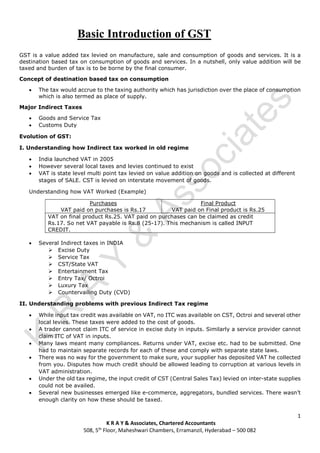
GST is a value added tax levied on manufacture, sale and consumption of goods and services. It is a
destination based tax on consumption of goods and services. In a nutshell, only value addition will be
taxed and burden of tax is to be borne by the final consumer.
Concept of destination based tax on consumption
 The tax would accrue to the taxing authority which has jurisdiction over the place of consumption
which is also termed as place of supply.
Major Indirect Taxes
 Goods and Service Tax
 Customs Duty
Evolution of GST:
I. Understanding how Indirect tax worked in old regime
 India launched VAT in 2005
 However several local taxes and levies continued to exist
 VAT is state level multi point tax levied on value addition on goods and is collected at different
stages of SALE. CST is levied on interstate movement of goods.
Understanding how VAT Worked (Example)
Purchases
VAT paid on purchases is Rs.17
Final Product
VAT paid on Final product is Rs.25
VAT on final product Rs.25. VAT paid on purchases can be claimed as credit
Rs.17. So net VAT payable is Rs.8 (25-17). This mechanism is called INPUT
CREDIT.
 Several Indirect taxes in INDIA
 Excise Duty
 Service Tax
 CST/State VAT
 Entertainment Tax
 Entry Tax/ Octroi
 Luxury Tax
 Countervailing Duty (CVD)
II. Understanding problems with previous Indirect Tax regime
 While input tax credit was available on VAT, no ITC was available on CST, Octroi and several other
local levies. These taxes were added to the cost of goods.
 A trader cannot claim ITC of service in excise duty in inputs. Similarly a service provider cannot
claim ITC of VAT in inputs.
 Many laws meant many compliances. Returns under VAT, excise etc. had to be submitted. One
had to maintain separate records for each of these and comply with separate state laws.
 There was no way for the government to make sure, your supplier has deposited VAT he collected
from you. Disputes how much credit should be allowed leading to corruption at various levels in
VAT administration.
 Under the old tax regime, the input credit of CST (Central Sales Tax) levied on inter-state supplies
could not be availed.
 Several new businesses emerged like e-commerce, aggregators, bundled services. There wasn’t
enough clarity on how these should be taxed.
2
K R A Y & Associates, Chartered Accountants
508, 5th
Floor, Maheshwari Chambers, Erramanzil, Hyderabad – 500 082
III. Understanding how GST come into picture
 Internationally, GST was first introduced in France and now more than 160 countries have
introduced GST. Most of the countries, depending on their own socio-economic formation, have
introduced National level GST or Dual GST.
 As a result of problems and various drawbacks with the previous Indirect tax regime in India, the
Union has thought of integrating all the indirect taxes in a single window and reduce the burden
to the common people.
 Union Finance Minister, Shri P. Chidambaram, while presenting the central budget (2006 - 2007),
announced that GST would be introduced from April 1, 2010.
 The Lok Sabha passed the Bill on 6th
May, 2015 and Rajya Sabha on 3rd
August, 2016. Subsequent
to the ratification of the states, Constitution (122nd
Amendment) Bill, 2014 received the assent of
the president on 8th
September, 2016 and became Constitution (101st
Amendment) Act, 2016.
which paved the way for the introduction of GST in India.
Concept of GST:
 GST is a tax on both the Goods and Services except for some of the goods like alcohol (for human
consumption)
 GST is levied at the time of supply
 GST will make sure input credit is available for taxes paid on all purchases and input services
except specified
 under sec 17 (Blocked Credits under CGST Act) and
 under sec 10 composite levy scheme.
 Input credit shall only be allowed when your supplier has deposited the GST he collected from
you. (But as now this process is not yet implemented)
 There shall be a common law, return procedures and governance for all.
 GST is a destination based tax and levied at a single point at the time of consumption of goods
or services by the ultimate consumer. GST is based on the principle of value added tax. GST law
emphasizes on voluntary compliance and on accounts based reporting and monitoring system. It
is a comprehensive levy and envisages tax collection on both goods and services at the same
rate.
Understanding how GST Works (Example)
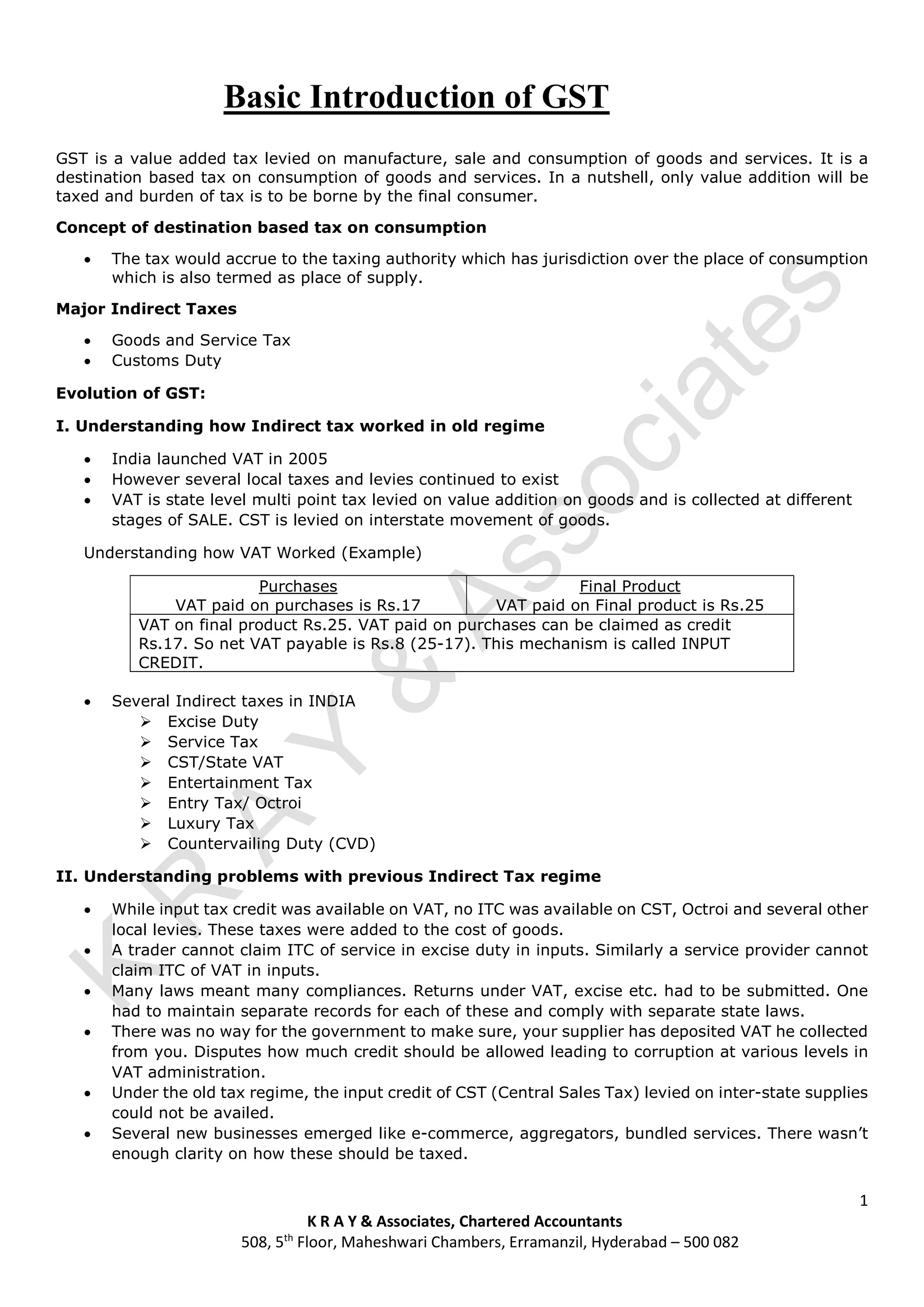
 A product has to go through different stages before it reaches the end consumer, and there
are several taxes applicable throughout this process. However, this situation will change in
the GST regime. Here’s an illustration to understand how:
 Take apparel manufacturing as an example and 10% as the GST applicable.
Steps in
utilisation of
INUPT CREDIT
Stage 1:
Manufacturer
Stage 2:
Wholesaler
Stage 2: Retailer
Step – I
Tax paid on
Purchase/Inward
Supplies (Input
Tax)
Manufacturer buys raw
material worth Rs.500
that is inclusive of the
GST of Rs.50 (10% of
500) and he then adds
his own value Rs.50.
So this brings gross
value of product to
Rs.550.
The apparel is
passed from the
manufacturer to the
wholesaler at a
gross value
of Rs.550 that is
inclusive of the GST
of Rs.55 (10% of
550).
The retailer buys
the apparel from
the wholesaler at a
gross value
of Rs.600 that is
inclusive of the GST
of Rs.60 (10% of
600).
3
K R A Y & Associates, Chartered Accountants
508, 5th
Floor, Maheshwari Chambers, Erramanzil, Hyderabad – 500 082
Need for GST in India:
 Deficiencies in existing Value added taxation has led to GST (as referred in “II. Understanding
problems with previous Indirect Tax regime”)
 Non-conclusion of several local levies in state VAT such as luxury tax, entertainment tax etc.
 Cascading of taxes on account of
(i) Levy of Non-VATable CST and
(ii) Inclusion of CENVAT in the value for.
 No CENVAT after manufacturing stage
 Non-integration of VAT & Service Tax
 Double Taxation of a transaction both as goods & services
The Benefits which the country will accrue from GST:
For Business and Industry
 Easy Compliance: All tax payer services such as registrations, returns, payments, etc. would
be available to the taxpayers online, which would make compliance easy and transparent.
 Uniformity of tax rates and structures
 Removal of Cascading
 Improved competitiveness
 Gain to Manufacturers and exporters
For Central and State Governments
 Simple and easy to administer
 Better controls on leakage
 Higher revenue efficiency
For the consumer
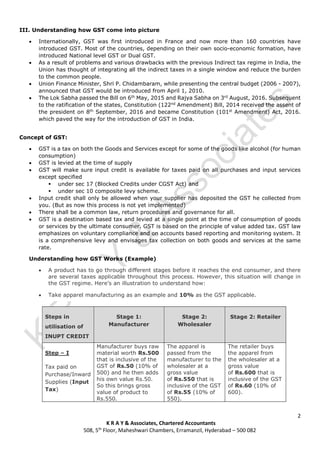
Step – II
Tax on outward
Supplies
(Output Tax)
Now the total tax
amount on the apparel
comes to Rs.55 (10%
of Rs.550). The
manufacturer required
to pay Rs.55
The wholesaler then
adds his value (his
margin) of Rs.50
making the total
Rs.600 (550 + 50).
This brings the total
tax amount on the
final to Rs.60 (10%
of 600).
He then adds his
value or margin of
RS.50 making the
total cost of the
goods Rs.650. The
GST applicable here
is Rs.65 (10% of
650).
Step - III
Utilisation of
INPUT CREDIT
and amount of
Final GST
However under GST,
he can set off the tax
paid at the time of raw
material purchase as
input credit.
Therefore the final GST
that the manufacturer
will incur is Rs.5 (55-
50)
Like the
manufacturer, the
wholesaler too can
set off this tax
amount with the
input tax. Thus, the
final GST for the
wholesaler would be
Rs.5 (60 – 55)
Since the retailer
has already paid a
tax while
purchasing the
goods, he can set it
off. Thus, the final
GST incidence for
the retailer would
be Rs.5 (65 – 60).
At the end, since the retailer will sell the product at Rs.650, the GST paid by the customer
would be Rs.65 (10% of 650) only. This number would have been much higher in our
current tax structure.
Thus GST can be a win-win scenario that will benefit the entire value chain and make it
easier for both businesses and consumers.
4
K R A Y & Associates, Chartered Accountants
508, 5th
Floor, Maheshwari Chambers, Erramanzil, Hyderabad – 500 082
 Single and transparent tax proportionate to the value of goods and services
 Relief in overall tax burden
 Introduction of GST would be a very significant step in the field of indirect tax reforms in India.
By amalgamating a large number of Central and State taxes into a single tax and allowing set-off
of prior-stage taxes, it would mitigate the ill effects of cascading and pave the way for a common
national market. For the consumers, the biggest gain would be in terms of a reduction in the
overall tax burden on goods, which is currently estimated at 25%-30%. Introduction of GST would
also make our products competitive in the domestic and international markets. Studies show that
this would instantly spur economic growth. There may also be revenue gain for the Centre and
the States due to widening of the tax base, increase in trade volumes and improved.
Best Regards
Sai Charan Goshika
Intern
K R A Y & Associates

Basic introduction to gst

  • 1.
    1 K R AY & Associates, Chartered Accountants 508, 5th Floor, Maheshwari Chambers, Erramanzil, Hyderabad – 500 082 Basic Introduction of GST GST is a value added tax levied on manufacture, sale and consumption of goods and services. It is a destination based tax on consumption of goods and services. In a nutshell, only value addition will be taxed and burden of tax is to be borne by the final consumer. Concept of destination based tax on consumption  The tax would accrue to the taxing authority which has jurisdiction over the place of consumption which is also termed as place of supply. Major Indirect Taxes  Goods and Service Tax  Customs Duty Evolution of GST: I. Understanding how Indirect tax worked in old regime  India launched VAT in 2005  However several local taxes and levies continued to exist  VAT is state level multi point tax levied on value addition on goods and is collected at different stages of SALE. CST is levied on interstate movement of goods. Understanding how VAT Worked (Example) Purchases VAT paid on purchases is Rs.17 Final Product VAT paid on Final product is Rs.25 VAT on final product Rs.25. VAT paid on purchases can be claimed as credit Rs.17. So net VAT payable is Rs.8 (25-17). This mechanism is called INPUT CREDIT.  Several Indirect taxes in INDIA  Excise Duty  Service Tax  CST/State VAT  Entertainment Tax  Entry Tax/ Octroi  Luxury Tax  Countervailing Duty (CVD) II. Understanding problems with previous Indirect Tax regime  While input tax credit was available on VAT, no ITC was available on CST, Octroi and several other local levies. These taxes were added to the cost of goods.  A trader cannot claim ITC of service in excise duty in inputs. Similarly a service provider cannot claim ITC of VAT in inputs.  Many laws meant many compliances. Returns under VAT, excise etc. had to be submitted. One had to maintain separate records for each of these and comply with separate state laws.  There was no way for the government to make sure, your supplier has deposited VAT he collected from you. Disputes how much credit should be allowed leading to corruption at various levels in VAT administration.  Under the old tax regime, the input credit of CST (Central Sales Tax) levied on inter-state supplies could not be availed.  Several new businesses emerged like e-commerce, aggregators, bundled services. There wasn’t enough clarity on how these should be taxed.
  • 2.
    2 K R AY & Associates, Chartered Accountants 508, 5th Floor, Maheshwari Chambers, Erramanzil, Hyderabad – 500 082 III. Understanding how GST come into picture  Internationally, GST was first introduced in France and now more than 160 countries have introduced GST. Most of the countries, depending on their own socio-economic formation, have introduced National level GST or Dual GST.  As a result of problems and various drawbacks with the previous Indirect tax regime in India, the Union has thought of integrating all the indirect taxes in a single window and reduce the burden to the common people.  Union Finance Minister, Shri P. Chidambaram, while presenting the central budget (2006 - 2007), announced that GST would be introduced from April 1, 2010.  The Lok Sabha passed the Bill on 6th May, 2015 and Rajya Sabha on 3rd August, 2016. Subsequent to the ratification of the states, Constitution (122nd Amendment) Bill, 2014 received the assent of the president on 8th September, 2016 and became Constitution (101st Amendment) Act, 2016. which paved the way for the introduction of GST in India. Concept of GST:  GST is a tax on both the Goods and Services except for some of the goods like alcohol (for human consumption)  GST is levied at the time of supply  GST will make sure input credit is available for taxes paid on all purchases and input services except specified  under sec 17 (Blocked Credits under CGST Act) and  under sec 10 composite levy scheme.  Input credit shall only be allowed when your supplier has deposited the GST he collected from you. (But as now this process is not yet implemented)  There shall be a common law, return procedures and governance for all.  GST is a destination based tax and levied at a single point at the time of consumption of goods or services by the ultimate consumer. GST is based on the principle of value added tax. GST law emphasizes on voluntary compliance and on accounts based reporting and monitoring system. It is a comprehensive levy and envisages tax collection on both goods and services at the same rate. Understanding how GST Works (Example)  A product has to go through different stages before it reaches the end consumer, and there are several taxes applicable throughout this process. However, this situation will change in the GST regime. Here’s an illustration to understand how:  Take apparel manufacturing as an example and 10% as the GST applicable. Steps in utilisation of INUPT CREDIT Stage 1: Manufacturer Stage 2: Wholesaler Stage 2: Retailer Step – I Tax paid on Purchase/Inward Supplies (Input Tax) Manufacturer buys raw material worth Rs.500 that is inclusive of the GST of Rs.50 (10% of 500) and he then adds his own value Rs.50. So this brings gross value of product to Rs.550. The apparel is passed from the manufacturer to the wholesaler at a gross value of Rs.550 that is inclusive of the GST of Rs.55 (10% of 550). The retailer buys the apparel from the wholesaler at a gross value of Rs.600 that is inclusive of the GST of Rs.60 (10% of 600).
  • 3.
    3 K R AY & Associates, Chartered Accountants 508, 5th Floor, Maheshwari Chambers, Erramanzil, Hyderabad – 500 082 Need for GST in India:  Deficiencies in existing Value added taxation has led to GST (as referred in “II. Understanding problems with previous Indirect Tax regime”)  Non-conclusion of several local levies in state VAT such as luxury tax, entertainment tax etc.  Cascading of taxes on account of (i) Levy of Non-VATable CST and (ii) Inclusion of CENVAT in the value for.  No CENVAT after manufacturing stage  Non-integration of VAT & Service Tax  Double Taxation of a transaction both as goods & services The Benefits which the country will accrue from GST: For Business and Industry  Easy Compliance: All tax payer services such as registrations, returns, payments, etc. would be available to the taxpayers online, which would make compliance easy and transparent.  Uniformity of tax rates and structures  Removal of Cascading  Improved competitiveness  Gain to Manufacturers and exporters For Central and State Governments  Simple and easy to administer  Better controls on leakage  Higher revenue efficiency For the consumer Step – II Tax on outward Supplies (Output Tax) Now the total tax amount on the apparel comes to Rs.55 (10% of Rs.550). The manufacturer required to pay Rs.55 The wholesaler then adds his value (his margin) of Rs.50 making the total Rs.600 (550 + 50). This brings the total tax amount on the final to Rs.60 (10% of 600). He then adds his value or margin of RS.50 making the total cost of the goods Rs.650. The GST applicable here is Rs.65 (10% of 650). Step - III Utilisation of INPUT CREDIT and amount of Final GST However under GST, he can set off the tax paid at the time of raw material purchase as input credit. Therefore the final GST that the manufacturer will incur is Rs.5 (55- 50) Like the manufacturer, the wholesaler too can set off this tax amount with the input tax. Thus, the final GST for the wholesaler would be Rs.5 (60 – 55) Since the retailer has already paid a tax while purchasing the goods, he can set it off. Thus, the final GST incidence for the retailer would be Rs.5 (65 – 60). At the end, since the retailer will sell the product at Rs.650, the GST paid by the customer would be Rs.65 (10% of 650) only. This number would have been much higher in our current tax structure. Thus GST can be a win-win scenario that will benefit the entire value chain and make it easier for both businesses and consumers.
  • 4.
    4 K R AY & Associates, Chartered Accountants 508, 5th Floor, Maheshwari Chambers, Erramanzil, Hyderabad – 500 082  Single and transparent tax proportionate to the value of goods and services  Relief in overall tax burden  Introduction of GST would be a very significant step in the field of indirect tax reforms in India. By amalgamating a large number of Central and State taxes into a single tax and allowing set-off of prior-stage taxes, it would mitigate the ill effects of cascading and pave the way for a common national market. For the consumers, the biggest gain would be in terms of a reduction in the overall tax burden on goods, which is currently estimated at 25%-30%. Introduction of GST would also make our products competitive in the domestic and international markets. Studies show that this would instantly spur economic growth. There may also be revenue gain for the Centre and the States due to widening of the tax base, increase in trade volumes and improved. Best Regards Sai Charan Goshika Intern K R A Y & Associates