MIMO RADAR
Presented by-
TWINKLE SINGH (15101036)
URJA THAKUR (15101037)
Contents
 Introduction of radar
 Mimo radar
 Angle estimation
 Principles of mimo radar
 Multiplexing
 Virtual array concept
 Literature review
 Research area
 Future work
 Refrences
INTRODUCTION
 Radar is a system of transmitters and receivers that can detect,
locate and measure the speed of a target using electromagnetic
waves.
 Radar perform many other tasks such as geo sensing, terrain
mapping and air traffic control.
 For proper detection, the radar system must be able to distinguish the
echo signals returning from the target from the noise components.
 Detection is done one can calculate the range which is the separation
between the radar system and the target
MIMO RADAR
 MIMO radar system is a novel radar method in which MIMO stands
for Multiple Input Multiple Output.
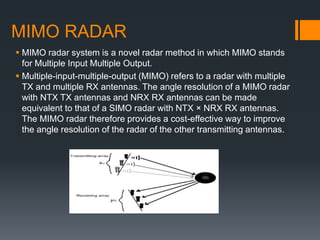
 Multiple-input-multiple-output (MIMO) refers to a radar with multiple
TX and multiple RX antennas. The angle resolution of a MIMO radar
with NTX TX antennas and NRX RX antennas can be made
equivalent to that of a SIMO radar with NTX × NRX RX antennas.
The MIMO radar therefore provides a cost-effective way to improve
the angle resolution of the radar of the other transmitting antennas.
Literature review
 The first demonstration of a MIMO-like system was through the
French RIAS/SIAR (synthetic impulse and aperture radar), first
demonstrated in 1989 (Doreyet al.1989, Colin 1996, Duofanget al.2006
 One of the virtues attributed to mimo radar is spatial diversity offered
by it.
 The construction of filled virtual arrays from given sparse
transmit/receive arrays is the topic of discussion .
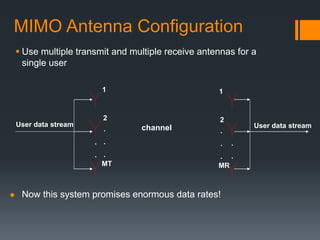
MIMO Antenna Configuration
 Use multiple transmit and multiple receive antennas for a
single user
User data streamUser data stream
.
.
1
2
MT
.
.
.
1
2
MR
.
.
.
.
.
channel
 Now this system promises enormous data rates!
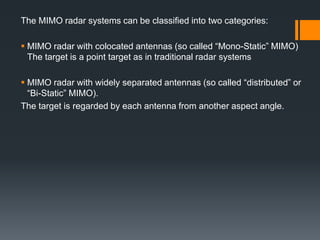
The MIMO radar systems can be classified into two categories:
 MIMO radar with colocated antennas (so called “Mono-Static” MIMO)
The target is a point target as in traditional radar systems
 MIMO radar with widely separated antennas (so called “distributed” or
“Bi-Static” MIMO).
The target is regarded by each antenna from another aspect angle.
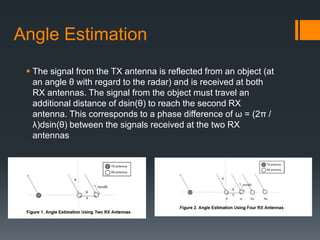
Angle Estimation
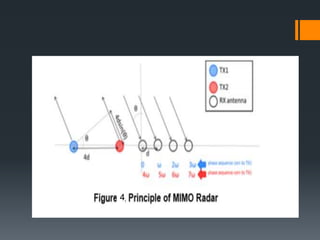
 The signal from the TX antenna is reflected from an object (at
an angle θ with regard to the radar) and is received at both
RX antennas. The signal from the object must travel an
additional distance of dsin(θ) to reach the second RX
antenna. This corresponds to a phase difference of ω = (2π /
λ)dsin(θ) between the signals received at the two RX
antennas
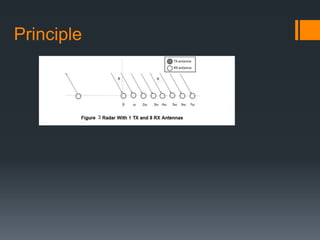
Principle
3
4
MULTIPLEXING
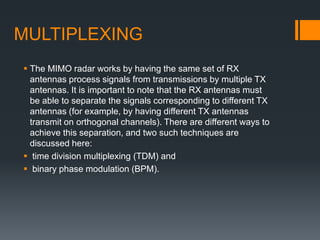
 The MIMO radar works by having the same set of RX
antennas process signals from transmissions by multiple TX
antennas. It is important to note that the RX antennas must
be able to separate the signals corresponding to different TX
antennas (for example, by having different TX antennas
transmit on orthogonal channels). There are different ways to
achieve this separation, and two such techniques are
discussed here:
 time division multiplexing (TDM) and
 binary phase modulation (BPM).
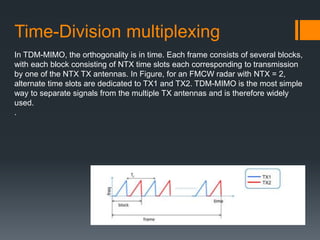
In TDM-MIMO, the orthogonality is in time. Each frame consists of several blocks,
with each block consisting of NTX time slots each corresponding to transmission
by one of the NTX TX antennas. In Figure, for an FMCW radar with NTX = 2,
alternate time slots are dedicated to TX1 and TX2. TDM-MIMO is the most simple
way to separate signals from the multiple TX antennas and is therefore widely
used.
.
Time-Division multiplexing
Binary Phase Multiplexing
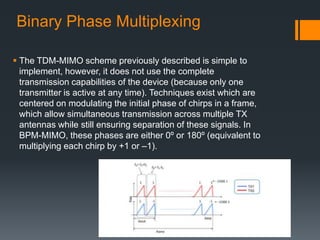
 The TDM-MIMO scheme previously described is simple to
implement, however, it does not use the complete
transmission capabilities of the device (because only one
transmitter is active at any time). Techniques exist which are
centered on modulating the initial phase of chirps in a frame,
which allow simultaneous transmission across multiple TX
antennas while still ensuring separation of these signals. In
BPM-MIMO, these phases are either 0º or 180º (equivalent to
multiplying each chirp by +1 or –1).
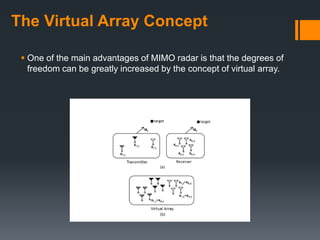
The Virtual Array Concept
 One of the main advantages of MIMO radar is that the degrees of
freedom can be greatly increased by the concept of virtual array.
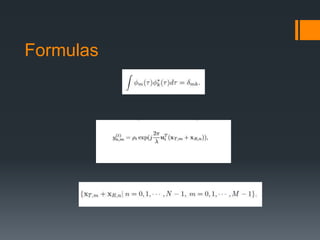
Formulas
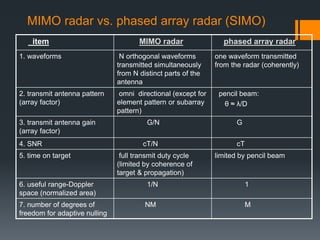
MIMO radar vs. phased array radar (SIMO)
item MIMO radar phased array radar
1. waveforms N orthogonal waveforms
transmitted simultaneously
from N distinct parts of the
antenna
one waveform transmitted
from the radar (coherently)
2. transmit antenna pattern
(array factor)
omni directional (except for
element pattern or subarray
pattern)
pencil beam:
θ ≈ λ/D
3. transmit antenna gain
(array factor)
G/N G
4. SNR cT/N cT
5. time on target full transmit duty cycle
(limited by coherence of
target & propagation)
limited by pencil beam
6. useful range-Doppler
space (normalized area)
1/N 1
7. number of degrees of
freedom for adaptive nulling
NM M
Application
These include
 air-surveillance systems,
 clutter mitigation ,
 airborne ground moving-target indication (GMTI) radar
application.
RESEARCH AREA
MIMO radar has provided a new paradigm for
signal processing research. Some of these are:
 Improved target detection capability
 Enhanced accuracy in angle estimation
 Lower minimum detectible velocity
 Direct applicability of adaptive algorithms
 Enhanced spatial diversity gain
 High degree of flexibility in designing beampattern
Future possiblities
 On developing methods for real time beam pattern synthesis for tracking
targets and generalizing the beam pattern synthesis algorithms for both
narrow as well as wide band signals design of fixed cross-correlation
constant modulus signals.
 There may exist some better approach to obtain the virtual array
resolution without compromising the processing gain.
REFRENCES
 [1] Y. I. Abramovich and G. J. Frazer, “Bounds on the Volume and Height
Distributions for theMIMO Radar Ambiguity Function,” IEEE Signal Processing
Letters, Volume 15, pp. 505–508,May 2008.
 [2] G. S. Antonio and D. R. Fuhrmann, “Beampattern Synthesis for Wideband
MIMO Radar Systems,” Proc. 1st. IEEE International Workshop on
Computational Advances in Multi-Sensor AdaptiveProcessing, pp. 105–108, Dec.
2005.
 [3] S. P. Applebaum and D. J. Chapman, “Adaptive arrays with main beam
constraints,” IEEETrans. Ant. Prop., vol. AP-24, pp. 650–662, Sept. 1976.
 [4] M. R. Bell, “Information Theory and Radar Waveform Design,” IEEE Trans. on
Information Theory, Vol 39, Issue 5, pp. 1578–1597, Sept. 1993.
 [5] K. L. Bell, Y. Ephraim, and H. L. Van Trees, “A Bayesian approach to robust
adaptive beamforming”,IEEE Trans. Sig. Proc., vol. 48, pp. 386–398, Feb. 2000.
 [6] D. W. Bliss and K. W. Forsythe, “Multiple-input multiple-output (MIMO) radar and
imaging: degrees of freedom and resolution,” Proc. 37th IEEE Asilomar Conf. on
Signals, Systems, and Computers,
THANKYOU

Mimo radar(1)

  • 1.
    MIMO RADAR Presented by- TWINKLESINGH (15101036) URJA THAKUR (15101037)
  • 2.
    Contents  Introduction ofradar  Mimo radar  Angle estimation  Principles of mimo radar  Multiplexing  Virtual array concept  Literature review  Research area  Future work  Refrences
  • 3.
    INTRODUCTION  Radar isa system of transmitters and receivers that can detect, locate and measure the speed of a target using electromagnetic waves.  Radar perform many other tasks such as geo sensing, terrain mapping and air traffic control.  For proper detection, the radar system must be able to distinguish the echo signals returning from the target from the noise components.  Detection is done one can calculate the range which is the separation between the radar system and the target
  • 4.
    MIMO RADAR  MIMOradar system is a novel radar method in which MIMO stands for Multiple Input Multiple Output.  Multiple-input-multiple-output (MIMO) refers to a radar with multiple TX and multiple RX antennas. The angle resolution of a MIMO radar with NTX TX antennas and NRX RX antennas can be made equivalent to that of a SIMO radar with NTX × NRX RX antennas. The MIMO radar therefore provides a cost-effective way to improve the angle resolution of the radar of the other transmitting antennas.
  • 5.
    Literature review  Thefirst demonstration of a MIMO-like system was through the French RIAS/SIAR (synthetic impulse and aperture radar), first demonstrated in 1989 (Doreyet al.1989, Colin 1996, Duofanget al.2006  One of the virtues attributed to mimo radar is spatial diversity offered by it.  The construction of filled virtual arrays from given sparse transmit/receive arrays is the topic of discussion .
  • 6.
    MIMO Antenna Configuration Use multiple transmit and multiple receive antennas for a single user User data streamUser data stream . . 1 2 MT . . . 1 2 MR . . . . . channel  Now this system promises enormous data rates!
  • 7.
    The MIMO radarsystems can be classified into two categories:  MIMO radar with colocated antennas (so called “Mono-Static” MIMO) The target is a point target as in traditional radar systems  MIMO radar with widely separated antennas (so called “distributed” or “Bi-Static” MIMO). The target is regarded by each antenna from another aspect angle.
  • 8.
    Angle Estimation  Thesignal from the TX antenna is reflected from an object (at an angle θ with regard to the radar) and is received at both RX antennas. The signal from the object must travel an additional distance of dsin(θ) to reach the second RX antenna. This corresponds to a phase difference of ω = (2π / λ)dsin(θ) between the signals received at the two RX antennas
  • 9.
  • 10.
  • 11.
    MULTIPLEXING  The MIMOradar works by having the same set of RX antennas process signals from transmissions by multiple TX antennas. It is important to note that the RX antennas must be able to separate the signals corresponding to different TX antennas (for example, by having different TX antennas transmit on orthogonal channels). There are different ways to achieve this separation, and two such techniques are discussed here:  time division multiplexing (TDM) and  binary phase modulation (BPM).
  • 12.
    In TDM-MIMO, theorthogonality is in time. Each frame consists of several blocks, with each block consisting of NTX time slots each corresponding to transmission by one of the NTX TX antennas. In Figure, for an FMCW radar with NTX = 2, alternate time slots are dedicated to TX1 and TX2. TDM-MIMO is the most simple way to separate signals from the multiple TX antennas and is therefore widely used. . Time-Division multiplexing
  • 13.
    Binary Phase Multiplexing The TDM-MIMO scheme previously described is simple to implement, however, it does not use the complete transmission capabilities of the device (because only one transmitter is active at any time). Techniques exist which are centered on modulating the initial phase of chirps in a frame, which allow simultaneous transmission across multiple TX antennas while still ensuring separation of these signals. In BPM-MIMO, these phases are either 0º or 180º (equivalent to multiplying each chirp by +1 or –1).
  • 14.
    The Virtual ArrayConcept  One of the main advantages of MIMO radar is that the degrees of freedom can be greatly increased by the concept of virtual array.
  • 15.
  • 17.
    MIMO radar vs.phased array radar (SIMO) item MIMO radar phased array radar 1. waveforms N orthogonal waveforms transmitted simultaneously from N distinct parts of the antenna one waveform transmitted from the radar (coherently) 2. transmit antenna pattern (array factor) omni directional (except for element pattern or subarray pattern) pencil beam: θ ≈ λ/D 3. transmit antenna gain (array factor) G/N G 4. SNR cT/N cT 5. time on target full transmit duty cycle (limited by coherence of target & propagation) limited by pencil beam 6. useful range-Doppler space (normalized area) 1/N 1 7. number of degrees of freedom for adaptive nulling NM M
  • 18.
    Application These include  air-surveillancesystems,  clutter mitigation ,  airborne ground moving-target indication (GMTI) radar application.
  • 19.
    RESEARCH AREA MIMO radarhas provided a new paradigm for signal processing research. Some of these are:  Improved target detection capability  Enhanced accuracy in angle estimation  Lower minimum detectible velocity  Direct applicability of adaptive algorithms  Enhanced spatial diversity gain  High degree of flexibility in designing beampattern
  • 20.
    Future possiblities  Ondeveloping methods for real time beam pattern synthesis for tracking targets and generalizing the beam pattern synthesis algorithms for both narrow as well as wide band signals design of fixed cross-correlation constant modulus signals.  There may exist some better approach to obtain the virtual array resolution without compromising the processing gain.
  • 21.
    REFRENCES  [1] Y.I. Abramovich and G. J. Frazer, “Bounds on the Volume and Height Distributions for theMIMO Radar Ambiguity Function,” IEEE Signal Processing Letters, Volume 15, pp. 505–508,May 2008.  [2] G. S. Antonio and D. R. Fuhrmann, “Beampattern Synthesis for Wideband MIMO Radar Systems,” Proc. 1st. IEEE International Workshop on Computational Advances in Multi-Sensor AdaptiveProcessing, pp. 105–108, Dec. 2005.  [3] S. P. Applebaum and D. J. Chapman, “Adaptive arrays with main beam constraints,” IEEETrans. Ant. Prop., vol. AP-24, pp. 650–662, Sept. 1976.  [4] M. R. Bell, “Information Theory and Radar Waveform Design,” IEEE Trans. on Information Theory, Vol 39, Issue 5, pp. 1578–1597, Sept. 1993.  [5] K. L. Bell, Y. Ephraim, and H. L. Van Trees, “A Bayesian approach to robust adaptive beamforming”,IEEE Trans. Sig. Proc., vol. 48, pp. 386–398, Feb. 2000.  [6] D. W. Bliss and K. W. Forsythe, “Multiple-input multiple-output (MIMO) radar and imaging: degrees of freedom and resolution,” Proc. 37th IEEE Asilomar Conf. on Signals, Systems, and Computers,
  • 22.