GSM HISTORY
• Developed by group speciale mobile(founded 1892) which was an
initiative of CPET(Conference of European Post and
Telecommunication)
• Under ETSI,GSM is named as ”Global System for Mobile
Communication” in 1989
• Full set of specifications phase-I became available in 1990
• Phase 2 of the GSM specifications occurs in 1995.Coverage is
extended to rural areas
1
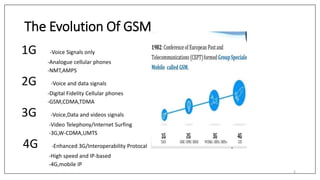
The Evolution Of GSM
1G -Voice Signals only
-Analogue cellular phones
-NMT,AMPS
2G -Voice and data signals
-Digital Fidelity Cellular phones
-GSM,CDMA,TDMA
3G -Voice,Data and videos signals
-Video Telephony/Internet Surfing
-3G,W-CDMA,UMTS
4G -Enhanced 3G/Interoperability Protocal
-High speed and IP-based
-4G,mobile IP
2
3
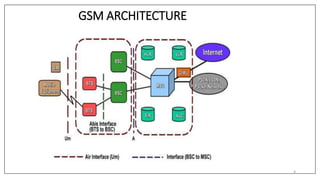
GSM ARCHITECTURE
4
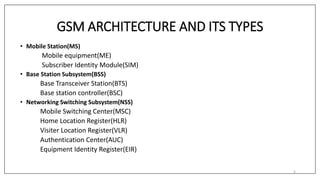
GSM ARCHITECTURE AND ITS TYPES
• Mobile Station(MS)
Mobile equipment(ME)
Subscriber Identity Module(SIM)
• Base Station Subsystem(BSS)
Base Transceiver Station(BTS)
Base station controller(BSC)
• Networking Switching Subsystem(NSS)
Mobile Switching Center(MSC)
Home Location Register(HLR)
Visiter Location Register(VLR)
Authentication Center(AUC)
Equipment Identity Register(EIR)
5
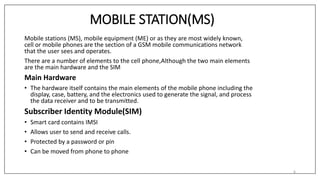
MOBILE STATION(MS)
Mobile stations (MS), mobile equipment (ME) or as they are most widely known,
cell or mobile phones are the section of a GSM mobile communications network
that the user sees and operates.
There are a number of elements to the cell phone,Although the two main elements
are the main hardware and the SIM
Main Hardware
• The hardware itself contains the main elements of the mobile phone including the
display, case, battery, and the electronics used to generate the signal, and process
the data receiver and to be transmitted.
Subscriber Identity Module(SIM)
• Smart card contains IMSI
• Allows user to send and receive calls.
• Protected by a password or pin
• Can be moved from phone to phone
6
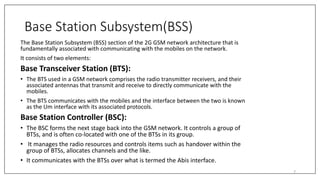
Base Station Subsystem(BSS)
The Base Station Subsystem (BSS) section of the 2G GSM network architecture that is
fundamentally associated with communicating with the mobiles on the network.
It consists of two elements:
Base Transceiver Station (BTS):
• The BTS used in a GSM network comprises the radio transmitter receivers, and their
associated antennas that transmit and receive to directly communicate with the
mobiles.
• The BTS communicates with the mobiles and the interface between the two is known
as the Um interface with its associated protocols.
Base Station Controller (BSC):
• The BSC forms the next stage back into the GSM network. It controls a group of
BTSs, and is often co-located with one of the BTSs in its group.
• It manages the radio resources and controls items such as handover within the
group of BTSs, allocates channels and the like.
• It communicates with the BTSs over what is termed the Abis interface.
7
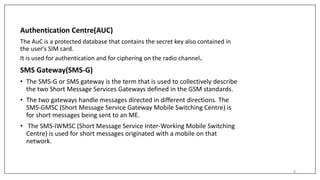
Authentication Centre(AUC)
The AuC is a protected database that contains the secret key also contained in
the user's SIM card.
It is used for authentication and for ciphering on the radio channel.
SMS Gateway(SMS-G)
• The SMS-G or SMS gateway is the term that is used to collectively describe
the two Short Message Services Gateways defined in the GSM standards.
• The two gateways handle messages directed in different directions. The
SMS-GMSC (Short Message Service Gateway Mobile Switching Centre) is
for short messages being sent to an ME.
• The SMS-IWMSC (Short Message Service Inter-Working Mobile Switching
Centre) is used for short messages originated with a mobile on that
network.
8
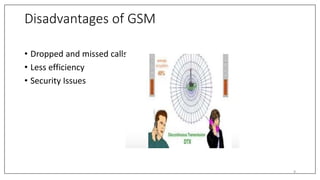
Disadvantages of GSM
• Dropped and missed calls
• Less efficiency
• Security Issues
9

GSM TECH.pptx

  • 1.
    GSM HISTORY • Developedby group speciale mobile(founded 1892) which was an initiative of CPET(Conference of European Post and Telecommunication) • Under ETSI,GSM is named as ”Global System for Mobile Communication” in 1989 • Full set of specifications phase-I became available in 1990 • Phase 2 of the GSM specifications occurs in 1995.Coverage is extended to rural areas 1
  • 2.
    The Evolution OfGSM 1G -Voice Signals only -Analogue cellular phones -NMT,AMPS 2G -Voice and data signals -Digital Fidelity Cellular phones -GSM,CDMA,TDMA 3G -Voice,Data and videos signals -Video Telephony/Internet Surfing -3G,W-CDMA,UMTS 4G -Enhanced 3G/Interoperability Protocal -High speed and IP-based -4G,mobile IP 2
  • 3.
  • 4.
  • 5.
    GSM ARCHITECTURE ANDITS TYPES • Mobile Station(MS) Mobile equipment(ME) Subscriber Identity Module(SIM) • Base Station Subsystem(BSS) Base Transceiver Station(BTS) Base station controller(BSC) • Networking Switching Subsystem(NSS) Mobile Switching Center(MSC) Home Location Register(HLR) Visiter Location Register(VLR) Authentication Center(AUC) Equipment Identity Register(EIR) 5
  • 6.
    MOBILE STATION(MS) Mobile stations(MS), mobile equipment (ME) or as they are most widely known, cell or mobile phones are the section of a GSM mobile communications network that the user sees and operates. There are a number of elements to the cell phone,Although the two main elements are the main hardware and the SIM Main Hardware • The hardware itself contains the main elements of the mobile phone including the display, case, battery, and the electronics used to generate the signal, and process the data receiver and to be transmitted. Subscriber Identity Module(SIM) • Smart card contains IMSI • Allows user to send and receive calls. • Protected by a password or pin • Can be moved from phone to phone 6
  • 7.
    Base Station Subsystem(BSS) TheBase Station Subsystem (BSS) section of the 2G GSM network architecture that is fundamentally associated with communicating with the mobiles on the network. It consists of two elements: Base Transceiver Station (BTS): • The BTS used in a GSM network comprises the radio transmitter receivers, and their associated antennas that transmit and receive to directly communicate with the mobiles. • The BTS communicates with the mobiles and the interface between the two is known as the Um interface with its associated protocols. Base Station Controller (BSC): • The BSC forms the next stage back into the GSM network. It controls a group of BTSs, and is often co-located with one of the BTSs in its group. • It manages the radio resources and controls items such as handover within the group of BTSs, allocates channels and the like. • It communicates with the BTSs over what is termed the Abis interface. 7
  • 8.
    Authentication Centre(AUC) The AuCis a protected database that contains the secret key also contained in the user's SIM card. It is used for authentication and for ciphering on the radio channel. SMS Gateway(SMS-G) • The SMS-G or SMS gateway is the term that is used to collectively describe the two Short Message Services Gateways defined in the GSM standards. • The two gateways handle messages directed in different directions. The SMS-GMSC (Short Message Service Gateway Mobile Switching Centre) is for short messages being sent to an ME. • The SMS-IWMSC (Short Message Service Inter-Working Mobile Switching Centre) is used for short messages originated with a mobile on that network. 8
  • 9.
    Disadvantages of GSM •Dropped and missed calls • Less efficiency • Security Issues 9