• List them on the board
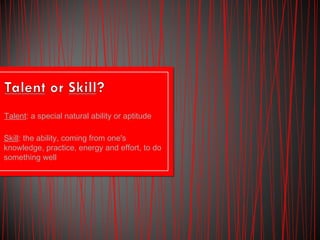
Talent: a special natural ability or aptitude
Skill: the ability, coming from one's
knowledge, practice, energy and effort, to do
something well
Of the qualities listed, which are
considered talents, and which are
considered skills?
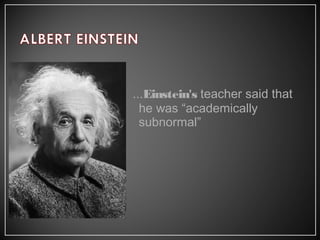
...Einstein's teacher said that
he was “academically
subnormal”
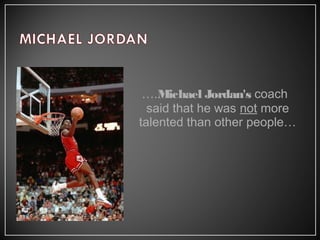
….Michael Jordan's coach
said that he was not more
talented than other people…
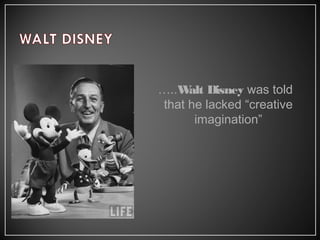
…..Walt Disney was told
that he lacked “creative
imagination”
How did they become
successful?
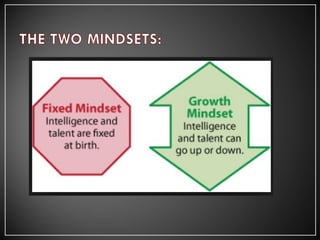
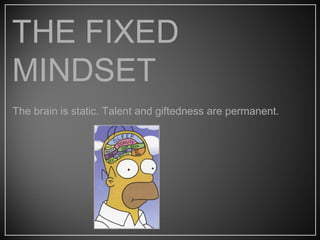
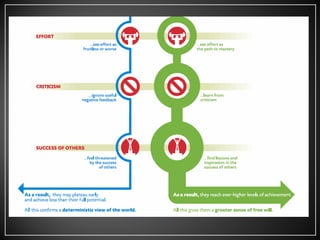
The brain is static. Talent and giftedness are permanent.
THE FIXED
MINDSET
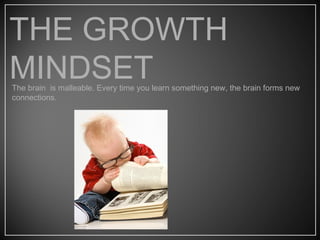
The brain is malleable. Every time you learn something new, the brain forms new
connections.
THE GROWTH
MINDSET
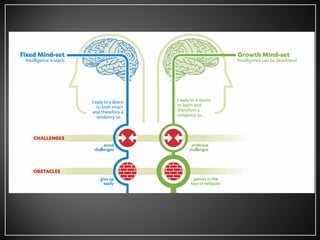
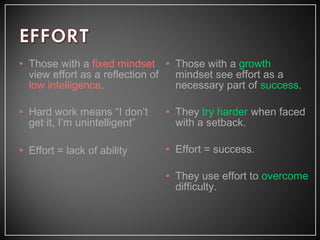
• Those with a fixed mindset
view effort as a reflection of
low intelligence.
• Hard work means “I don’t
get it, I’m unintelligent”
• Effort = lack of ability
• Those with a growth
mindset see effort as a
necessary part of success.
• They try harder when faced
with a setback.
• Effort = success.
• They use effort to overcome
difficulty.
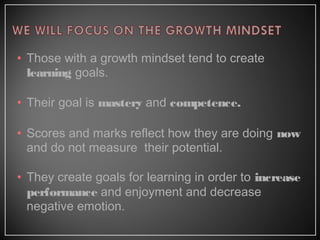
• Those with a growth mindset tend to create
learning goals.
• Their goal is mastery and competence.
• Scores and marks reflect how they are doing now
and do not measure their potential.
• They create goals for learning in order to increase
performance and enjoyment and decrease
negative emotion.
• People adopting a growth mindset tend to
generate other, and new, ways to do things.
• If one route doesn’t work they will try others.
• They will think ‘outside of the box’ to solve
problems because they believe that they ‘can’.
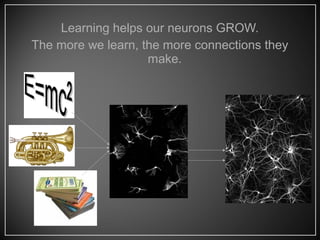
Learning helps our neurons GROW.
The more we learn, the more connections they
make.
• Pay attention to learning
• Focus on what I am learning, rather than focusing on how
I feel.
• Try out new ways of doing things and seek out
challenges
• Use self-motivating statements such as ‘ the harder it
gets the harder I try’.
• Try things that are challenging.
• It is not always important that know how to do something
at first
1. Learn, Learn, Learn- It’s more important to learn than
get good grades, focus on learning and improving.
2. Realize hard workis key- Putting a lot of work and
effort into learning and working hard is key, seek
challenges, focus on strategies, effort, struggle and
persistence despite setbacks.
3. Set feedback- Capitalize on mistakes, confront
deficiencies, reflect on different strategies that work
and don’t work, focus on learning and improving
• How you interpret challenges, setbacks, and criticism is
your choice.
• You can interpret them in a fixed mindset as signs that
your fixed talents or abilities are lacking.
• Or you can interpret them in a growth mindset as signs
that you need to ramp up your strategies and effort,
stretch yourself, and expand your abilities.
• It’s up to you.
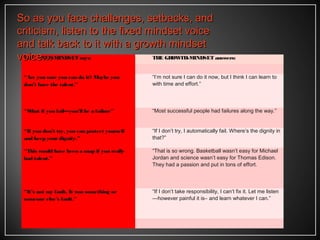
THE FIXED-MINDSET says:   THE GROWTH-MINDSET answers:
     
“Are you sure you can do it? Maybe you
don’t have the talent.”
  “I’m not sure I can do it now, but I think I can learn to
with time and effort.”
“What if you fail—you’ll be a failure”   “Most successful people had failures along the way.”
“If you don’t try, you can protect yourself
and keep yourdignity.”
  “If I don’t try, I automatically fail. Where’s the dignity in
that?”
“This would have been a snap if you really
had talent.”
  “That is so wrong. Basketball wasn’t easy for Michael
Jordan and science wasn’t easy for Thomas Edison.
They had a passion and put in tons of effort.
“It’s not my fault. It was something or
someone else’s fault.”
  “If I don’t take responsibility, I can’t fix it. Let me listen
—however painful it is– and learn whatever I can.”
     
So as you face challenges, setbacks, andSo as you face challenges, setbacks, and
criticism, listen to the fixed mindset voicecriticism, listen to the fixed mindset voice
and talk back to it with a growth mindsetand talk back to it with a growth mindset
voice…voice…

Growth mindset

  • 2.
    • List themon the board
  • 3.
    Talent: a specialnatural ability or aptitude Skill: the ability, coming from one's knowledge, practice, energy and effort, to do something well
  • 4.
    Of the qualitieslisted, which are considered talents, and which are considered skills?
  • 5.
    ...Einstein's teacher saidthat he was “academically subnormal”
  • 6.
    ….Michael Jordan's coach saidthat he was not more talented than other people…
  • 7.
    …..Walt Disney wastold that he lacked “creative imagination”
  • 8.
    How did theybecome successful?
  • 10.
    The brain isstatic. Talent and giftedness are permanent. THE FIXED MINDSET
  • 11.
    The brain ismalleable. Every time you learn something new, the brain forms new connections. THE GROWTH MINDSET
  • 14.
    • Those witha fixed mindset view effort as a reflection of low intelligence. • Hard work means “I don’t get it, I’m unintelligent” • Effort = lack of ability • Those with a growth mindset see effort as a necessary part of success. • They try harder when faced with a setback. • Effort = success. • They use effort to overcome difficulty.
  • 15.
    • Those witha growth mindset tend to create learning goals. • Their goal is mastery and competence. • Scores and marks reflect how they are doing now and do not measure their potential. • They create goals for learning in order to increase performance and enjoyment and decrease negative emotion.
  • 16.
    • People adoptinga growth mindset tend to generate other, and new, ways to do things. • If one route doesn’t work they will try others. • They will think ‘outside of the box’ to solve problems because they believe that they ‘can’.
  • 17.
    Learning helps ourneurons GROW. The more we learn, the more connections they make.
  • 18.
    • Pay attentionto learning • Focus on what I am learning, rather than focusing on how I feel. • Try out new ways of doing things and seek out challenges • Use self-motivating statements such as ‘ the harder it gets the harder I try’. • Try things that are challenging. • It is not always important that know how to do something at first
  • 19.
    1. Learn, Learn,Learn- It’s more important to learn than get good grades, focus on learning and improving. 2. Realize hard workis key- Putting a lot of work and effort into learning and working hard is key, seek challenges, focus on strategies, effort, struggle and persistence despite setbacks. 3. Set feedback- Capitalize on mistakes, confront deficiencies, reflect on different strategies that work and don’t work, focus on learning and improving
  • 20.
    • How youinterpret challenges, setbacks, and criticism is your choice. • You can interpret them in a fixed mindset as signs that your fixed talents or abilities are lacking. • Or you can interpret them in a growth mindset as signs that you need to ramp up your strategies and effort, stretch yourself, and expand your abilities. • It’s up to you.
  • 21.
    THE FIXED-MINDSET says:  THE GROWTH-MINDSET answers:       “Are you sure you can do it? Maybe you don’t have the talent.”   “I’m not sure I can do it now, but I think I can learn to with time and effort.” “What if you fail—you’ll be a failure”   “Most successful people had failures along the way.” “If you don’t try, you can protect yourself and keep yourdignity.”   “If I don’t try, I automatically fail. Where’s the dignity in that?” “This would have been a snap if you really had talent.”   “That is so wrong. Basketball wasn’t easy for Michael Jordan and science wasn’t easy for Thomas Edison. They had a passion and put in tons of effort. “It’s not my fault. It was something or someone else’s fault.”   “If I don’t take responsibility, I can’t fix it. Let me listen —however painful it is– and learn whatever I can.”       So as you face challenges, setbacks, andSo as you face challenges, setbacks, and criticism, listen to the fixed mindset voicecriticism, listen to the fixed mindset voice and talk back to it with a growth mindsetand talk back to it with a growth mindset voice…voice…