Mazher Mohammed
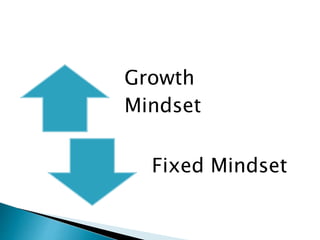
Growth
Mindset
Fixed Mindset
 Stanford University, Psychology professor
CAROL DWECK .
Authored Book: MINDSET: The New
Psychology of Success
Growth Mindset is the belief that
one's abilities, qualities, and
intelligence can be developed.
Fixed mindset believes that
intelligence and one's qualities
are unchangeable.
 A growth mindset, Carol Dweck
asserts, empowers people to believe they can
develop their abilities — brains and talent are
just the starting point. This view creates a
love of learning and a resilience that are
essential for accomplishment in just about
any sphere.
 A child with a fixed mindset may not engage
with the process of learning, believing that any
challenges they face are due to a lack of
natural talent, skill, or intelligence. They will
approach learning and challenges with an “I'm
not good at this” attitude.
When we teach our students to learn, grow,
improve and change, the same applies for
educators too.
Incorporate these key steps to have Growth
Mindset:
 Never stop growing (Acquire learning)
 Inquisitiveness (Ask questions “why”)
 Always be flexible
 Learn something from everything (especially new
technology)
 Be an active and Good listener
 Lastly, Self accountability(RRR) – Reflection,
Reflection and Reflection for improvement.
 Normalize struggle. Struggle is part of the learning process, and emphasizing and reinforcing that
idea helps students react positively when they feel challenged.
 Encourage engagement with challenges. Portray challenges as fun and exciting, and easy tasks as
boring.
 Embrace the word “yet”. If someone makes the statement “I’m not a math person,” adding a simple
qualifier will signal that a process exists for gaining ability. “You’re not a math person yet.”
 Tout the value of hard tasks to the brain. Promote the idea that brains are malleable “muscles” that
can be developed. Research on brain plasticity supports the idea of neural growth, and mindset
research has shown that believing the brain can grow has a demonstrative effect on behavior and
achievement.
 Demonstrate mistakes and celebrate corrections. Mistakes should be viewed as learning
opportunities. Teachers can model this outlook in reactions to their own mistakes and steps they take
to correct a mistake.
 Set goals. Having students set incremental, achievable goals demonstrates the attainability of growth
and progress.
 Develop cooperative exercises. Working together to solve problems emphasizes process and
reinforces the importance of getting help and finding solutions. It also deemphasizes individual
outcomes.
 Provide challenges. Part of developing a growth mindset is teaching students to overcome obstacles.
A particularly hard math problem or complex writing assignment that stretches their abilities can
provide opportunities for growth and further instruction that emphasizes problem-solving.
 Avoid praising intelligence. This may seem counterintuitive, but praise for “being smart” reinforces
the idea that intelligence is a fixed trait. This can be demotivating for the students being praised (“I’m
smart; I don’t have to try harder”), as well as for those who don’t not receive the praise (“That student
is smart; I’m not”).
 Don’t oversimplify. “You can do anything!” may feel like harmless encouragement, but if students
aren’t put in a position to overcome challenges, they’ll conclude that such statements are empty, and
the educator will lose credibility.
Working together to reframe their shared challenges and goals can help
both teachers and administrators develop growth mindsets and
culture:
 Value the process over the result. Valuing the process over the
result can be difficult in a results-driven environment, but teachers
and administrators who value the growth mindset and its long-
term benefits are more likely to stay the course.
 View challenges as opportunities. Students aren’t the only ones
facing challenges; teachers and administrators can benefit just as
much from an outlook that celebrates the process.
 Experiment with different teaching methods and learning
strategies. Helping students build the skills they need to improve
is a key element of the growth mindset approach. Teachers and
administrators who embrace a growth mindset shouldn’t be afraid
to experiment.
 Celebrate growth. Finding teaching strategies that reach students
and help them learn should be celebrated with the students, as
well as with other teachers and administrators. This reinforces the
emphasis on effort and process. It also provides opportunities to
share valuable learning's.
 Communicate about your growth mindset. Sharing successes and
failures among teachers and administrators helps to establish a
culture that values challenges and a growth mindset.
Thank you

Growth Mindset Vs Fixed Mindset.pptx

  • 1.
  • 2.
  • 3.
     Stanford University,Psychology professor CAROL DWECK . Authored Book: MINDSET: The New Psychology of Success
  • 4.
    Growth Mindset isthe belief that one's abilities, qualities, and intelligence can be developed. Fixed mindset believes that intelligence and one's qualities are unchangeable.
  • 5.
     A growthmindset, Carol Dweck asserts, empowers people to believe they can develop their abilities — brains and talent are just the starting point. This view creates a love of learning and a resilience that are essential for accomplishment in just about any sphere.
  • 6.
     A childwith a fixed mindset may not engage with the process of learning, believing that any challenges they face are due to a lack of natural talent, skill, or intelligence. They will approach learning and challenges with an “I'm not good at this” attitude.
  • 7.
    When we teachour students to learn, grow, improve and change, the same applies for educators too. Incorporate these key steps to have Growth Mindset:  Never stop growing (Acquire learning)  Inquisitiveness (Ask questions “why”)  Always be flexible  Learn something from everything (especially new technology)  Be an active and Good listener  Lastly, Self accountability(RRR) – Reflection, Reflection and Reflection for improvement.
  • 8.
     Normalize struggle.Struggle is part of the learning process, and emphasizing and reinforcing that idea helps students react positively when they feel challenged.  Encourage engagement with challenges. Portray challenges as fun and exciting, and easy tasks as boring.  Embrace the word “yet”. If someone makes the statement “I’m not a math person,” adding a simple qualifier will signal that a process exists for gaining ability. “You’re not a math person yet.”  Tout the value of hard tasks to the brain. Promote the idea that brains are malleable “muscles” that can be developed. Research on brain plasticity supports the idea of neural growth, and mindset research has shown that believing the brain can grow has a demonstrative effect on behavior and achievement.  Demonstrate mistakes and celebrate corrections. Mistakes should be viewed as learning opportunities. Teachers can model this outlook in reactions to their own mistakes and steps they take to correct a mistake.  Set goals. Having students set incremental, achievable goals demonstrates the attainability of growth and progress.  Develop cooperative exercises. Working together to solve problems emphasizes process and reinforces the importance of getting help and finding solutions. It also deemphasizes individual outcomes.  Provide challenges. Part of developing a growth mindset is teaching students to overcome obstacles. A particularly hard math problem or complex writing assignment that stretches their abilities can provide opportunities for growth and further instruction that emphasizes problem-solving.  Avoid praising intelligence. This may seem counterintuitive, but praise for “being smart” reinforces the idea that intelligence is a fixed trait. This can be demotivating for the students being praised (“I’m smart; I don’t have to try harder”), as well as for those who don’t not receive the praise (“That student is smart; I’m not”).  Don’t oversimplify. “You can do anything!” may feel like harmless encouragement, but if students aren’t put in a position to overcome challenges, they’ll conclude that such statements are empty, and the educator will lose credibility.
  • 9.
    Working together toreframe their shared challenges and goals can help both teachers and administrators develop growth mindsets and culture:  Value the process over the result. Valuing the process over the result can be difficult in a results-driven environment, but teachers and administrators who value the growth mindset and its long- term benefits are more likely to stay the course.  View challenges as opportunities. Students aren’t the only ones facing challenges; teachers and administrators can benefit just as much from an outlook that celebrates the process.  Experiment with different teaching methods and learning strategies. Helping students build the skills they need to improve is a key element of the growth mindset approach. Teachers and administrators who embrace a growth mindset shouldn’t be afraid to experiment.  Celebrate growth. Finding teaching strategies that reach students and help them learn should be celebrated with the students, as well as with other teachers and administrators. This reinforces the emphasis on effort and process. It also provides opportunities to share valuable learning's.  Communicate about your growth mindset. Sharing successes and failures among teachers and administrators helps to establish a culture that values challenges and a growth mindset.
  • 10.