GROWTH AND MAINTENANCE IN
       RESPIRATION
RESPIRATION
RESPIRATION

 Oxidation of organic substances to CO2 and water


 Can be divided into 3 groups :


   Autotrophic respiration / plant respiration.

   Heterotrophic respiration / soil respiration.

   Photorespiration.
Diagram 1: Autotrophic respiration and Heterotrophic respiration
DEFINITION OF
   AUTOTROPHIC,
HETEROTROPHIC AND
 PHOTORESPIRATION
AUTOTROPHIC

 Capable of self-nourishment


 Requires only minerals for growth


 Uses carbonate or carbon dioxide as a source of
  carbon and simple inorganic nitrogen as a nitrogen
  source


Sources: GNU Webster's 1913
HETEROTROPHIC

 Not self-sustaining


 Dependent upon others for food.


 Requires organic compounds of carbon and nitrogen
  for nourishment


Sources: Century Dictionary and Cyclopedia and WordNet 3.0
PHOTORESPIRATION

 Oxidation of carbohydrates in plants with the release
  of carbon dioxide during photosynthesis.

 Happens on hot dry days when a plant is forced to
  close its stomata to prevent excess water loss.


Sources: American Heritage® Dictionary of the English Language, Fourth Edition
AUTOTROPHIC
RESPIRATION
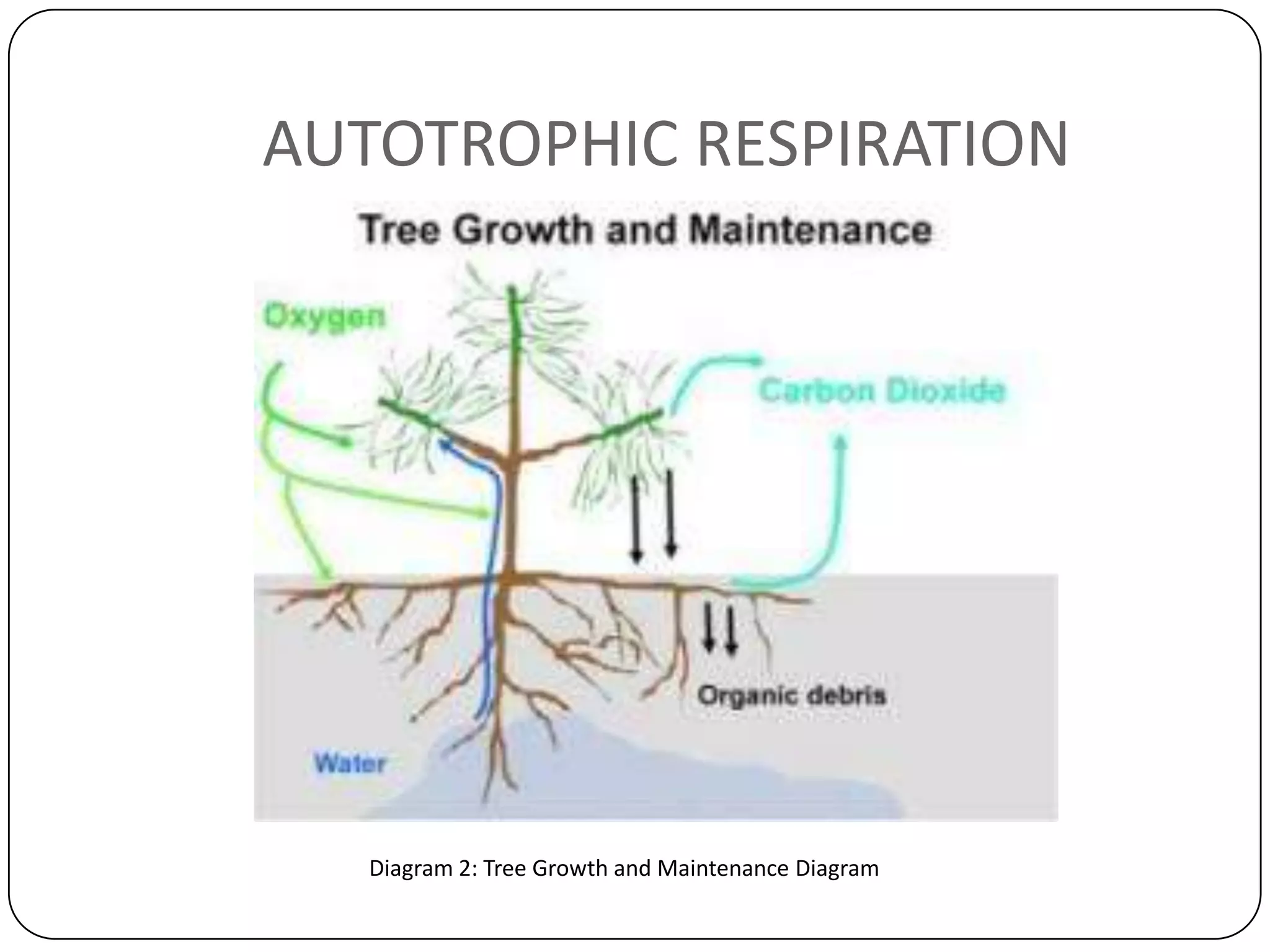
AUTOTROPHIC RESPIRATION

 Respiration: Oxidation of organic substances to CO2
  and water

 Defined as loss of photosynthetically fixed carbon lost
  by internal plant metabolism

 Byproduct are ATP and NADPH
AUTOTROPHIC RESPIRATION

 Common chemical equation of autotrophic respiration
  for glucose is:


    C6H12O6 + 6O2  6CO2 + 6H2O + energy

 The autotrophic respiration consists of:

  • Growth Respiration

  • Maintenance Respiration
AUTOTROPHIC RESPIRATION


   Diagram 2: Tree Growth and Maintenance Diagram
GROWTH
RESPIRATION
GROWTH RESPIRATION

 Growth - refers to the biosynthesis process within a
  growing organ and related phloem transport,
  excluding mineral uptake and nitrogen reduction

 Includes the carbon cost of synthesizing new tissue
  from glucose and minerals used for growth

 Rate for various tissue differs depends on the their
  compositions.
GROWTH RESPIRATION

 Repair of injured tissue increase maintenance
  respiration above basal rate.
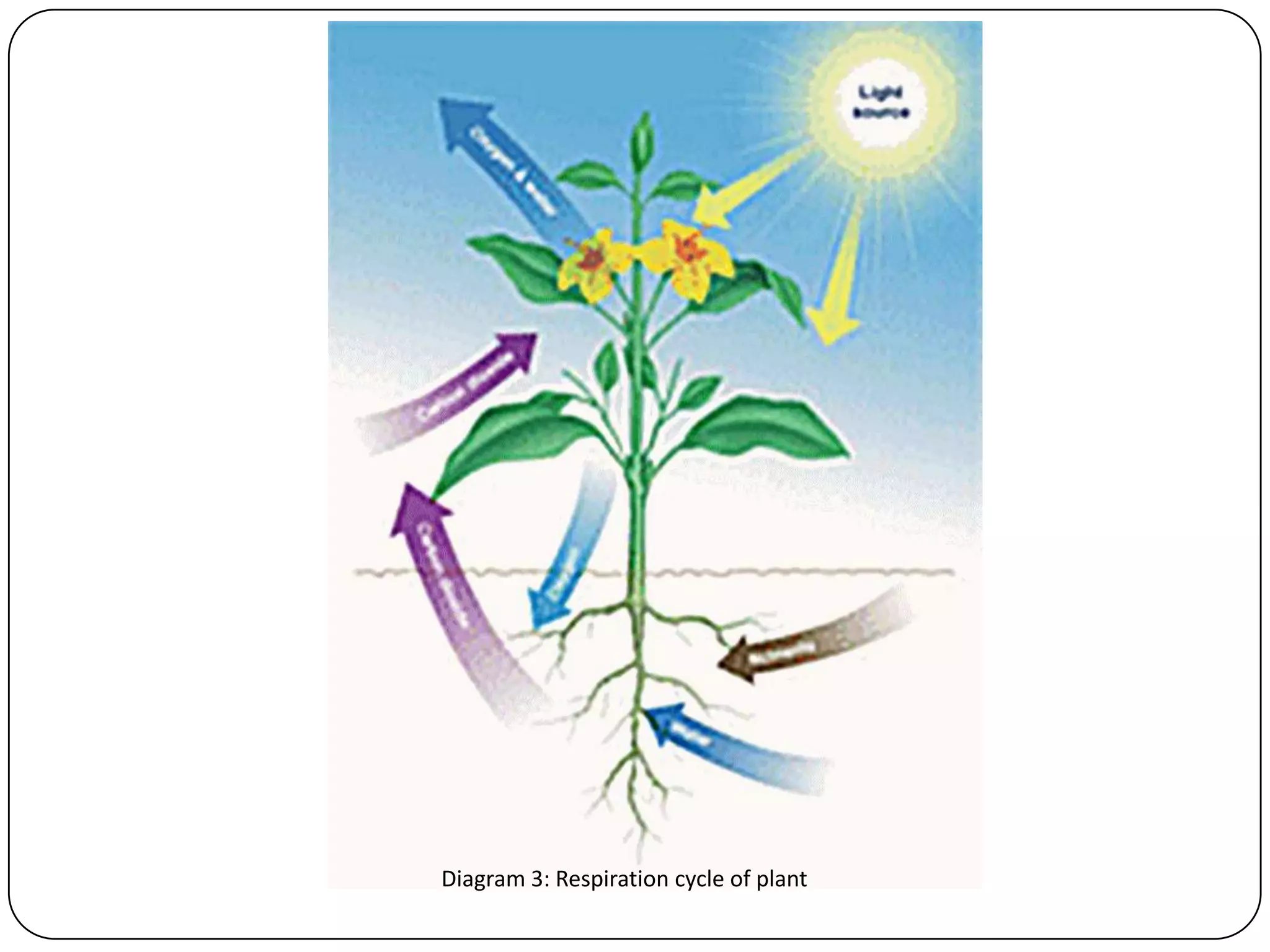
Diagram 3: Respiration cycle of plant
MAINTENANCE
RESPIRATION
MAINTENANCE RESPIRATION

 Refers to the CO2 released, or O2 consumed, during
  basal rate of metabolism of usable energy used for:
   Resynthesis of compounds that undergo renewal

   Maintenance of chemical gradients of ions and

    metabolites across cellular membranes
   Operation of metabolic processes involved in

    physiological adjustment to a change in the plant's
    environment
MAINTENANCE RESPIRATION

 Temperature is the most important environmental
  factor affecting maintenance respiration

 The metabolic costs of the repair of injury from stress
  (biotic/abiotic) also considered as part of maintenance
  respiration

 Essential for biological health and growth of plants,
  sustain living tissues.
MAINTENANCE RESPIRATION

 Key component of most physiologically based
 mathematical models of plant growth, includes:
   models of crop growth and yield

   models of ecosystem primary production and carbon

   balance
Diagram 4: Example of Autotrophic Respiration of plant
CONCLUSION
CONCLUSION
 In sense of learning growth and maintenance
 respiration in crop physiology, we can:
   Learn mechanism used by plants to grow and maintain

   its growth
   Learn and predict the life cycle of a specific plant

   How to maintain a specific plant growth to increase its

   yield as well as its yield production longevity (important
   for economic crop producers)
REFERENCES
REFERENCES
BOOKS:

 Julian Evans ,The Forests Handbook, An Overview of Forest Science (Google

   Books), pg. 195 – 196.

 J. J. Landsberg, S. T. Gower, Applications Of Physiological Ecology To Forest

   Management (Google Books), pg. 139 – 140.

 James I. L. Morison, Michael D. Morecroft, Plant Growth And Climate Change

   (Google Books), pg. 197 – 198.

 Richard H. Waring, S. W. Running, Forest Ecosystems: Analysis At Multiple

   Scales (Google Books), pg. 67 – 69.

 Christopher The, Introduction To Mathematical Modeling Of Crop Growth

   (Google Books), pg. 144
REFERENCES
 Theodore Thomas Kozlowski, Stephen G. Pallardy, Growth Control in Woody

   Plants (Google Books), pg. 96 – 97.

 Yin Xinyou, H. H. van Laar, Crop Systems Dynamics (Google Books), pg. 20.

 Hans Lambers, Francis Stuart Chapin (III.), Francis Stuart Chapin, Thijs Leendert

   Pons, Plant Physiological Ecology, Pg. 134 – 136.


INTERNET:

 Peter Kolb, University of Montana, 5 October 2011, Tree Biology,

   http://www.extension.org/pages/33616/tree-biology

 Definitions of biological terms as well as its citation;

   http://www.wordnik.com
REFERENCES
JOURNALS:

 Michael G. Ryan, Department of Forest Science, Oregon State University, 30

  August 1989, Growth and Maintenance Respiration In Stems Of Pinus controta
  and Picea engelmannii, Pg. 48 – 57

 Markus Lötscher, Katja Klumpp and Hans Schnyder, Plant Science Department,

  Technische Universität München, Am Hochanger 1, D-85350 Freising-
  Weihenstephan, Germany, Growth And Maintenance Respiration For Individual
  Plants In Hierarchically Structured Canopies Of Medicago sativa And
  Helianthus annuus : The Contribution Of Current And Old Assimilates
THANK YOU

Growth and maintenance in respiration

  • 1.
    GROWTH AND MAINTENANCEIN RESPIRATION
  • 2.
  • 3.
    RESPIRATION  Oxidation oforganic substances to CO2 and water  Can be divided into 3 groups :  Autotrophic respiration / plant respiration.  Heterotrophic respiration / soil respiration.  Photorespiration.
  • 4.
    Diagram 1: Autotrophicrespiration and Heterotrophic respiration
  • 5.
    DEFINITION OF AUTOTROPHIC, HETEROTROPHIC AND PHOTORESPIRATION
  • 6.
    AUTOTROPHIC  Capable ofself-nourishment  Requires only minerals for growth  Uses carbonate or carbon dioxide as a source of carbon and simple inorganic nitrogen as a nitrogen source Sources: GNU Webster's 1913
  • 7.
    HETEROTROPHIC  Not self-sustaining Dependent upon others for food.  Requires organic compounds of carbon and nitrogen for nourishment Sources: Century Dictionary and Cyclopedia and WordNet 3.0
  • 8.
    PHOTORESPIRATION  Oxidation ofcarbohydrates in plants with the release of carbon dioxide during photosynthesis.  Happens on hot dry days when a plant is forced to close its stomata to prevent excess water loss. Sources: American Heritage® Dictionary of the English Language, Fourth Edition
  • 9.
  • 10.
    AUTOTROPHIC RESPIRATION  Respiration:Oxidation of organic substances to CO2 and water  Defined as loss of photosynthetically fixed carbon lost by internal plant metabolism  Byproduct are ATP and NADPH
  • 11.
    AUTOTROPHIC RESPIRATION  Commonchemical equation of autotrophic respiration for glucose is: C6H12O6 + 6O2  6CO2 + 6H2O + energy  The autotrophic respiration consists of: • Growth Respiration • Maintenance Respiration
  • 12.
    AUTOTROPHIC RESPIRATION Diagram 2: Tree Growth and Maintenance Diagram
  • 13.
  • 14.
    GROWTH RESPIRATION  Growth- refers to the biosynthesis process within a growing organ and related phloem transport, excluding mineral uptake and nitrogen reduction  Includes the carbon cost of synthesizing new tissue from glucose and minerals used for growth  Rate for various tissue differs depends on the their compositions.
  • 15.
    GROWTH RESPIRATION  Repairof injured tissue increase maintenance respiration above basal rate.
  • 16.
    Diagram 3: Respirationcycle of plant
  • 17.
  • 18.
    MAINTENANCE RESPIRATION  Refersto the CO2 released, or O2 consumed, during basal rate of metabolism of usable energy used for:  Resynthesis of compounds that undergo renewal  Maintenance of chemical gradients of ions and metabolites across cellular membranes  Operation of metabolic processes involved in physiological adjustment to a change in the plant's environment
  • 19.
    MAINTENANCE RESPIRATION  Temperatureis the most important environmental factor affecting maintenance respiration  The metabolic costs of the repair of injury from stress (biotic/abiotic) also considered as part of maintenance respiration  Essential for biological health and growth of plants, sustain living tissues.
  • 20.
    MAINTENANCE RESPIRATION  Keycomponent of most physiologically based mathematical models of plant growth, includes:  models of crop growth and yield  models of ecosystem primary production and carbon balance
  • 21.
    Diagram 4: Exampleof Autotrophic Respiration of plant
  • 22.
  • 23.
    CONCLUSION  In senseof learning growth and maintenance respiration in crop physiology, we can:  Learn mechanism used by plants to grow and maintain its growth  Learn and predict the life cycle of a specific plant  How to maintain a specific plant growth to increase its yield as well as its yield production longevity (important for economic crop producers)
  • 24.
  • 25.
    REFERENCES BOOKS:  Julian Evans,The Forests Handbook, An Overview of Forest Science (Google Books), pg. 195 – 196.  J. J. Landsberg, S. T. Gower, Applications Of Physiological Ecology To Forest Management (Google Books), pg. 139 – 140.  James I. L. Morison, Michael D. Morecroft, Plant Growth And Climate Change (Google Books), pg. 197 – 198.  Richard H. Waring, S. W. Running, Forest Ecosystems: Analysis At Multiple Scales (Google Books), pg. 67 – 69.  Christopher The, Introduction To Mathematical Modeling Of Crop Growth (Google Books), pg. 144
  • 26.
    REFERENCES  Theodore ThomasKozlowski, Stephen G. Pallardy, Growth Control in Woody Plants (Google Books), pg. 96 – 97.  Yin Xinyou, H. H. van Laar, Crop Systems Dynamics (Google Books), pg. 20.  Hans Lambers, Francis Stuart Chapin (III.), Francis Stuart Chapin, Thijs Leendert Pons, Plant Physiological Ecology, Pg. 134 – 136. INTERNET:  Peter Kolb, University of Montana, 5 October 2011, Tree Biology, http://www.extension.org/pages/33616/tree-biology  Definitions of biological terms as well as its citation; http://www.wordnik.com
  • 27.
    REFERENCES JOURNALS:  Michael G.Ryan, Department of Forest Science, Oregon State University, 30 August 1989, Growth and Maintenance Respiration In Stems Of Pinus controta and Picea engelmannii, Pg. 48 – 57  Markus Lötscher, Katja Klumpp and Hans Schnyder, Plant Science Department, Technische Universität München, Am Hochanger 1, D-85350 Freising- Weihenstephan, Germany, Growth And Maintenance Respiration For Individual Plants In Hierarchically Structured Canopies Of Medicago sativa And Helianthus annuus : The Contribution Of Current And Old Assimilates
  • 28.