Temperature stress
in plants
Harithalekshmi V
2018-11-067
Dept. Agrl. Meteorology
Significance of temperature on organic life
• Physical and chemical process within the plants are goverened by
temperature
• The diffusion rate of gases and liquids
• Solubility of different substances
• Rate of reactions
• Stability of the enzyme system
• Normally the growth permitting range of
temperature – 10℃- 45 ℃ - Biokinetic zone
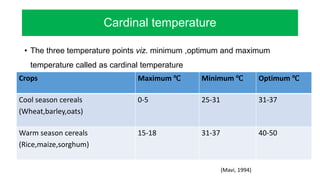
Cardinal temperature
• The three temperature points viz. minimum ,optimum and maximum
temperature called as cardinal temperature
Crops Maximum ℃ Minimum ℃ Optimum ℃
Cool season cereals
(Wheat,barley,oats)
0-5 25-31 31-37
Warm season cereals
(Rice,maize,sorghum)
15-18 31-37 40-50
(Mavi, 1994)
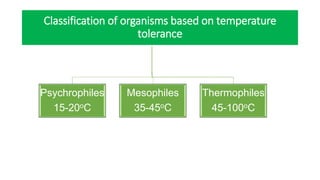
Classification of organisms based on temperature
tolerance
Psychrophiles
15-20oC
Mesophiles
35-45oC
Thermophiles
45-100oC
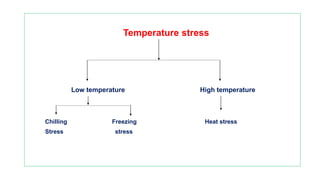
Temperature stress
Low temperature High temperature
Chilling Freezing Heat stress
Stress stress
Heat stress
Heat stress is defined as the rise in temperature beyond a
threshold level for a period of time sufficient to cause irreversible
damage to plant growth and development
(Singh, 1973)
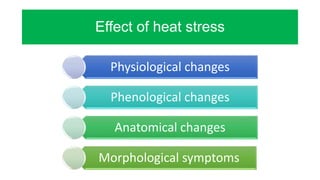
Effect of heat stress
Physiological changes
Phenological changes
Anatomical changes
Morphological symptoms
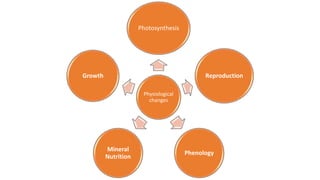
Physiological
changes
Photosynthesis
Reproduction
Phenology
Mineral
Nutrition
Growth
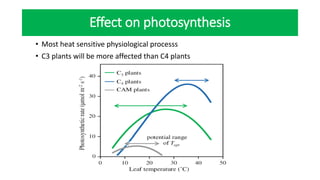
Effect on photosynthesis
• Most heat sensitive physiological processs
• C3 plants will be more affected than C4 plants
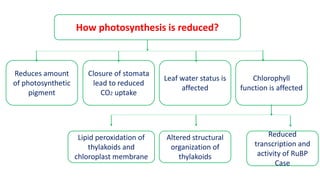
How photosynthesis is reduced?
Reduces amount
of photosynthetic
pigment
Closure of stomata
lead to reduced
CO2 uptake
Leaf water status is
affected
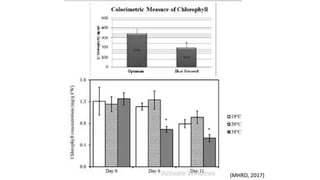
Chlorophyll
function is affected
Reduced
transcription and
activity of RuBP
Case
Altered structural
organization of
thylakoids
Lipid peroxidation of
thylakoids and
chloroplast membrane
(MHRD, 2017)
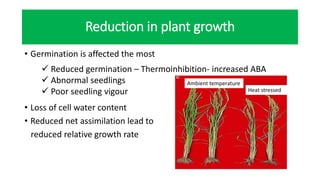
Reduction in plant growth
• Germination is affected the most
• Loss of cell water content
• Reduced net assimilation lead to
reduced relative growth rate
 Reduced germination – Thermoinhibition- increased ABA
 Abnormal seedlings
 Poor seedling vigour
Ambient temperature
Heat stressed
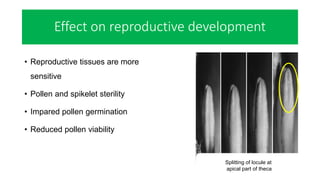
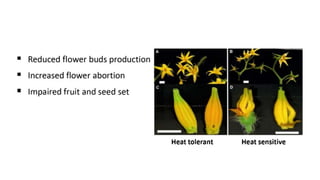
Effect on reproductive development
• Reproductive tissues are more
sensitive
• Pollen and spikelet sterility
• Impared pollen germination
• Reduced pollen viability
Splitting of locule at
apical part of theca
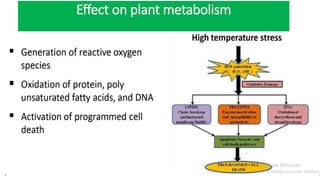
Effect on plant metabolism
Yield
• Increase in temperature by 1℃ will reduce yield of the cereals by
4.1% to 10%
Reduced photosynthesis
Increased respiration
Reduced assimilatory capacity
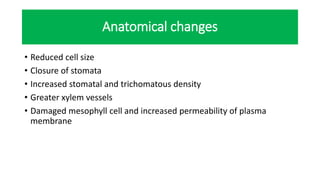
Anatomical changes
• Reduced cell size
• Closure of stomata
• Increased stomatal and trichomatous density
• Greater xylem vessels
• Damaged mesophyll cell and increased permeability of plasma
membrane
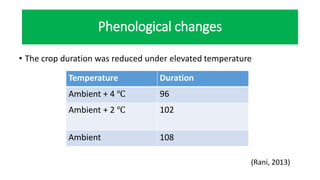
Phenological changes
• The crop duration was reduced under elevated temperature
(Rani, 2013)
Temperature Duration
Ambient + 4 ℃ 96
Ambient + 2 ℃ 102
Ambient 108
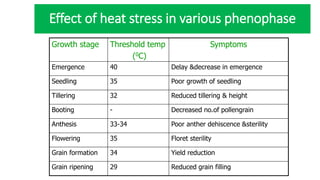
Effect of heat stress in various phenophase
Growth stage Threshold temp
(0C)
Symptoms
Emergence 40 Delay &decrease in emergence
Seedling 35 Poor growth of seedling
Tillering 32 Reduced tillering & height
Booting - Decreased no.of pollengrain
Anthesis 33-34 Poor anther dehiscence &sterility
Flowering 35 Floret sterility
Grain formation 34 Yield reduction
Grain ripening 29 Reduced grain filling
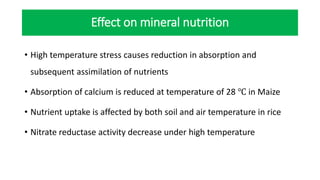
Effect on mineral nutrition
• High temperature stress causes reduction in absorption and
subsequent assimilation of nutrients
• Absorption of calcium is reduced at temperature of 28 ℃ in Maize
• Nutrient uptake is affected by both soil and air temperature in rice
• Nitrate reductase activity decrease under high temperature
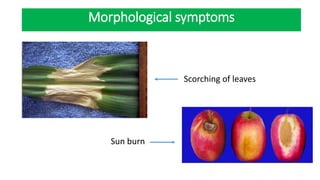
Scorching of leaves
Sun burn
Morphological symptoms
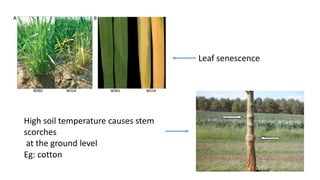
Leaf senescence
High soil temperature causes stem
scorches
at the ground level
Eg: cotton
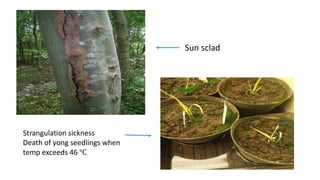
Sun sclad
Strangulation sickness
Death of yong seedlings when
temp exceeds 46 ℃
Effect on produce quality
High temperature stress during post-flowering stage increases
the proportion of gliadins to glutelins and decreases the proportion of
starch hampering the quality of wheat flour and the grain yield
(Ashraf, 2014)
Mitigating heat stress
• Avoidance
Mechanisms for surviving which include log term evolutionary,
phenological and morphological adaptations and short term avoidance
or acclimation mechanisms
• Tolerance
Ability to grow and produce yield under HT
Avoidance
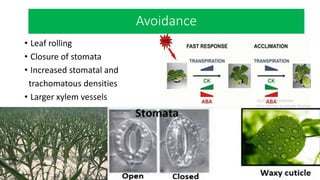
• Leaf rolling
• Closure of stomata
• Increased stomatal and
trachomatous densities
• Larger xylem vessels
• Waxy cuticle
Tolerence – Antioxidative response
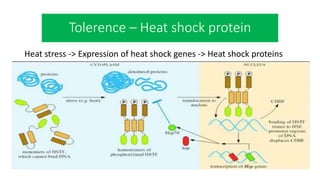
Heat stress -> Expression of heat shock genes -> Heat shock proteins
Tolerence – Heat shock protein
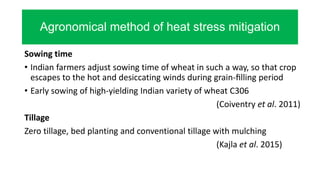
Agronomical method of heat stress mitigation
Sowing time
• Indian farmers adjust sowing time of wheat in such a way, so that crop
escapes to the hot and desiccating winds during grain-filling period
• Early sowing of high-yielding Indian variety of wheat C306
(Coiventry et al. 2011)
Tillage
Zero tillage, bed planting and conventional tillage with mulching
(Kajla et al. 2015)
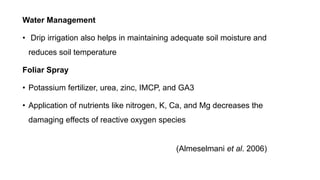
Water Management
• Drip irrigation also helps in maintaining adequate soil moisture and
reduces soil temperature
Foliar Spray
• Potassium fertilizer, urea, zinc, IMCP, and GA3
• Application of nutrients like nitrogen, K, Ca, and Mg decreases the
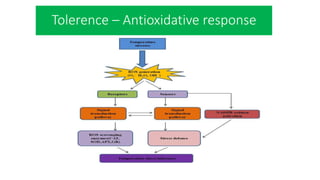
damaging effects of reactive oxygen species
(Almeselmani et al. 2006)
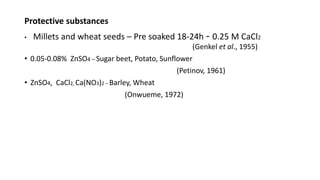
Protective substances
• Millets and wheat seeds – Pre soaked 18-24h - 0.25 M CaCl2
(Genkel et al., 1955)
• 0.05-0.08% ZnSO4 – Sugar beet, Potato, Sunflower
(Petinov, 1961)
• ZnSO4, CaCl2, Ca(NO3)2 – Barley, Wheat
(Onwueme, 1972)
Low temperature stress
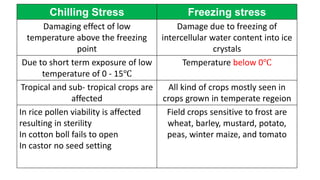
Chilling Stress Freezing stress
Damaging effect of low
temperature above the freezing
point
Damage due to freezing of
intercellular water content into ice
crystals
Due to short term exposure of low
temperature of 0 - 15℃
Temperature below 0℃
Tropical and sub- tropical crops are
affected
All kind of crops mostly seen in
crops grown in temperate regeion
In rice pollen viability is affected
resulting in sterility
In cotton boll fails to open
In castor no seed setting
Field crops sensitive to frost are
wheat, barley, mustard, potato,
peas, winter maize, and tomato
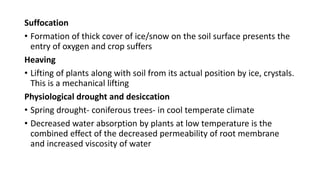
Suffocation
• Formation of thick cover of ice/snow on the soil surface presents the
entry of oxygen and crop suffers
Heaving
• Lifting of plants along with soil from its actual position by ice, crystals.
This is a mechanical lifting
Physiological drought and desiccation
• Spring drought- coniferous trees- in cool temperate climate
• Decreased water absorption by plants at low temperature is the
combined effect of the decreased permeability of root membrane
and increased viscosity of water
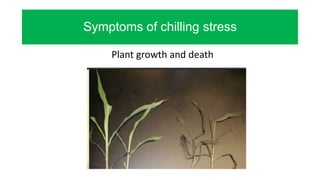
Symptoms of chilling stress
Plant growth and death
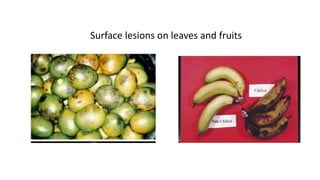
Surface lesions on leaves and fruits
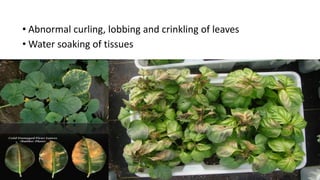
• Abnormal curling, lobbing and crinkling of leaves
• Water soaking of tissues
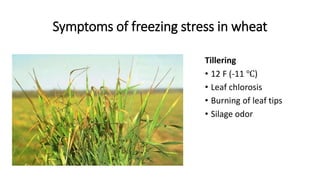
Symptoms of freezing stress in wheat
Tillering
• 12 F (-11 ℃)
• Leaf chlorosis
• Burning of leaf tips
• Silage odor
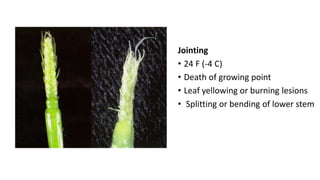
Jointing
• 24 F (-4 C)
• Death of growing point
• Leaf yellowing or burning lesions
• Splitting or bending of lower stem
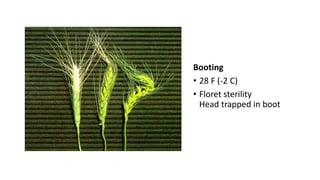
Booting
• 28 F (-2 C)
• Floret sterility
Head trapped in boot
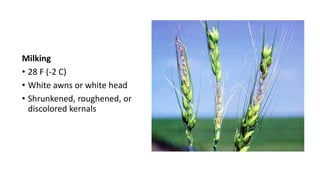
Milking
• 28 F (-2 C)
• White awns or white head
• Shrunkened, roughened, or
discolored kernals
• Altered date of sowing
• In cotton early planting increases percentage of open ball
• In mustard early planting reduces adverse effect of frost
• Selection of varieties and crops
• Barley and oats are more tolerant than wheat
• Maintaining good crop stand and spacing
• Use high seed rate to cover frost effect on germination
• Adequate inter row spaces should be maintained to allow sunlight incidence and to
increase soil temperature
Agro-techniques for management of Low
temperature stress
• Irrigation
• Keep crop well irrigated. Sprinkler irrigation increases canopy temperature
• Delving
• Using of wide blade tyne to mix deep clay soil with sandy top soil
• Delving reduces soil albedo, increases potential to store and release heat by soil
• Covers/thermal blankets for protecting high value crops
• Allow sunlight to penetrate during day and trap radiation at night time by covers and reduces freeze
damage
• Nutrient management
• High N increases vulnerability to frost
• K, Cu and Mo deficiency render crop vulnerable to frost
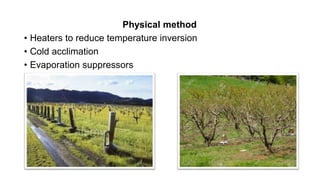
Physical method
• Heaters to reduce temperature inversion
• Cold acclimation
• Evaporation suppressors
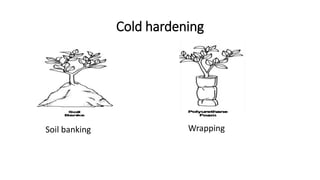
Cold hardening
Soil banking Wrapping
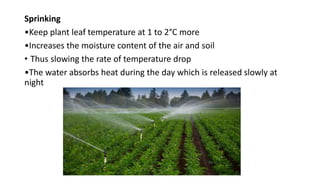
Sprinking
•Keep plant leaf temperature at 1 to 2°C more
•Increases the moisture content of the air and soil
• Thus slowing the rate of temperature drop
•The water absorbs heat during the day which is released slowly at
night
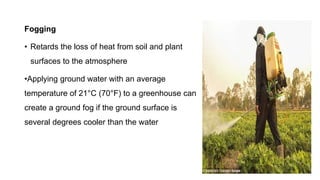
Fogging
• Retards the loss of heat from soil and plant
surfaces to the atmosphere
•Applying ground water with an average
temperature of 21°C (70°F) to a greenhouse can
create a ground fog if the ground surface is
several degrees cooler than the water
Summary
• Significance of temperature
• High temperature stress
• Low temperature stress
- Cold injury
- Freezing injury
• Mitigation strategies for temperature stress
Thank you..

Temperature stress in crops

  • 1.
    Temperature stress in plants HarithalekshmiV 2018-11-067 Dept. Agrl. Meteorology
  • 2.
    Significance of temperatureon organic life • Physical and chemical process within the plants are goverened by temperature • The diffusion rate of gases and liquids • Solubility of different substances • Rate of reactions • Stability of the enzyme system • Normally the growth permitting range of temperature – 10℃- 45 ℃ - Biokinetic zone
  • 3.
    Cardinal temperature • Thethree temperature points viz. minimum ,optimum and maximum temperature called as cardinal temperature Crops Maximum ℃ Minimum ℃ Optimum ℃ Cool season cereals (Wheat,barley,oats) 0-5 25-31 31-37 Warm season cereals (Rice,maize,sorghum) 15-18 31-37 40-50 (Mavi, 1994)
  • 4.
    Classification of organismsbased on temperature tolerance Psychrophiles 15-20oC Mesophiles 35-45oC Thermophiles 45-100oC
  • 5.
    Temperature stress Low temperatureHigh temperature Chilling Freezing Heat stress Stress stress
  • 6.
    Heat stress Heat stressis defined as the rise in temperature beyond a threshold level for a period of time sufficient to cause irreversible damage to plant growth and development (Singh, 1973)
  • 7.
    Effect of heatstress Physiological changes Phenological changes Anatomical changes Morphological symptoms
  • 8.
  • 9.
    Effect on photosynthesis •Most heat sensitive physiological processs • C3 plants will be more affected than C4 plants
  • 10.
    How photosynthesis isreduced? Reduces amount of photosynthetic pigment Closure of stomata lead to reduced CO2 uptake Leaf water status is affected Chlorophyll function is affected Reduced transcription and activity of RuBP Case Altered structural organization of thylakoids Lipid peroxidation of thylakoids and chloroplast membrane
  • 11.
  • 12.
    Reduction in plantgrowth • Germination is affected the most • Loss of cell water content • Reduced net assimilation lead to reduced relative growth rate  Reduced germination – Thermoinhibition- increased ABA  Abnormal seedlings  Poor seedling vigour Ambient temperature Heat stressed
  • 13.
    Effect on reproductivedevelopment • Reproductive tissues are more sensitive • Pollen and spikelet sterility • Impared pollen germination • Reduced pollen viability Splitting of locule at apical part of theca
  • 15.
    Effect on plantmetabolism
  • 16.
    Yield • Increase intemperature by 1℃ will reduce yield of the cereals by 4.1% to 10% Reduced photosynthesis Increased respiration Reduced assimilatory capacity
  • 17.
    Anatomical changes • Reducedcell size • Closure of stomata • Increased stomatal and trichomatous density • Greater xylem vessels • Damaged mesophyll cell and increased permeability of plasma membrane
  • 18.
    Phenological changes • Thecrop duration was reduced under elevated temperature (Rani, 2013) Temperature Duration Ambient + 4 ℃ 96 Ambient + 2 ℃ 102 Ambient 108
  • 19.
    Effect of heatstress in various phenophase Growth stage Threshold temp (0C) Symptoms Emergence 40 Delay &decrease in emergence Seedling 35 Poor growth of seedling Tillering 32 Reduced tillering & height Booting - Decreased no.of pollengrain Anthesis 33-34 Poor anther dehiscence &sterility Flowering 35 Floret sterility Grain formation 34 Yield reduction Grain ripening 29 Reduced grain filling
  • 20.
    Effect on mineralnutrition • High temperature stress causes reduction in absorption and subsequent assimilation of nutrients • Absorption of calcium is reduced at temperature of 28 ℃ in Maize • Nutrient uptake is affected by both soil and air temperature in rice • Nitrate reductase activity decrease under high temperature
  • 21.
    Scorching of leaves Sunburn Morphological symptoms
  • 22.
    Leaf senescence High soiltemperature causes stem scorches at the ground level Eg: cotton
  • 23.
    Sun sclad Strangulation sickness Deathof yong seedlings when temp exceeds 46 ℃
  • 24.
    Effect on producequality High temperature stress during post-flowering stage increases the proportion of gliadins to glutelins and decreases the proportion of starch hampering the quality of wheat flour and the grain yield (Ashraf, 2014)
  • 25.
    Mitigating heat stress •Avoidance Mechanisms for surviving which include log term evolutionary, phenological and morphological adaptations and short term avoidance or acclimation mechanisms • Tolerance Ability to grow and produce yield under HT
  • 26.
    Avoidance • Leaf rolling •Closure of stomata • Increased stomatal and trachomatous densities • Larger xylem vessels • Waxy cuticle
  • 27.
  • 28.
    Heat stress ->Expression of heat shock genes -> Heat shock proteins Tolerence – Heat shock protein
  • 29.
    Agronomical method ofheat stress mitigation Sowing time • Indian farmers adjust sowing time of wheat in such a way, so that crop escapes to the hot and desiccating winds during grain-filling period • Early sowing of high-yielding Indian variety of wheat C306 (Coiventry et al. 2011) Tillage Zero tillage, bed planting and conventional tillage with mulching (Kajla et al. 2015)
  • 30.
    Water Management • Dripirrigation also helps in maintaining adequate soil moisture and reduces soil temperature Foliar Spray • Potassium fertilizer, urea, zinc, IMCP, and GA3 • Application of nutrients like nitrogen, K, Ca, and Mg decreases the damaging effects of reactive oxygen species (Almeselmani et al. 2006)
  • 31.
    Protective substances • Milletsand wheat seeds – Pre soaked 18-24h - 0.25 M CaCl2 (Genkel et al., 1955) • 0.05-0.08% ZnSO4 – Sugar beet, Potato, Sunflower (Petinov, 1961) • ZnSO4, CaCl2, Ca(NO3)2 – Barley, Wheat (Onwueme, 1972)
  • 32.
  • 33.
    Chilling Stress Freezingstress Damaging effect of low temperature above the freezing point Damage due to freezing of intercellular water content into ice crystals Due to short term exposure of low temperature of 0 - 15℃ Temperature below 0℃ Tropical and sub- tropical crops are affected All kind of crops mostly seen in crops grown in temperate regeion In rice pollen viability is affected resulting in sterility In cotton boll fails to open In castor no seed setting Field crops sensitive to frost are wheat, barley, mustard, potato, peas, winter maize, and tomato
  • 34.
    Suffocation • Formation ofthick cover of ice/snow on the soil surface presents the entry of oxygen and crop suffers Heaving • Lifting of plants along with soil from its actual position by ice, crystals. This is a mechanical lifting Physiological drought and desiccation • Spring drought- coniferous trees- in cool temperate climate • Decreased water absorption by plants at low temperature is the combined effect of the decreased permeability of root membrane and increased viscosity of water
  • 35.
    Symptoms of chillingstress Plant growth and death
  • 36.
    Surface lesions onleaves and fruits
  • 37.
    • Abnormal curling,lobbing and crinkling of leaves • Water soaking of tissues
  • 38.
    Symptoms of freezingstress in wheat Tillering • 12 F (-11 ℃) • Leaf chlorosis • Burning of leaf tips • Silage odor
  • 39.
    Jointing • 24 F(-4 C) • Death of growing point • Leaf yellowing or burning lesions • Splitting or bending of lower stem
  • 40.
    Booting • 28 F(-2 C) • Floret sterility Head trapped in boot
  • 41.
    Milking • 28 F(-2 C) • White awns or white head • Shrunkened, roughened, or discolored kernals
  • 42.
    • Altered dateof sowing • In cotton early planting increases percentage of open ball • In mustard early planting reduces adverse effect of frost • Selection of varieties and crops • Barley and oats are more tolerant than wheat • Maintaining good crop stand and spacing • Use high seed rate to cover frost effect on germination • Adequate inter row spaces should be maintained to allow sunlight incidence and to increase soil temperature Agro-techniques for management of Low temperature stress
  • 43.
    • Irrigation • Keepcrop well irrigated. Sprinkler irrigation increases canopy temperature • Delving • Using of wide blade tyne to mix deep clay soil with sandy top soil • Delving reduces soil albedo, increases potential to store and release heat by soil • Covers/thermal blankets for protecting high value crops • Allow sunlight to penetrate during day and trap radiation at night time by covers and reduces freeze damage • Nutrient management • High N increases vulnerability to frost • K, Cu and Mo deficiency render crop vulnerable to frost
  • 44.
    Physical method • Heatersto reduce temperature inversion • Cold acclimation • Evaporation suppressors
  • 45.
  • 46.
    Sprinking •Keep plant leaftemperature at 1 to 2°C more •Increases the moisture content of the air and soil • Thus slowing the rate of temperature drop •The water absorbs heat during the day which is released slowly at night
  • 47.
    Fogging • Retards theloss of heat from soil and plant surfaces to the atmosphere •Applying ground water with an average temperature of 21°C (70°F) to a greenhouse can create a ground fog if the ground surface is several degrees cooler than the water
  • 48.
    Summary • Significance oftemperature • High temperature stress • Low temperature stress - Cold injury - Freezing injury • Mitigation strategies for temperature stress
  • 49.

Editor's Notes

  • #3 Temperature variations throughout the globe is has significant affected on distribution of crops over the globe
  • #4 Rice 10-12 30-32 36-38 3-4.5 25 30-32
  • #6 Both extrmly high and low tep have adverse effect on growth and survival of an organism
  • #7 Heat stress is a complex function of intensity(temp in degree), duration and rate of increase in temp
  • #27 CTD –trait for selecting physiologically superior lines for high tem.tolerance.
  • #30 allows longer maturation time with early anthesis Zero tillage protects the seedlings from high temperature during initial growthperiodduetothepresenceofmulchesandcropresidueswhichkeepsthesoil temperature down during the day and reduces the cooling at night and also helps in conserving the moisture
  • #34 Molish chilling injury
  • #35 Accumulatn of harmful substances