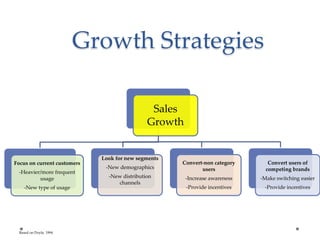
Growth Strategies
Sales
Growth
Focus on current customers
-Heavier/more frequent
usage
-New type of usage
Look for new segments
-New demographics
-New distribution
channels
Convert-non category
users
-Increase awareness
-Provide incentives
Convert users of
competing brands
-Make switching easier
-Provide incentives
Based on Doyle, 1994
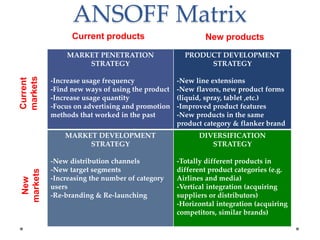
ANSOFF Matrix
MARKET PENETRATION
STRATEGY
-Increase usage frequency
-Find new ways of using the product
-Increase usage quantity
-Focus on advertising and promotion
methods that worked in the past
PRODUCT DEVELOPMENT
STRATEGY
-New line extensions
-New flavors, new product forms
(liquid, spray, tablet ,etc.)
-Improved product features
-New products in the same
product category & flanker brand
MARKET DEVELOPMENT
STRATEGY
-New distribution channels
-New target segments
-Increasing the number of category
users
-Re-branding & Re-launching
DIVERSIFICATION
STRATEGY
-Totally different products in
different product categories (e.g.
Airlines and media)
-Vertical integration (acquiring
suppliers or distributors)
-Horizontal integration (acquiring
competitors, similar brands)
Current products New products
Current
markets
New
markets
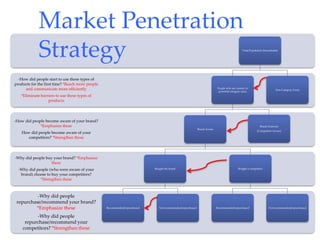
-Why did people
repurchase/recommend your brand?
*Emphasize these
-Why did people
repurchase/recommend your
competitors? *Strengthen these
-Why did people buy your brand? *Emphasize
these
-Why did people (who were aware of your
brand) choose to buy your competitors?
*Strengthen these
-How did people become aware of your brand?
*Emphasize these
How did people become aware of your
competitors? *Strengthen these
-How did people start to use these types of
products for the first time? *Reach more people
and communicate more efficiently
*Eliminate barriers to use these types of
products
Total Population (households)
People who are current or
potential category users
Brand Aware
Bought the brand
Recommended/repurchased Not recommended/repurchased
Bought a competitor
Recommended/repurchased Not recommended/repurchased
Brand Unaware
(Competitor Aware)
Non Category Users
Market Penetration
Strategy
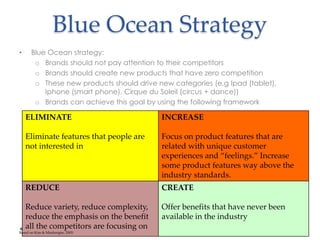
Blue Ocean Strategy
• Blue Ocean strategy:
o Brands should not pay attention to their competitors
o Brands should create new products that have zero competition
o These new products should drive new categories (e.g Ipad (tablet),
Iphone (smart phone), Cirque du Soleil (circus + dance))
o Brands can achieve this goal by using the following framework
ELIMINATE
Eliminate features that people are
not interested in
INCREASE
Focus on product features that are
related with unique customer
experiences and “feelings.” Increase
some product features way above the
industry standards.
REDUCE
Reduce variety, reduce complexity,
reduce the emphasis on the benefit
all the competitors are focusing on
CREATE
Offer benefits that have never been
available in the industry
Based on Kim & Mauborgne, 2005
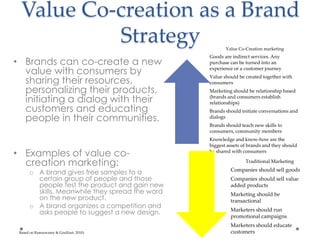
Value Co-creation as a Brand
Strategy
• Brands can co-create a new
value with consumers by
sharing their resources,
personalizing their products,
initiating a dialog with their
customers and educating
people in their communities.
• Examples of value co-
creation marketing:
o A brand gives free samples to a
certain group of people and those
people test the product and gain new
skills. Meanwhile they spread the word
on the new product.
o A brand organizes a competition and
asks people to suggest a new design.
Value Co-Creation marketing
Goods are indirect services. Any
purchase can be turned into an
experience or a customer journey
Value should be created together with
consumers
Marketing should be relationship based
(brands and consumers establish
relationships)
Brands should initiate conversations and
dialogs
Brands should teach new skills to
consumers, community members
Knowledge and know-how are the
biggest assets of brands and they should
be shared with consumers
Traditional Marketing
Companies should sell goods
Companies should sell value
added products
Marketing should be
transactional
Marketers should run
promotional campaigns
Marketers should educate
customersBased on Ramaswamy & Goulliart, 2010)

Growth

  • 1.
    Growth Strategies Sales Growth Focus oncurrent customers -Heavier/more frequent usage -New type of usage Look for new segments -New demographics -New distribution channels Convert-non category users -Increase awareness -Provide incentives Convert users of competing brands -Make switching easier -Provide incentives Based on Doyle, 1994
  • 2.
    ANSOFF Matrix MARKET PENETRATION STRATEGY -Increaseusage frequency -Find new ways of using the product -Increase usage quantity -Focus on advertising and promotion methods that worked in the past PRODUCT DEVELOPMENT STRATEGY -New line extensions -New flavors, new product forms (liquid, spray, tablet ,etc.) -Improved product features -New products in the same product category & flanker brand MARKET DEVELOPMENT STRATEGY -New distribution channels -New target segments -Increasing the number of category users -Re-branding & Re-launching DIVERSIFICATION STRATEGY -Totally different products in different product categories (e.g. Airlines and media) -Vertical integration (acquiring suppliers or distributors) -Horizontal integration (acquiring competitors, similar brands) Current products New products Current markets New markets
  • 3.
    -Why did people repurchase/recommendyour brand? *Emphasize these -Why did people repurchase/recommend your competitors? *Strengthen these -Why did people buy your brand? *Emphasize these -Why did people (who were aware of your brand) choose to buy your competitors? *Strengthen these -How did people become aware of your brand? *Emphasize these How did people become aware of your competitors? *Strengthen these -How did people start to use these types of products for the first time? *Reach more people and communicate more efficiently *Eliminate barriers to use these types of products Total Population (households) People who are current or potential category users Brand Aware Bought the brand Recommended/repurchased Not recommended/repurchased Bought a competitor Recommended/repurchased Not recommended/repurchased Brand Unaware (Competitor Aware) Non Category Users Market Penetration Strategy
  • 4.
    Blue Ocean Strategy •Blue Ocean strategy: o Brands should not pay attention to their competitors o Brands should create new products that have zero competition o These new products should drive new categories (e.g Ipad (tablet), Iphone (smart phone), Cirque du Soleil (circus + dance)) o Brands can achieve this goal by using the following framework ELIMINATE Eliminate features that people are not interested in INCREASE Focus on product features that are related with unique customer experiences and “feelings.” Increase some product features way above the industry standards. REDUCE Reduce variety, reduce complexity, reduce the emphasis on the benefit all the competitors are focusing on CREATE Offer benefits that have never been available in the industry Based on Kim & Mauborgne, 2005
  • 5.
    Value Co-creation asa Brand Strategy • Brands can co-create a new value with consumers by sharing their resources, personalizing their products, initiating a dialog with their customers and educating people in their communities. • Examples of value co- creation marketing: o A brand gives free samples to a certain group of people and those people test the product and gain new skills. Meanwhile they spread the word on the new product. o A brand organizes a competition and asks people to suggest a new design. Value Co-Creation marketing Goods are indirect services. Any purchase can be turned into an experience or a customer journey Value should be created together with consumers Marketing should be relationship based (brands and consumers establish relationships) Brands should initiate conversations and dialogs Brands should teach new skills to consumers, community members Knowledge and know-how are the biggest assets of brands and they should be shared with consumers Traditional Marketing Companies should sell goods Companies should sell value added products Marketing should be transactional Marketers should run promotional campaigns Marketers should educate customersBased on Ramaswamy & Goulliart, 2010)

Editor's Notes

  • #6 Ramaswamy, Venkat; Gouillart, Francis (2010). The Power of Co-Creation: Build It with Them To Boost Growth, Productivity, and Profits.  Vargo, S. L., Maglio, P. P., & Akaka, M. A. (2008). On value and value co-creation: A service systems and service logic perspective. European management journal, 26(3), 145-152.