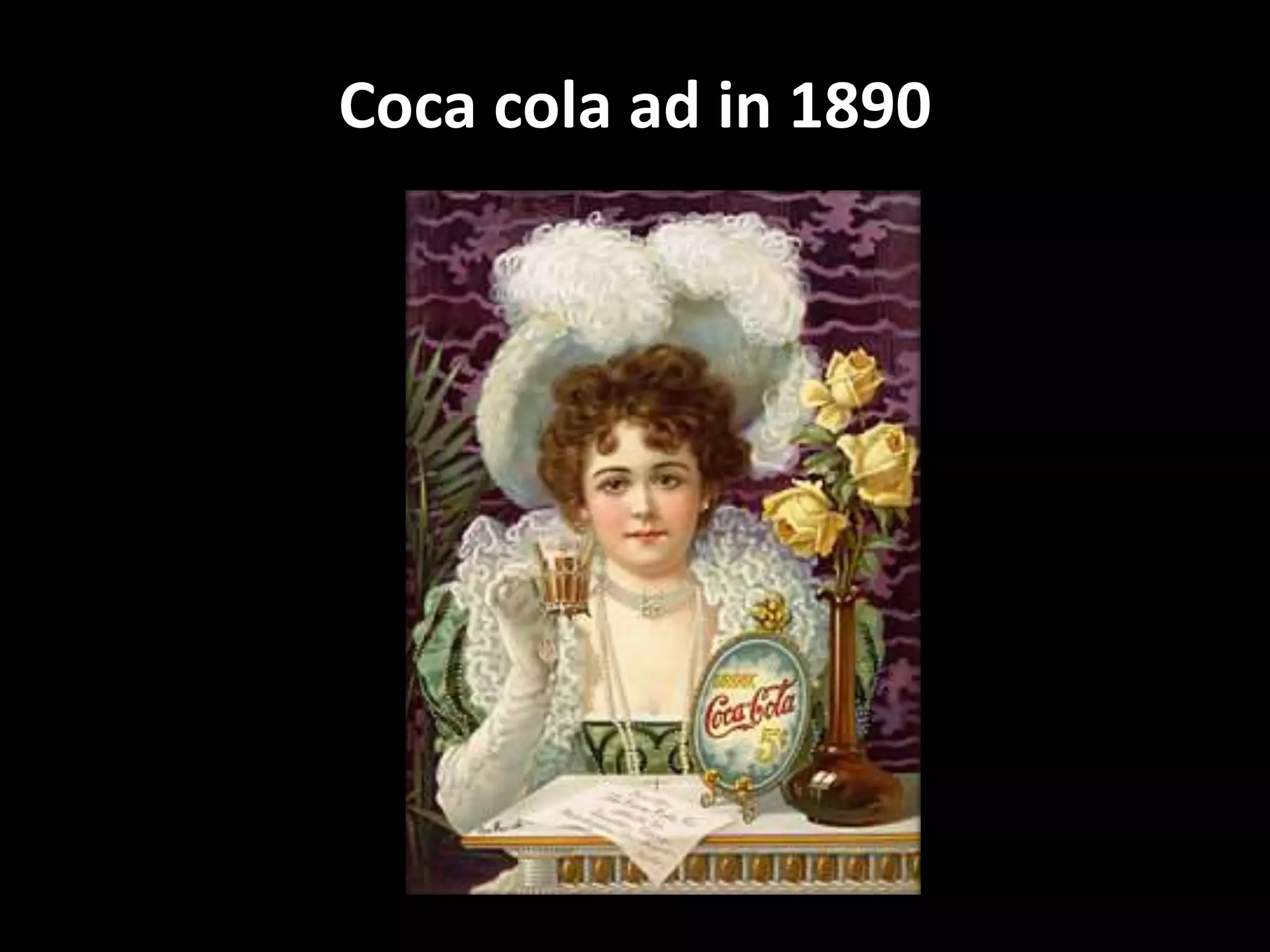



Coca cola ad in 1890
Any paid form of nonpersonal communication
about an organization, product, service, idea or
cause by an identified sponsor.
Advertising
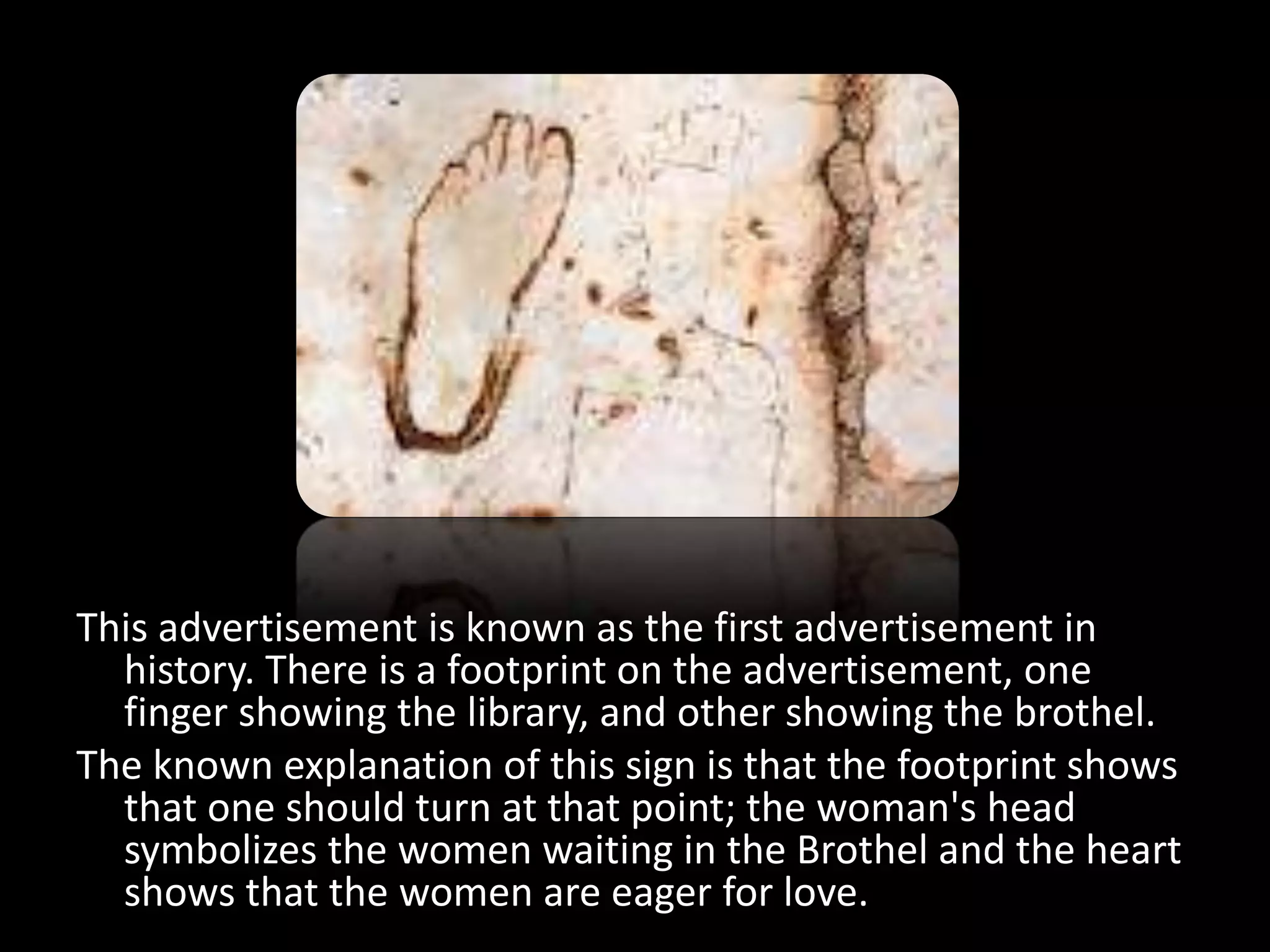
This advertisement is known as the first advertisement in
history. There is a footprint on the advertisement, one
finger showing the library, and other showing the brothel.
The known explanation of this sign is that the footprint shows
that one should turn at that point; the woman's head
symbolizes the women waiting in the Brothel and the heart
shows that the women are eager for love.
SETTING OBJECTIVES
Advertising objectives
An advertising objective is a
specific communication task to be
accomplished with a specific target
audience during a period of time.
To inform
To persuade
To remind
Comparison
advertising
To inform
• Telling the market about a new product
• Suggesting new uses for a product
• Informing the market of a price change
• Explaining how the product works
• Describing available services
• Correcting false impressions
• Reducing buyers’ fears
• Building a company image
Informative advertising
• Informative advertising is used when
introducing a new product category
• The objective is to build primary
demand
Informative Ad
To persuade
• Building brand preference
• Encouraging switching to your brand
• Changing customer perceptions of
product attributes
• Persuading customers to purchase
now
• Persuading customers to receive a
sales call
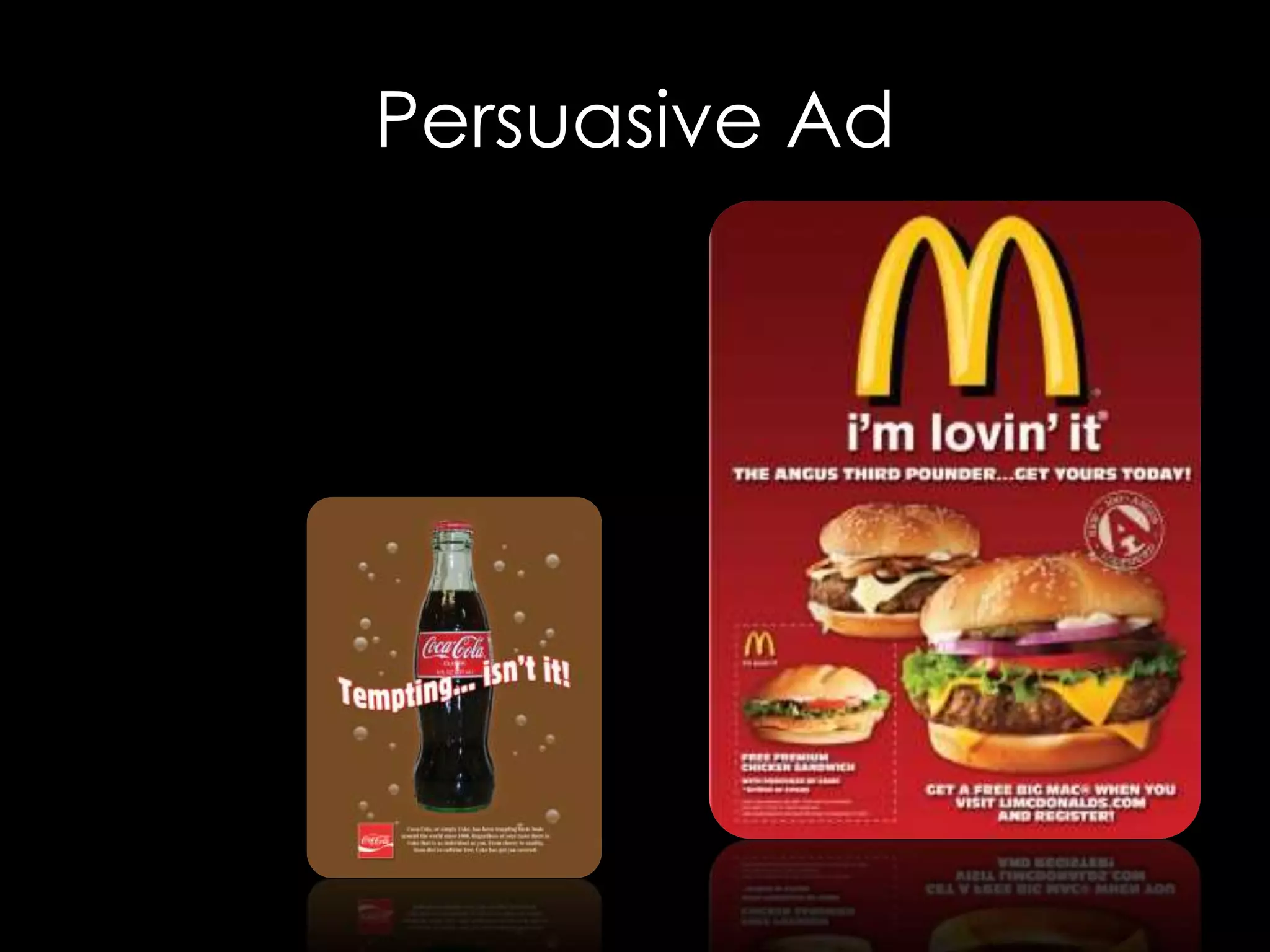
Persuasive advertising
• Persuasive advertising is important with
increased competition to build
selective demand
Persuasive Ad
A giant mirror was built that allowed
passers by to stop and look at
themselves wearing individual clothes
at a shopping mall in Tokyo, Japan
A print of a cup of Folgers coffee was placed on top of
manhole covers in New York City, USA.
Holes on the print allows the steam to come out. Wordings
around the cup reads
‘Hey, City That Never Sleeps. Wake up.” from Folgers.
Comparative advertising
• Comparative advertising directly or
indirectly compares the brand with
one or more other brands
To remind
• Reminding customers that the product
may be needed in the near future
• Reminding customers where to buy the
product
• Keeping the product in customers
minds during off seasons
• Maintaining to-of-mind product
awareness
Reminder advertising
• Reminder advertising is important with
mature products to help maintain
customer relationships and keep
customers thinking about the product
Reminder Ad
MESSAGE EXECUTION
MESSAGE EXECUTION
Message execution captures the target market’s
attention and interest, and can include the
following execution styles.
• Slice of life
• Lifestyle
• Fantasy
• Mood or image
• Musical
• Personality symbol
• Technical expertise
• Scientific evidence
• Testimonial evidence or endorsement.
Slice of life
1. Slice of life
- This style shows one or more typical people using the
product in a normal setting.
Exp: KFC advertisement showing customers eating at one of
its restaurants.
Life style
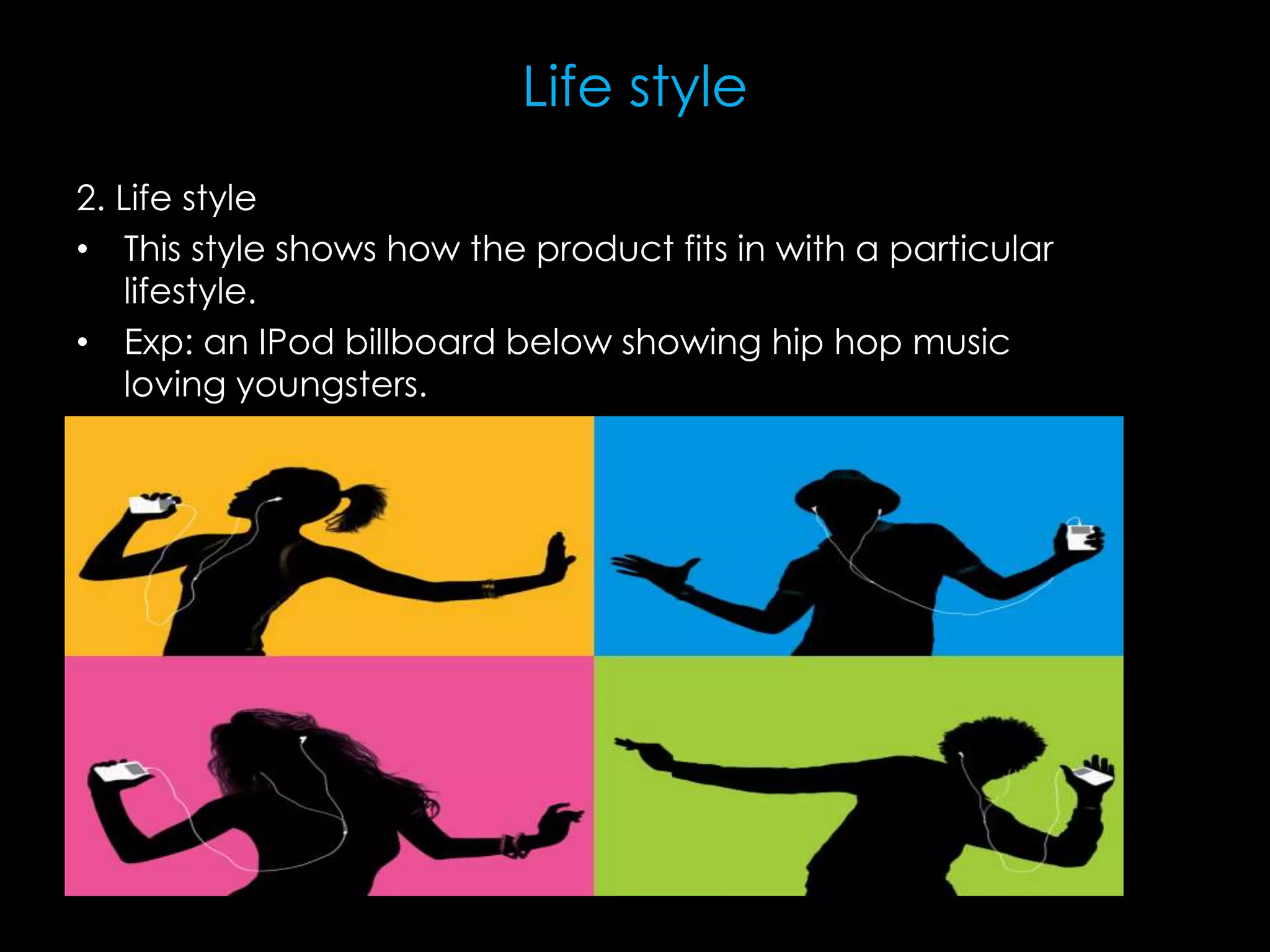
2. Life style
• This style shows how the product fits in with a particular
lifestyle.
• Exp: an IPod billboard below showing hip hop music
loving youngsters.
Fantasy
3. fantasy
• This style creates a fantasy around the product or its use.
• exp: this advertisement features diamond name
‘Nakshatra which makes a user feel a queen.
Mood or image
4. Mood or image
• This style builds a mood or image around the product,
such as beauty, love or serenity
• Exp: an advertisement of Sunway lagoon stating -“ come
feel the fun”, the image provided with supporting this
statement.
Musical
5. musical
• This style show one or more people or cartoon characters
singing about the product.
• Exp: one of the most famous ads in history was a coca
cola product ad build around the song “ I’d like to teach
the world to sing”.
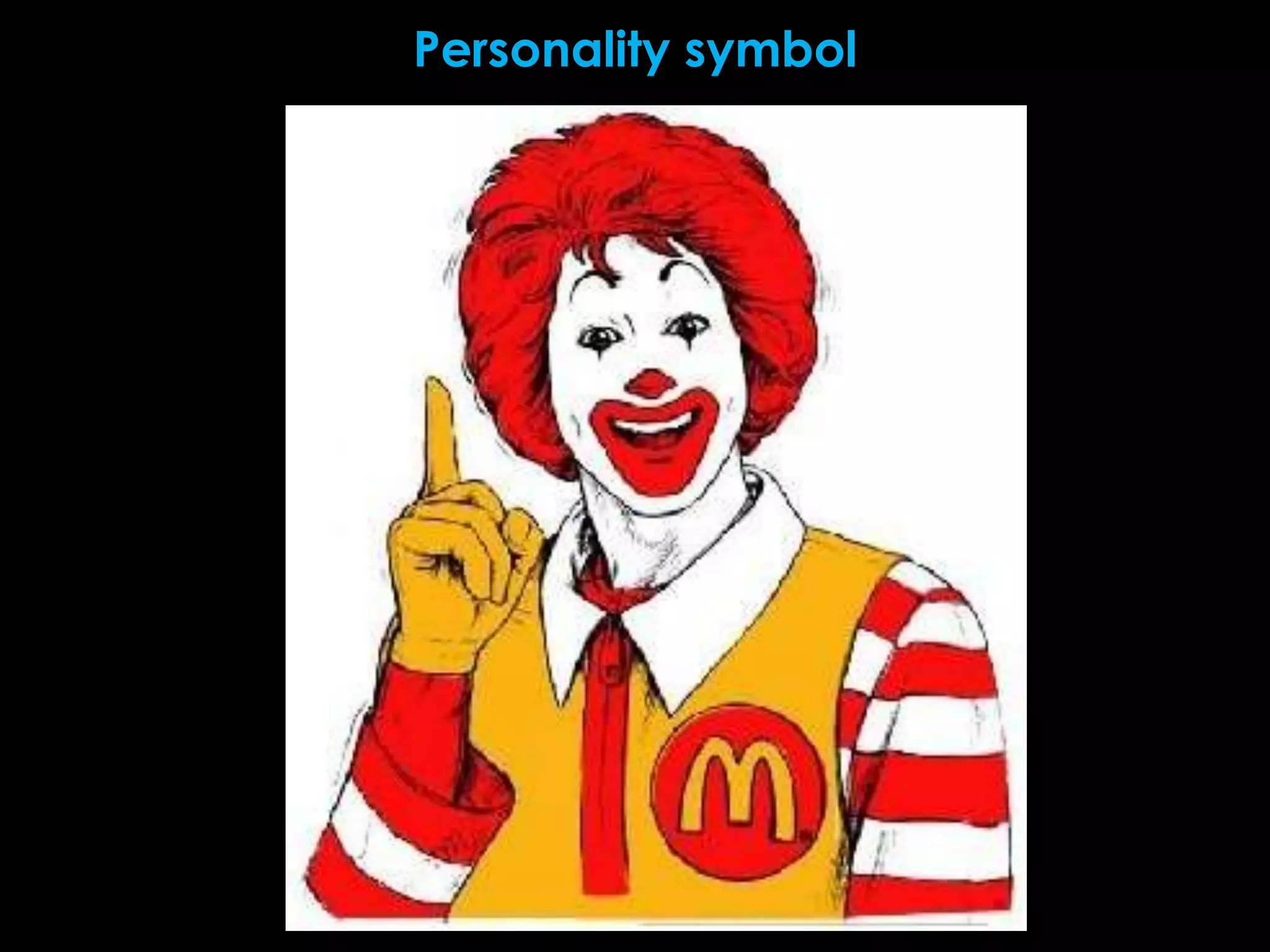
Personality symbol
6. Personality symbol
• The style create a character that represent the product.
The character might be animated or real.
Personality symbol
Personality symbol
Technical expertise
7. Technical expertise
• This style shows the company’s expertise in making the
product.
• Exp: Lexus Rx advertisement showing the company’s
expertise in car manufacturing. “ reinventing the vehicle
that invented it all”
Scientific evidence
8. Scientific evidence
• The style presents survey or scientific evidence that the
brand is better or better liked than one or more other
brands.
• Exp: for years, Colgate toothpaste has used scientific
evidence to better confident to convince buyers that
Colgate is better than other brands at fighting cavities.
Testimonial evidence/endorsement
9. Testimonial evidence or endorsement
• The style features a highly believable or likeable source
endorsing the product. It could be ordinary people
saying how much they like a given product or a celebrity
presenting the product.
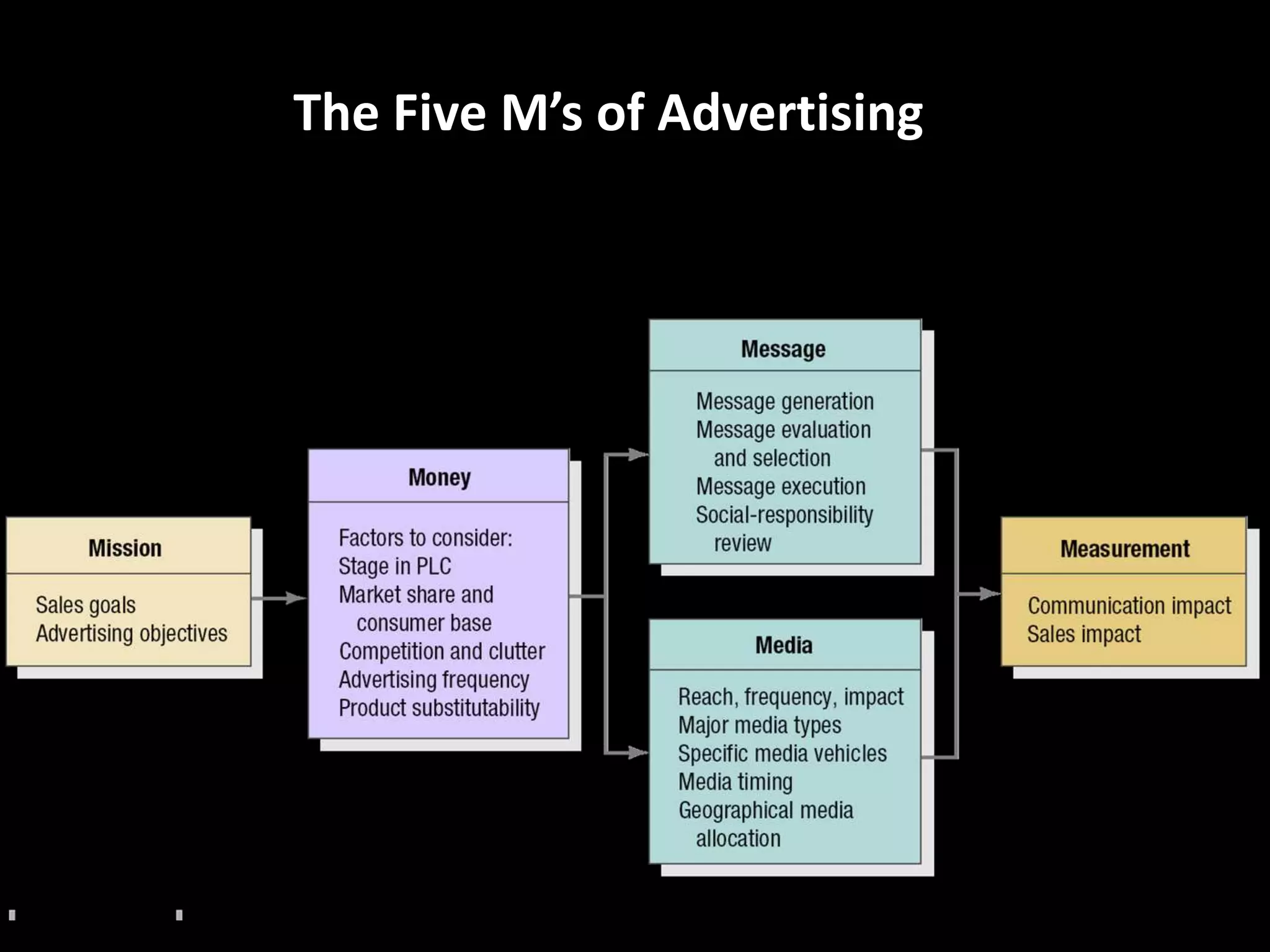
The Five M’s of Advertising
Factors to Consider in Setting an Advertising
Budget
Stage in the product life cycle
Market share and consumer base
Competition and clutter
Advertising frequency
Product substitutability
Product Life Cycle.
Marketing Responses to the PLC
Introduction Growth Maturity Decline
Marketing
Emphasis
Create product
awareness
Establish high market
share
Fight off competition;
generate profits
Minimise marketing
expenditure
Product
strategy
Introduce basic
products
Improve features of
basic products
Design product versions
for different segments
Rationalise the service
offer range
Pricing
Strategy
Price skimming or
price penetration
Reduce prices enough
to expand the market
and establish market
share
Match or beat the
competition
Reduce prices further
Advertisement
Strategy
Advertising and sales
promotion to end
user and dealers/
agents
Mass media advertising
to establish brand
image
Emphasize brand
strengths to different
segments
Minimal level to retain
loyal customers
Distribution
Strategy
Build selective
distribution outlets
Increase the number of
outlets
Maintain Intensive
Distribution
Rationalize outlets
To minimize
Distribution cost
Product Life Cycle.
Advertising
Market share
• Building or taking market share requires larger
budgets
• Markets with heavy competition or high
advertising clutter require larger budgets
• Undifferentiated brands require larger budgets
Setting the Advertising Budget
Advertising
Advertising strategy is the strategy by which
the company accomplishes its advertising
objectives and consists of:
• Creating advertising messages
• Selecting advertising media
Developing Advertising Strategy
Advertising
Advertisements need to break through the clutter:
• Gain attention
• Communicate well
Creating the Advertising Message
ZooZoo- Best advertisement Practice
Advertising
Creative concept is the idea that will bring the message
strategy to life and guide specific appeals to be used
in an advertising campaign
Characteristics of the appeals include:
• Meaningful
• Believable
• Distinctive
Creating the Advertising Message
Advertising
• Message execution is when the advertiser
turns the big idea into an actual ad
execution that will capture the target
market’s attention and interest.
• The creative team must find the best
approach, style, tone, words, and format
for executing the message.
Creating the Advertising Message
Advertising
Message execution also includes:
• Tone
– Positive or negative
• Attention-getting words
• Format
– Illustration
– Headline
– Copy
Creating the Advertising Message
Advertising
Reach is a measure of the percentage of people in
the target market who are exposed to the ad
campaign during a given period of time
Frequency is a measure of how many times the
average person in the target market is exposed
to the message
Impact is the qualitative value of a message
exposure through a given medium
Selecting Advertising Media
Advertising
Selecting media vehicles involves decisions presenting
the media effectively and efficiently to the target
customer and must consider the message’s:
• Impact
• Effectiveness
• Cost
Selecting Advertising Media
Advertising
When deciding on media timing, the planner must
consider:
• Seasonality
• Pattern of the advertising
– Continuity—scheduling within a given period
– Pulsing—scheduling unevenly within a given period
Selecting Advertising Media
Advertising
• Advantages of advertising
– Advertiser controls the
message
– Cost effective way to
communicate with large
audiences
– Effective way to create
brand images and
symbolic appeals
– Effective way to connect
with the customers
• Disadvantages of advertising
– High costs of producing
and running ads
– Credibility problems and
consumer skepticism
– Clutter
– Difficulty in determining
effectiveness
Pros and Cons of Advertising
Advantages
• Changes in society have made
consumers more receptive to
direct-marketing
• Allows marketers to be very
selective and target specific
segments of customers
• Messages can be customized
for specific customers.
• Effectiveness easier to measure
Disadvantages
• Lack of customer receptivity
and very low response rates
• Clutter (too many messages)
• Image problems – particularly
with telemarketing

Advertisement

  • 1.
    Coca cola adin 1890
  • 2.
    Any paid formof nonpersonal communication about an organization, product, service, idea or cause by an identified sponsor. Advertising
  • 3.
    This advertisement isknown as the first advertisement in history. There is a footprint on the advertisement, one finger showing the library, and other showing the brothel. The known explanation of this sign is that the footprint shows that one should turn at that point; the woman's head symbolizes the women waiting in the Brothel and the heart shows that the women are eager for love.
  • 4.
  • 5.
    Advertising objectives An advertisingobjective is a specific communication task to be accomplished with a specific target audience during a period of time.
  • 6.
    To inform To persuade Toremind Comparison advertising
  • 7.
    To inform • Tellingthe market about a new product • Suggesting new uses for a product • Informing the market of a price change • Explaining how the product works • Describing available services • Correcting false impressions • Reducing buyers’ fears • Building a company image
  • 8.
    Informative advertising • Informativeadvertising is used when introducing a new product category • The objective is to build primary demand
  • 9.
  • 11.
    To persuade • Buildingbrand preference • Encouraging switching to your brand • Changing customer perceptions of product attributes • Persuading customers to purchase now • Persuading customers to receive a sales call
  • 12.
    Persuasive advertising • Persuasiveadvertising is important with increased competition to build selective demand
  • 13.
  • 14.
    A giant mirrorwas built that allowed passers by to stop and look at themselves wearing individual clothes at a shopping mall in Tokyo, Japan
  • 18.
    A print ofa cup of Folgers coffee was placed on top of manhole covers in New York City, USA. Holes on the print allows the steam to come out. Wordings around the cup reads ‘Hey, City That Never Sleeps. Wake up.” from Folgers.
  • 19.
    Comparative advertising • Comparativeadvertising directly or indirectly compares the brand with one or more other brands
  • 22.
    To remind • Remindingcustomers that the product may be needed in the near future • Reminding customers where to buy the product • Keeping the product in customers minds during off seasons • Maintaining to-of-mind product awareness
  • 23.
    Reminder advertising • Reminderadvertising is important with mature products to help maintain customer relationships and keep customers thinking about the product
  • 24.
  • 26.
  • 27.
    MESSAGE EXECUTION Message executioncaptures the target market’s attention and interest, and can include the following execution styles. • Slice of life • Lifestyle • Fantasy • Mood or image • Musical • Personality symbol • Technical expertise • Scientific evidence • Testimonial evidence or endorsement.
  • 28.
    Slice of life 1.Slice of life - This style shows one or more typical people using the product in a normal setting. Exp: KFC advertisement showing customers eating at one of its restaurants.
  • 29.
    Life style 2. Lifestyle • This style shows how the product fits in with a particular lifestyle. • Exp: an IPod billboard below showing hip hop music loving youngsters.
  • 31.
    Fantasy 3. fantasy • Thisstyle creates a fantasy around the product or its use. • exp: this advertisement features diamond name ‘Nakshatra which makes a user feel a queen.
  • 32.
    Mood or image 4.Mood or image • This style builds a mood or image around the product, such as beauty, love or serenity • Exp: an advertisement of Sunway lagoon stating -“ come feel the fun”, the image provided with supporting this statement.
  • 35.
    Musical 5. musical • Thisstyle show one or more people or cartoon characters singing about the product. • Exp: one of the most famous ads in history was a coca cola product ad build around the song “ I’d like to teach the world to sing”.
  • 36.
    Personality symbol 6. Personalitysymbol • The style create a character that represent the product. The character might be animated or real.
  • 37.
  • 38.
  • 39.
    Technical expertise 7. Technicalexpertise • This style shows the company’s expertise in making the product. • Exp: Lexus Rx advertisement showing the company’s expertise in car manufacturing. “ reinventing the vehicle that invented it all”
  • 40.
    Scientific evidence 8. Scientificevidence • The style presents survey or scientific evidence that the brand is better or better liked than one or more other brands. • Exp: for years, Colgate toothpaste has used scientific evidence to better confident to convince buyers that Colgate is better than other brands at fighting cavities.
  • 41.
    Testimonial evidence/endorsement 9. Testimonialevidence or endorsement • The style features a highly believable or likeable source endorsing the product. It could be ordinary people saying how much they like a given product or a celebrity presenting the product.
  • 42.
    The Five M’sof Advertising
  • 43.
    Factors to Considerin Setting an Advertising Budget Stage in the product life cycle Market share and consumer base Competition and clutter Advertising frequency Product substitutability
  • 44.
  • 45.
    Marketing Responses tothe PLC Introduction Growth Maturity Decline Marketing Emphasis Create product awareness Establish high market share Fight off competition; generate profits Minimise marketing expenditure Product strategy Introduce basic products Improve features of basic products Design product versions for different segments Rationalise the service offer range Pricing Strategy Price skimming or price penetration Reduce prices enough to expand the market and establish market share Match or beat the competition Reduce prices further Advertisement Strategy Advertising and sales promotion to end user and dealers/ agents Mass media advertising to establish brand image Emphasize brand strengths to different segments Minimal level to retain loyal customers Distribution Strategy Build selective distribution outlets Increase the number of outlets Maintain Intensive Distribution Rationalize outlets To minimize Distribution cost Product Life Cycle.
  • 46.
    Advertising Market share • Buildingor taking market share requires larger budgets • Markets with heavy competition or high advertising clutter require larger budgets • Undifferentiated brands require larger budgets Setting the Advertising Budget
  • 47.
    Advertising Advertising strategy isthe strategy by which the company accomplishes its advertising objectives and consists of: • Creating advertising messages • Selecting advertising media Developing Advertising Strategy
  • 48.
    Advertising Advertisements need tobreak through the clutter: • Gain attention • Communicate well Creating the Advertising Message
  • 49.
  • 50.
    Advertising Creative concept isthe idea that will bring the message strategy to life and guide specific appeals to be used in an advertising campaign Characteristics of the appeals include: • Meaningful • Believable • Distinctive Creating the Advertising Message
  • 51.
    Advertising • Message executionis when the advertiser turns the big idea into an actual ad execution that will capture the target market’s attention and interest. • The creative team must find the best approach, style, tone, words, and format for executing the message. Creating the Advertising Message
  • 52.
    Advertising Message execution alsoincludes: • Tone – Positive or negative • Attention-getting words • Format – Illustration – Headline – Copy Creating the Advertising Message
  • 53.
    Advertising Reach is ameasure of the percentage of people in the target market who are exposed to the ad campaign during a given period of time Frequency is a measure of how many times the average person in the target market is exposed to the message Impact is the qualitative value of a message exposure through a given medium Selecting Advertising Media
  • 54.
    Advertising Selecting media vehiclesinvolves decisions presenting the media effectively and efficiently to the target customer and must consider the message’s: • Impact • Effectiveness • Cost Selecting Advertising Media
  • 55.
    Advertising When deciding onmedia timing, the planner must consider: • Seasonality • Pattern of the advertising – Continuity—scheduling within a given period – Pulsing—scheduling unevenly within a given period Selecting Advertising Media
  • 56.
    Advertising • Advantages ofadvertising – Advertiser controls the message – Cost effective way to communicate with large audiences – Effective way to create brand images and symbolic appeals – Effective way to connect with the customers • Disadvantages of advertising – High costs of producing and running ads – Credibility problems and consumer skepticism – Clutter – Difficulty in determining effectiveness
  • 57.
    Pros and Consof Advertising Advantages • Changes in society have made consumers more receptive to direct-marketing • Allows marketers to be very selective and target specific segments of customers • Messages can be customized for specific customers. • Effectiveness easier to measure Disadvantages • Lack of customer receptivity and very low response rates • Clutter (too many messages) • Image problems – particularly with telemarketing