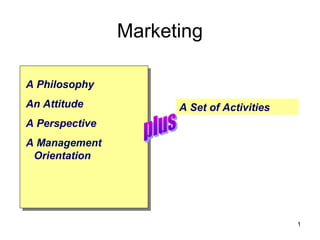
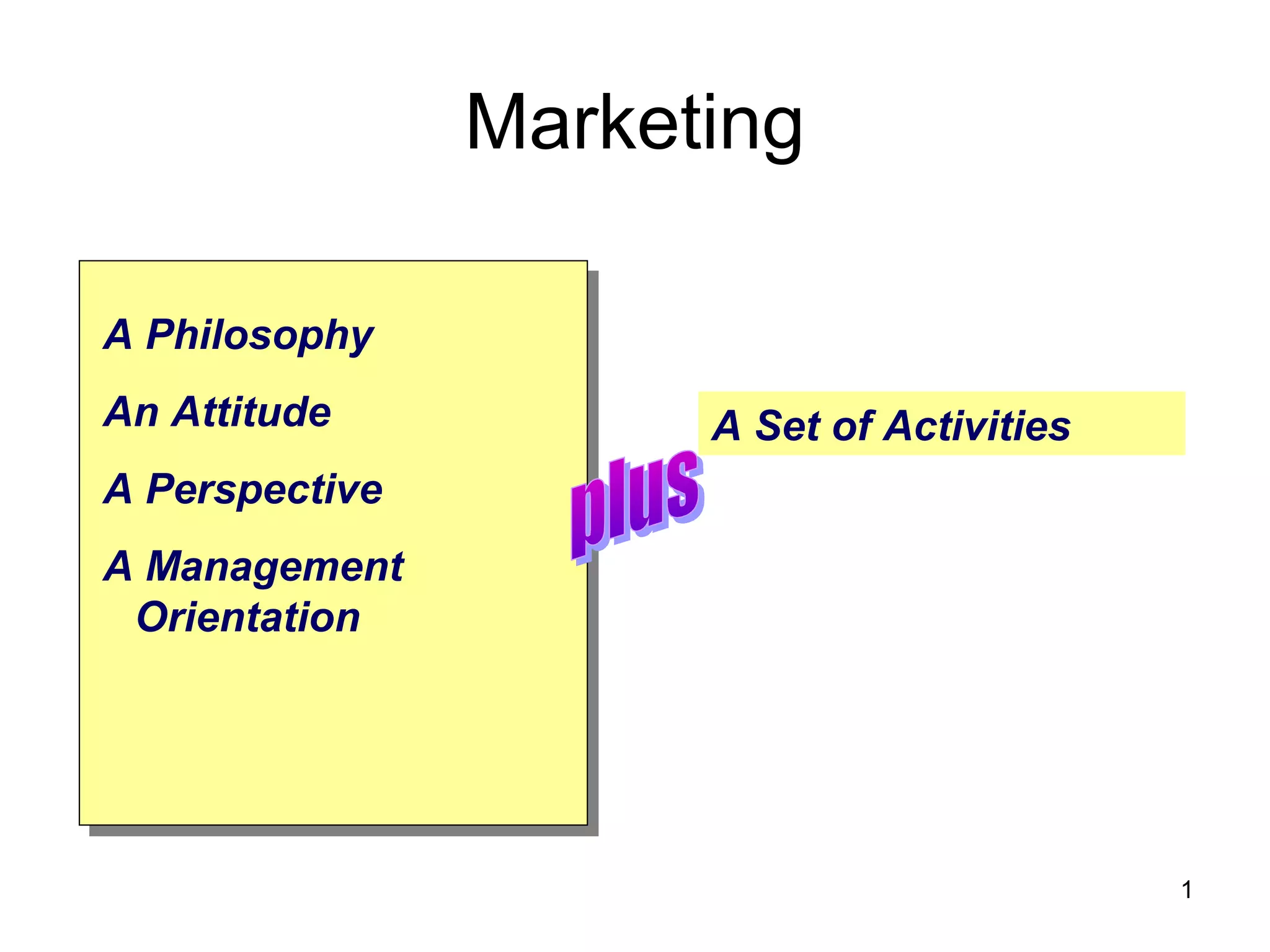

Marketing
A Philosophy
An Attitude
A Perspective
A Management
Orientation
A Set of Activities
1
The Purpose of Marketing
• To understand the Needs & Wants of Customers
• To create customer value through satisfaction and
loyalty
• To operate more effectively and efficiently than
competitors
• To increase the value of the organization
2
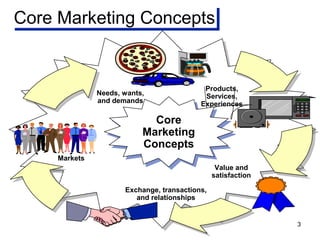
Core Marketing ConceptsCore Marketing Concepts
Products,
Services,
Experiences
Value and
satisfaction
Needs, wants,
and demands
Exchange, transactions,
and relationships
Markets
Core
Marketing
Concepts
Core
Marketing
Concepts
3
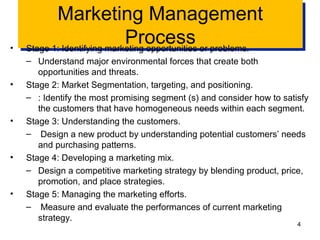
Marketing Management
Process
Marketing Management
Process• Stage 1: Identifying marketing opportunities or problems.
– Understand major environmental forces that create both
opportunities and threats.
• Stage 2: Market Segmentation, targeting, and positioning.
– : Identify the most promising segment (s) and consider how to satisfy
the customers that have homogeneous needs within each segment.
• Stage 3: Understanding the customers.
– Design a new product by understanding potential customers’ needs
and purchasing patterns.
• Stage 4: Developing a marketing mix.
– Design a competitive marketing strategy by blending product, price,
promotion, and place strategies.
• Stage 5: Managing the marketing efforts.
– Measure and evaluate the performances of current marketing
strategy.
4
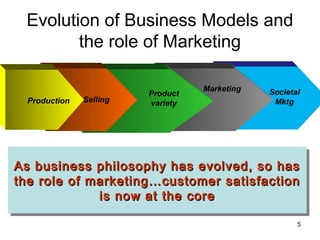
Evolution of Business Models and
the role of Marketing
Marketing
Product
varietySellingProduction
As business philosophy has evolved, so hasAs business philosophy has evolved, so has
the role of marketing…customer satisfactionthe role of marketing…customer satisfaction
is now at the coreis now at the core
As business philosophy has evolved, so hasAs business philosophy has evolved, so has
the role of marketing…customer satisfactionthe role of marketing…customer satisfaction
is now at the coreis now at the core
5
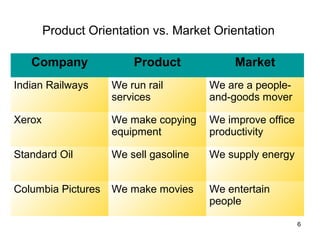
Product Orientation vs. Market Orientation
Company Product Market
Indian Railways We run rail
services
We are a people-
and-goods mover
Xerox We make copying
equipment
We improve office
productivity
Standard Oil We sell gasoline We supply energy
Columbia Pictures We make movies We entertain
people
6
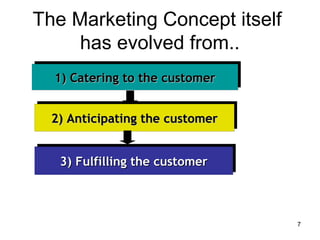
The Marketing Concept itself
has evolved from..
1) Catering to the customer1) Catering to the customer1) Catering to the customer1) Catering to the customer
2) Anticipating the customer2) Anticipating the customer2) Anticipating the customer2) Anticipating the customer
3) Fulfilling the customer3) Fulfilling the customer3) Fulfilling the customer3) Fulfilling the customer
7
9
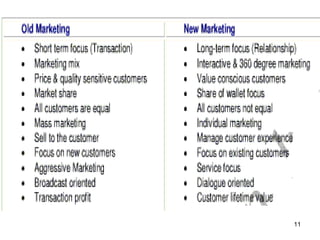
Old vs New marketing
Challenges for Marketing in 21st
century
Speed ?….Outrun….?
10
11
Some New-Age Marketing Trends
• Relationship Marketing
• Database Marketing
• Network Marketing
• Permission or Interruption marketing
• Viral Marketing
• Ambush Marketing
12
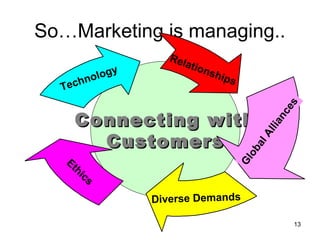
So…Marketing is managing..
Connecting withConnecting with
CustomersCustomers
Technology
Relationships
GlobalAlliances
Diverse Demands
Ethics
13
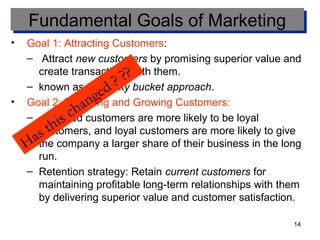
Fundamental Goals of MarketingFundamental Goals of Marketing
• Goal 1: Attracting Customers:
– Attract new customers by promising superior value and
create transactions with them.
– known as the leaky bucket approach.
• Goal 2: Retaining and Growing Customers:
– Satisfied customers are more likely to be loyal
customers, and loyal customers are more likely to give
the company a larger share of their business in the long
run.
– Retention strategy: Retain current customers for
maintaining profitable long-term relationships with them
by delivering superior value and customer satisfaction.
Has this changed ? ??
14
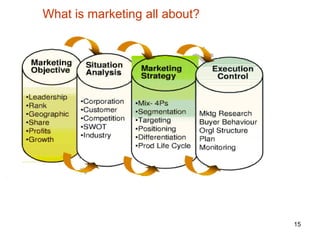
What is marketing all about?
15
16
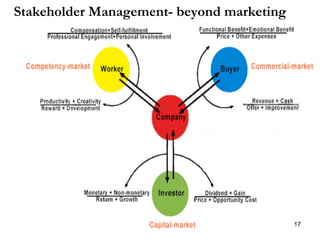
Stakeholder Management- beyond marketing
17
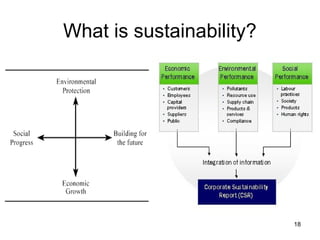
What is sustainability?
18
Why is it important to achieve both
satisfaction and loyalty?
19
Satisfaction is a person’s
feelings of pleasure or
disappointment resulting
from comparing a product’s
perceived performance (or
outcome) in relation to his or
her expectations.
20
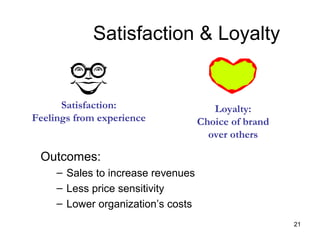
Satisfaction & Loyalty
Outcomes:
– Sales to increase revenues
– Less price sensitivity
– Lower organization’s costs
Satisfaction:
Feelings from experience
Loyalty:
Choice of brand
over others
21
Value and Satisfaction:Value and Satisfaction:
– Customers choose a product that provides the
maximum perceived value among many marketing
offers.
• Customer perceived value = total benefits – total
costs.
• Total benefits: product features, services,
information, and experiential values.
• Total costs: monetary, time, and psychological costs.
22
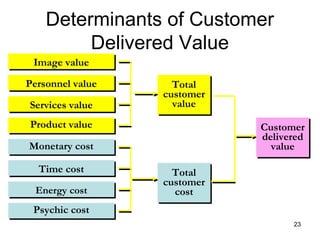
Determinants of Customer
Delivered Value
Image valueImage value
Personnel valuePersonnel value
Services valueServices value
Product valueProduct value
Total
customer
value
Total
customer
value
Monetary costMonetary cost
Time costTime cost
Energy costEnergy cost
Psychic costPsychic cost
Total
customer
cost
Total
customer
cost
Customer
delivered
value
Customer
delivered
value
23
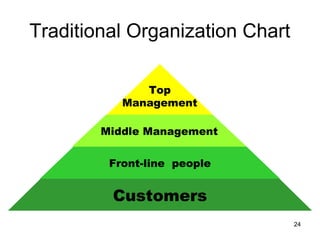
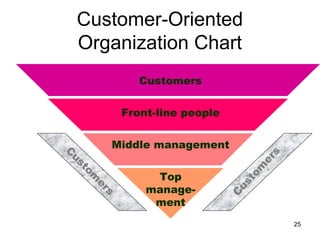
Customers
Front-line people
Middle Management
Top
Management
Traditional Organization Chart
24
Customer-Oriented
Organization Chart
Customers
Front-line people
Middle management
Top
manage-
ment
C
ustom
ers
C
ustom
ers
25
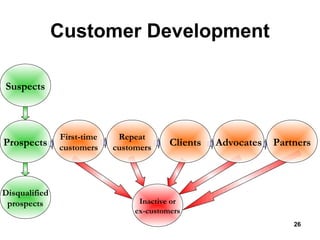
Inactive or
ex-customers
Customer Development
PartnersAdvocatesClients
Repeat
customers
First-time
customers
Suspects
Prospects
Disqualified
prospects
26
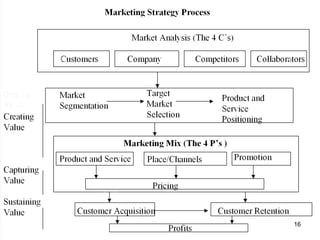
Marketing Strategy
27
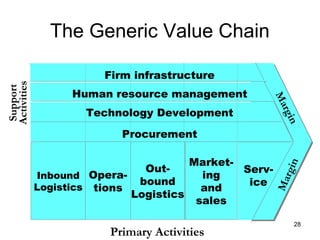
Margin
Margin
The Generic Value Chain
Primary Activities
Support
Activities
Procurement
Serv-
ice
Technology Development
Human resource management
Firm infrastructure
Inbound
Logistics
Opera-
tions
Out-
bound
Logistics
Market-
ing
and
sales
28
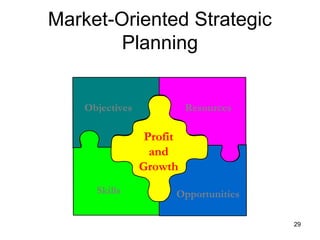
Market-Oriented Strategic
Planning
Objectives
Skills
Resources
Opportunities
Profit
and
Growth
29
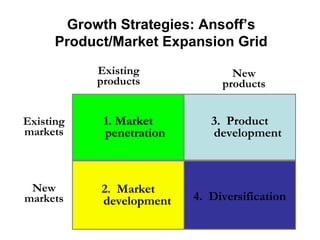
Growth Strategies: Ansoff’s
Product/Market Expansion Grid
4. Diversification
2. Market
development
New
markets
1. Market
penetration
Existing
markets
Existing
products
3. Product
development
New
products
Marketing Environment
What is ?
How to analyze? For what?
31
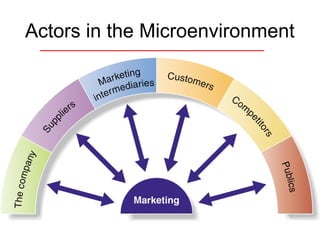
Actors in the Microenvironment
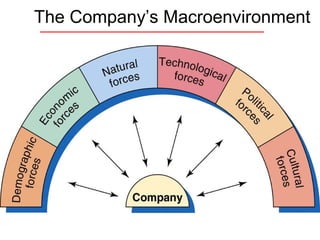
The Company’s Macroenvironment
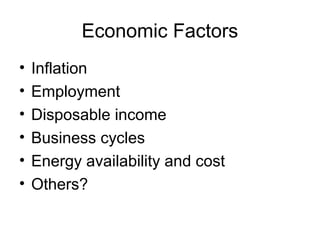
Economic Factors
• Inflation
• Employment
• Disposable income
• Business cycles
• Energy availability and cost
• Others?
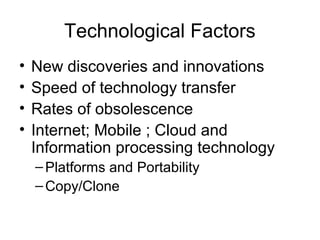
Technological Factors
• New discoveries and innovations
• Speed of technology transfer
• Rates of obsolescence
• Internet; Mobile ; Cloud and
Information processing technology
–Platforms and Portability
–Copy/Clone
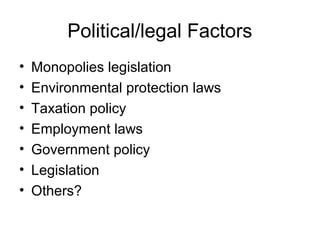
Political/legal Factors
• Monopolies legislation
• Environmental protection laws
• Taxation policy
• Employment laws
• Government policy
• Legislation
• Others?
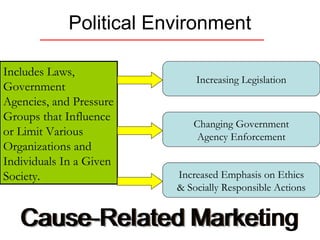
Political Environment
Includes Laws,
Government
Agencies, and Pressure
Groups that Influence
or Limit Various
Organizations and
Individuals In a Given
Society.
Increasing Legislation
Changing Government
Agency Enforcement
Increased Emphasis on Ethics
& Socially Responsible Actions
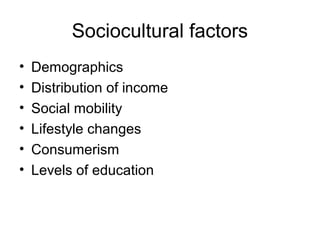
Sociocultural factors
• Demographics
• Distribution of income
• Social mobility
• Lifestyle changes
• Consumerism
• Levels of education
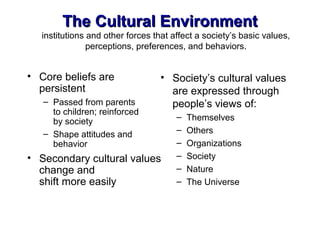
The Cultural EnvironmentThe Cultural Environment
institutions and other forces that affect a society’s basic values,
perceptions, preferences, and behaviors.
• Core beliefs are
persistent
– Passed from parents
to children; reinforced
by society
– Shape attitudes and
behavior
• Secondary cultural values
change and
shift more easily
• Society’s cultural values
are expressed through
people’s views of:
– Themselves
– Others
– Organizations
– Society
– Nature
– The Universe
The Marketing Environment and
Competitor Analysis
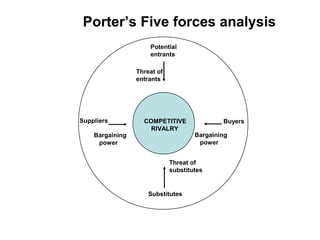
• Five forces analysis
• SWOT analysis
Threat of
substitutes
Potential
entrants
Threat of
entrants
Suppliers
Bargaining
power
Substitutes
Buyers
Bargaining
power
COMPETITIVE
RIVALRY
Porter’s Five forces analysis
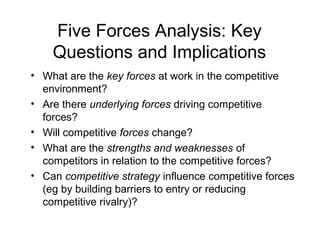
Five Forces Analysis: Key
Questions and Implications
• What are the key forces at work in the competitive
environment?
• Are there underlying forces driving competitive
forces?
• Will competitive forces change?
• What are the strengths and weaknesses of
competitors in relation to the competitive forces?
• Can competitive strategy influence competitive forces
(eg by building barriers to entry or reducing
competitive rivalry)?
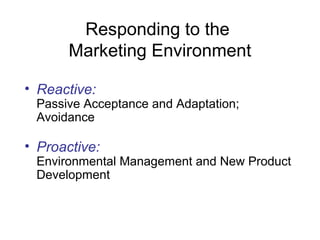
Responding to the
Marketing Environment
• Reactive:
Passive Acceptance and Adaptation;
Avoidance
• Proactive:
Environmental Management and New Product
Development
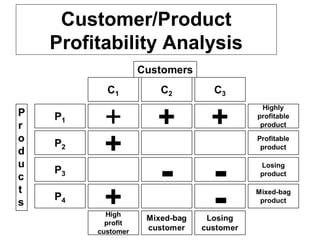
Customer/Product
Profitability Analysis
Consumer Behaviour
An Introduction
What is Consumer Behaviour?
Those activities directly involved
in obtaining , consuming and
disposing of products and
services, including the decision
processes that precede and follow
these actions
Consumer Characteristics… Take-
Away
• CB is influenced by consumer characteristics
– Individual chars (Personality, Lifestyle)
– Environment (Reference Groups, Culture)
• Important to take these variables into account in your
marketing plan
– introvert/extrovert:
• Also important to keep track of trends…
– E.g., lifestyle trends (McDonald’s)
• Culture: Important because of global marketing
– Localization vs. Standardization??
– Flexible Globalization is often the solution (McDonald’s)
Perspectives of CB
Logical Positivism
1. Understanding and predicting consumer
behaviour
2. Cause and effect relationships that
govern persuasion and/or education
Post Modern – to understand consumption
behaviour without any attempt to
influence it
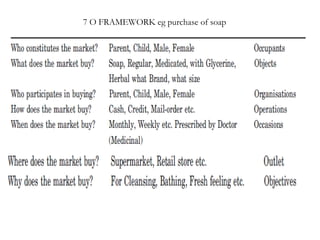
7 O FRAMEWORK eg purchase of soap
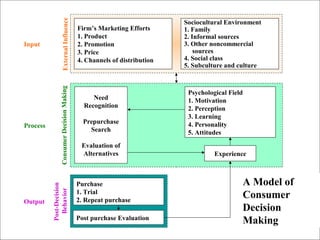
50
Firm’s Marketing Efforts
1. Product
2. Promotion
3. Price
4. Channels of distribution
Sociocultural Environment
1. Family
2. Informal sources
3. Other noncommercial
sources
4. Social class
5. Subculture and culture
Output
Process
Input
ExternalInfluenceConsumerDecisionMaking
Post-Decision
Behavior
Post purchase Evaluation
Purchase
1. Trial
2. Repeat purchase
Need
Recognition
Prepurchase
Search
Evaluation of
Alternatives
Psychological Field
1. Motivation
2. Perception
3. Learning
4. Personality
5. Attitudes
Experience
A Model of
Consumer
Decision
Making
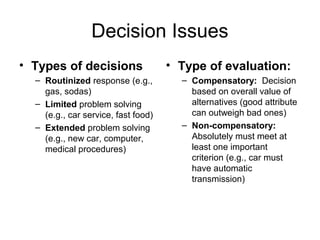
Decision Issues
• Types of decisions
– Routinized response (e.g.,
gas, sodas)
– Limited problem solving
(e.g., car service, fast food)
– Extended problem solving
(e.g., new car, computer,
medical procedures)
• Type of evaluation:
– Compensatory: Decision
based on overall value of
alternatives (good attribute
can outweigh bad ones)
– Non-compensatory:
Absolutely must meet at
least one important
criterion (e.g., car must
have automatic
transmission)
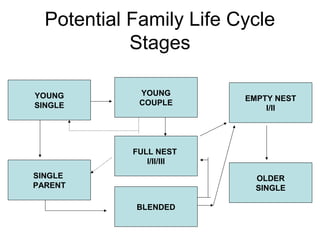
Potential Family Life Cycle
Stages
YOUNG
SINGLE
BLENDED
SINGLE
PARENT
FULL NEST
I/II/III
EMPTY NEST
I/II
OLDER
SINGLE
YOUNG
COUPLE
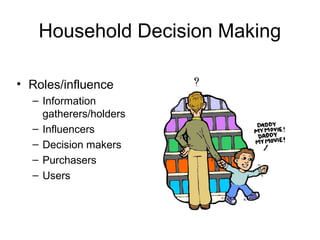
Household Decision Making
• Roles/influence
– Information
gatherers/holders
– Influencers
– Decision makers
– Purchasers
– Users
Adoption Process
1. Awareness
2. Interest
3. Evaluation
4. Trial
5. Decision
6. Confirmation
Organizational Buyers
• Types
– Industrial
– Reseller
– Government and non-
profit organizations
• Characteristics
– Greater involvement
– Bureaucracy
– Long term
relationships
Organizational decision making
v/s Consumer decision making
• Purchase decisions made by companies frequently involve many people
• Organizational and industrial products are often bought according to
precise, technical specifications that require a lot of knowledge about the
product category.
• Impulse buying is rare because buyers are professionals, their decisions
are based on past experience and a careful weighing of alternatives.
• Decisions often are risky, especially in the sense that a buyer´s career may
be riding on his demonstration of good judgment.
• The business-to-business marketing often involves more of an emphasis
on personal selling than on advertising or other forms of promotion.
MODELS OF ORGANIZATIONAL
BUYING BEHAVIOR
To gain a simplified view to organizational buying behaviour for
a practical use, there are several models to handle the complex
environment. The following introduces four major groups first
conceptualized by Rowland T. Moriarty :
• Task oriented model
• Non task oriented model
• Decision process model
• Complex model
three types of buying decisions:
• Straight rebuy- Purchasing department reorders on a
regular basis. The buyer chooses from suppliers on an
approved list. The suppliers make an effort to maintain
product and service quality and propose “automatic
reordering systems”. The “out-suppliers” attempt to
offer something new or exploit dissatisfaction with
existing supplier.
• Modified rebuy- The buyer wants to modify product
specifications, prices, delivery requirements and other
terms. This involves additional decision participants on
both sides. The “in-suppliers” become nervous and
“out-suppliers” try to offer a better deal.
• New task- The purchaser buys a product or service for
the first time.
MARKET SEGMENTATION
• CONCEPT AND DEFINITION
The concept of market segment is based
on the fact that the market of commodities
are not homogeneous but they are
heterogeneous. Market represent a group
of customer having common
characteristics but two customer are never
common in their nature, habits, hobbies
income and purchasing techniques.
• According to Philip kotler , “ Market
segmentation is sub-dividing a market into
distinct and homogeneous subgroups of
customers, where any group can
conceivably be selected as a target
market to be met with distinct marketing
mix.”
• Market Segmentation is a method of
“dividing a market (Large) into smaller
groupings of consumers or organisations
in which each segment has a common
characteristic such as needs or
behaviour.”
DEFINITIONS
• MARKET SEGMENTATION: Customer
oriented -- identifies customer subgroups
of the market as they currently exist.
• PRODUCT DIFFERENTIATION: Product
oriented -- identifies subgroups of
competing products.
RULE OF MARKET
SEGMENTATION
• Maximize homogeneity within market
segments
• Maximize heterogeneity between
market segments
Why you need customer
segments
• Customers are usually very different
• College students, senior citizens, families
with children, empty nesters…
• The same message to all may not work so
well.
• Solution: create segments, and design a
program for each segment.
A valid segment strategy
involves:
• Communications to the segment (direct mail,
email, on-location personal attention)
• Rewards designed to modify behavior
• Controls to measure the success of the strategy
• A budget for implementation of the strategy
• Specific goals and metrics for engagement: for
behavior modification
• An organization that accepts responsibility for
the segment
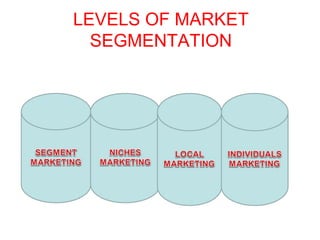
LEVELS OF MARKET
SEGMENTATION
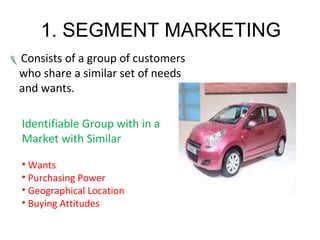
1. SEGMENT MARKETING
Consists of a group of customers
who share a similar set of needs
and wants.
Identifiable Group with in a
Market with Similar
• Wants
• Purchasing Power
• Geographical Location
• Buying Attitudes
FLEXIBLE MARKET OFFERING
• Even in segments 100 % needs are not
same – consists of two parts
1.Naked Solution :- products and services that
all members of the segment values.
2.Discretionary options :- that some segment
members value. Each option might carry an
additional charge.
 Example: Automobile industry – basic model is
same but for A.C , power steering, power
window buyer
has to pay extra price.
 Delta Airlines offers all economy
passengers a seat and soft drinks. It
charges economy passengers extra for
alcoholic beverages.
 Market Segments can be defined in many
different ways. One way to carve up a
market is to identify Preference
segments
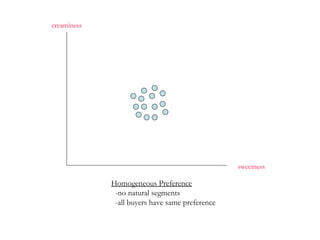
Suppose ice cream buyers are asked how
much they value sweetness and
creaminess as two product attributes.
Three different patterns can emerge.
Homogeneous preference :
– where all the consumer have roughly the same preferences.
– We would predict that existing brand would be similar and
cluster around the middle of the scale in both sweetness and
creaminess.
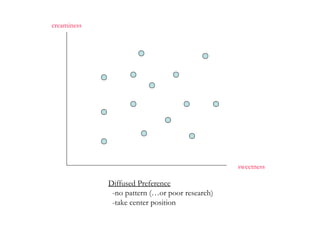
Diffused preference :
– consumers vary greatly in their preferences
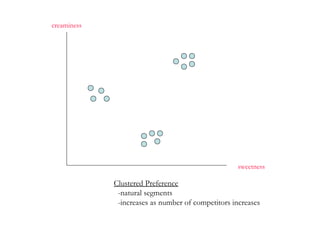
Clustered preference :
creaminess
sweetness
Homogeneous Preference
-no natural segments
-all buyers have same preference
creaminess
sweetness
Diffused Preference
-no pattern (…or poor research)
-take center position
creaminess
sweetness
Clustered Preference
-natural segments
-increases as number of competitors increases
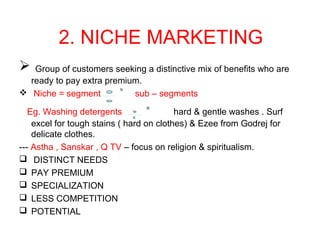
2. NICHE MARKETING
 Group of customers seeking a distinctive mix of benefits who are
ready to pay extra premium.
 Niche = segment sub – segments
Eg. Washing detergents hard & gentle washes . Surf
excel for tough stains ( hard on clothes) & Ezee from Godrej for
delicate clothes.
--- Astha , Sanskar , Q TV – focus on religion & spiritualism.
 DISTINCT NEEDS
 PAY PREMIUM
 SPECIALIZATION
 LESS COMPETITION
 POTENTIAL
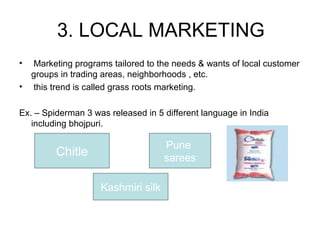
3. LOCAL MARKETING
• Marketing programs tailored to the needs & wants of local customer
groups in trading areas, neighborhoods , etc.
• this trend is called grass roots marketing.
Ex. – Spiderman 3 was released in 5 different language in India
including bhojpuri.
Chitle
Pune
sarees
Kashmiri silk
4. INDIVIDUAL MARKETING
• Ultimate segmentation – segments of 1 or customized marketing or
one to one marketing.
• Customerization – empower the consumers to design the product
or service offering of their choice.
• Ex. Paint companies have started doing this- Asian Paint , Nerolac ,
Berger Paints
• Arvind mills launched Ruff’n Tuff Jeans, branded ready – to – stitch
GEOGRAPHIC SEGMENTATION
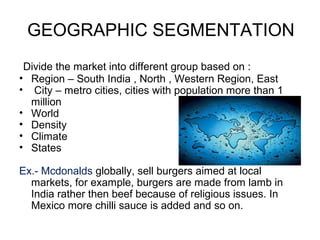
Divide the market into different group based on :
• Region – South India , North , Western Region, East
• City – metro cities, cities with population more than 1
million
• World
• Density
• Climate
• States
Ex.- Mcdonalds globally, sell burgers aimed at local
markets, for example, burgers are made from lamb in
India rather then beef because of religious issues. In
Mexico more chilli sauce is added and so on.
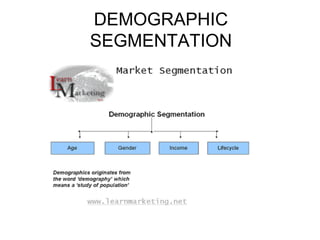
DEMOGRAPHIC
SEGMENTATION
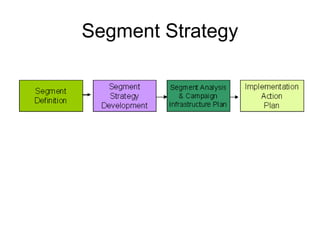
Segment Strategy
An ideal segment…
• Has definable characteristics in terms of behavior
and demographics: for example, Retired Couples
• Is large enough in terms of potential sales to justify
a custom marketing strategy with appropriate
rewards and budget
• Has members who can be motivated by cost
effective rewards to modify their behavior in ways
that are profitable for your company
• Makes efficient use of available data to support
segment definition and marketing efforts
• Can be measured in performance, with control
groups
• Justifies an organization devoted to it: can be a
single person, or part of a person’s time, but there
should be someone who “owns” each segment.
Segment action plan:
• A roadmap showing what will happen when.
“Send each policyholder a birthday card and a
policy review 45 days before their policy renewal
date.”
• A budget for the infrastructure and for the
segment marketing plans
• An organization chart that shows who is
responsible for each segment
• Specific goals to be achieved with milestones for
measurement of success
BASES FOR SEGMENTING
MARKETS
CONSUMER:
• Geographic
• Demographic (age, income,
marital, occupation, ethnicity,
etc.
• Psychographic (AIO,
lifestyles)
• Behavioral (occasions, user
status, usage rate, loyalty
status, hierarchy of needs)
• Benefits
BUSINESS TO BUSINESS:
• Demographic (industry, size,
location)
• Customer Variables (technology,
user/nonuser, loyalty status)
• Purchasing(centralized/decentral
ized, functional orientation,
contracts vs. bids vs. lease)
• Situational (urgency, order size,
product application)
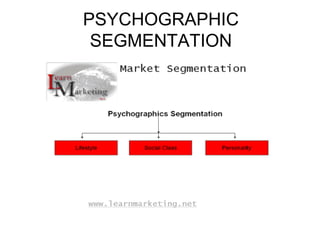
PSYCHOGRAPHIC
SEGMENTATION
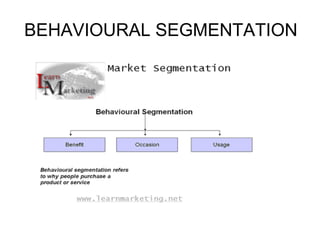
BEHAVIOURAL SEGMENTATION
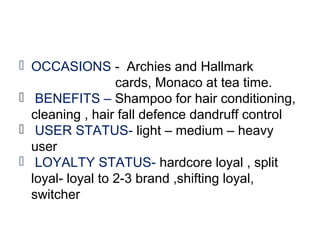
 OCCASIONS - Archies and Hallmark
cards, Monaco at tea time.
 BENEFITS – Shampoo for hair conditioning,
cleaning , hair fall defence dandruff control
 USER STATUS- light – medium – heavy
user
 LOYALTY STATUS- hardcore loyal , split
loyal- loyal to 2-3 brand ,shifting loyal,
switcher
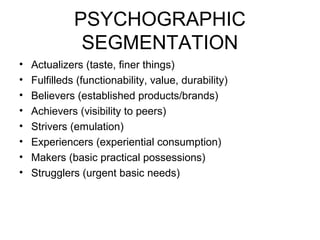
PSYCHOGRAPHIC
SEGMENTATION
• Actualizers (taste, finer things)
• Fulfilleds (functionability, value, durability)
• Believers (established products/brands)
• Achievers (visibility to peers)
• Strivers (emulation)
• Experiencers (experiential consumption)
• Makers (basic practical possessions)
• Strugglers (urgent basic needs)

Introduction of-marketing-management-and-rest-for-exam

  • 1.
    Marketing A Philosophy An Attitude APerspective A Management Orientation A Set of Activities 1
  • 2.
    The Purpose ofMarketing • To understand the Needs & Wants of Customers • To create customer value through satisfaction and loyalty • To operate more effectively and efficiently than competitors • To increase the value of the organization 2
  • 3.
    Core Marketing ConceptsCoreMarketing Concepts Products, Services, Experiences Value and satisfaction Needs, wants, and demands Exchange, transactions, and relationships Markets Core Marketing Concepts Core Marketing Concepts 3
  • 4.
    Marketing Management Process Marketing Management Process•Stage 1: Identifying marketing opportunities or problems. – Understand major environmental forces that create both opportunities and threats. • Stage 2: Market Segmentation, targeting, and positioning. – : Identify the most promising segment (s) and consider how to satisfy the customers that have homogeneous needs within each segment. • Stage 3: Understanding the customers. – Design a new product by understanding potential customers’ needs and purchasing patterns. • Stage 4: Developing a marketing mix. – Design a competitive marketing strategy by blending product, price, promotion, and place strategies. • Stage 5: Managing the marketing efforts. – Measure and evaluate the performances of current marketing strategy. 4
  • 5.
    Evolution of BusinessModels and the role of Marketing Marketing Product varietySellingProduction As business philosophy has evolved, so hasAs business philosophy has evolved, so has the role of marketing…customer satisfactionthe role of marketing…customer satisfaction is now at the coreis now at the core As business philosophy has evolved, so hasAs business philosophy has evolved, so has the role of marketing…customer satisfactionthe role of marketing…customer satisfaction is now at the coreis now at the core 5
  • 6.
    Product Orientation vs.Market Orientation Company Product Market Indian Railways We run rail services We are a people- and-goods mover Xerox We make copying equipment We improve office productivity Standard Oil We sell gasoline We supply energy Columbia Pictures We make movies We entertain people 6
  • 7.
    The Marketing Conceptitself has evolved from.. 1) Catering to the customer1) Catering to the customer1) Catering to the customer1) Catering to the customer 2) Anticipating the customer2) Anticipating the customer2) Anticipating the customer2) Anticipating the customer 3) Fulfilling the customer3) Fulfilling the customer3) Fulfilling the customer3) Fulfilling the customer 7
  • 8.
  • 9.
    Old vs Newmarketing Challenges for Marketing in 21st century Speed ?….Outrun….? 10
  • 10.
  • 11.
    Some New-Age MarketingTrends • Relationship Marketing • Database Marketing • Network Marketing • Permission or Interruption marketing • Viral Marketing • Ambush Marketing 12
  • 12.
    So…Marketing is managing.. ConnectingwithConnecting with CustomersCustomers Technology Relationships GlobalAlliances Diverse Demands Ethics 13
  • 13.
    Fundamental Goals ofMarketingFundamental Goals of Marketing • Goal 1: Attracting Customers: – Attract new customers by promising superior value and create transactions with them. – known as the leaky bucket approach. • Goal 2: Retaining and Growing Customers: – Satisfied customers are more likely to be loyal customers, and loyal customers are more likely to give the company a larger share of their business in the long run. – Retention strategy: Retain current customers for maintaining profitable long-term relationships with them by delivering superior value and customer satisfaction. Has this changed ? ?? 14
  • 14.
    What is marketingall about? 15
  • 15.
  • 16.
  • 17.
  • 18.
    Why is itimportant to achieve both satisfaction and loyalty? 19
  • 19.
    Satisfaction is aperson’s feelings of pleasure or disappointment resulting from comparing a product’s perceived performance (or outcome) in relation to his or her expectations. 20
  • 20.
    Satisfaction & Loyalty Outcomes: –Sales to increase revenues – Less price sensitivity – Lower organization’s costs Satisfaction: Feelings from experience Loyalty: Choice of brand over others 21
  • 21.
    Value and Satisfaction:Valueand Satisfaction: – Customers choose a product that provides the maximum perceived value among many marketing offers. • Customer perceived value = total benefits – total costs. • Total benefits: product features, services, information, and experiential values. • Total costs: monetary, time, and psychological costs. 22
  • 22.
    Determinants of Customer DeliveredValue Image valueImage value Personnel valuePersonnel value Services valueServices value Product valueProduct value Total customer value Total customer value Monetary costMonetary cost Time costTime cost Energy costEnergy cost Psychic costPsychic cost Total customer cost Total customer cost Customer delivered value Customer delivered value 23
  • 23.
  • 24.
    Customer-Oriented Organization Chart Customers Front-line people Middlemanagement Top manage- ment C ustom ers C ustom ers 25
  • 25.
  • 26.
  • 27.
    Margin Margin The Generic ValueChain Primary Activities Support Activities Procurement Serv- ice Technology Development Human resource management Firm infrastructure Inbound Logistics Opera- tions Out- bound Logistics Market- ing and sales 28
  • 28.
  • 29.
    Growth Strategies: Ansoff’s Product/MarketExpansion Grid 4. Diversification 2. Market development New markets 1. Market penetration Existing markets Existing products 3. Product development New products
  • 30.
    Marketing Environment What is? How to analyze? For what? 31
  • 31.
    Actors in theMicroenvironment
  • 32.
  • 33.
    Economic Factors • Inflation •Employment • Disposable income • Business cycles • Energy availability and cost • Others?
  • 34.
    Technological Factors • Newdiscoveries and innovations • Speed of technology transfer • Rates of obsolescence • Internet; Mobile ; Cloud and Information processing technology –Platforms and Portability –Copy/Clone
  • 35.
    Political/legal Factors • Monopolieslegislation • Environmental protection laws • Taxation policy • Employment laws • Government policy • Legislation • Others?
  • 36.
    Political Environment Includes Laws, Government Agencies,and Pressure Groups that Influence or Limit Various Organizations and Individuals In a Given Society. Increasing Legislation Changing Government Agency Enforcement Increased Emphasis on Ethics & Socially Responsible Actions
  • 37.
    Sociocultural factors • Demographics •Distribution of income • Social mobility • Lifestyle changes • Consumerism • Levels of education
  • 38.
    The Cultural EnvironmentTheCultural Environment institutions and other forces that affect a society’s basic values, perceptions, preferences, and behaviors. • Core beliefs are persistent – Passed from parents to children; reinforced by society – Shape attitudes and behavior • Secondary cultural values change and shift more easily • Society’s cultural values are expressed through people’s views of: – Themselves – Others – Organizations – Society – Nature – The Universe
  • 39.
    The Marketing Environmentand Competitor Analysis • Five forces analysis • SWOT analysis
  • 40.
  • 41.
    Five Forces Analysis:Key Questions and Implications • What are the key forces at work in the competitive environment? • Are there underlying forces driving competitive forces? • Will competitive forces change? • What are the strengths and weaknesses of competitors in relation to the competitive forces? • Can competitive strategy influence competitive forces (eg by building barriers to entry or reducing competitive rivalry)?
  • 42.
    Responding to the MarketingEnvironment • Reactive: Passive Acceptance and Adaptation; Avoidance • Proactive: Environmental Management and New Product Development
  • 43.
  • 44.
  • 45.
    What is ConsumerBehaviour? Those activities directly involved in obtaining , consuming and disposing of products and services, including the decision processes that precede and follow these actions
  • 46.
    Consumer Characteristics… Take- Away •CB is influenced by consumer characteristics – Individual chars (Personality, Lifestyle) – Environment (Reference Groups, Culture) • Important to take these variables into account in your marketing plan – introvert/extrovert: • Also important to keep track of trends… – E.g., lifestyle trends (McDonald’s) • Culture: Important because of global marketing – Localization vs. Standardization?? – Flexible Globalization is often the solution (McDonald’s)
  • 47.
    Perspectives of CB LogicalPositivism 1. Understanding and predicting consumer behaviour 2. Cause and effect relationships that govern persuasion and/or education Post Modern – to understand consumption behaviour without any attempt to influence it
  • 48.
    7 O FRAMEWORKeg purchase of soap
  • 49.
    50 Firm’s Marketing Efforts 1.Product 2. Promotion 3. Price 4. Channels of distribution Sociocultural Environment 1. Family 2. Informal sources 3. Other noncommercial sources 4. Social class 5. Subculture and culture Output Process Input ExternalInfluenceConsumerDecisionMaking Post-Decision Behavior Post purchase Evaluation Purchase 1. Trial 2. Repeat purchase Need Recognition Prepurchase Search Evaluation of Alternatives Psychological Field 1. Motivation 2. Perception 3. Learning 4. Personality 5. Attitudes Experience A Model of Consumer Decision Making
  • 50.
    Decision Issues • Typesof decisions – Routinized response (e.g., gas, sodas) – Limited problem solving (e.g., car service, fast food) – Extended problem solving (e.g., new car, computer, medical procedures) • Type of evaluation: – Compensatory: Decision based on overall value of alternatives (good attribute can outweigh bad ones) – Non-compensatory: Absolutely must meet at least one important criterion (e.g., car must have automatic transmission)
  • 51.
    Potential Family LifeCycle Stages YOUNG SINGLE BLENDED SINGLE PARENT FULL NEST I/II/III EMPTY NEST I/II OLDER SINGLE YOUNG COUPLE
  • 52.
    Household Decision Making •Roles/influence – Information gatherers/holders – Influencers – Decision makers – Purchasers – Users
  • 53.
    Adoption Process 1. Awareness 2.Interest 3. Evaluation 4. Trial 5. Decision 6. Confirmation
  • 54.
    Organizational Buyers • Types –Industrial – Reseller – Government and non- profit organizations • Characteristics – Greater involvement – Bureaucracy – Long term relationships
  • 55.
    Organizational decision making v/sConsumer decision making • Purchase decisions made by companies frequently involve many people • Organizational and industrial products are often bought according to precise, technical specifications that require a lot of knowledge about the product category. • Impulse buying is rare because buyers are professionals, their decisions are based on past experience and a careful weighing of alternatives. • Decisions often are risky, especially in the sense that a buyer´s career may be riding on his demonstration of good judgment. • The business-to-business marketing often involves more of an emphasis on personal selling than on advertising or other forms of promotion.
  • 56.
    MODELS OF ORGANIZATIONAL BUYINGBEHAVIOR To gain a simplified view to organizational buying behaviour for a practical use, there are several models to handle the complex environment. The following introduces four major groups first conceptualized by Rowland T. Moriarty : • Task oriented model • Non task oriented model • Decision process model • Complex model
  • 57.
    three types ofbuying decisions: • Straight rebuy- Purchasing department reorders on a regular basis. The buyer chooses from suppliers on an approved list. The suppliers make an effort to maintain product and service quality and propose “automatic reordering systems”. The “out-suppliers” attempt to offer something new or exploit dissatisfaction with existing supplier. • Modified rebuy- The buyer wants to modify product specifications, prices, delivery requirements and other terms. This involves additional decision participants on both sides. The “in-suppliers” become nervous and “out-suppliers” try to offer a better deal. • New task- The purchaser buys a product or service for the first time.
  • 58.
  • 59.
    • CONCEPT ANDDEFINITION The concept of market segment is based on the fact that the market of commodities are not homogeneous but they are heterogeneous. Market represent a group of customer having common characteristics but two customer are never common in their nature, habits, hobbies income and purchasing techniques.
  • 60.
    • According toPhilip kotler , “ Market segmentation is sub-dividing a market into distinct and homogeneous subgroups of customers, where any group can conceivably be selected as a target market to be met with distinct marketing mix.”
  • 61.
    • Market Segmentationis a method of “dividing a market (Large) into smaller groupings of consumers or organisations in which each segment has a common characteristic such as needs or behaviour.”
  • 62.
    DEFINITIONS • MARKET SEGMENTATION:Customer oriented -- identifies customer subgroups of the market as they currently exist. • PRODUCT DIFFERENTIATION: Product oriented -- identifies subgroups of competing products.
  • 63.
    RULE OF MARKET SEGMENTATION •Maximize homogeneity within market segments • Maximize heterogeneity between market segments
  • 64.
    Why you needcustomer segments • Customers are usually very different • College students, senior citizens, families with children, empty nesters… • The same message to all may not work so well. • Solution: create segments, and design a program for each segment.
  • 65.
    A valid segmentstrategy involves: • Communications to the segment (direct mail, email, on-location personal attention) • Rewards designed to modify behavior • Controls to measure the success of the strategy • A budget for implementation of the strategy • Specific goals and metrics for engagement: for behavior modification • An organization that accepts responsibility for the segment
  • 66.
  • 67.
    1. SEGMENT MARKETING Consistsof a group of customers who share a similar set of needs and wants. Identifiable Group with in a Market with Similar • Wants • Purchasing Power • Geographical Location • Buying Attitudes
  • 68.
    FLEXIBLE MARKET OFFERING •Even in segments 100 % needs are not same – consists of two parts 1.Naked Solution :- products and services that all members of the segment values. 2.Discretionary options :- that some segment members value. Each option might carry an additional charge.  Example: Automobile industry – basic model is same but for A.C , power steering, power window buyer
  • 69.
    has to payextra price.  Delta Airlines offers all economy passengers a seat and soft drinks. It charges economy passengers extra for alcoholic beverages.
  • 70.
     Market Segmentscan be defined in many different ways. One way to carve up a market is to identify Preference segments Suppose ice cream buyers are asked how much they value sweetness and creaminess as two product attributes. Three different patterns can emerge.
  • 71.
    Homogeneous preference : –where all the consumer have roughly the same preferences. – We would predict that existing brand would be similar and cluster around the middle of the scale in both sweetness and creaminess. Diffused preference : – consumers vary greatly in their preferences Clustered preference :
  • 72.
    creaminess sweetness Homogeneous Preference -no naturalsegments -all buyers have same preference
  • 73.
    creaminess sweetness Diffused Preference -no pattern(…or poor research) -take center position
  • 74.
  • 75.
    2. NICHE MARKETING Group of customers seeking a distinctive mix of benefits who are ready to pay extra premium.  Niche = segment sub – segments Eg. Washing detergents hard & gentle washes . Surf excel for tough stains ( hard on clothes) & Ezee from Godrej for delicate clothes. --- Astha , Sanskar , Q TV – focus on religion & spiritualism.  DISTINCT NEEDS  PAY PREMIUM  SPECIALIZATION  LESS COMPETITION  POTENTIAL
  • 76.
    3. LOCAL MARKETING •Marketing programs tailored to the needs & wants of local customer groups in trading areas, neighborhoods , etc. • this trend is called grass roots marketing. Ex. – Spiderman 3 was released in 5 different language in India including bhojpuri. Chitle Pune sarees Kashmiri silk
  • 77.
    4. INDIVIDUAL MARKETING •Ultimate segmentation – segments of 1 or customized marketing or one to one marketing. • Customerization – empower the consumers to design the product or service offering of their choice. • Ex. Paint companies have started doing this- Asian Paint , Nerolac , Berger Paints • Arvind mills launched Ruff’n Tuff Jeans, branded ready – to – stitch
  • 78.
    GEOGRAPHIC SEGMENTATION Divide themarket into different group based on : • Region – South India , North , Western Region, East • City – metro cities, cities with population more than 1 million • World • Density • Climate • States Ex.- Mcdonalds globally, sell burgers aimed at local markets, for example, burgers are made from lamb in India rather then beef because of religious issues. In Mexico more chilli sauce is added and so on.
  • 79.
  • 80.
  • 81.
    An ideal segment… •Has definable characteristics in terms of behavior and demographics: for example, Retired Couples • Is large enough in terms of potential sales to justify a custom marketing strategy with appropriate rewards and budget • Has members who can be motivated by cost effective rewards to modify their behavior in ways that are profitable for your company • Makes efficient use of available data to support segment definition and marketing efforts • Can be measured in performance, with control groups • Justifies an organization devoted to it: can be a single person, or part of a person’s time, but there should be someone who “owns” each segment.
  • 82.
    Segment action plan: •A roadmap showing what will happen when. “Send each policyholder a birthday card and a policy review 45 days before their policy renewal date.” • A budget for the infrastructure and for the segment marketing plans • An organization chart that shows who is responsible for each segment • Specific goals to be achieved with milestones for measurement of success
  • 83.
    BASES FOR SEGMENTING MARKETS CONSUMER: •Geographic • Demographic (age, income, marital, occupation, ethnicity, etc. • Psychographic (AIO, lifestyles) • Behavioral (occasions, user status, usage rate, loyalty status, hierarchy of needs) • Benefits BUSINESS TO BUSINESS: • Demographic (industry, size, location) • Customer Variables (technology, user/nonuser, loyalty status) • Purchasing(centralized/decentral ized, functional orientation, contracts vs. bids vs. lease) • Situational (urgency, order size, product application)
  • 84.
  • 85.
  • 86.
     OCCASIONS -Archies and Hallmark cards, Monaco at tea time.  BENEFITS – Shampoo for hair conditioning, cleaning , hair fall defence dandruff control  USER STATUS- light – medium – heavy user  LOYALTY STATUS- hardcore loyal , split loyal- loyal to 2-3 brand ,shifting loyal, switcher
  • 87.
    PSYCHOGRAPHIC SEGMENTATION • Actualizers (taste,finer things) • Fulfilleds (functionability, value, durability) • Believers (established products/brands) • Achievers (visibility to peers) • Strivers (emulation) • Experiencers (experiential consumption) • Makers (basic practical possessions) • Strugglers (urgent basic needs)

Editor's Notes

  • #4 Core Concepts This CTR corresponds to Figure 1-1 on p. 4 and relates to the discussion on pp. 3-10. Also to the CTRs numbers 4 - 8 which follow. Core Concepts Needs. These emerge from a state of felt deprivation. Ask students to distinguish among physical, social, and individual needs. Wants . These are the form taken by human needs as they are shaped by culture and individual experience. Have students provide examples for different wants based upon geographical differences, gender, age, wealth. Link culture to socio-economic standing, education. Demands . These are wants backed by buying power. Discuss such popular items as dream vacations or favorite cars to illustrate the difference between wants and demands. You may want an Acura Legend but drive a Subaru Justy. Introduce the idea that demands are often for a bundle or group of benefits and may address a number of related needs and wants. Products . These are anything offered for sale to satisfy a need or want. Have students discuss an extended view of products to include services and ideas. Discuss the role of value in distinguishing products. Discussion Note: Ask students to identify their product choice set for cars, vacations, dating partners, or college professors. Exchanges . These are the act of obtaining desired objects by offering something in return. Link to barter economies and promises to pay (i.e., credit, checks). Transactions. These are an actual trade of value between at least two parties. Transaction marketing is part of the larger concept of relationship marketing in which parties build long-term, economic ties to enhance quality and customer-delivered value. Markets . These are the set of actual and potential buyers of a product. Markets may be decentralized or centralized. Markets exist wherever something of value is desired, such as in the labor market, the money market, even the donor market - for human “products” such as blood or organs.