


PRESENTED BY
NIKHIL.A.R
INTRODUCTION

Airtel was Established in 1985, Bharti (Airtel) has been a
pioneering force in the Telecom Sector.

Airtel comes to you from Bharti Airtel Limited,India’s largest
integrated and the first private telecom services provider with
a footprint in all the 23 telecom circles.

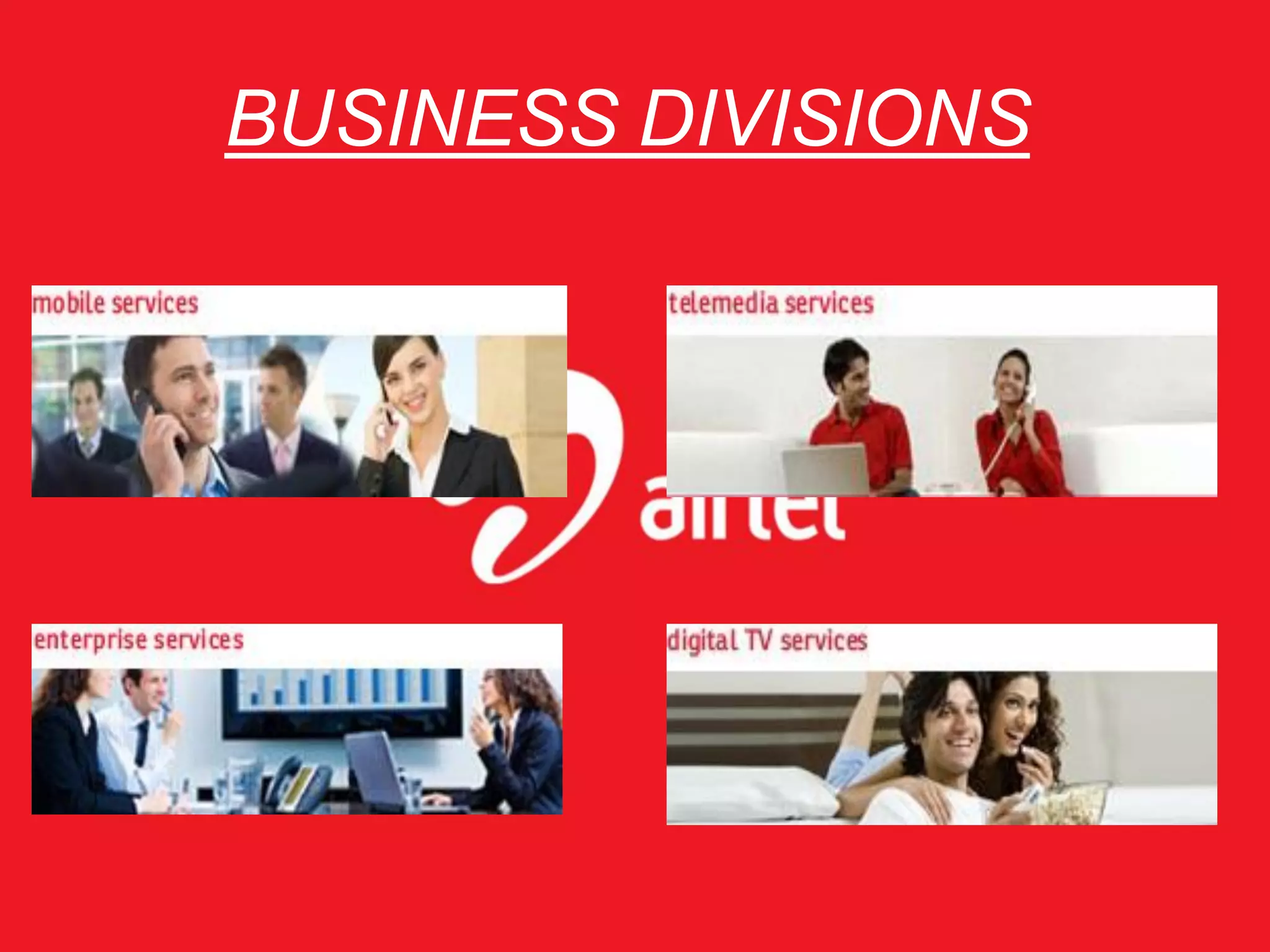
The businesses at Bharti Airtel have been structured into
four individual strategic business units (SBU’s)- Mobile
Services, Airtel Telemedia Services, Enterprise Services&
Digital TV Services.
Bharti Airtel is one of India's leading private
sector providers of telecommunications services
based on an aggregate of 66,689,943 customers.

Approx 64,370,434 GSM mobile subscribers.

Approx 2,319,509 Bharti Telemedia subscribers.

 Bharti has recently entered into retail business as
Bharti Retail Pvt. Ltd.
FACT SHEET
Name : Bharti Airtel Limited

 Business Description : Provides mobile, telemedia
services (fixed line) and enterprise services (carriers&
services to corporates)

Established : July 07, 1995, as a Public Limited
Company

Listings : The Stock Exchange, Mumbai (BSE),
The National Stock Exchange of India Limited (NSE).
Operational Network : Provides GSM mobile
services in all the 23 telecom circles in India,
and was the first private operator to have an all
India presence.

Provides telemedia services (fixed line) in 94
cities in India.
BUSINESS DIVISIONS
HIGHLIGHTS
Bharti Airtel and MERCEDES AMG PETRONAS
announce Race Partnership for 2012 Formula One
airtel Indian Grand Prix


Bharti Airtel launches Cloud Enablement Platform
powered by HP

Bharti Airtel bags Adam Smith Award 2012 for
Highly Commended “Best in Class Benchmarking”
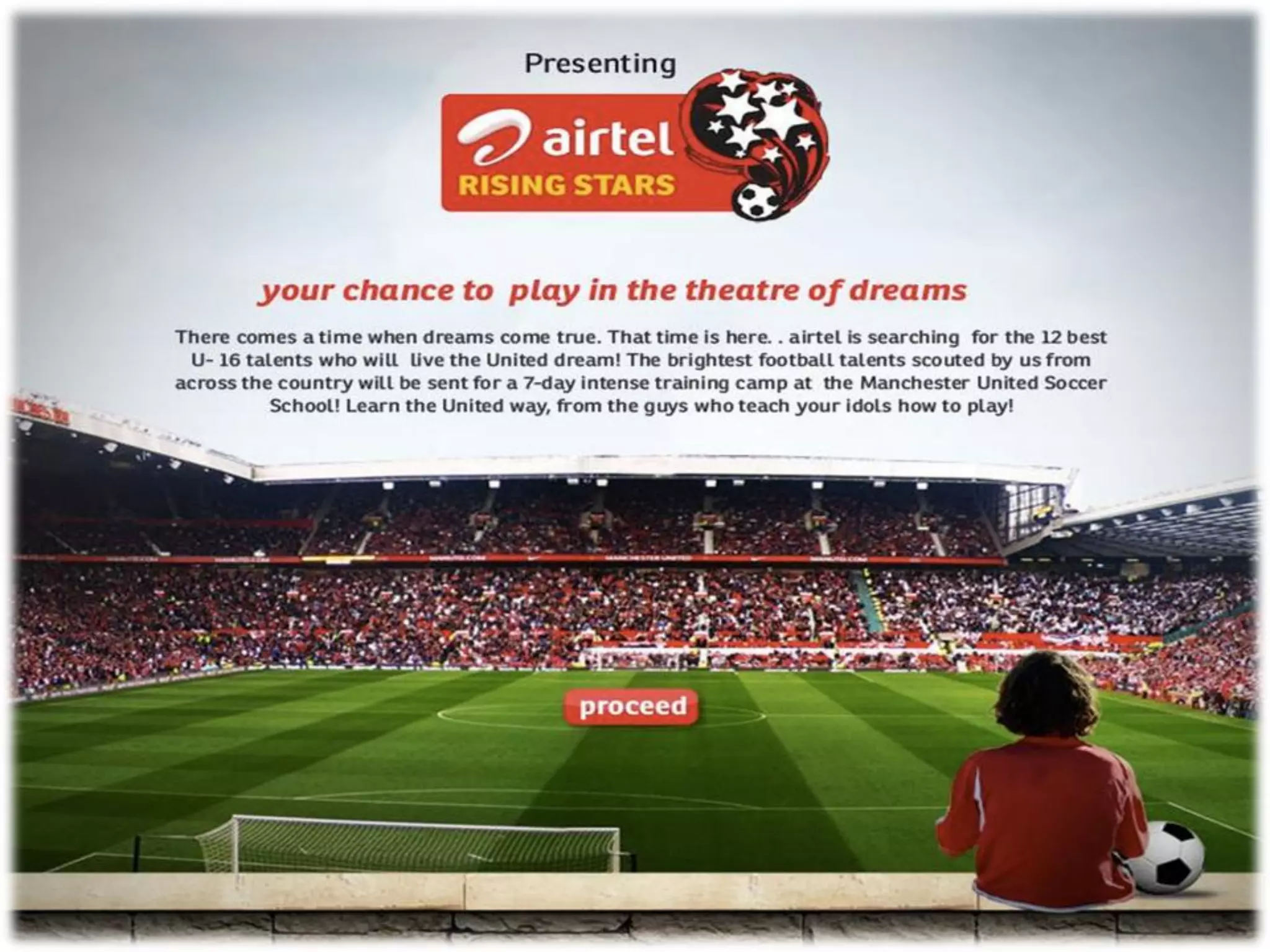
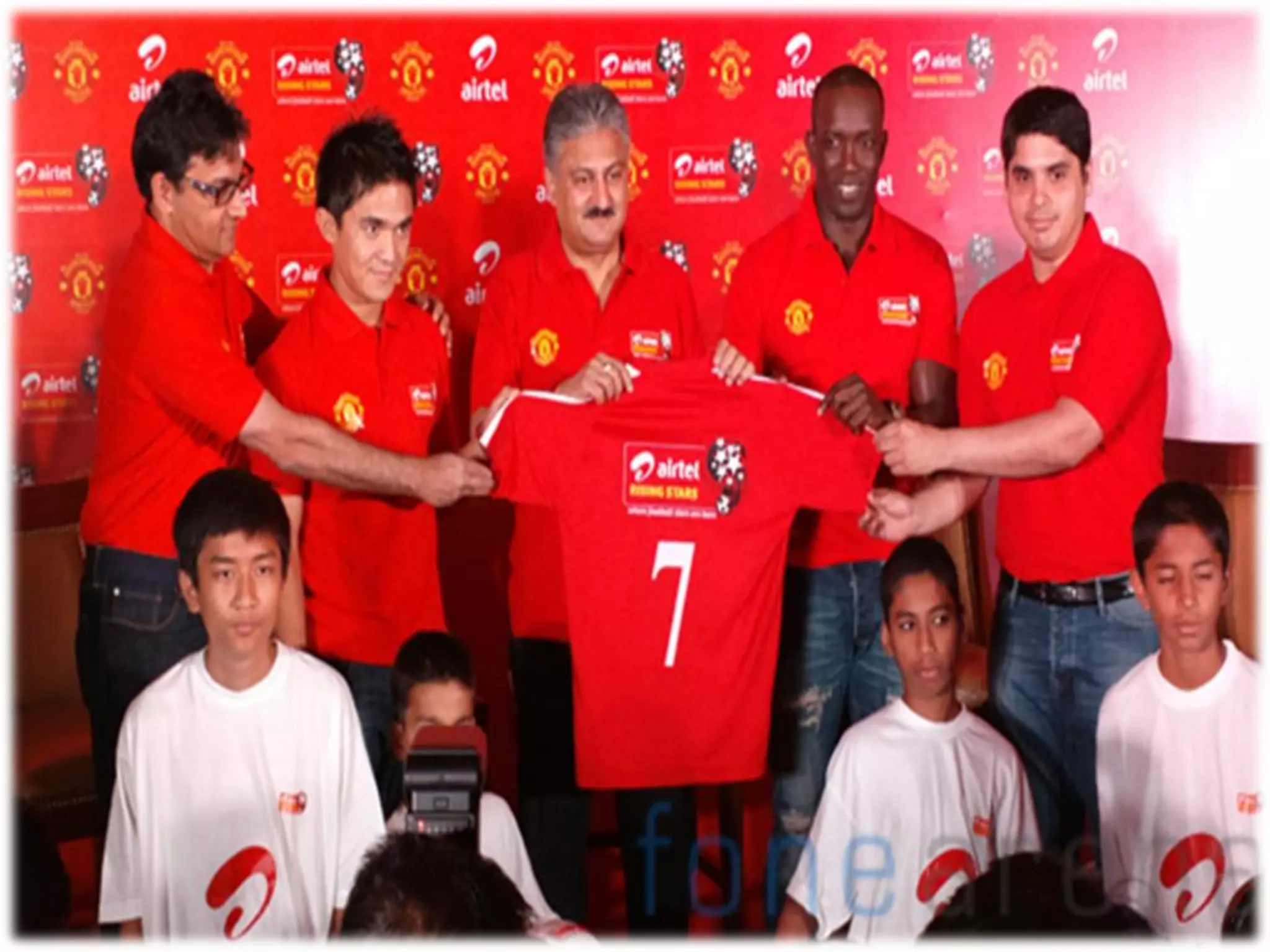
'Airtel Rising Stars' to bring alive young
India's soccer dreams


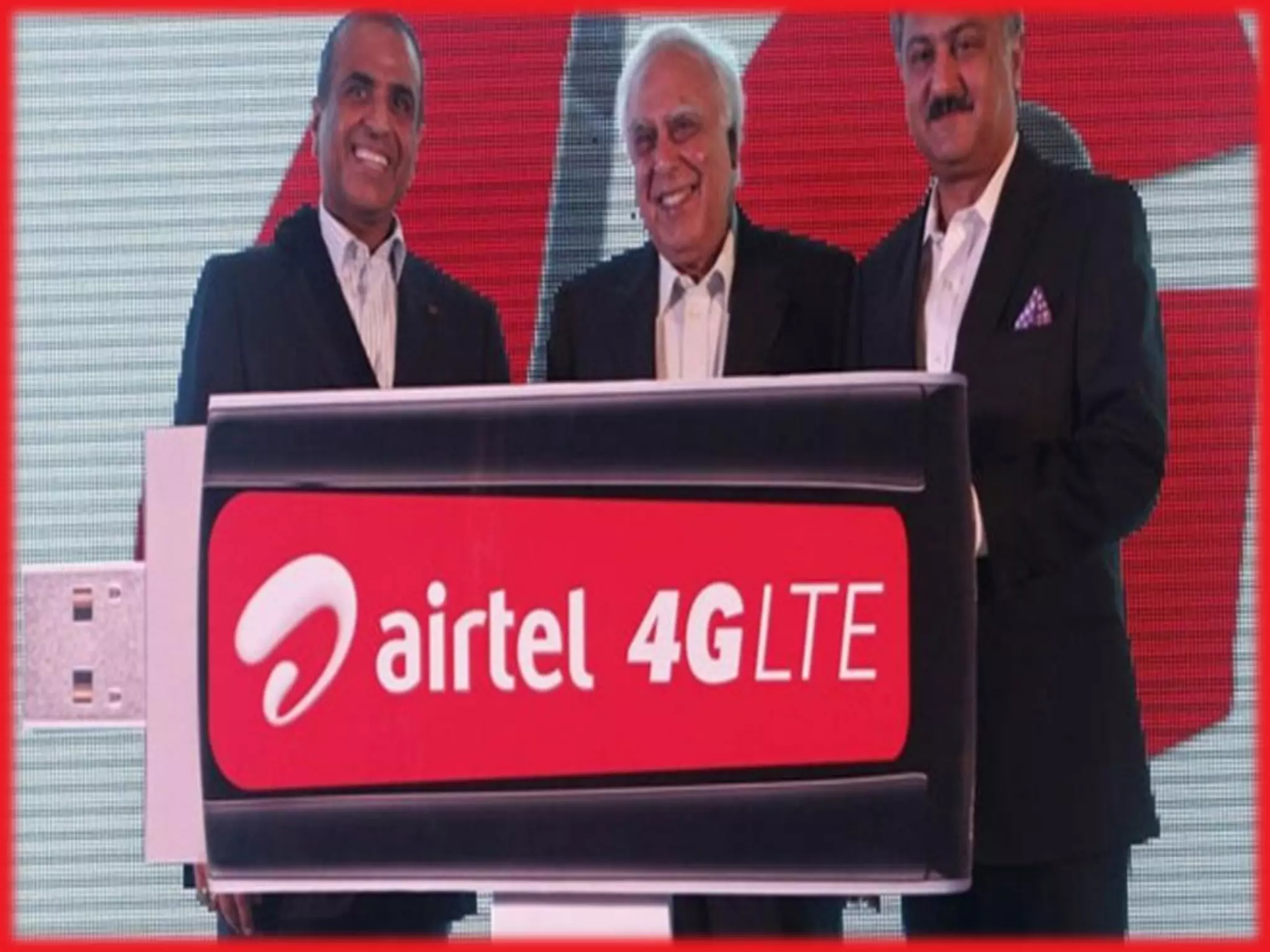
Airtel brings the 4G revolution to
Bangalore
DIRECTOR PROFILE
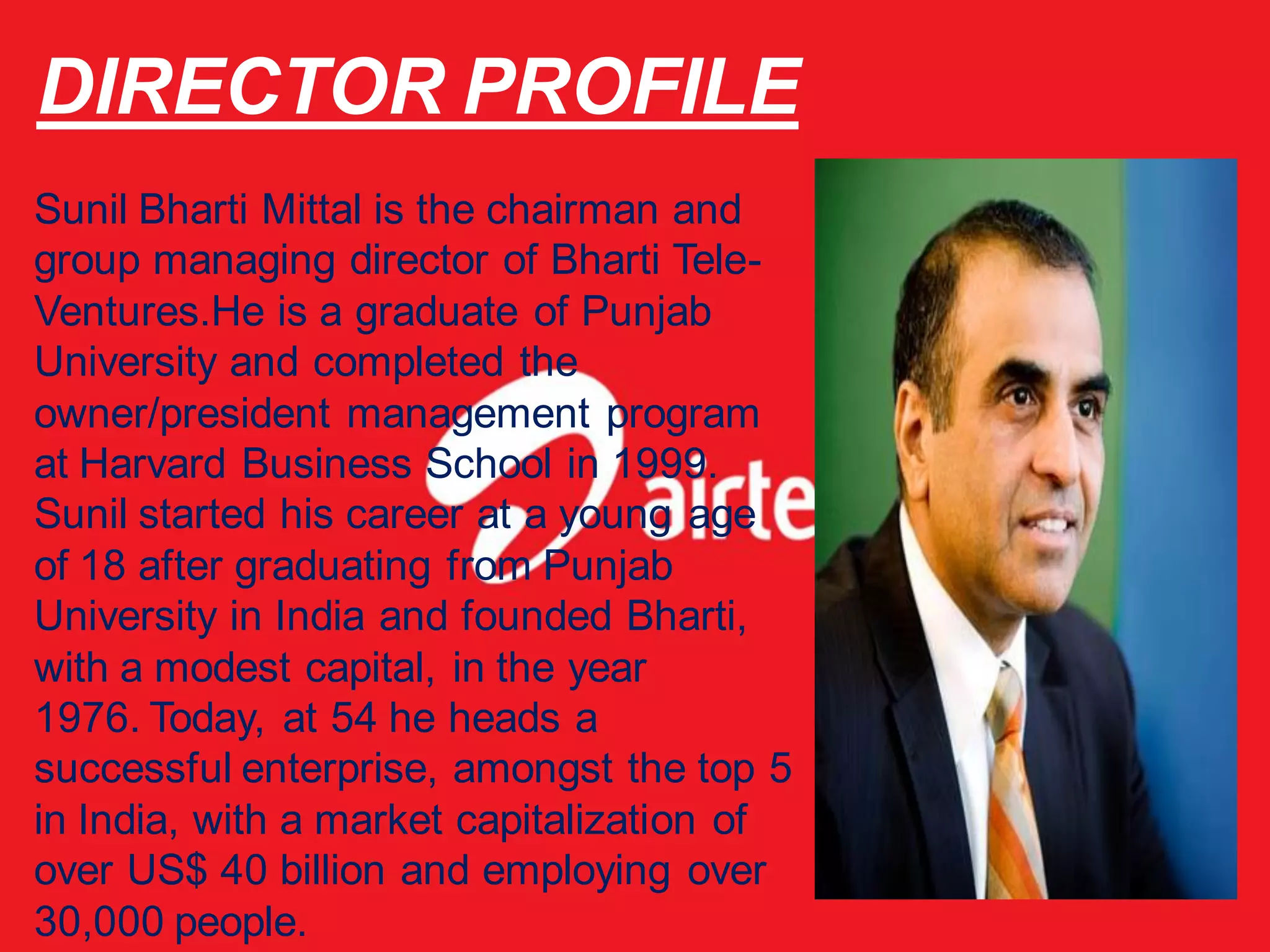
Sunil Bharti Mittal is the chairman and
group managing director of Bharti Tele-
Ventures.He is a graduate of Punjab
University and completed the
owner/president management program
at Harvard Business School in 1999.
Sunil started his career at a young age
of 18 after graduating from Punjab
University in India and founded Bharti,
with a modest capital, in the year
1976. Today, at 54 he heads a
successful enterprise, amongst the top 5
in India, with a market capitalization of
over US$ 40 billion and employing over
30,000 people.
KEY MILESTONE
In 1983, Mittal was in an agreement with Germany's Siemens to
manufacture push-button telephone models for the Indian market.

In 1986, Mittal incorporated Bharti Telecom Limited (BTL), and
his company became the first in India to offer push-button
telephones, establishing the basis of Bharti Enterprises.

By the early 1990s, Sunil Mittal had also launched the country's
first fax machines and its first cordless telephones.

 In 1992, Mittal won a bid to build a cellular phone network in
Delhi.

 In 1995, Mittal incorporated the cellular operations as Bharti
Tele-Ventures and launched service in Delhi.
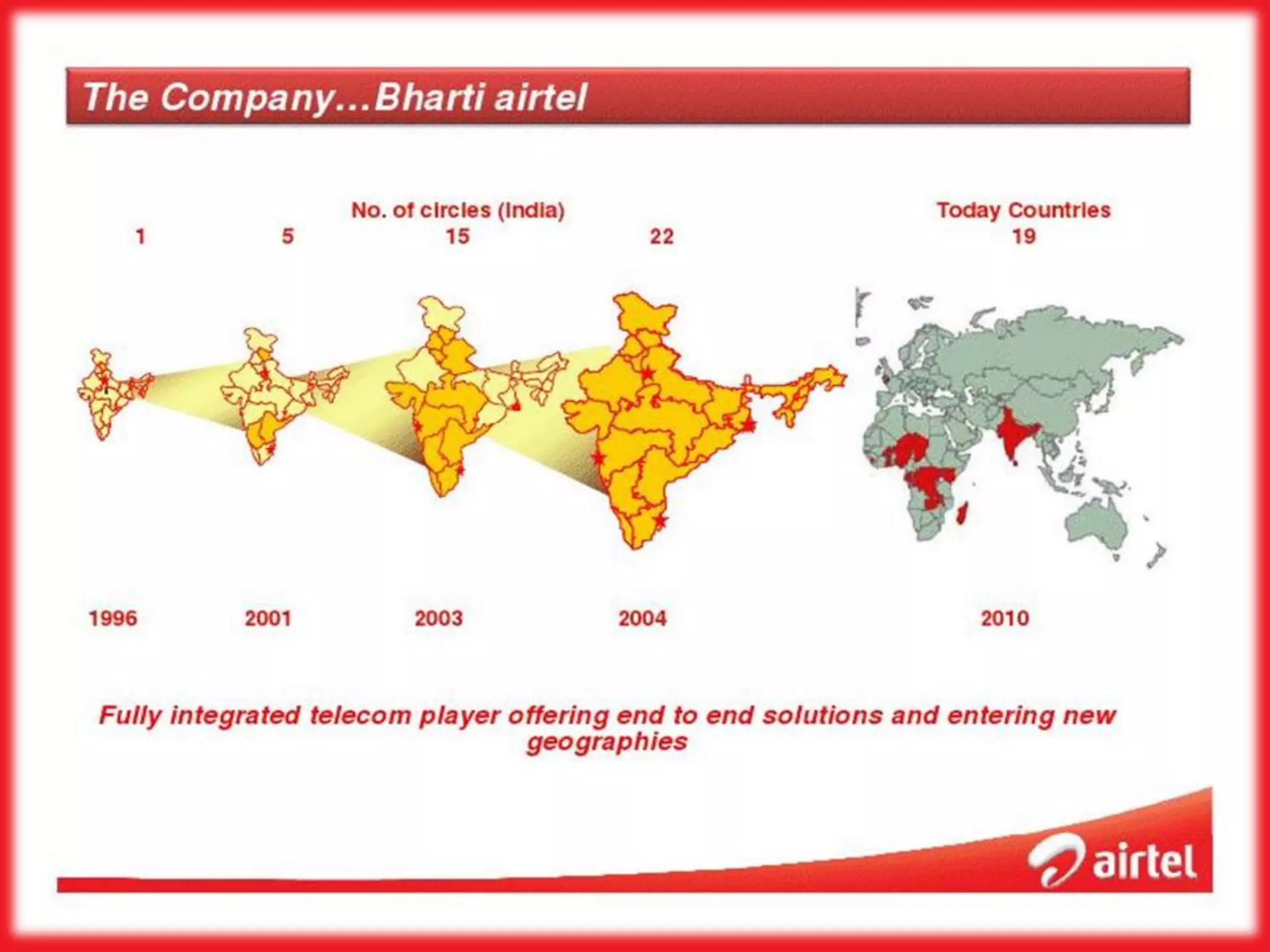
In 1996, cellular service was extended to Himachal Pradesh.

 In 1999, Bharti Enterprises acquired control of JT Holdings, and
extended cellular operations to Karnataka and Andhra Pradesh.

In 2000, Bharti acquired control of Skycell Communications, in
Chennai.

In 2001, the company acquired control of Spice Cell in Calcutta.
Bharti Enterprises went public

In 2002, and the company was listed on Bombay Stock
Exchange and National Stock Exchange of India.

In 2003, the cellular phone operations were rebranded under the
single Airtel brand.
In 2004, Bharti acquired control of Hexacom and
entered Rajasthan.

In 2005, Bharti extended its network to Andaman and
Nicobar. This expansion allowed it to offer voice services
all across India.

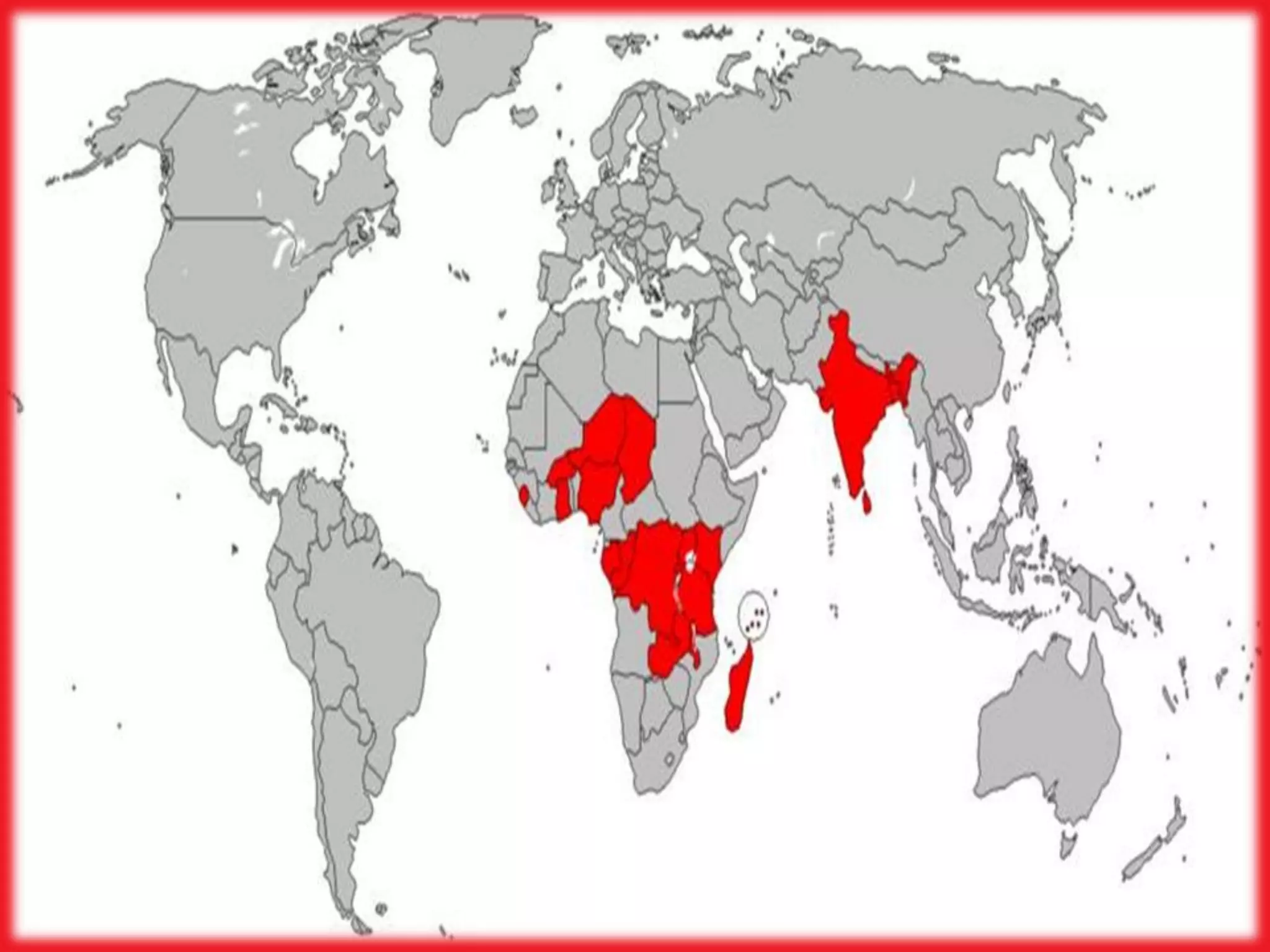
 In 2009, Airtel launched its first international mobile
network in Sri Lanka.

 In 2010, Airtel acquired the African operations of the
Kuwait based ZainTelecom.

In March 2012,Airtel launched a mobile operation in
Rwanda.

Today, Airtel is the largest cellular service provider in India
and the third largest in the world.
PARTNERS
The company has a strategic alliance with
SingTel.

The company’s mobile network equipment
partners are Ericsson and Nokia.

In the case of the broadband and telephone
services and enterprise services(carriers),
equipment suppliers include Siemens, Nortel,
Corning, among others.
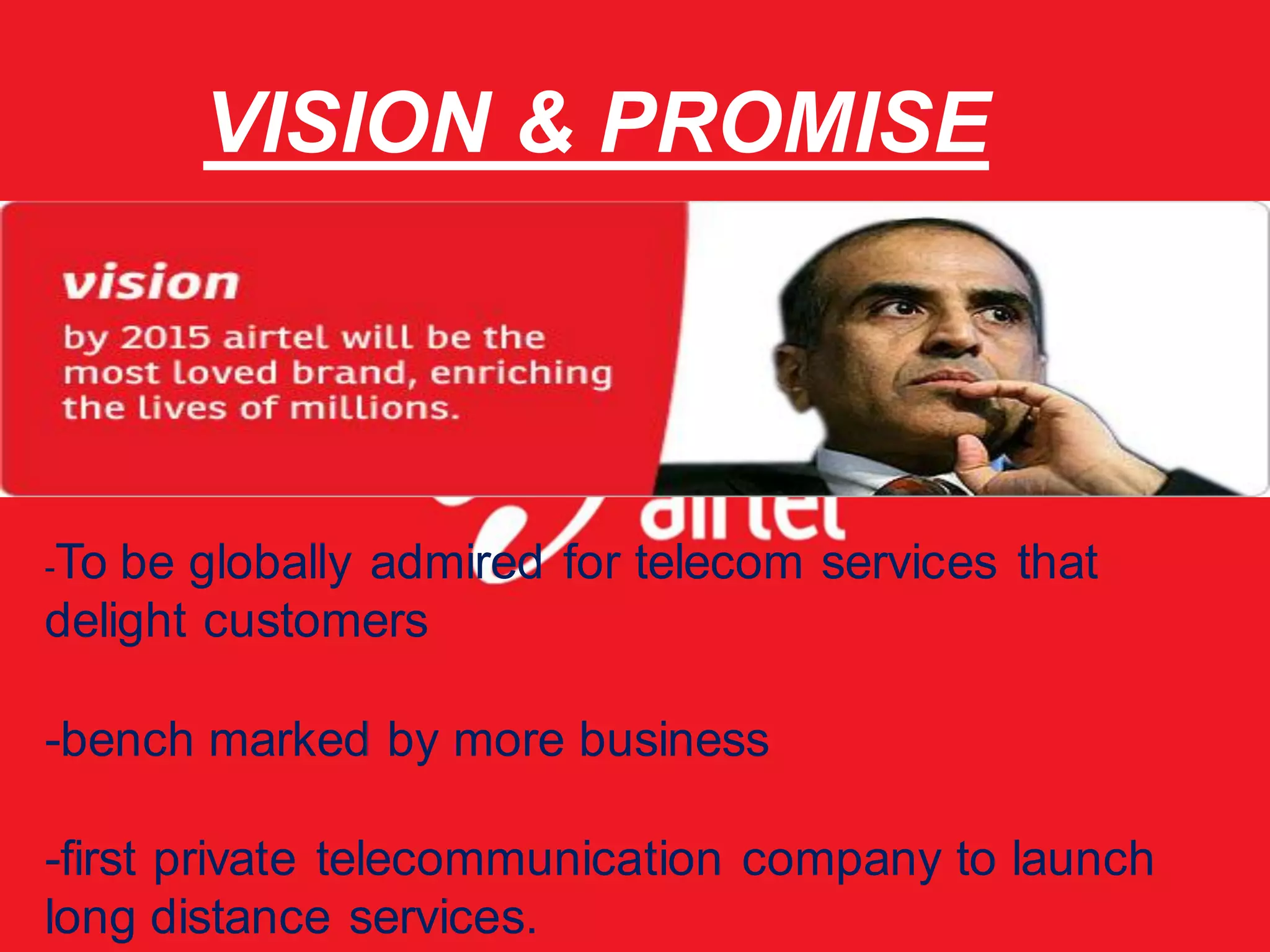
VISION & PROMISE


-To be globally admired for telecom services that
delight customers

-bench marked by more business

-first private telecommunication company to launch
long distance services.
MISSION
  Customer service focus
company will meet the mobile communication needs
of his customers through Error- free service delivery

Innovative products and services

Empowered employees

Cost efficiency

Unified Messaging Solutions
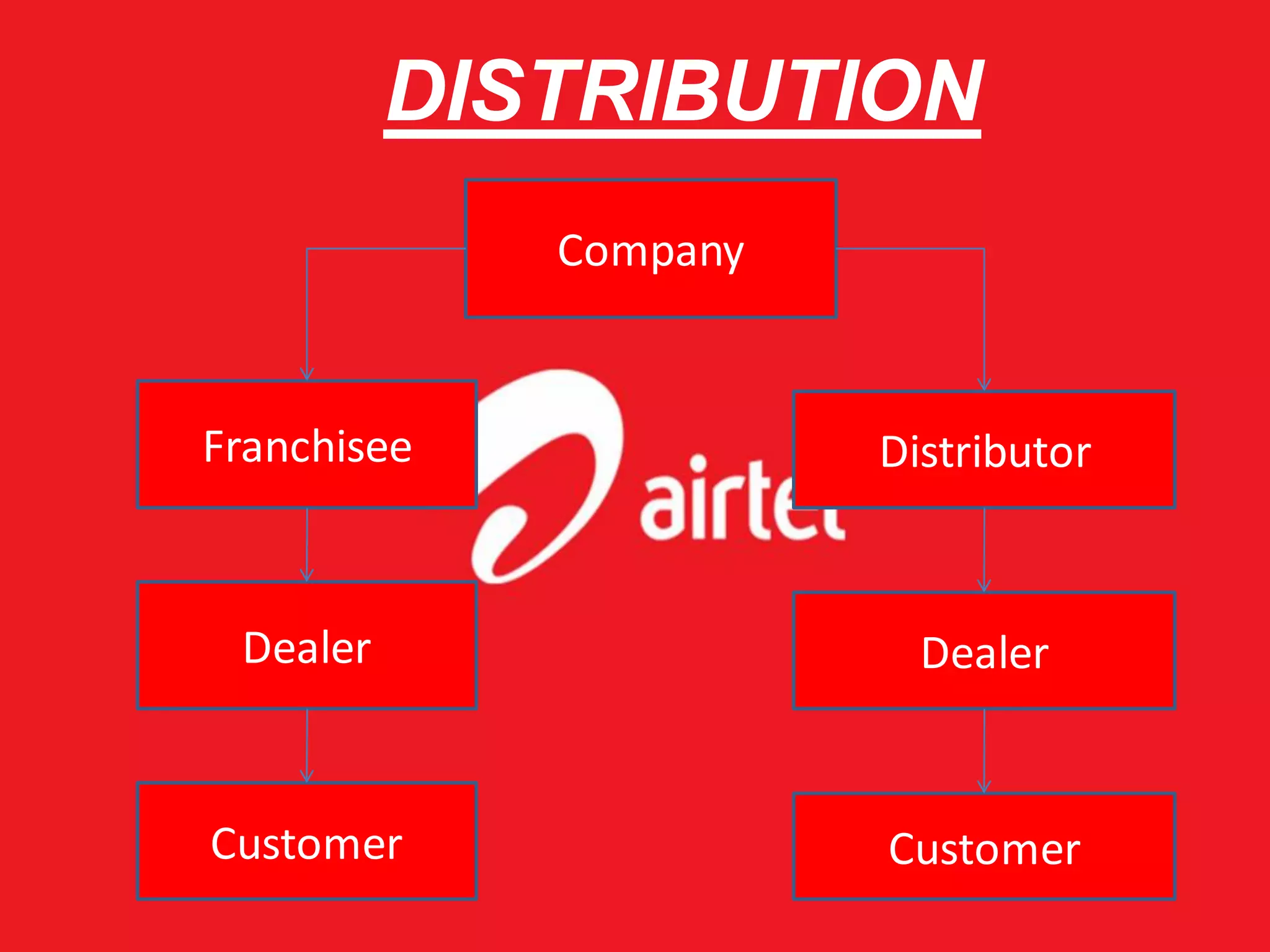
DISTRIBUTION
             Company


Franchisee             Distributor


 Dealer                  Dealer


Customer               Customer
MARKETING ANALYSIS
MARKETING ANALYSIS In the mind of the consumer,
Airtel Services should provide following features:
 Easy Billing
Strong Market Coverage
Credit Limit
Long Distance Calling Facility
 Best Value Plan
 Widest Roaming – National & International
 Easy Payment Option- Anytime & Anywhere
SITUATIONAL ANALYSIS
SITUATIONAL ANALYSIS Some uncontrollable situational
factors that are faced by the Airtel are as follows,

 Price : Although the Customer of Airtel is very high but when we
talk about the price, Airtel has to make a strong strategy for
price.

Competition :Competition in market is very high. New
Companies are entering in the market like Aircel , MTS etc. They
are offering best service at competitive price .

 Geographical factors: Airtel service didn’t reach in all villages
yet. In Village , People are using BSNL service so Airtel has a
chance to grow in village on the basis of their best service
quality.
CORPORATE RESPONSIBILITY
corporate Responsibility at Bharti Airtel

To be responsive to the needs of our customers
To trust and respect our employees
To continuously improve our services innovatively and
expeditiously
To be transparent and sensitive in our dealings with all
stakeholder
TARGET MARKET SEGMENT
Airtel has targeted the premium and upper middle class.
The rationale behind it is that only those segments
should be targeted who value time and have the paying
capacity. It Is also planning to target the business
tourists during their stay in the capital.
POSITIONING
The product is sought to be positioned as a business
efficiency tool, a lifestyle revolution and a status
symbol. The emphasis is to remove misconception
that the cell phone is an expensive means of
communication and drive home the point that the cell
phone is actually a day-to-day utility.
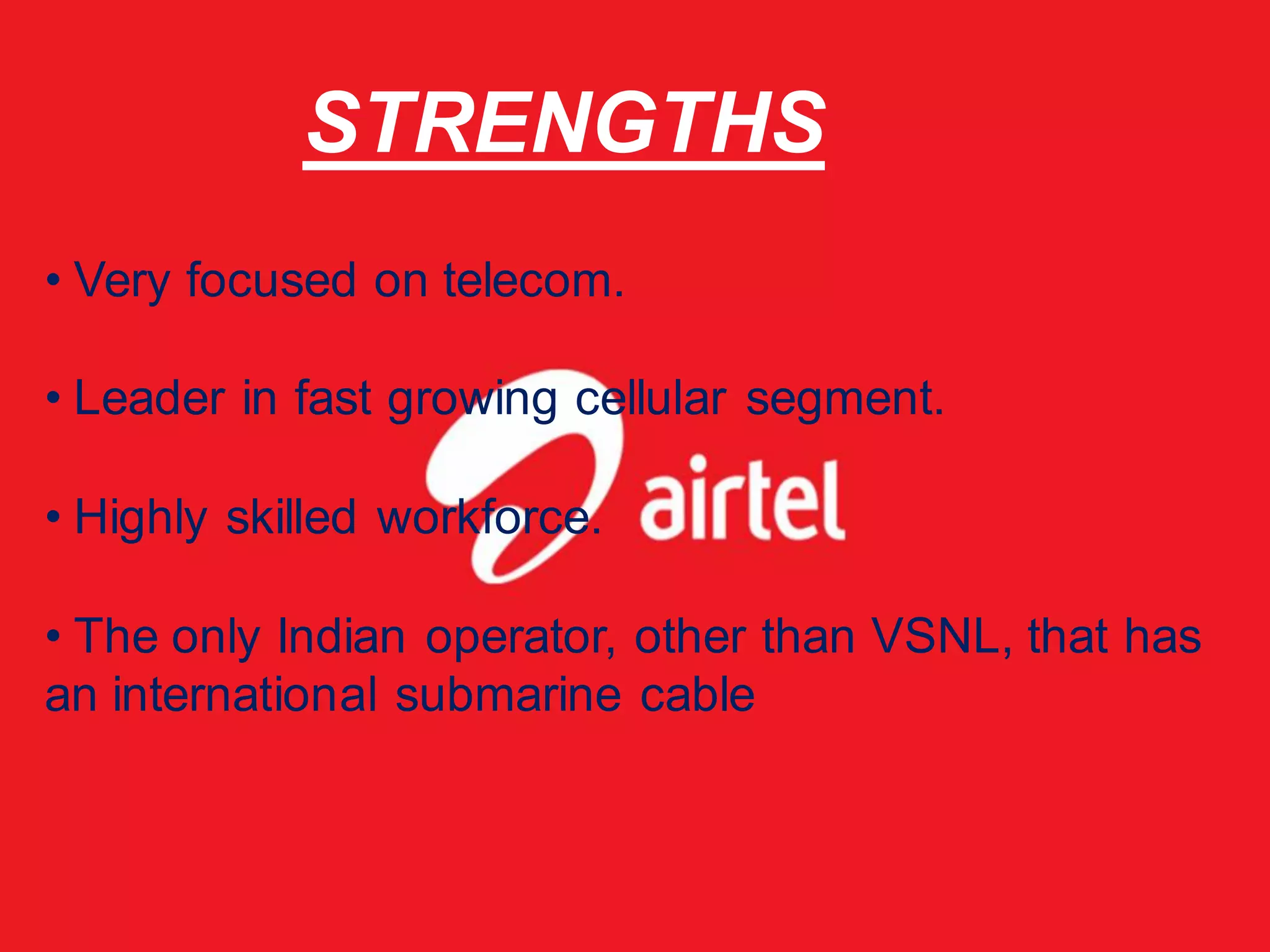
STRENGTHS
• Very focused on telecom.

• Leader in fast growing cellular segment.

• Highly skilled workforce.

• The only Indian operator, other than VSNL, that has
an international submarine cable
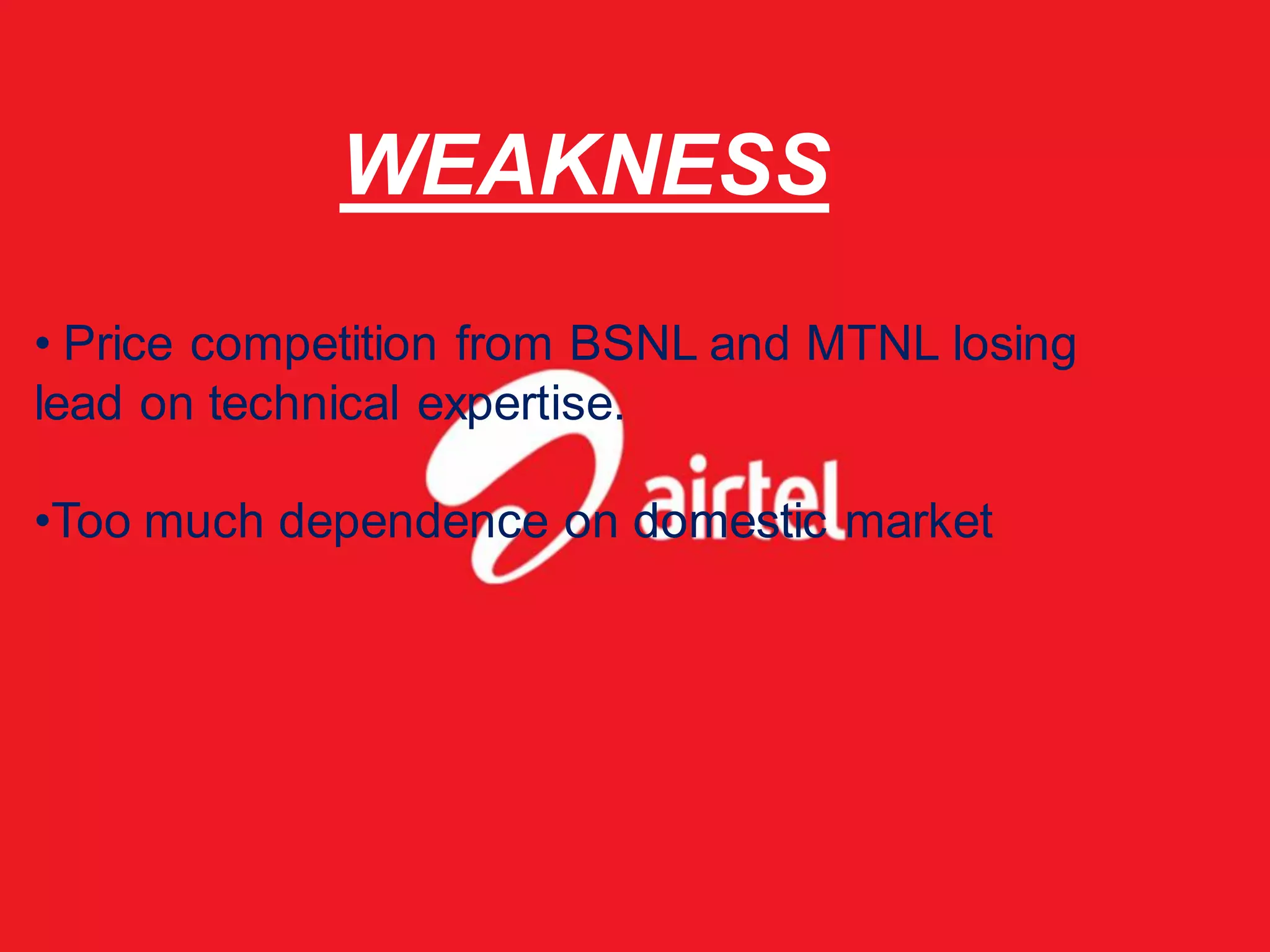
WEAKNESS
• Price competition from BSNL and MTNL losing
lead on technical expertise.

•Too much dependence on domestic market
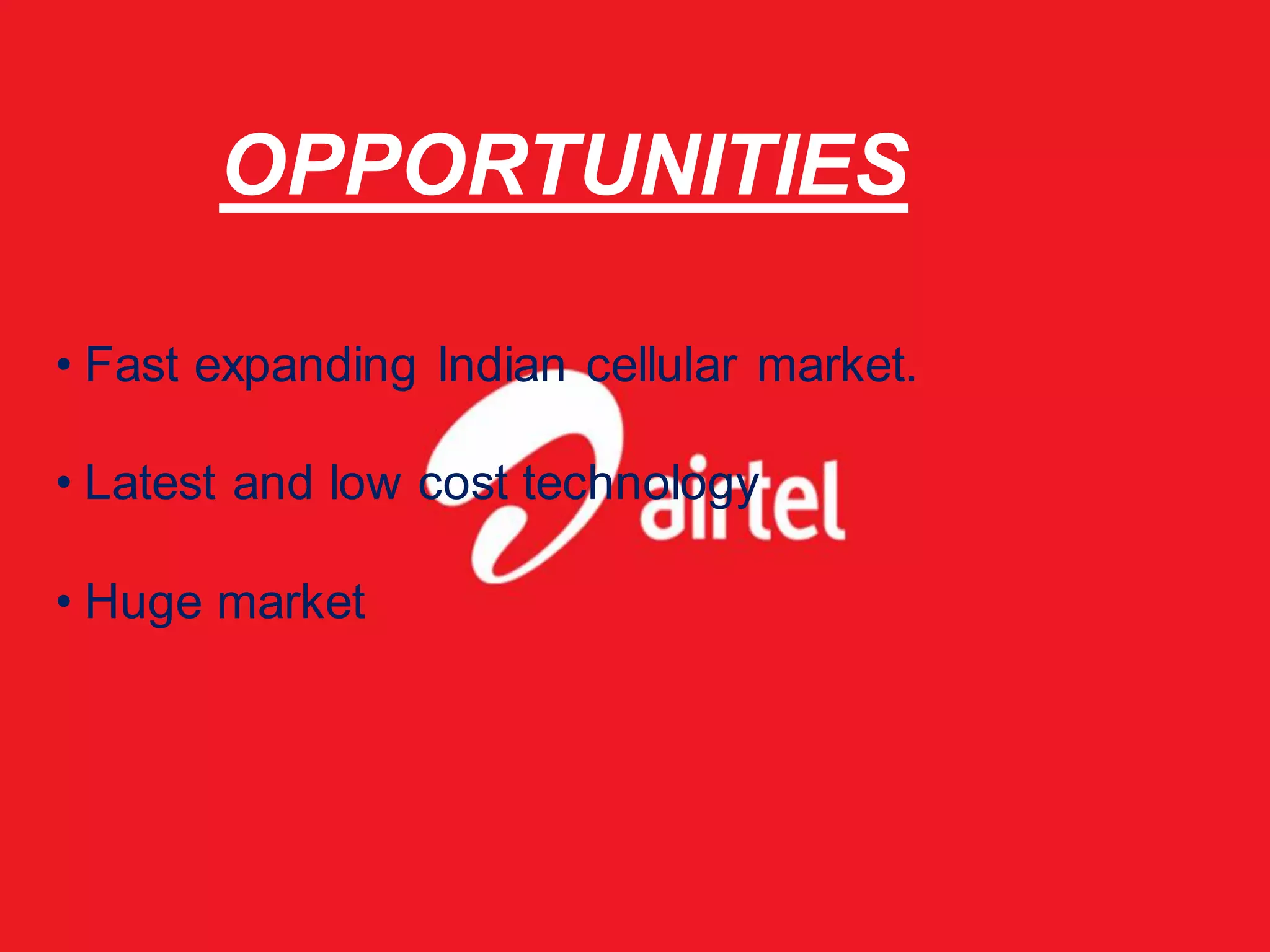
OPPORTUNITIES

• Fast expanding Indian cellular market.

• Latest and low cost technology

• Huge market
THREATS

• Competition from other cellular and mobile
operators

• Saturation point in Basic telephony service
video
Airtel ppt new
Airtel ppt new

Airtel ppt new

  • 1.
  • 2.
    INTRODUCTION Airtel was Establishedin 1985, Bharti (Airtel) has been a pioneering force in the Telecom Sector. Airtel comes to you from Bharti Airtel Limited,India’s largest integrated and the first private telecom services provider with a footprint in all the 23 telecom circles. The businesses at Bharti Airtel have been structured into four individual strategic business units (SBU’s)- Mobile Services, Airtel Telemedia Services, Enterprise Services& Digital TV Services.
  • 3.
    Bharti Airtel isone of India's leading private sector providers of telecommunications services based on an aggregate of 66,689,943 customers. Approx 64,370,434 GSM mobile subscribers. Approx 2,319,509 Bharti Telemedia subscribers.  Bharti has recently entered into retail business as Bharti Retail Pvt. Ltd.
  • 4.
    FACT SHEET Name :Bharti Airtel Limited  Business Description : Provides mobile, telemedia services (fixed line) and enterprise services (carriers& services to corporates) Established : July 07, 1995, as a Public Limited Company Listings : The Stock Exchange, Mumbai (BSE), The National Stock Exchange of India Limited (NSE).
  • 5.
    Operational Network :Provides GSM mobile services in all the 23 telecom circles in India, and was the first private operator to have an all India presence. Provides telemedia services (fixed line) in 94 cities in India.
  • 8.
  • 9.
    HIGHLIGHTS Bharti Airtel andMERCEDES AMG PETRONAS announce Race Partnership for 2012 Formula One airtel Indian Grand Prix Bharti Airtel launches Cloud Enablement Platform powered by HP Bharti Airtel bags Adam Smith Award 2012 for Highly Commended “Best in Class Benchmarking”
  • 10.
    'Airtel Rising Stars'to bring alive young India's soccer dreams Airtel brings the 4G revolution to Bangalore
  • 11.
    DIRECTOR PROFILE Sunil BhartiMittal is the chairman and group managing director of Bharti Tele- Ventures.He is a graduate of Punjab University and completed the owner/president management program at Harvard Business School in 1999. Sunil started his career at a young age of 18 after graduating from Punjab University in India and founded Bharti, with a modest capital, in the year 1976. Today, at 54 he heads a successful enterprise, amongst the top 5 in India, with a market capitalization of over US$ 40 billion and employing over 30,000 people.
  • 12.
    KEY MILESTONE In 1983,Mittal was in an agreement with Germany's Siemens to manufacture push-button telephone models for the Indian market. In 1986, Mittal incorporated Bharti Telecom Limited (BTL), and his company became the first in India to offer push-button telephones, establishing the basis of Bharti Enterprises. By the early 1990s, Sunil Mittal had also launched the country's first fax machines and its first cordless telephones.  In 1992, Mittal won a bid to build a cellular phone network in Delhi.  In 1995, Mittal incorporated the cellular operations as Bharti Tele-Ventures and launched service in Delhi.
  • 13.
    In 1996, cellularservice was extended to Himachal Pradesh.  In 1999, Bharti Enterprises acquired control of JT Holdings, and extended cellular operations to Karnataka and Andhra Pradesh. In 2000, Bharti acquired control of Skycell Communications, in Chennai. In 2001, the company acquired control of Spice Cell in Calcutta. Bharti Enterprises went public In 2002, and the company was listed on Bombay Stock Exchange and National Stock Exchange of India. In 2003, the cellular phone operations were rebranded under the single Airtel brand.
  • 14.
    In 2004, Bhartiacquired control of Hexacom and entered Rajasthan. In 2005, Bharti extended its network to Andaman and Nicobar. This expansion allowed it to offer voice services all across India.  In 2009, Airtel launched its first international mobile network in Sri Lanka.  In 2010, Airtel acquired the African operations of the Kuwait based ZainTelecom. In March 2012,Airtel launched a mobile operation in Rwanda. Today, Airtel is the largest cellular service provider in India and the third largest in the world.
  • 15.
    PARTNERS The company hasa strategic alliance with SingTel. The company’s mobile network equipment partners are Ericsson and Nokia. In the case of the broadband and telephone services and enterprise services(carriers), equipment suppliers include Siemens, Nortel, Corning, among others.
  • 16.
    VISION & PROMISE -Tobe globally admired for telecom services that delight customers -bench marked by more business -first private telecommunication company to launch long distance services.
  • 17.
    MISSION Customerservice focus company will meet the mobile communication needs of his customers through Error- free service delivery Innovative products and services Empowered employees Cost efficiency Unified Messaging Solutions
  • 18.
    DISTRIBUTION Company Franchisee Distributor Dealer Dealer Customer Customer
  • 19.
    MARKETING ANALYSIS MARKETING ANALYSISIn the mind of the consumer, Airtel Services should provide following features:  Easy Billing Strong Market Coverage Credit Limit Long Distance Calling Facility  Best Value Plan  Widest Roaming – National & International  Easy Payment Option- Anytime & Anywhere
  • 20.
    SITUATIONAL ANALYSIS SITUATIONAL ANALYSISSome uncontrollable situational factors that are faced by the Airtel are as follows, Price : Although the Customer of Airtel is very high but when we talk about the price, Airtel has to make a strong strategy for price. Competition :Competition in market is very high. New Companies are entering in the market like Aircel , MTS etc. They are offering best service at competitive price . Geographical factors: Airtel service didn’t reach in all villages yet. In Village , People are using BSNL service so Airtel has a chance to grow in village on the basis of their best service quality.
  • 21.
    CORPORATE RESPONSIBILITY corporate Responsibilityat Bharti Airtel To be responsive to the needs of our customers To trust and respect our employees To continuously improve our services innovatively and expeditiously To be transparent and sensitive in our dealings with all stakeholder
  • 22.
    TARGET MARKET SEGMENT Airtelhas targeted the premium and upper middle class. The rationale behind it is that only those segments should be targeted who value time and have the paying capacity. It Is also planning to target the business tourists during their stay in the capital.
  • 23.
    POSITIONING The product issought to be positioned as a business efficiency tool, a lifestyle revolution and a status symbol. The emphasis is to remove misconception that the cell phone is an expensive means of communication and drive home the point that the cell phone is actually a day-to-day utility.
  • 25.
    STRENGTHS • Very focusedon telecom. • Leader in fast growing cellular segment. • Highly skilled workforce. • The only Indian operator, other than VSNL, that has an international submarine cable
  • 26.
    WEAKNESS • Price competitionfrom BSNL and MTNL losing lead on technical expertise. •Too much dependence on domestic market
  • 27.
    OPPORTUNITIES • Fast expandingIndian cellular market. • Latest and low cost technology • Huge market
  • 28.
    THREATS • Competition fromother cellular and mobile operators • Saturation point in Basic telephony service
  • 37.