Customer Value
 Is a bundle of benefit customers expect
from a brand.
 As well as, the bundle of costs customer
expect to incur in evaluating, obtaining,
and using the product or service
𝐶𝑢𝑠𝑡𝑜𝑚𝑒𝑟 𝑉𝑎𝑙𝑢𝑒 = 𝐵𝑒𝑛𝑒𝑓𝑖𝑡𝑠 − 𝐶𝑜𝑠𝑡𝑠
Core Benefit
1. Product
2. Attribute – functional utility
3. Quality – satisfies preferences and
expectations
4. Uses—occasions of its use
Product Attribute
 Benefits based on attribute that provides
functional utility
Ex: Volvo is a safe durable car because of
its light weight design
Product Quality
 The collection of features of a product
that satisfies a consumers preference and
expectation
 Durability
 Warranty
 On-time
 Easy-to-deal with
 Reasonable cost
Product Uses
 What the product is used for, occasions
Ex: Gatorade to sustain high level of
performance
Ex: Starbucks as a familiar upscale place
to relax and have coffee
Communicating Core Benefits
1. User Imagery — shows types of people
who uses the product most often.
2. Symbols — is an object that represents,
stands for, or suggest an idea, belief, or
action.
In marketing, symbols take the form of
words, sounds, visual image, and logos to
represent a brand for easy recognition and
recall.
Ex: häagen-dazs logo/word is used to
communicate a Belgium like ice cream.
3. Country of Origin — the origin of the
brand can add credibility
Ex: “Made in China”
4. Emotional Benefits — the purchase or use
of a brand gives the customer a positive
feeling
Ex: warm when buying or reading
Hallmark cards
Ex: Strong and rugged when wearing
Levi’s
Product
Quality
Uses
Attributes
SYMBOLS
Country of
Origin
USER
IMAGERY
Emotional
Benefits
Brand
Personality
5. Brand Personality — is the set of human
characteristics associated with a brand
 Gender
 Age
 Socio-economic class
Ex: frugal and unpretentious by shopping
at SM Mall
Limitations of Product Core Benefits
 When all brands are perceived to be
adequate on an attribute
 The uniqueness is important, otherwise it
is not a differentiator
 Can be easily copied
 Assumes that customer is a rational
decision-maker all the time, which they
aren’t
o Many customers do not care as
much about function as they do
about style, status, reassurance,
and other less functional benefits.
Marketing Planning
A planner considers these questions:
 Where will sales next year come from?
 What is the business environment?
How can the Brand grow?
Four (4) Step Marketing Management Process
1. Analysis of Market Opportunities
2. Develop Marketing Strategy
3. Action Plan & Budget
4. Execute & Monitor
1. Situational Analysis
 Customer
 Competitors
 Market Environment
 Brand Performance
2. Marketing Strategy
 Objectives of sales and market share
 Marketing mix strategy
3. Action Plan and Budget
 Product Plan
 Pricing
 Advertising/Promotion
 Distribution
4. Execute and Monitor
MARKETING OPTIONS
Market
Existing New
Product
Same Market
Penetration
Market
Development
New Product
Development
Diversification
Option 1: Marketing Penetration
a. Encourage Frequent Use
Ex. Coke big bottle to smaller bottles
b. Increase Quantity of Use
Ex. Lucky Me is a snack but it was
introduce for breakfast as well
c. Make New Applications
Ex. Baking Soda can take away bad odors
d. Attract Competitor’s Customers
Ex. Coke regular to coke zero
Growth in the current market segment
Segmentation
Is a process of placing the buyer in a
product market into sub groups so that
members of each segment displays
similar responsiveness to a particular
marketing strategy
.
The target customer…
 Know the product attributes and bundles
of benefits that satisfy customers needs
and wants
Product Offerings Customers Using
Other Brands
ExistingCustomers
 Respond positively to the emotional and
social appeals as they are experienced in
the pricing point of sale and advertising
material.
 Are predisposed to the product concept
and willing to try
Reasons for Segmentation of Market
 Markets are no longer “one size fits all,”
requiring different value offerings
 Consumer s that are similar will behave
and respond in particular way to a given
stimulus
 Products with different features will
appeal to another set of consumers
Shared Characteristics
a. Demographic
b. Behavioristic
c. Psychographic
Segmentation by Demographic
 Age: under 6; 6-11; 12-19; 20-34; 35-49;
50-64; 65+
 Sex: male, female
 Income: low, middle, high
 Religion: Catholic, Muslim, Protestant
 Geographic: Luzon, Visayas, Mindanao
Segmentation by Behavioristic
- Group consumers by purchase behavior
- Tells us who the customers are, when
they buy and how much
Variables of Behavioristic
 Benefits Sought
economy, convenience, prestige
 User Status
nonuser, first-timers, regular
 Usage Rate
light, medium, heavy
 Usage Type
product type, size, flavor
 Purchase Occasion:
regular, special occasion
Option 2: Market Development Strategy
a. Discover New Customer Segment
Ex. Coke life
b. Seek New Distribution Channels
Ex. ATM machines in Malls
c. Sell in New Geographic Locations
Ex. Penshoppe form Cebu to Manila
Analyzing Competition
i. Performance
 Size and growth of company
 Firms that represent the most direct
competition
ii. Marketing Practice
 Pricing
 Advertising (positioning) and Media
Spending
 Sales Promotion Activities
 Distribution Surveys
iii. Customer Motivations
 What is important to the customers?
Identify Customers
- Competitors are group of firms that offer
similar products that are close substitute.
- Products that can satisfy same customer
need from another category
Understand Competitor Strengths and
Weaknesses
- In what areas are they successful?
Unsuccessful?
- What relevant assets and competencies
do they have? Not have?
- What are the key customer motivations?
- Which components of the value chain can
create competitive advantage?
Competitive Force that Shape Strategy
- Rivalry among existing firms
- Threat
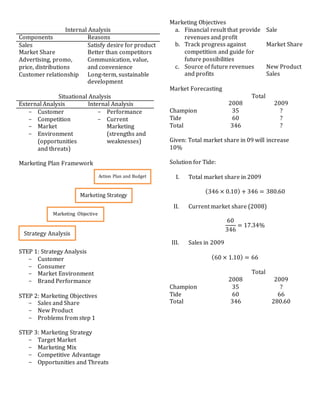
Internal Analysis
Components Reasons
Sales Satisfy desire for product
Market Share Better than competitors
Advertising, promo,
price, distributions
Communication, value,
and convenience
Customer relationship Long-term, sustainable
development
Situational Analysis
External Analysis Internal Analysis
- Customer
- Competition
- Market
- Environment
(opportunities
and threats)
- Performance
- Current
Marketing
(strengths and
weaknesses)
Marketing Plan Framework
STEP 1: Strategy Analysis
- Customer
- Consumer
- Market Environment
- Brand Performance
STEP 2: Marketing Objectives
- Sales and Share
- New Product
- Problems from step 1
STEP 3: Marketing Strategy
- Target Market
- Marketing Mix
- Competitive Advantage
- Opportunities and Threats
Marketing Objectives
a. Financial result that provide
revenues and profit
Sale
b. Track progress against
competition and guide for
future possibilities
Market Share
c. Source of future revenues
and profits
New Product
Sales
Market Forecasting
Total
2008 2009
Champion 35 ?
Tide 60 ?
Total 346 ?
Given: Total market share in 09 will increase
10%
Solution for Tide:
I. Total market share in 2009
(346 × 0.10) + 346 = 380.60
II. Current market share (2008)
60
346
= 17.34%
III. Sales in 2009
(60 × 1.10) = 66
Total
2008 2009
Champion 35 ?
Tide 60 66
Total 346 280.60
Strategy Analysis
Marketing Objective
Marketing Strategy
Action Plan and Budget
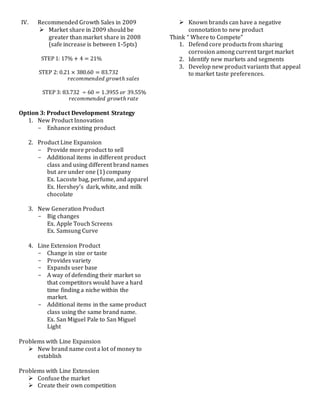
IV. Recommended Growth Sales in 2009
 Market share in 2009 should be
greater than market share in 2008
(safe increase is between 1-5pts)
STEP 1: 17% + 4 = 21%
STEP 2: 0.21 × 380.60 = 83.732
𝑟𝑒𝑐𝑜𝑚𝑚𝑒𝑛𝑑𝑒𝑑 𝑔𝑟𝑜𝑤𝑡ℎ 𝑠𝑎𝑙𝑒𝑠
STEP 3: 83.732 ÷ 60 = 1.3955 𝑜𝑟 39.55%
𝑟𝑒𝑐𝑜𝑚𝑚𝑒𝑛𝑑𝑒𝑑 𝑔𝑟𝑜𝑤𝑡ℎ 𝑟𝑎𝑡𝑒
Option 3: Product Development Strategy
1. New Product Innovation
- Enhance existing product
2. Product Line Expansion
- Provide more product to sell
- Additional items in different product
class and using different brand names
but are under one (1) company
Ex. Lacoste bag, perfume, and apparel
Ex. Hershey’s dark, white, and milk
chocolate
3. New Generation Product
- Big changes
Ex. Apple Touch Screens
Ex. Samsung Curve
4. Line Extension Product
- Change in size or taste
- Provides variety
- Expands user base
- A way of defending their market so
that competitors would have a hard
time finding a niche within the
market.
- Additional items in the same product
class using the same brand name.
Ex. San Miguel Pale to San Miguel
Light
Problems with Line Expansion
 New brand name cost a lot of money to
establish
Problems with Line Extension
 Confuse the market
 Create their own competition
 Known brands can have a negative
connotation to new product
Think “ Where to Compete”
1. Defend core products from sharing
corrosion among current target market
2. Identify new markets and segments
3. Develop new product variants that appeal
to market taste preferences.

MARKMAG Notes for Midterms

  • 1.
    Customer Value  Isa bundle of benefit customers expect from a brand.  As well as, the bundle of costs customer expect to incur in evaluating, obtaining, and using the product or service 𝐶𝑢𝑠𝑡𝑜𝑚𝑒𝑟 𝑉𝑎𝑙𝑢𝑒 = 𝐵𝑒𝑛𝑒𝑓𝑖𝑡𝑠 − 𝐶𝑜𝑠𝑡𝑠 Core Benefit 1. Product 2. Attribute – functional utility 3. Quality – satisfies preferences and expectations 4. Uses—occasions of its use Product Attribute  Benefits based on attribute that provides functional utility Ex: Volvo is a safe durable car because of its light weight design Product Quality  The collection of features of a product that satisfies a consumers preference and expectation  Durability  Warranty  On-time  Easy-to-deal with  Reasonable cost Product Uses  What the product is used for, occasions Ex: Gatorade to sustain high level of performance Ex: Starbucks as a familiar upscale place to relax and have coffee Communicating Core Benefits 1. User Imagery — shows types of people who uses the product most often. 2. Symbols — is an object that represents, stands for, or suggest an idea, belief, or action. In marketing, symbols take the form of words, sounds, visual image, and logos to represent a brand for easy recognition and recall. Ex: häagen-dazs logo/word is used to communicate a Belgium like ice cream. 3. Country of Origin — the origin of the brand can add credibility Ex: “Made in China” 4. Emotional Benefits — the purchase or use of a brand gives the customer a positive feeling Ex: warm when buying or reading Hallmark cards Ex: Strong and rugged when wearing Levi’s Product Quality Uses Attributes SYMBOLS Country of Origin USER IMAGERY Emotional Benefits Brand Personality
  • 2.
    5. Brand Personality— is the set of human characteristics associated with a brand  Gender  Age  Socio-economic class Ex: frugal and unpretentious by shopping at SM Mall Limitations of Product Core Benefits  When all brands are perceived to be adequate on an attribute  The uniqueness is important, otherwise it is not a differentiator  Can be easily copied  Assumes that customer is a rational decision-maker all the time, which they aren’t o Many customers do not care as much about function as they do about style, status, reassurance, and other less functional benefits. Marketing Planning A planner considers these questions:  Where will sales next year come from?  What is the business environment? How can the Brand grow? Four (4) Step Marketing Management Process 1. Analysis of Market Opportunities 2. Develop Marketing Strategy 3. Action Plan & Budget 4. Execute & Monitor 1. Situational Analysis  Customer  Competitors  Market Environment  Brand Performance 2. Marketing Strategy  Objectives of sales and market share  Marketing mix strategy 3. Action Plan and Budget  Product Plan  Pricing  Advertising/Promotion  Distribution 4. Execute and Monitor MARKETING OPTIONS Market Existing New Product Same Market Penetration Market Development New Product Development Diversification Option 1: Marketing Penetration a. Encourage Frequent Use Ex. Coke big bottle to smaller bottles b. Increase Quantity of Use Ex. Lucky Me is a snack but it was introduce for breakfast as well c. Make New Applications Ex. Baking Soda can take away bad odors d. Attract Competitor’s Customers Ex. Coke regular to coke zero Growth in the current market segment Segmentation Is a process of placing the buyer in a product market into sub groups so that members of each segment displays similar responsiveness to a particular marketing strategy . The target customer…  Know the product attributes and bundles of benefits that satisfy customers needs and wants Product Offerings Customers Using Other Brands ExistingCustomers
  • 3.
     Respond positivelyto the emotional and social appeals as they are experienced in the pricing point of sale and advertising material.  Are predisposed to the product concept and willing to try Reasons for Segmentation of Market  Markets are no longer “one size fits all,” requiring different value offerings  Consumer s that are similar will behave and respond in particular way to a given stimulus  Products with different features will appeal to another set of consumers Shared Characteristics a. Demographic b. Behavioristic c. Psychographic Segmentation by Demographic  Age: under 6; 6-11; 12-19; 20-34; 35-49; 50-64; 65+  Sex: male, female  Income: low, middle, high  Religion: Catholic, Muslim, Protestant  Geographic: Luzon, Visayas, Mindanao Segmentation by Behavioristic - Group consumers by purchase behavior - Tells us who the customers are, when they buy and how much Variables of Behavioristic  Benefits Sought economy, convenience, prestige  User Status nonuser, first-timers, regular  Usage Rate light, medium, heavy  Usage Type product type, size, flavor  Purchase Occasion: regular, special occasion Option 2: Market Development Strategy a. Discover New Customer Segment Ex. Coke life b. Seek New Distribution Channels Ex. ATM machines in Malls c. Sell in New Geographic Locations Ex. Penshoppe form Cebu to Manila Analyzing Competition i. Performance  Size and growth of company  Firms that represent the most direct competition ii. Marketing Practice  Pricing  Advertising (positioning) and Media Spending  Sales Promotion Activities  Distribution Surveys iii. Customer Motivations  What is important to the customers? Identify Customers - Competitors are group of firms that offer similar products that are close substitute. - Products that can satisfy same customer need from another category Understand Competitor Strengths and Weaknesses - In what areas are they successful? Unsuccessful? - What relevant assets and competencies do they have? Not have? - What are the key customer motivations? - Which components of the value chain can create competitive advantage? Competitive Force that Shape Strategy - Rivalry among existing firms - Threat
  • 4.
    Internal Analysis Components Reasons SalesSatisfy desire for product Market Share Better than competitors Advertising, promo, price, distributions Communication, value, and convenience Customer relationship Long-term, sustainable development Situational Analysis External Analysis Internal Analysis - Customer - Competition - Market - Environment (opportunities and threats) - Performance - Current Marketing (strengths and weaknesses) Marketing Plan Framework STEP 1: Strategy Analysis - Customer - Consumer - Market Environment - Brand Performance STEP 2: Marketing Objectives - Sales and Share - New Product - Problems from step 1 STEP 3: Marketing Strategy - Target Market - Marketing Mix - Competitive Advantage - Opportunities and Threats Marketing Objectives a. Financial result that provide revenues and profit Sale b. Track progress against competition and guide for future possibilities Market Share c. Source of future revenues and profits New Product Sales Market Forecasting Total 2008 2009 Champion 35 ? Tide 60 ? Total 346 ? Given: Total market share in 09 will increase 10% Solution for Tide: I. Total market share in 2009 (346 × 0.10) + 346 = 380.60 II. Current market share (2008) 60 346 = 17.34% III. Sales in 2009 (60 × 1.10) = 66 Total 2008 2009 Champion 35 ? Tide 60 66 Total 346 280.60 Strategy Analysis Marketing Objective Marketing Strategy Action Plan and Budget
  • 5.
    IV. Recommended GrowthSales in 2009  Market share in 2009 should be greater than market share in 2008 (safe increase is between 1-5pts) STEP 1: 17% + 4 = 21% STEP 2: 0.21 × 380.60 = 83.732 𝑟𝑒𝑐𝑜𝑚𝑚𝑒𝑛𝑑𝑒𝑑 𝑔𝑟𝑜𝑤𝑡ℎ 𝑠𝑎𝑙𝑒𝑠 STEP 3: 83.732 ÷ 60 = 1.3955 𝑜𝑟 39.55% 𝑟𝑒𝑐𝑜𝑚𝑚𝑒𝑛𝑑𝑒𝑑 𝑔𝑟𝑜𝑤𝑡ℎ 𝑟𝑎𝑡𝑒 Option 3: Product Development Strategy 1. New Product Innovation - Enhance existing product 2. Product Line Expansion - Provide more product to sell - Additional items in different product class and using different brand names but are under one (1) company Ex. Lacoste bag, perfume, and apparel Ex. Hershey’s dark, white, and milk chocolate 3. New Generation Product - Big changes Ex. Apple Touch Screens Ex. Samsung Curve 4. Line Extension Product - Change in size or taste - Provides variety - Expands user base - A way of defending their market so that competitors would have a hard time finding a niche within the market. - Additional items in the same product class using the same brand name. Ex. San Miguel Pale to San Miguel Light Problems with Line Expansion  New brand name cost a lot of money to establish Problems with Line Extension  Confuse the market  Create their own competition  Known brands can have a negative connotation to new product Think “ Where to Compete” 1. Defend core products from sharing corrosion among current target market 2. Identify new markets and segments 3. Develop new product variants that appeal to market taste preferences.