REPAIR OF DAMAGED
CONCRETE STRUCTURES
UNDER THE GUIDANCE OF
Dr. M.V.N. SIVAKUMAR
SUGANTHAN R
(161521)
IMPORTANCE OF CEMENT CONCRETE
 Concrete is a composite material that consists
essentially of a binding medium, within which are embedded
particles or fragments of aggregates. However in cement
concrete, which is relevant to RCC structures, the binding
medium is the mixture of hydraulic cement (25%) and
aggregates (75%).
 As we know it is an inexpensive, durable, strong and
basic building material often used in dams for core walls,
spillways, stilling basins, control towers, slope protection and
most construction process.
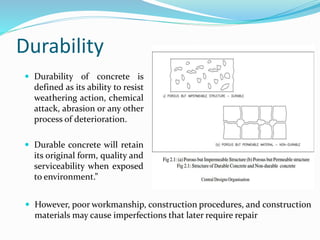
Durability
 Durability of concrete is
defined as its ability to resist
weathering action, chemical
attack, abrasion or any other
process of deterioration.
 Durable concrete will retain
its original form, quality and
serviceability when exposed
to environment.”
 However, poor workmanship, construction procedures, and construction
materials may cause imperfections that later require repair
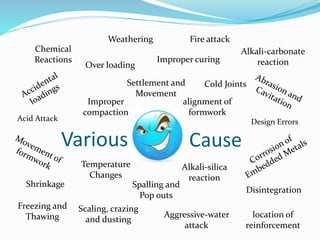
alignment of
formwork
Various
Settlement and
Movement
Improper
compaction
Acid Attack
Spalling and
Pop outs
Disintegration
Alkali-carbonate
reaction
Freezing and
Thawing
Over loading
Chemical
Reactions
Aggressive-water
attack
Temperature
Changes
Design Errors
Shrinkage
Improper curing
Scaling, crazing
and dusting
location of
reinforcement
Fire attack
Weathering
Alkali-silica
reaction
Cold Joints
Cause
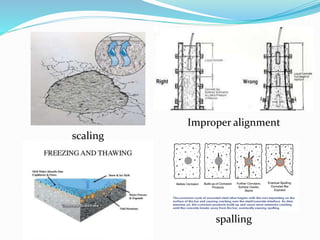
scaling
Improper alignment
spalling
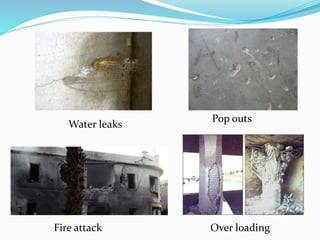
Pop outs
Water leaks
Over loading
Fire attack
Why a repair is required ?
 Restore or improve structural integrity
 Improve appearance
 Improve durability
 Improve functional performance
 Provide water-tightness
EVALUATION OF DAMAGED CONCRETE
 Review existing records
 Visual survey and recording observations
 Detailed crack mapping/measurement
 Surveying movements
 Non-destructive tests
 Evaluation and analysis of data
 Instrumentation/monitoring
- Crack movement
- Deformations
- Stresses
 Timing/costs
Visual Survey
 Cracking
- Type, pattern
- Alignment
- Exudation activity/staining
- Measurement (width, depth)
 Water/moisture
-leakage thru joints /cracks
- Surface dampness
 Surface distress
-Spalling/scaling
-Pop-outs
-Leaching/dissolution
-Abrasion/erosion
- Staining/discoloration
 Metal corrosion
 Movements
-Deflections/deformations
- Misalignments
- Settlement
 Joints
-Leaking
-Movement
 Aesthetics
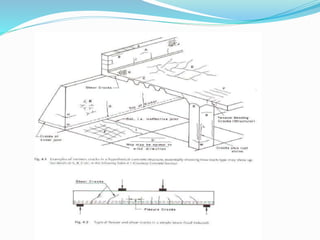
CRACKS IN CONCRETE
All concrete structures crack. Cracks in concrete
have many causes. They may affect the appearance only or
indicate significant structural distress or lack of durability.
Significance of cracks depends on the type of the structure.
Concrete can crack in any or in each of the following three
phases of its life, namely
 plastic-phase while it has still not set
 hardening-phase while if is still green
 hardened-phase and in service
11
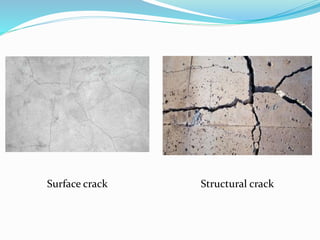
So in general cracks are broadly classified as,
 Surface Cracks (hairline cracks)
 Less than a few millimetres wide.
 Usually don’t cause any severe problems.
 freezing and thawing, poor construction practices,
and alkali-aggregate reactivity are the main cause.
 Structural Cracks
 Larger than 0.25 inch in width.
 They extend deeper into the concrete through wall,
slab, or other structural member.
 Often caused by overloads.
 May worsen in severity due to the forces of weathering
Surface crack Structural crack
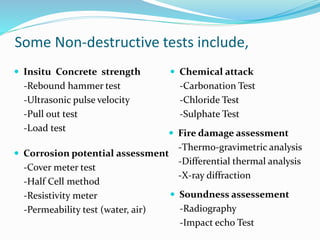
Some Non-destructive tests include,
 Insitu Concrete strength
-Rebound hammer test
-Ultrasonic pulse velocity
-Pull out test
-Load test
 Fire damage assessment
-Thermo-gravimetric analysis
-Differential thermal analysis
-X-ray diffraction
 Corrosion potential assessment
-Cover meter test
-Half Cell method
-Resistivity meter
-Permeability test (water, air)
 Chemical attack
-Carbonation Test
-Chloride Test
-Sulphate Test
 Soundness assessement
-Radiography
-Impact echo Test
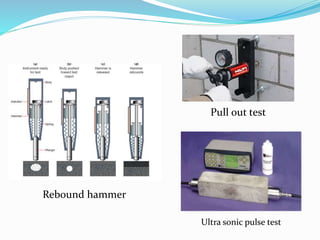
Rebound hammer
Ultra sonic pulse test
Pull out test
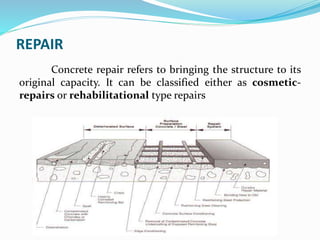
REPAIR
Concrete repair refers to bringing the structure to its
original capacity. It can be classified either as cosmetic-
repairs or rehabilitational type repairs
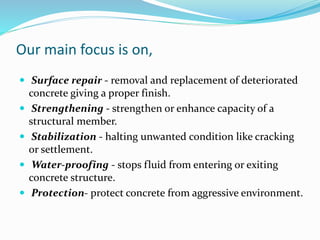
Our main focus is on,
 Surface repair - removal and replacement of deteriorated
concrete giving a proper finish.
 Strengthening - strengthen or enhance capacity of a
structural member.
 Stabilization - halting unwanted condition like cracking
or settlement.
 Water-proofing - stops fluid from entering or exiting
concrete structure.
 Protection- protect concrete from aggressive environment.
The following are commonly used methods for
repairs,
 Dry-Pack Method for deep and narrow cavities
 Preplaced Aggregate Method for restoration of large areas
 Partial or Full Depth Concrete Replacement
 Shotcrete and Gunite
 Crack Sealing and Filling
- epoxy Mortar Injection
- cement Mortar Injection
 Surface Protection by Overlays or by various Sealing coats
 Prestressing for water tanks, slabs, deflection control
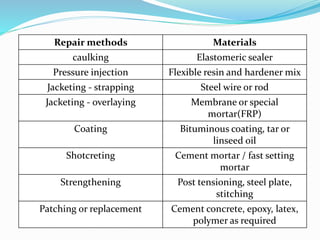
Repair methods Materials
caulking Elastomeric sealer
Pressure injection Flexible resin and hardener mix
Jacketing - strapping Steel wire or rod
Jacketing - overlaying Membrane or special
mortar(FRP)
Coating Bituminous coating, tar or
linseed oil
Shotcreting Cement mortar / fast setting
mortar
Strengthening Post tensioning, steel plate,
stitching
Patching or replacement Cement concrete, epoxy, latex,
polymer as required
Surface repair and its Compatibility
requirements,
 Thermal coefficient of expansion
 Modulus of elasticity
 Drying shrinkage
 Creep
The above property of the parent and repair material
must be almost same in order to reduce the bond shear stress
induced at the junction. Hence the repair material must be
properly selected in accordance to its parental matrix.
21
Strengthening of structural member,
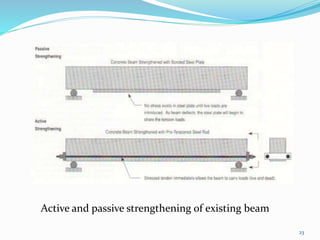
Strengthening refers to upgrading the capacity of a
structure over its original design. It can be active or passive
depending upon the purpose served. Strengthening can be
attempted by the following means:
 ‘replacing’ poor quality or defective material by better
quality material
 ‘attaching’ additional load-bearing material
 ‘re-distribution of the loading actions’ through ‘imposed
deformation’ on the structural system.
22
23
Active and passive strengthening of existing beam
Composite
construction
To add stiffness
and load
capacity
External and
internal
grouting
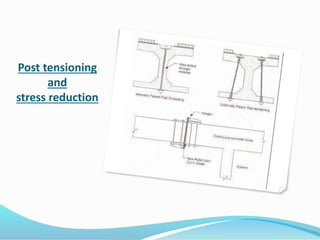
Post tensioning
and
stress reduction
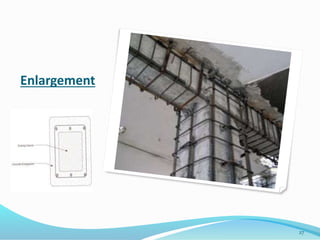
Enlargement
27
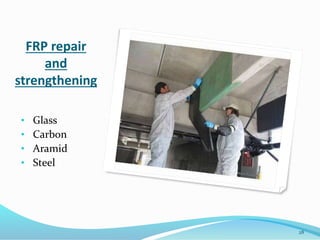
FRP repair
and
strengthening
• Glass
• Carbon
• Aramid
• Steel
28
 FRP laminated products is the state-of-the-art for the
rehabilitating and upgrading concrete structures. They are
very thin (1-3mm) laminates of high strength fibres
embedded in polymer matrix material.
 Laminates are produced by embedding continuous high
strength fibres (i.e. carbon, glass, or aramid) in
thermosetting matrices (i.e. polyester, epoxy).
 The fibres can be arranged in a unidirectional, bi-
directional or off-axis fashion, depending on the load
distribution and strength requirements.
FRP
Advantages of FRP
 Analysis and application is relatively simple.
 Economical as quantity of composite required is less.
 Light weight and hence less labour and hence less cost of
erection comparatively.
 FRP could be installed either with glue or fasteners.
 High durability of FRPs, is valuable in environments that
promote corrosion
 FRP laminates give negligible clearance loss compared to other
forms of rehabilitation, this is particularly important in bridges.
 Strong scratch resistance and improved chemical resistance.
30
Drawbacks of repair and
rehabilitation,
 The main problem in repair works is to achieve
‘compatibility’ and a ‘continuity’ in the structural
behaviour between the original material structure and
the new material/ repaired structure.
 But this can be overcome by proper analysis of
damage/deterioration/distress and suitable repair
analysis
31
OVERALL
Through proper evaluation, design, and
installation; concrete repairs can be made that perform as
well as the surrounding material. A comprehensive
evaluation will identify the areas that require repair, as well as
assist in identifying possible sources of the damage. By
understanding the extent and source of the damage incurred,
a suitable repair using the most appropriate materials can be
designed. Only through proper preparation and execution
will a repair be successful. Many of the repair materials used
have specific requirements that must be carefully followed to
produce a quality repair.
32
CONCLUSION
33

Repair_of_damaged_concrete_structures.pptx

  • 1.
    REPAIR OF DAMAGED CONCRETESTRUCTURES UNDER THE GUIDANCE OF Dr. M.V.N. SIVAKUMAR SUGANTHAN R (161521)
  • 2.
    IMPORTANCE OF CEMENTCONCRETE  Concrete is a composite material that consists essentially of a binding medium, within which are embedded particles or fragments of aggregates. However in cement concrete, which is relevant to RCC structures, the binding medium is the mixture of hydraulic cement (25%) and aggregates (75%).  As we know it is an inexpensive, durable, strong and basic building material often used in dams for core walls, spillways, stilling basins, control towers, slope protection and most construction process.
  • 3.
    Durability  Durability ofconcrete is defined as its ability to resist weathering action, chemical attack, abrasion or any other process of deterioration.  Durable concrete will retain its original form, quality and serviceability when exposed to environment.”  However, poor workmanship, construction procedures, and construction materials may cause imperfections that later require repair
  • 4.
    alignment of formwork Various Settlement and Movement Improper compaction AcidAttack Spalling and Pop outs Disintegration Alkali-carbonate reaction Freezing and Thawing Over loading Chemical Reactions Aggressive-water attack Temperature Changes Design Errors Shrinkage Improper curing Scaling, crazing and dusting location of reinforcement Fire attack Weathering Alkali-silica reaction Cold Joints Cause
  • 5.
  • 6.
    Pop outs Water leaks Overloading Fire attack
  • 7.
    Why a repairis required ?  Restore or improve structural integrity  Improve appearance  Improve durability  Improve functional performance  Provide water-tightness
  • 9.
    EVALUATION OF DAMAGEDCONCRETE  Review existing records  Visual survey and recording observations  Detailed crack mapping/measurement  Surveying movements  Non-destructive tests  Evaluation and analysis of data  Instrumentation/monitoring - Crack movement - Deformations - Stresses  Timing/costs
  • 10.
    Visual Survey  Cracking -Type, pattern - Alignment - Exudation activity/staining - Measurement (width, depth)  Water/moisture -leakage thru joints /cracks - Surface dampness  Surface distress -Spalling/scaling -Pop-outs -Leaching/dissolution -Abrasion/erosion - Staining/discoloration  Metal corrosion  Movements -Deflections/deformations - Misalignments - Settlement  Joints -Leaking -Movement  Aesthetics
  • 11.
    CRACKS IN CONCRETE Allconcrete structures crack. Cracks in concrete have many causes. They may affect the appearance only or indicate significant structural distress or lack of durability. Significance of cracks depends on the type of the structure. Concrete can crack in any or in each of the following three phases of its life, namely  plastic-phase while it has still not set  hardening-phase while if is still green  hardened-phase and in service 11
  • 13.
    So in generalcracks are broadly classified as,  Surface Cracks (hairline cracks)  Less than a few millimetres wide.  Usually don’t cause any severe problems.  freezing and thawing, poor construction practices, and alkali-aggregate reactivity are the main cause.  Structural Cracks  Larger than 0.25 inch in width.  They extend deeper into the concrete through wall, slab, or other structural member.  Often caused by overloads.  May worsen in severity due to the forces of weathering
  • 14.
  • 15.
    Some Non-destructive testsinclude,  Insitu Concrete strength -Rebound hammer test -Ultrasonic pulse velocity -Pull out test -Load test  Fire damage assessment -Thermo-gravimetric analysis -Differential thermal analysis -X-ray diffraction  Corrosion potential assessment -Cover meter test -Half Cell method -Resistivity meter -Permeability test (water, air)  Chemical attack -Carbonation Test -Chloride Test -Sulphate Test  Soundness assessement -Radiography -Impact echo Test
  • 16.
    Rebound hammer Ultra sonicpulse test Pull out test
  • 17.
    REPAIR Concrete repair refersto bringing the structure to its original capacity. It can be classified either as cosmetic- repairs or rehabilitational type repairs
  • 18.
    Our main focusis on,  Surface repair - removal and replacement of deteriorated concrete giving a proper finish.  Strengthening - strengthen or enhance capacity of a structural member.  Stabilization - halting unwanted condition like cracking or settlement.  Water-proofing - stops fluid from entering or exiting concrete structure.  Protection- protect concrete from aggressive environment.

  • 19.
    The following arecommonly used methods for repairs,  Dry-Pack Method for deep and narrow cavities  Preplaced Aggregate Method for restoration of large areas  Partial or Full Depth Concrete Replacement  Shotcrete and Gunite  Crack Sealing and Filling - epoxy Mortar Injection - cement Mortar Injection  Surface Protection by Overlays or by various Sealing coats  Prestressing for water tanks, slabs, deflection control
  • 20.
    Repair methods Materials caulkingElastomeric sealer Pressure injection Flexible resin and hardener mix Jacketing - strapping Steel wire or rod Jacketing - overlaying Membrane or special mortar(FRP) Coating Bituminous coating, tar or linseed oil Shotcreting Cement mortar / fast setting mortar Strengthening Post tensioning, steel plate, stitching Patching or replacement Cement concrete, epoxy, latex, polymer as required
  • 21.
    Surface repair andits Compatibility requirements,  Thermal coefficient of expansion  Modulus of elasticity  Drying shrinkage  Creep The above property of the parent and repair material must be almost same in order to reduce the bond shear stress induced at the junction. Hence the repair material must be properly selected in accordance to its parental matrix. 21
  • 22.
    Strengthening of structuralmember, Strengthening refers to upgrading the capacity of a structure over its original design. It can be active or passive depending upon the purpose served. Strengthening can be attempted by the following means:  ‘replacing’ poor quality or defective material by better quality material  ‘attaching’ additional load-bearing material  ‘re-distribution of the loading actions’ through ‘imposed deformation’ on the structural system. 22
  • 23.
    23 Active and passivestrengthening of existing beam
  • 24.
  • 25.
  • 26.
  • 27.
  • 28.
    FRP repair and strengthening • Glass •Carbon • Aramid • Steel 28
  • 29.
     FRP laminatedproducts is the state-of-the-art for the rehabilitating and upgrading concrete structures. They are very thin (1-3mm) laminates of high strength fibres embedded in polymer matrix material.  Laminates are produced by embedding continuous high strength fibres (i.e. carbon, glass, or aramid) in thermosetting matrices (i.e. polyester, epoxy).  The fibres can be arranged in a unidirectional, bi- directional or off-axis fashion, depending on the load distribution and strength requirements. FRP
  • 30.
    Advantages of FRP Analysis and application is relatively simple.  Economical as quantity of composite required is less.  Light weight and hence less labour and hence less cost of erection comparatively.  FRP could be installed either with glue or fasteners.  High durability of FRPs, is valuable in environments that promote corrosion  FRP laminates give negligible clearance loss compared to other forms of rehabilitation, this is particularly important in bridges.  Strong scratch resistance and improved chemical resistance. 30
  • 31.
    Drawbacks of repairand rehabilitation,  The main problem in repair works is to achieve ‘compatibility’ and a ‘continuity’ in the structural behaviour between the original material structure and the new material/ repaired structure.  But this can be overcome by proper analysis of damage/deterioration/distress and suitable repair analysis 31
  • 32.
    OVERALL Through proper evaluation,design, and installation; concrete repairs can be made that perform as well as the surrounding material. A comprehensive evaluation will identify the areas that require repair, as well as assist in identifying possible sources of the damage. By understanding the extent and source of the damage incurred, a suitable repair using the most appropriate materials can be designed. Only through proper preparation and execution will a repair be successful. Many of the repair materials used have specific requirements that must be carefully followed to produce a quality repair. 32 CONCLUSION
  • 33.