The document discusses the importance of retrofitting reinforced concrete structures to enhance their earthquake resistance and overall safety. It outlines various retrofitting techniques, both global and local, aimed at improving structural performance against seismic activity. The conclusion emphasizes the maturity of seismic retrofitting technology and the need for expertise and proper design codes in the field.
INTRODUCTION
• Earthquake createsgreat devastation in terms of life, money and failures
of structures
• Upgrading of certain building systems (existing structures) to make them
more resistant to seismic activity (earthquake resistance) is really of
more importance.
• Structures can be (a) Earthquake damaged, (b) Earthquake vulnerable
• Retrofitting proves to be a better economic consideration and immediate
shelter to problems rather than replacement of building.
3.
RETROFITTING
IT IS THEMODIFICATION OF EXISTING STRUCTURES TO MAKE THEM MORE RESISTANT TO
SEISMIC ACTIVITY, GROUND MOTION, OR SOIL FAILURE DUE TO EARTHQUAKES.
THE RETROFIT TECHNIQUES ARE ALSO APPLICABLE FOR OTHER NATURAL HAZARDS SUCH AS
TROPICAL CYCLONES, TORNADOES, AND SEVERE WINDS FROM THUNDERSTORMS.
4.
NEED FOR SEISMICRETROFITTING
• To ensure the safety and security of a building, employees,
structure functionality, machinery and inventory
• Essential to reduce hazard and losses from non-structural
elements.
• predominantly concerned with structural improvement to reduce
seismic hazard.
• Important buildings must be strengthened whose services are
assumed to be essential just after an earthquake like hospitals.
5.
PROBLEMS FACED BYSTRUCTURAL
ENGINEERS AND BASIC CONCEPT OF
RETROFITTING
PROBLEMS
• Lack of standards for retrofitting methods
• Effectiveness of each methods varies a lot depending upon parameters like
type of structures, material condition, amount of damage etc.,
BASIC CONCEPT OF RETROFITTING
The aim is at:-
• Upgradation of lateral strength of the structure
• Increase in the ductility of the structure
• Increase in strength and lateral stiffness of a building.
6.
CLASSIFICATION OF RETROFITTING
TECHNIQUES
RETROFITTINGTECHNIQUES ARE CLASSIFIED INTO TWO GROUPS
• GLOBAL RETROFITTING TECHNIQUES:- Global retrofit strategies aim to stiffen the building, by providing additional lateral load resisting elements, or to reduce the irregularities or mass. It includes
• Addiing Infill walls
• Additng Shear walls
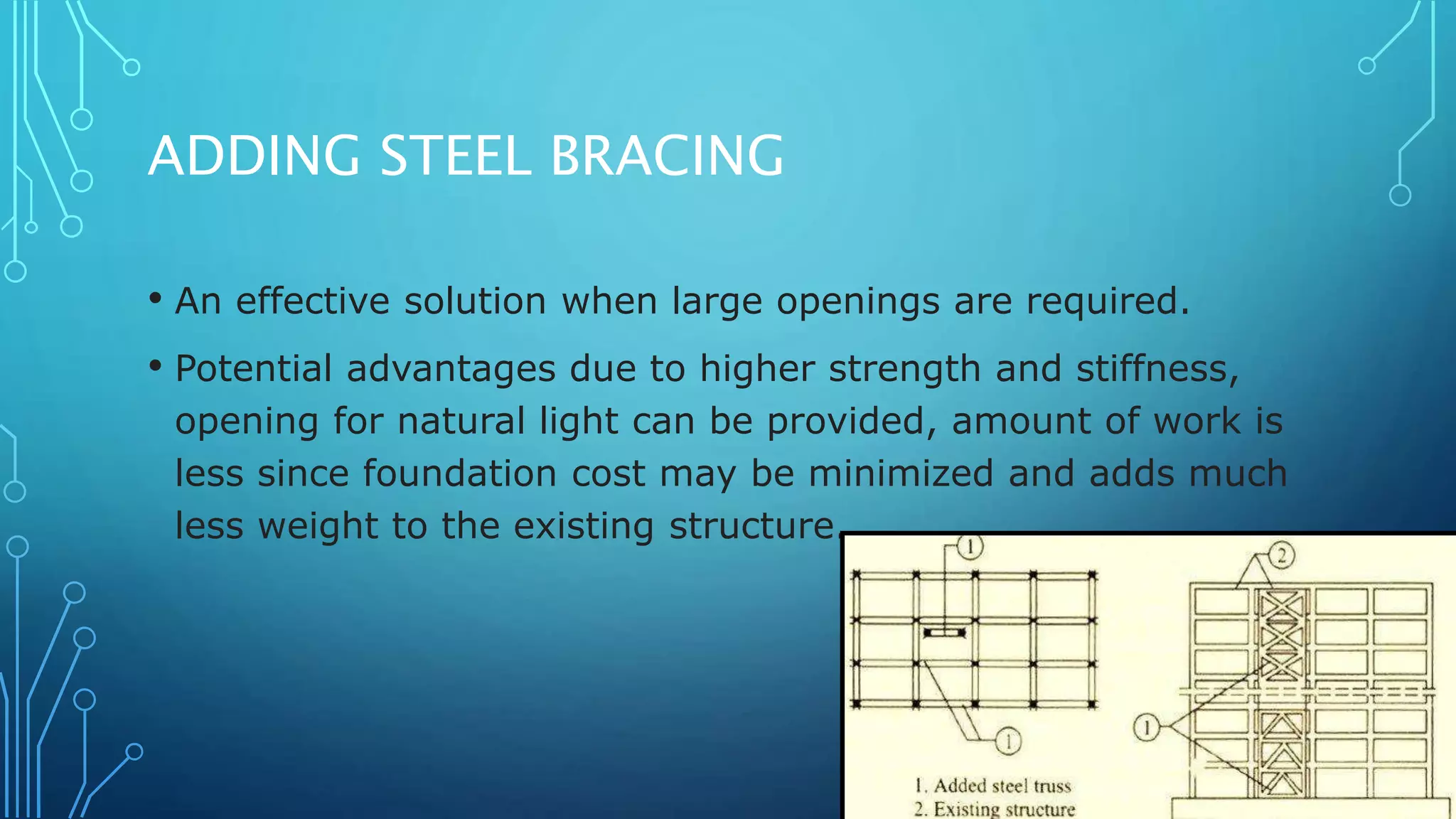
• Adding Steel Bracing
• Reduction of irregularities
• Mass reduction
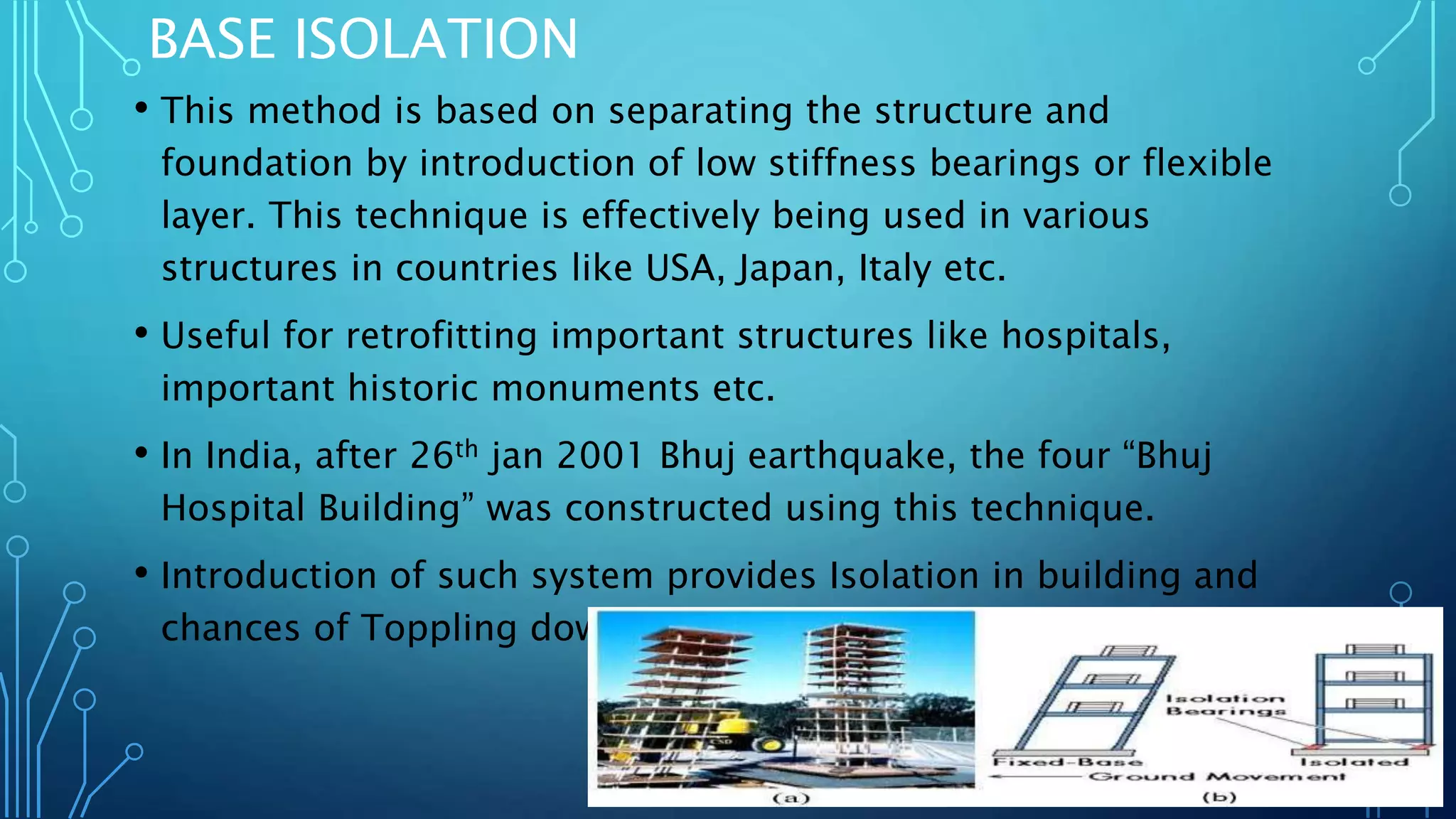
• Base Isolation
LOCAL RETROFITTING TECHNIQUES:- Local retrofit strategies include local strengthening of beams, columns, slabs, beam-to-column or slab-to-column joints, walls and foundations.
Local strengthening allows one or more under-strength elements or connections to resist the strength demands predicted by the analysis, without affecting the overall response of the structure. This scheme tends to be the most economical alternative when
only a few of the building’s elements are deficient.It includes:-
• Jacketing of beams
• Jacketing of columns
• Jacketing of Beam- Column joints
• Strengthning of isolated footings
7.
ADDITION OF INFILLWALL
The infill wall is the supported wall that closes the perimeter of a building constructed with
a three-dimensional framework structure. Therefore, the structural frame ensures the
bearing function, whereas the infill wall serves to separate inner and outer space, filling up
the boxes of the outer frames. The infill wall has the unique static function to bear its own
weight. The infill wall is an external vertical opaque type of closure.
FEATURES:-
• Increases lateral stiffness of the building.
• Due to ‘Strut Action’ of the infill walls, the flexural and shear forces and ductility
demand on the ground story columns are substantially reduced.
• It doesnot increase the ductility of structure.
8.
ADDITION OF SHEARWALL
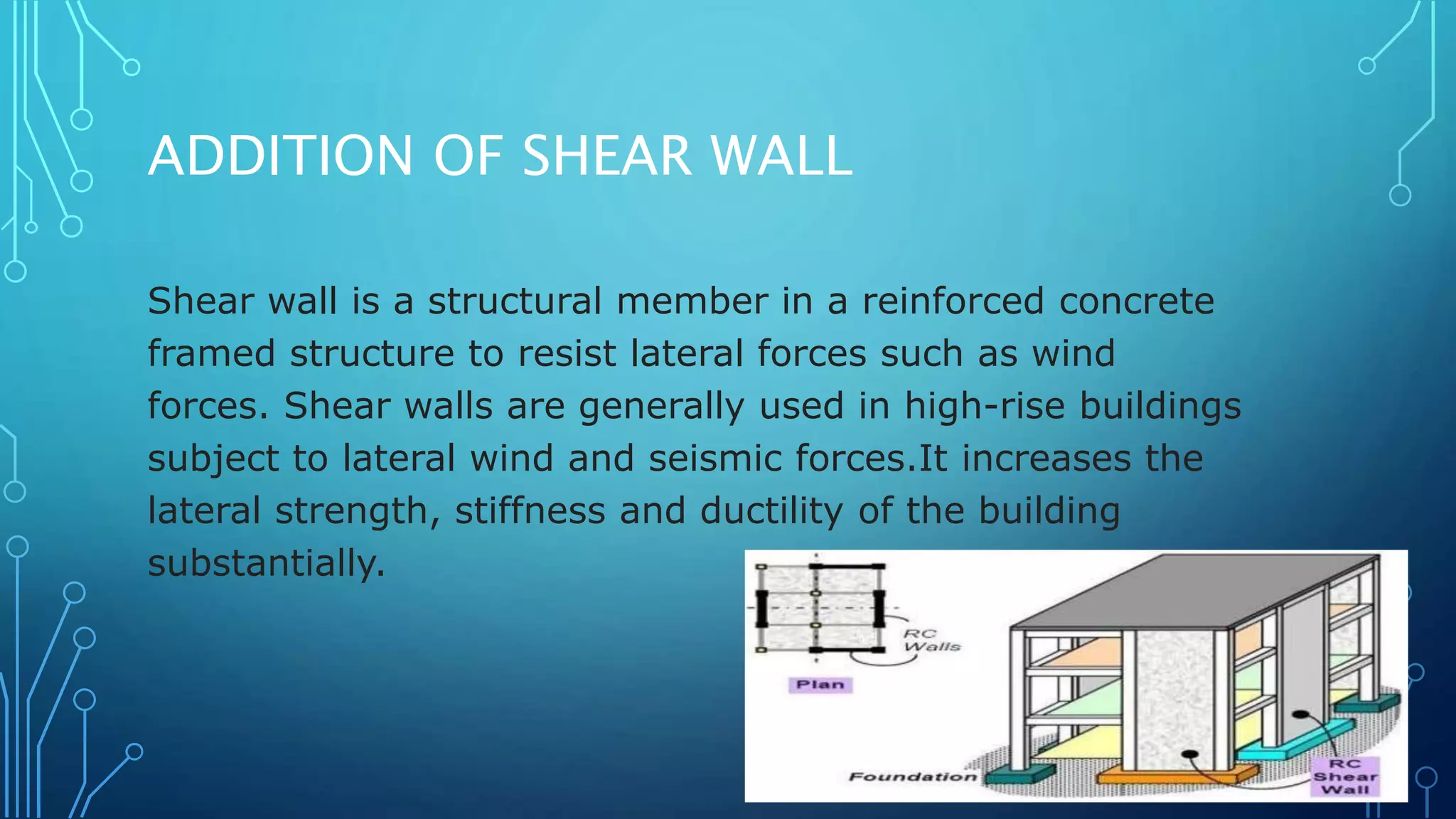
Shear wall is a structural member in a reinforced concrete
framed structure to resist lateral forces such as wind
forces. Shear walls are generally used in high-rise buildings
subject to lateral wind and seismic forces.It increases the
lateral strength, stiffness and ductility of the building
substantially.
9.
ADDING STEEL BRACING
•An effective solution when large openings are required.
• Potential advantages due to higher strength and stiffness,
opening for natural light can be provided, amount of work is
less since foundation cost may be minimized and adds much
less weight to the existing structure.
10.
REDUCTION OF IRREGULARITIESAND MASS
REDUCTION
• Torsional irregularities can be corrected by the addition of frames or
shear walls. Eccentric masses can be relocated. Seismic joints can be
created to transform an irregular building into multiple regular
structures. Partial demolition can also be an effective measure,
although this may have significant impact on the utility of the
building. Discontinuous components such as columns can be
extended beyond the zone of discontinuity. Walls or braces can
alleviate the deficiency of soft and weak storey
• Reduction of mass results in reduction of the lateral force demand,
and therefore, can be used in specific cases in lieu of structural
strengthening.
11.
BASE ISOLATION
• Thismethod is based on separating the structure and
foundation by introduction of low stiffness bearings or flexible
layer. This technique is effectively being used in various
structures in countries like USA, Japan, Italy etc.
• Useful for retrofitting important structures like hospitals,
important historic monuments etc.
• In India, after 26th jan 2001 Bhuj earthquake, the four “Bhuj
Hospital Building” was constructed using this technique.
• Introduction of such system provides Isolation in building and
chances of Toppling down are reduced.
12.
JACKETING (LOCAL RETROFITTING
TECHNIQUE)
•Jacketing a Reinforced concrete member is done to enhance it's strength. This may be
necessary either in case of increase of load or to overcome deficiencies that may
develop over time.
• This is mostly done for compression members like columns in a building, piers and
abutments of bridges. The process is similar to wearing a jacket in extreme weather
conditions and hence the name.
• The old concrete surface is thoroughly cleared of loose material or Cement plaster if any
and cleaned properly. Reinforcement bars both vertical and horizontal are provided as
per design and concrete is poured.
• RCC jacketing can also be carried out for masonry members. Indian Railways have
extensively strengthened the century old bridges this way.
13.
STRENGTHENING OF ISOLATEDFOOTINGS
Generally, strengthening of the foundations might be needed due to the
alterations in serviceability of the buildings. One method of
strengthening can be carried out by constructing a concrete jacket to
the existing footings. Strengthening foundations by installing jackets can
be achieved either without increase in bearing area at the base or
increasing it, whenever the soil has inadequate bearing capacity.
14.
CONCLUSION
• Seismic Retrofittingis a suitable technology for protection of a variety of structures.
• It has matured in the recent years to a highly reliable technology.
• But, the expertise needed is not available in the basic level.
• The main challenge is to achieve a desired performance level at a minimum cost,
which can be achieved through a detailed nonlinear analysis.
• Optimization techniques are needed to know the most efficient retrofit for a particular
structure.
• Proper Design Codes are needed to be published as code of practice for professionals
related to this field