Value pricing at 
Procter & Gamble 
Team Members 
Aditya R: DM16102 
Aditya V: DM16154 
Shalini : DM16141 
Akash K:DM16104 
Himanshu:DM16118 
Vijay:DM16156
P&G: A brief overview 
• P&G is a multinational American corporation 
headquartered in Cincinnati, Ohio 
• Founded in 1837 P&G is well known for 
brands like Tide, Crisco,& Crest 
• It has four broad product categories 
1) Laundry & cleaning 
2) Personal Care 
3) Food & Beverage 
4) Paper
P&G “Value pricing” strategy 
• The setting of a product price, based on the 
benefits it provides to consumers is value 
pricing. 
• P&G wanted to modify its pricing to consistent 
list prices requiring any promotional spending. 
• Value pricing bandwagon in LDL (Light duty 
liquid) & coffee
Consumer 
confidence 
Product safety 
Consistent 
Quality 
Core elements of value pricing for P&G that Durk Jager wanted instead 
of huge spending on trade and consumer promotion.
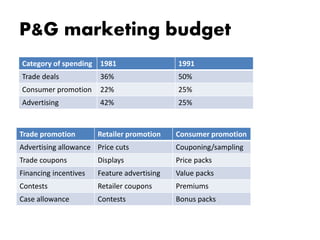
P&G marketing budget 
Category of spending 1981 1991 
Trade deals 36% 50% 
Consumer promotion 22% 25% 
Advertising 42% 25% 
Trade promotion Retailer promotion Consumer promotion 
Advertising allowance Price cuts Couponing/sampling 
Trade coupons Displays Price packs 
Financing incentives Feature advertising Value packs 
Contests Retailer coupons Premiums 
Case allowance Contests Bonus packs
Marketing swamp: Inefficiencies 
of trade spending 
• Increased trade spending of $2.5 billion in 1991 
by P&G lead to the following 
1) Lower profits due to decreased brand loyalty 
because of wide fluctuations in shelf prices. 
2)Informational advantage for powerful retailers 
3)Threat of delisting with promotion cuts 
4) Arbitrary tactics like forward buying & 
diverting
Impact of long term promotions: 
LDL 
• In LDL segment there was 1% decline in sales 
volume due to ADWs. 
• Although total market share increased from 50% to 
53% no significant shift in market share of individual 
brands. 
• In 1991 even though DAWN had 25.9% market share 
only 25% of sales were purchased on promotion. 
• Customers were not strong brand loyal with value 
proposition losing transparency.
Impact of long term promotions: 
LDL 
• Elimination of price packs to avoid deep 
discounting 
• $5 million after tax budget for special coupon 
programs 
• Huge allocation for off-invoice discounts 
• Attempts to reaffirm purchase decisions by 
90% budget allocated for television campaigns
Impact of long term promotions: 
Coffee 
• From 1965 to 1991 per capita coffee 
consumption decreased by 50%. 
• Coffee was highly price sensitive segment with 
28% consumption accounting away from home 
• Highly fragmented market across geographies 
• Huge advertising spending from General foods 
to over $70 million /year with a 48% SOV
Impact of long term promotions: 
Coffee 
• Emerging competitors like Chase & Sanborn 
offering substantial savings with low prices 
and huge promotions (78% sold on deal) 
doubled market shares to 2% nationally. 
• Hence Coffee segment can attract increased 
volume by adopting long term promotional 
strategy
List price reduction 
Pricing LDL COFFEE 
Average unit price 19.34 56.25 
Sales ( In million $) 580.31 964.12 
Realization 340.31 432.78 
Marketing expenditures 186 377.08 
Advertising 30 58.28 
Coupons 36 53.13 
Derived profit 154.31 55.70 
Since the profit margin in LDL is higher list price reduction of 
about 10-15% is possible unlike in Coffee segment where derived 
profit is low because of high marketing expenditures
Pure pricing or pure costing? 
• For reclaiming category leadership P&G must 
resort to pure pricing to ensure customer 
loyalty in terms of value pricing 
• Potential reductions in BDF and off invoice 
with sustainable deal promotions and low list 
prices in both LDL and coffee segment 
• Top off line profit targets could met with less 
riskier credible price cuts around 10-20%
Customer attitude to radical price 
change 
In segments like LDL radical 
price changes will lead to 
increased sales in short run 
but will not be sustainable in 
long run with competitors 
following the same pricing 
But in segments like Coffee which 
is price sensitive radical price cuts 
will help in achieving increased 
sales & customer loyalty
Effect of changes & risks 
• The price reductions & various value pricing 
strategies will result in the following 
1) Constant price wars in LDL category 
2) Low ring of margins for retailers will bear the 
risk of delisting of products 
3) Low profits in Coffee segment 
4) Constant brand switching of customers
Approach for LDL & Coffee 
LDL: 1) Lowering of list prices because of high profit 
margins 
2) substantial reduction in trial purchases with 
increased display space > 80% 
Coffee: 1) Increasing market share through savings deals 
2) As profit margins are low, cost cutting expenditures 
on feature/display expenditures will help increase margins 
& shares
THANK 
YOU !!!

Value pricing in P&G

  • 1.
    Value pricing at Procter & Gamble Team Members Aditya R: DM16102 Aditya V: DM16154 Shalini : DM16141 Akash K:DM16104 Himanshu:DM16118 Vijay:DM16156
  • 2.
    P&G: A briefoverview • P&G is a multinational American corporation headquartered in Cincinnati, Ohio • Founded in 1837 P&G is well known for brands like Tide, Crisco,& Crest • It has four broad product categories 1) Laundry & cleaning 2) Personal Care 3) Food & Beverage 4) Paper
  • 3.
    P&G “Value pricing”strategy • The setting of a product price, based on the benefits it provides to consumers is value pricing. • P&G wanted to modify its pricing to consistent list prices requiring any promotional spending. • Value pricing bandwagon in LDL (Light duty liquid) & coffee
  • 4.
    Consumer confidence Productsafety Consistent Quality Core elements of value pricing for P&G that Durk Jager wanted instead of huge spending on trade and consumer promotion.
  • 5.
    P&G marketing budget Category of spending 1981 1991 Trade deals 36% 50% Consumer promotion 22% 25% Advertising 42% 25% Trade promotion Retailer promotion Consumer promotion Advertising allowance Price cuts Couponing/sampling Trade coupons Displays Price packs Financing incentives Feature advertising Value packs Contests Retailer coupons Premiums Case allowance Contests Bonus packs
  • 6.
    Marketing swamp: Inefficiencies of trade spending • Increased trade spending of $2.5 billion in 1991 by P&G lead to the following 1) Lower profits due to decreased brand loyalty because of wide fluctuations in shelf prices. 2)Informational advantage for powerful retailers 3)Threat of delisting with promotion cuts 4) Arbitrary tactics like forward buying & diverting
  • 7.
    Impact of longterm promotions: LDL • In LDL segment there was 1% decline in sales volume due to ADWs. • Although total market share increased from 50% to 53% no significant shift in market share of individual brands. • In 1991 even though DAWN had 25.9% market share only 25% of sales were purchased on promotion. • Customers were not strong brand loyal with value proposition losing transparency.
  • 8.
    Impact of longterm promotions: LDL • Elimination of price packs to avoid deep discounting • $5 million after tax budget for special coupon programs • Huge allocation for off-invoice discounts • Attempts to reaffirm purchase decisions by 90% budget allocated for television campaigns
  • 9.
    Impact of longterm promotions: Coffee • From 1965 to 1991 per capita coffee consumption decreased by 50%. • Coffee was highly price sensitive segment with 28% consumption accounting away from home • Highly fragmented market across geographies • Huge advertising spending from General foods to over $70 million /year with a 48% SOV
  • 10.
    Impact of longterm promotions: Coffee • Emerging competitors like Chase & Sanborn offering substantial savings with low prices and huge promotions (78% sold on deal) doubled market shares to 2% nationally. • Hence Coffee segment can attract increased volume by adopting long term promotional strategy
  • 11.
    List price reduction Pricing LDL COFFEE Average unit price 19.34 56.25 Sales ( In million $) 580.31 964.12 Realization 340.31 432.78 Marketing expenditures 186 377.08 Advertising 30 58.28 Coupons 36 53.13 Derived profit 154.31 55.70 Since the profit margin in LDL is higher list price reduction of about 10-15% is possible unlike in Coffee segment where derived profit is low because of high marketing expenditures
  • 12.
    Pure pricing orpure costing? • For reclaiming category leadership P&G must resort to pure pricing to ensure customer loyalty in terms of value pricing • Potential reductions in BDF and off invoice with sustainable deal promotions and low list prices in both LDL and coffee segment • Top off line profit targets could met with less riskier credible price cuts around 10-20%
  • 13.
    Customer attitude toradical price change In segments like LDL radical price changes will lead to increased sales in short run but will not be sustainable in long run with competitors following the same pricing But in segments like Coffee which is price sensitive radical price cuts will help in achieving increased sales & customer loyalty
  • 14.
    Effect of changes& risks • The price reductions & various value pricing strategies will result in the following 1) Constant price wars in LDL category 2) Low ring of margins for retailers will bear the risk of delisting of products 3) Low profits in Coffee segment 4) Constant brand switching of customers
  • 15.
    Approach for LDL& Coffee LDL: 1) Lowering of list prices because of high profit margins 2) substantial reduction in trial purchases with increased display space > 80% Coffee: 1) Increasing market share through savings deals 2) As profit margins are low, cost cutting expenditures on feature/display expenditures will help increase margins & shares
  • 16.

Editor's Notes

  • #8 Prices in LDL remained flat despite CPI increase.LDL still remained highly promoted categories with promotion spending increasing from 28% to 40%.
  • #10 Share of voice
  • #13 BDF-Brand development funds
  • #14 Since low costs ranks 2 in customer requirement (exhibit 5)