Introduction
• Hindustan Unilever Limited (HUL) is one of the largest Fast-Moving
Consumer Goods (FMCG) companies in India.
• Established in 1933, HUL operates with a wide portfolio of brands
across various categories.
• The company aims to meet the diverse needs of consumers while
maintaining sustainability and social responsibility.
Product Categories and Characteristics
• HUL's products are categorized into several segments, including
personal care, home care, and food & beverages.
• Each product line is designed to address specific consumer needs,
focusing on quality, affordability, and accessibility.
• Notable brands include Dove, Surf Excel, and Lipton, each known for
their unique qualities and consumer appeal.
Classification of HUL Products
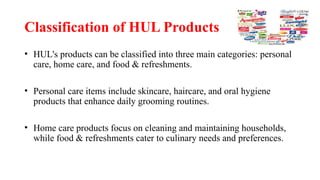
• HUL's products can be classified into three main categories: personal
care, home care, and food & refreshments.
• Personal care items include skincare, haircare, and oral hygiene
products that enhance daily grooming routines.
• Home care products focus on cleaning and maintaining households,
while food & refreshments cater to culinary needs and preferences.
FMCG Product Differentiation
• HUL differentiates its FMCG products through innovative marketing
strategies and consumer engagement.
• The company invests in research and development to introduce new
features and improve existing products, enhancing consumer
satisfaction.
• By leveraging brand equity and sustainability initiatives, HUL
maintains a competitive edge in the ever-evolving FMCG market.
Positioning
• position statement of Unilever? : Unilever's mission statement has
the following important components: Increasing life's vitality.
Providing for daily nutritional, hygienic, and personal care
requirements. Assisting individuals in feeling better, looking better,
and getting more out of life.
• Brand positioning : Unilever will continue to place “vitality” at the
heart of all its brand positionings, according to its president for home
and personal care. Unilever will continue to place “vitality” at the
heart of all its brand positionings, according to its president for home
and personal care.
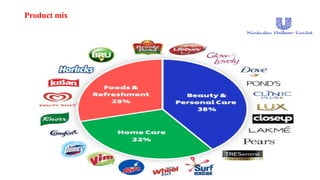
Product mix
Line extension
New flavors for existing food products, like new ice cream flavors under the
Quality Wall's brand.
Additional scents for personal care items, such as new fragrances in Dove
soaps.
Different packaging sizes for household products, like smaller sachets of Surf
Excel detergent.
Specialized variants, like Fair & Lovely's Ayurvedic variant for skincare.-
Seasonal or limited edition product versions, like winter care variants of
Vaseline.
Health-focused options, such as fortified variants of Horlicks.
Premium versions of regular products, like premium Lux soaps with essential
oils.
Competition and Product Strategy
Procter & Gamble (P&G): Competes with HUL in personal care,
home care, and health care segments.
ITC Limited: Competes in the FMCG sector, especially in personal
care and food products.
Dabur: A significant competitor in the health care and personal care
segments.
Nestle: Competes in the food and beverages sector.
Colgate-Palmolive: Competes primarily in oral care.
Product strategy :
Focuses on product differentiation through quality, packaging, and brand image.
Targets various consumer segments, from premium to mass market, with an emphasis on
health, wellness, and sustainability.
Offers a wide range of products in personal care, home care, food, and beverages.
Frequently extends product lines with new flavors, formulations, and packaging sizes.
Continuously evaluates and manages products through different life cycle stages, launching
new products and phasing out underperforming ones.
Invests heavily in research and development to innovate and enhance products.
Employs extensive advertising across multiple media channels to build brand awareness
and loyalty, designing promotional strategies tailored to different consumer segments.
Uses competitive pricing to offer value for money, applying premium pricing for high-
end products and competitive pricing for mass-market products.
Maintains a robust distribution network to ensure product availability in both urban and
rural markets, partnering with e-commerce platforms to enhance reach and convenience
The product in theory & practice
HUL's (Hindustan Unilever Limited) product in theory and practice can
be summarized as strategy that combines theoretical principles
(innovation, quality, consumer satisfaction) with practical applications
(diverse portfolio, strong branding, wide distribution) to create products
that meet consumer needs and drive business growth.
In theory:
Product: A solution that meets consumer needs and wants
Focus on innovation, quality, and consumer satisfaction
In Practice:
Personal Care (e.g., Lux, Lifebuoy, Axe)
Foods (e.g., Knorr, Kissan)
Beverages (e.g., Lipton, Bru)
Home Care (e.g., Surf Excel, Rin)
Emphasis on: - Innovation (new products, features, and packaging)
Quality (meeting high standards)
Consumer satisfaction (meeting needs and wants)
Strong branding and marketing
Wide distribution and availability
Buying Behavior
Consumer Research: HUL conducts surveys, focus groups, and data
analysis to understand consumer needs and preferences.
Segmentation: The market is segmented by demographics,
psychographics, geography, and behavior to tailor products effectively.
Targeting: HUL targets specific consumer groups, offering products for the
mass market, niche markets, and different segments like premium and
budget-conscious buyers.
Product Innovation: Focus on new product development, product
improvements, and eco-friendly products to meet changing consumer
demands.
Brand Loyalty: HUL builds strong brand loyalty through quality
assurance, consistent brand communication, and customer engagement via
social media and loyalty programs.
Distribution Network: An extensive distribution network ensures
product availability through direct distribution, rural penetration, and
online channels.
Promotional Activities: Extensive advertising, sales promotions,
public relations, and event sponsorships are used to boost brand
visibility and sales.
Pricing Strategy: Competitive pricing strategies are used, setting
prices based on perceived value, aligning with competitors, and
offering promotions to attract price-sensitive customers.
Feedback Mechanism: Effective feedback mechanisms like
customer surveys, online reviews, and social media monitoring are
implemented to gather feedback and improve products.
Product Life Cycle Theory and Practice
The Product Life Cycle (PLC) is a conceptual framework that
describes the stages a product goes through from its introduction to the
market until its eventual decline.
• Introduction: The product is launched, and sales are low. Marketing focus
is on creating awareness.
• Growth: Sales rapidly increase as the product gains acceptance.
Competition may start to enter the market.
• Maturity: Sales growth slows down as the market becomes saturated.
Competition intensifies.
• Decline: Sales start to decline due to changing consumer preferences or new
product introductions. HUL's Mastery of the Product Life Cycle Hindustan
Unilever Limited (HUL) is a prime example of a company that has
effectively managed its product portfolio through the various stages of the
PLC.
Examples
• Lifebuoy
Introduction: Initially positioned as a male hygiene product, Lifebuoy faced
declining sales.
Rejuvenation: HUL repositioned Lifebuoy as a family hygiene brand and
introduced new variants. This marked the growth stage.
Maturity: Lifebuoy continues to be a market leader, but HUL constantly
introduces new variants and promotions to maintain its position.
• Fair & Lovely
Introduction: The product was revolutionary in the Indian context, targeting
fairness as a beauty ideal.
Growth: Rapidly gained popularity and became a household name.
Maturity: Faced increasing competition and changing consumer preferences.
HUL has been rebranding and repositioning the product to address these
challenges.
HUL's Strategies for Product Life Cycle Management:
• Continuous Innovation: HUL invests heavily in research and development
to introduce new products and variants, ensuring a steady pipeline.
• Brand Extensions: Leveraging strong brand equity, HUL extends product
lines into new categories.
• Market Segmentation and Targeting: Identifying different customer
segments and tailoring products accordingly helps to extend the product life
cycle.
• Pricing Strategies: Adjusting prices based on the product life cycle stage is
crucial. For instance, premium pricing during the introduction stage and
competitive pricing during the maturity stage.
• Distribution and Promotion: Effective distribution channels and
persuasive advertising are essential for product success
Product portfolio and product brand relationship of HUL
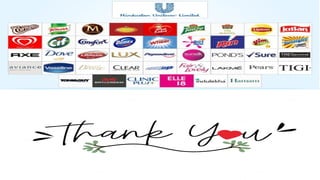
• Home Care:
Detergents: Surf Excel, Rin, Wheel, Sunlight
Household cleaners: Cif, Domex
Dishwash: Vim, Cif
• Personal Care & Hair care: Sun-silk, Dove, Clinic Plus, Clear
• Skin care: Fair & Lovely, Dove, Lakme. Oral care: Pepsodent, Closeup
• Deodorants: Axe, Rexona. Soaps: Lux, Lifebuoy, Dove, Pears
• Foods and Beverages:
• Tea: Brooke Bond, Lipton, Taj Mahal, Taaza
• Coffee: Bru
• Ice cream: Quality Walls
• Foods: Knorr, Kissan
Product Hierarchy
1. Product Lines:
 Personal Care: Skin care, hair care, oral care, deodorants, soaps.
 Home Care: Fabric solutions, household care, purifiers.
 Foods & Refreshments: Beverages, ice creams, foods.
2. Brands:
 Personal Care: Dove, Lifebuoy, Lux, Sunsilk, Pepsodent.
 Home Care: Surf Excel, Rin, Vim, Domex.
 Foods & Refreshments: Lipton, Brooke Bond, Kwality Wall’s, Kissan, Knorr.
3. Product Types:
Example: Dove offers shampoos, conditioners, body lotions.
4. Product Variants:
Example: Dove shampoo variants include Daily Shine, Intense Repair, Anti-Dandruff.
Product Mix Pricing
1. Value Pricing: Affordable products for the mass market (e.g., Lifebuoy,
Wheel detergent).
2. Premium Pricing: Higher-priced, premium products (e.g., Dove, Surf Excel).
3. Competitive Pricing: Prices set to compete with rivals.
4. Promotional Pricing: Discounts and offers during special occasions.
Co-Branding
5. Joint Promotions: Collaborations with retail chains for in-store
promotions.
6. Celebrity Endorsements: Using celebrities to endorse multiple brands.
Ingredient Branding
 Active Ingredients: Highlighting key active ingredients (e.g., "Micro
Moisture" in Dove Men+Care).
 Natural Ingredients: Emphasizing natural ingredients (e.g.,
Ayurvedic ingredients in Lever Ayush).
 Health Benefits: Showcasing health benefits (e.g., Pepsodent's germ-
fighting ingredients).
Prodct Management.pptx Prodct Management.

Prodct Management.pptx Prodct Management.

  • 2.
    Introduction • Hindustan UnileverLimited (HUL) is one of the largest Fast-Moving Consumer Goods (FMCG) companies in India. • Established in 1933, HUL operates with a wide portfolio of brands across various categories. • The company aims to meet the diverse needs of consumers while maintaining sustainability and social responsibility.
  • 3.
    Product Categories andCharacteristics • HUL's products are categorized into several segments, including personal care, home care, and food & beverages. • Each product line is designed to address specific consumer needs, focusing on quality, affordability, and accessibility. • Notable brands include Dove, Surf Excel, and Lipton, each known for their unique qualities and consumer appeal.
  • 4.
    Classification of HULProducts • HUL's products can be classified into three main categories: personal care, home care, and food & refreshments. • Personal care items include skincare, haircare, and oral hygiene products that enhance daily grooming routines. • Home care products focus on cleaning and maintaining households, while food & refreshments cater to culinary needs and preferences.
  • 5.
    FMCG Product Differentiation •HUL differentiates its FMCG products through innovative marketing strategies and consumer engagement. • The company invests in research and development to introduce new features and improve existing products, enhancing consumer satisfaction. • By leveraging brand equity and sustainability initiatives, HUL maintains a competitive edge in the ever-evolving FMCG market.
  • 6.
    Positioning • position statementof Unilever? : Unilever's mission statement has the following important components: Increasing life's vitality. Providing for daily nutritional, hygienic, and personal care requirements. Assisting individuals in feeling better, looking better, and getting more out of life. • Brand positioning : Unilever will continue to place “vitality” at the heart of all its brand positionings, according to its president for home and personal care. Unilever will continue to place “vitality” at the heart of all its brand positionings, according to its president for home and personal care.
  • 7.
  • 8.
    Line extension New flavorsfor existing food products, like new ice cream flavors under the Quality Wall's brand. Additional scents for personal care items, such as new fragrances in Dove soaps. Different packaging sizes for household products, like smaller sachets of Surf Excel detergent. Specialized variants, like Fair & Lovely's Ayurvedic variant for skincare.- Seasonal or limited edition product versions, like winter care variants of Vaseline. Health-focused options, such as fortified variants of Horlicks. Premium versions of regular products, like premium Lux soaps with essential oils.
  • 9.
    Competition and ProductStrategy Procter & Gamble (P&G): Competes with HUL in personal care, home care, and health care segments. ITC Limited: Competes in the FMCG sector, especially in personal care and food products. Dabur: A significant competitor in the health care and personal care segments. Nestle: Competes in the food and beverages sector. Colgate-Palmolive: Competes primarily in oral care.
  • 10.
    Product strategy : Focuseson product differentiation through quality, packaging, and brand image. Targets various consumer segments, from premium to mass market, with an emphasis on health, wellness, and sustainability. Offers a wide range of products in personal care, home care, food, and beverages. Frequently extends product lines with new flavors, formulations, and packaging sizes. Continuously evaluates and manages products through different life cycle stages, launching new products and phasing out underperforming ones. Invests heavily in research and development to innovate and enhance products.
  • 11.
    Employs extensive advertisingacross multiple media channels to build brand awareness and loyalty, designing promotional strategies tailored to different consumer segments. Uses competitive pricing to offer value for money, applying premium pricing for high- end products and competitive pricing for mass-market products. Maintains a robust distribution network to ensure product availability in both urban and rural markets, partnering with e-commerce platforms to enhance reach and convenience
  • 12.
    The product intheory & practice HUL's (Hindustan Unilever Limited) product in theory and practice can be summarized as strategy that combines theoretical principles (innovation, quality, consumer satisfaction) with practical applications (diverse portfolio, strong branding, wide distribution) to create products that meet consumer needs and drive business growth. In theory: Product: A solution that meets consumer needs and wants Focus on innovation, quality, and consumer satisfaction
  • 13.
    In Practice: Personal Care(e.g., Lux, Lifebuoy, Axe) Foods (e.g., Knorr, Kissan) Beverages (e.g., Lipton, Bru) Home Care (e.g., Surf Excel, Rin) Emphasis on: - Innovation (new products, features, and packaging) Quality (meeting high standards) Consumer satisfaction (meeting needs and wants) Strong branding and marketing Wide distribution and availability
  • 14.
    Buying Behavior Consumer Research:HUL conducts surveys, focus groups, and data analysis to understand consumer needs and preferences. Segmentation: The market is segmented by demographics, psychographics, geography, and behavior to tailor products effectively. Targeting: HUL targets specific consumer groups, offering products for the mass market, niche markets, and different segments like premium and budget-conscious buyers. Product Innovation: Focus on new product development, product improvements, and eco-friendly products to meet changing consumer demands. Brand Loyalty: HUL builds strong brand loyalty through quality assurance, consistent brand communication, and customer engagement via social media and loyalty programs.
  • 15.
    Distribution Network: Anextensive distribution network ensures product availability through direct distribution, rural penetration, and online channels. Promotional Activities: Extensive advertising, sales promotions, public relations, and event sponsorships are used to boost brand visibility and sales. Pricing Strategy: Competitive pricing strategies are used, setting prices based on perceived value, aligning with competitors, and offering promotions to attract price-sensitive customers. Feedback Mechanism: Effective feedback mechanisms like customer surveys, online reviews, and social media monitoring are implemented to gather feedback and improve products.
  • 16.
    Product Life CycleTheory and Practice The Product Life Cycle (PLC) is a conceptual framework that describes the stages a product goes through from its introduction to the market until its eventual decline. • Introduction: The product is launched, and sales are low. Marketing focus is on creating awareness. • Growth: Sales rapidly increase as the product gains acceptance. Competition may start to enter the market. • Maturity: Sales growth slows down as the market becomes saturated. Competition intensifies. • Decline: Sales start to decline due to changing consumer preferences or new product introductions. HUL's Mastery of the Product Life Cycle Hindustan Unilever Limited (HUL) is a prime example of a company that has effectively managed its product portfolio through the various stages of the PLC.
  • 17.
    Examples • Lifebuoy Introduction: Initiallypositioned as a male hygiene product, Lifebuoy faced declining sales. Rejuvenation: HUL repositioned Lifebuoy as a family hygiene brand and introduced new variants. This marked the growth stage. Maturity: Lifebuoy continues to be a market leader, but HUL constantly introduces new variants and promotions to maintain its position. • Fair & Lovely Introduction: The product was revolutionary in the Indian context, targeting fairness as a beauty ideal. Growth: Rapidly gained popularity and became a household name. Maturity: Faced increasing competition and changing consumer preferences. HUL has been rebranding and repositioning the product to address these challenges.
  • 18.
    HUL's Strategies forProduct Life Cycle Management: • Continuous Innovation: HUL invests heavily in research and development to introduce new products and variants, ensuring a steady pipeline. • Brand Extensions: Leveraging strong brand equity, HUL extends product lines into new categories. • Market Segmentation and Targeting: Identifying different customer segments and tailoring products accordingly helps to extend the product life cycle. • Pricing Strategies: Adjusting prices based on the product life cycle stage is crucial. For instance, premium pricing during the introduction stage and competitive pricing during the maturity stage. • Distribution and Promotion: Effective distribution channels and persuasive advertising are essential for product success
  • 19.
    Product portfolio andproduct brand relationship of HUL • Home Care: Detergents: Surf Excel, Rin, Wheel, Sunlight Household cleaners: Cif, Domex Dishwash: Vim, Cif • Personal Care & Hair care: Sun-silk, Dove, Clinic Plus, Clear • Skin care: Fair & Lovely, Dove, Lakme. Oral care: Pepsodent, Closeup • Deodorants: Axe, Rexona. Soaps: Lux, Lifebuoy, Dove, Pears • Foods and Beverages: • Tea: Brooke Bond, Lipton, Taj Mahal, Taaza • Coffee: Bru • Ice cream: Quality Walls • Foods: Knorr, Kissan
  • 20.
    Product Hierarchy 1. ProductLines:  Personal Care: Skin care, hair care, oral care, deodorants, soaps.  Home Care: Fabric solutions, household care, purifiers.  Foods & Refreshments: Beverages, ice creams, foods. 2. Brands:  Personal Care: Dove, Lifebuoy, Lux, Sunsilk, Pepsodent.  Home Care: Surf Excel, Rin, Vim, Domex.  Foods & Refreshments: Lipton, Brooke Bond, Kwality Wall’s, Kissan, Knorr. 3. Product Types: Example: Dove offers shampoos, conditioners, body lotions. 4. Product Variants: Example: Dove shampoo variants include Daily Shine, Intense Repair, Anti-Dandruff.
  • 21.
    Product Mix Pricing 1.Value Pricing: Affordable products for the mass market (e.g., Lifebuoy, Wheel detergent). 2. Premium Pricing: Higher-priced, premium products (e.g., Dove, Surf Excel). 3. Competitive Pricing: Prices set to compete with rivals. 4. Promotional Pricing: Discounts and offers during special occasions. Co-Branding 5. Joint Promotions: Collaborations with retail chains for in-store promotions. 6. Celebrity Endorsements: Using celebrities to endorse multiple brands.
  • 22.
    Ingredient Branding  ActiveIngredients: Highlighting key active ingredients (e.g., "Micro Moisture" in Dove Men+Care).  Natural Ingredients: Emphasizing natural ingredients (e.g., Ayurvedic ingredients in Lever Ayush).  Health Benefits: Showcasing health benefits (e.g., Pepsodent's germ- fighting ingredients).