Next Gen Architecture For
Enterprise Business
Application
Submitted by: Group 7
Akshat Agarwal
Shalini Tripathy
Srinandan G
Apoorva Singhal
History Of Oracle
 Larry Ellison cofounded Oracle corporation in 1977 along with Ed
Oates, Bob Miner under the name Software development
laboratories.
 SDL changed its name to Relational software Inc in 1979 & then
again to Oracle corp. to align closely with its flagship product
Oracle Database.
 Oracle corporation is headquartered in California, USA &
specializes in developing & marketing hardware & enterprise
software products.
 By 2011 Oracle was the second largest software maker by revenue
after Microsoft.
Oracle : USP & Benefits
 Oracle provides a host of programs like Oracle Accelerate, Oracle
on Demand, Oracle Business accelerators in areas covering product
development, optimization & service.
 Hence companies are left with a plethora of options to choose the
best alternative to suit their business strategy.
 For mid sized companies Oracle offers not only the flexibility &
affordability of a technology platform but also the robust tools to
standardize best practices, reduce costs while optimizing order to
flow & order to delivery processes.
 Oracle solutions enhance the order to delivery cycle by simplifying
multi tier supply chain planning and streamlining execution.
 Oracle helps in consolidating customer data for providing a 360
view of customer channels across multiple channels.
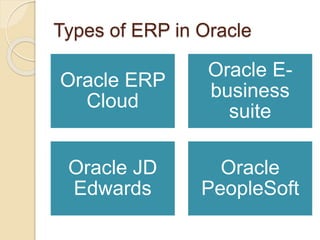
Types of ERP in Oracle
Oracle ERP
Cloud
Oracle E-
business
suite
Oracle JD
Edwards
Oracle
PeopleSoft
Case In Point: Infosys’ Oracle E-
Business Suite for Money Gram
International
 Context:
 Money Gram International (MGI) was a US based
international payment service provider was looking to
built a future ready IT landscape.
 It wanted to enhance efficiency & flexibility by cost
cuts, strengthen revenue by complying with international
regulations.
 MGI also wanted a robust, scalable & flexible ledger &
legal entity structure to meet legal & operational
requirements.
 MGI partnered with Infosys to streamline & automate
the business process.
Challenges in hand for MGI
 With numerous business processes in hand MGI had a
complex & disparate IT landscape.
 MGI had Oracle E-business 11i for financials in Canada,
& US while there were different applications used in
different countries.
 Multiple acquisitions had lead to many non-synchronous
processes across the organization.
 Its ledger structure was not scalable enough to meet the
statutory compliance of European Payment services.
Requirements for MGI
 MGI wanted to automate its settlement processes by
building on agile, scalable & standardized processes.
 Deploying an ERP that gives scalability to meet
statutory compliance of European PSD.
 Building a platform to handle bigger projects.
 Implementation of Oracle receivables, Oracle incentive
compensation & Oracle customer online.
 Enhance financial architecture to improve efficiency &
productivity.
 Consolidate a ledger structure that accommodates global
as well as country specific requirements.
The Infosys Approach for MGI
 MGI engaged Infosys to design and implement its
business transformation program.
 Infosys had experience in with Oracle E-Business Suite
Release 12 upgrades, thought leadership demonstrated
during the assessment phase and its reputation in
providing effective solutions within aggressive
timelines.
 Leveraging the Global Delivery Model (GDM) and
using a hybrid delivery approach of both, onsite and
remote units, the 25-member Infosys team completed the
upgrade in a short span of 90 days.
The Infosys Approach for MGI
 The solution got implemented in a phased manner by
performing an Oracle E-Business Suite Release 12
upgrade of Financials, redesign of Chart of Accounts,
Organization and Ledger structures and the global
rollout of Oracle Financials.
 The final phase was automation of the company’s core
business of settlement processing by implementing
Oracle Receivables, Oracle Incentive Compensation and
Oracle Customer Online
Benefits of implementing
Oracle
 It upgraded the client’s existing system and leveraged
functionalities in the newer version while extending the
solution to 14 additional countries at once.
 The global rollout of applications eliminated the lethargy
of applications, enabled single source of truth for master
data and transactions.
 The Chart of Accounts restructure brought about
considerable savings in efforts in reconciliation and
reporting and increased the efficiency of the
consolidation processes
As a consultant whom do we
recommend E-business suite to?
We will offer client E business suite if the client focus points are
 Ease of Application: Oracle is easy to use as compared to SAP and more
flexible.
 Organization requiring combination of database and ERP:- Oracle is leader in
database and their fusion application will help customer to gain benefit of both
application and data base.
 Organization which require less customization:- Compare to other ERP like
SAP, oracle has less customization but faster deployment process.
 Large data base: - Oracle databases can handle large memory and have very
fast processing speed. With lightening fast scan speed of up to 100 million
rows/second and up to 10x columnar compression, Oracle delivers faster
reports & dashboards for clients.
 Mobility: - Oracle has released mobile apps(mobile computing) for their ERP
product which can help business on the move. Like salesman can see customer
location on smart phone.
 Strong functions for oracle are Financial, Supply chain and Human
Resource.(More details in Next slide)
Oracle Cloud?
 Low cost is the key driver for Oracle ERP Cloud
 No hardware or software to install
 Continual, automatic upgrades and faster
implementation
 Reduced opportunity for customization
 Less control over data and security as compared to E-
suite.

Next gen architecture for enterprise business application

  • 1.
    Next Gen ArchitectureFor Enterprise Business Application Submitted by: Group 7 Akshat Agarwal Shalini Tripathy Srinandan G Apoorva Singhal
  • 2.
    History Of Oracle Larry Ellison cofounded Oracle corporation in 1977 along with Ed Oates, Bob Miner under the name Software development laboratories.  SDL changed its name to Relational software Inc in 1979 & then again to Oracle corp. to align closely with its flagship product Oracle Database.  Oracle corporation is headquartered in California, USA & specializes in developing & marketing hardware & enterprise software products.  By 2011 Oracle was the second largest software maker by revenue after Microsoft.
  • 3.
    Oracle : USP& Benefits  Oracle provides a host of programs like Oracle Accelerate, Oracle on Demand, Oracle Business accelerators in areas covering product development, optimization & service.  Hence companies are left with a plethora of options to choose the best alternative to suit their business strategy.  For mid sized companies Oracle offers not only the flexibility & affordability of a technology platform but also the robust tools to standardize best practices, reduce costs while optimizing order to flow & order to delivery processes.  Oracle solutions enhance the order to delivery cycle by simplifying multi tier supply chain planning and streamlining execution.  Oracle helps in consolidating customer data for providing a 360 view of customer channels across multiple channels.
  • 4.
    Types of ERPin Oracle Oracle ERP Cloud Oracle E- business suite Oracle JD Edwards Oracle PeopleSoft
  • 6.
    Case In Point:Infosys’ Oracle E- Business Suite for Money Gram International  Context:  Money Gram International (MGI) was a US based international payment service provider was looking to built a future ready IT landscape.  It wanted to enhance efficiency & flexibility by cost cuts, strengthen revenue by complying with international regulations.  MGI also wanted a robust, scalable & flexible ledger & legal entity structure to meet legal & operational requirements.  MGI partnered with Infosys to streamline & automate the business process.
  • 7.
    Challenges in handfor MGI  With numerous business processes in hand MGI had a complex & disparate IT landscape.  MGI had Oracle E-business 11i for financials in Canada, & US while there were different applications used in different countries.  Multiple acquisitions had lead to many non-synchronous processes across the organization.  Its ledger structure was not scalable enough to meet the statutory compliance of European Payment services.
  • 8.
    Requirements for MGI MGI wanted to automate its settlement processes by building on agile, scalable & standardized processes.  Deploying an ERP that gives scalability to meet statutory compliance of European PSD.  Building a platform to handle bigger projects.  Implementation of Oracle receivables, Oracle incentive compensation & Oracle customer online.  Enhance financial architecture to improve efficiency & productivity.  Consolidate a ledger structure that accommodates global as well as country specific requirements.
  • 9.
    The Infosys Approachfor MGI  MGI engaged Infosys to design and implement its business transformation program.  Infosys had experience in with Oracle E-Business Suite Release 12 upgrades, thought leadership demonstrated during the assessment phase and its reputation in providing effective solutions within aggressive timelines.  Leveraging the Global Delivery Model (GDM) and using a hybrid delivery approach of both, onsite and remote units, the 25-member Infosys team completed the upgrade in a short span of 90 days.
  • 10.
    The Infosys Approachfor MGI  The solution got implemented in a phased manner by performing an Oracle E-Business Suite Release 12 upgrade of Financials, redesign of Chart of Accounts, Organization and Ledger structures and the global rollout of Oracle Financials.  The final phase was automation of the company’s core business of settlement processing by implementing Oracle Receivables, Oracle Incentive Compensation and Oracle Customer Online
  • 11.
    Benefits of implementing Oracle It upgraded the client’s existing system and leveraged functionalities in the newer version while extending the solution to 14 additional countries at once.  The global rollout of applications eliminated the lethargy of applications, enabled single source of truth for master data and transactions.  The Chart of Accounts restructure brought about considerable savings in efforts in reconciliation and reporting and increased the efficiency of the consolidation processes
  • 12.
    As a consultantwhom do we recommend E-business suite to? We will offer client E business suite if the client focus points are  Ease of Application: Oracle is easy to use as compared to SAP and more flexible.  Organization requiring combination of database and ERP:- Oracle is leader in database and their fusion application will help customer to gain benefit of both application and data base.  Organization which require less customization:- Compare to other ERP like SAP, oracle has less customization but faster deployment process.  Large data base: - Oracle databases can handle large memory and have very fast processing speed. With lightening fast scan speed of up to 100 million rows/second and up to 10x columnar compression, Oracle delivers faster reports & dashboards for clients.  Mobility: - Oracle has released mobile apps(mobile computing) for their ERP product which can help business on the move. Like salesman can see customer location on smart phone.  Strong functions for oracle are Financial, Supply chain and Human Resource.(More details in Next slide)
  • 13.
    Oracle Cloud?  Lowcost is the key driver for Oracle ERP Cloud  No hardware or software to install  Continual, automatic upgrades and faster implementation  Reduced opportunity for customization  Less control over data and security as compared to E- suite.