Solutions to Ghana’s trade imbalance 
The Chief Executive Officer of the Ghana Export Promotion Authority, Mr. Gideon Quarcoo on July 
16th 2014 asked Ghanaians to embrace import substitution as a sure solution to tilting Ghana’s 
balance of trade in its favour. “Buy, use and sell Ghanaian,” he urged the public, saying it is the 
categorical economic imperative to pull out the country from the dearth of trade imbalance. 
Running a balance of trade deficit has been a part of Ghana’s history as a result of the country’s heavy 
dependence on imports as against exports with its trading partners. 
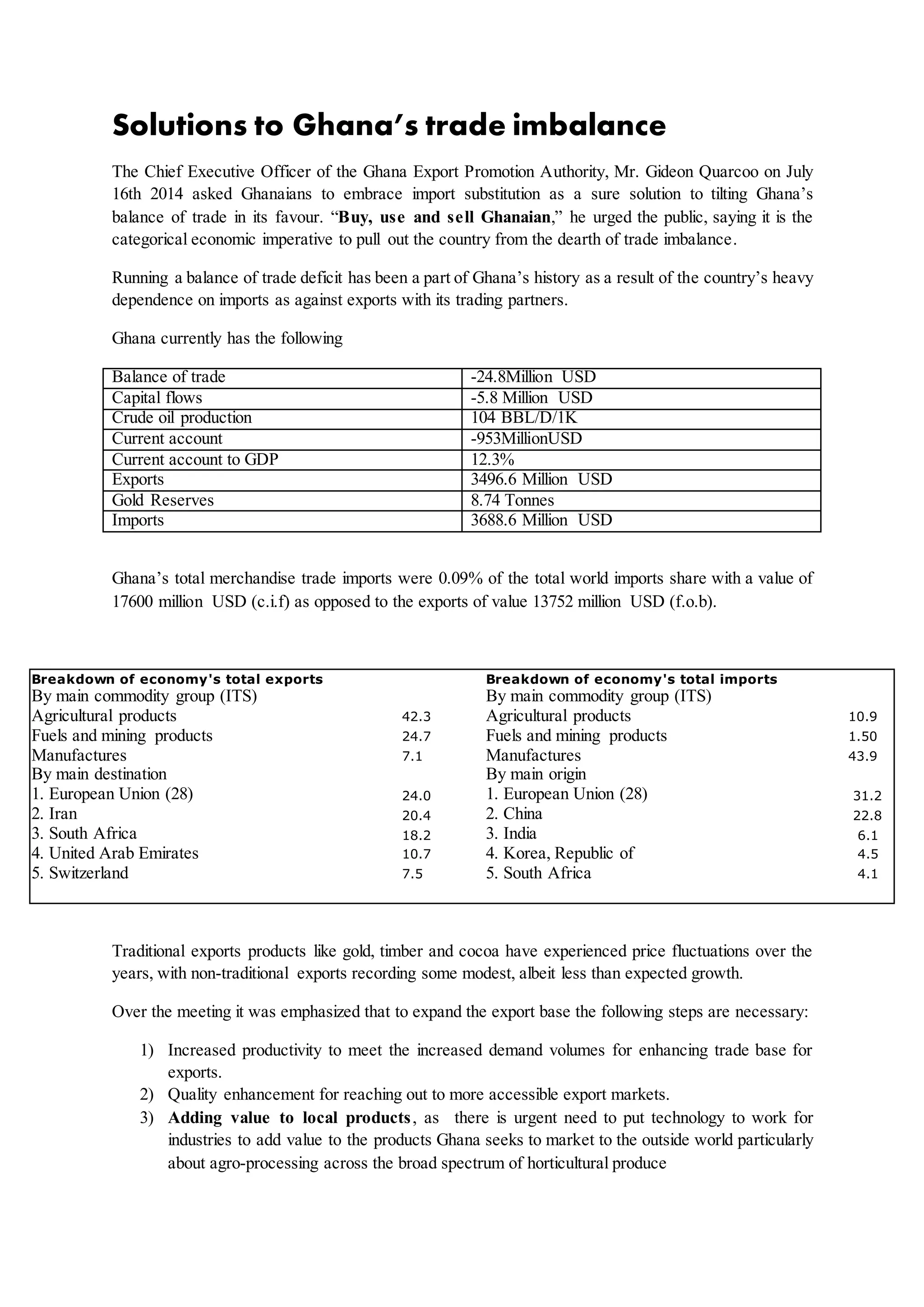
Ghana currently has the following 
Balance of trade -24.8Million USD 
Capital flows -5.8 Million USD 
Crude oil production 104 BBL/D/1K 
Current account -953MillionUSD 
Current account to GDP 12.3% 
Exports 3496.6 Million USD 
Gold Reserves 8.74 Tonnes 
Imports 3688.6 Million USD 
Ghana’s total merchandise trade imports were 0.09% of the total world imports share with a value of 
17600 million USD (c.i.f) as opposed to the exports of value 13752 million USD (f.o.b). 
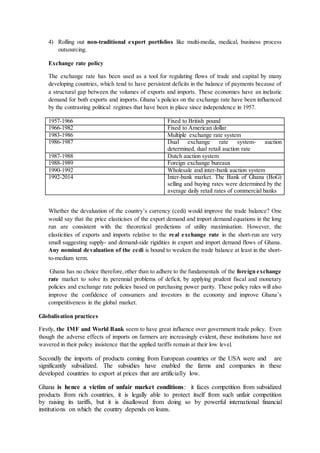
Breakdown of economy's total exports 
Breakdown of economy's total imports 
By main commodity group (ITS) 
Agricultural products 
42.3 
Agricultural products 
10.9 
Fuels and mining products 
24.7 
Fuels and mining products 
1.50 
Manufactures 
7.1 
Manufactures 
43.9 
By main destination 
By main origin 
1. European Union (28) 
24.0 
1. European Union (28) 
31.2 
2. Iran 
20.4 
2. China 
22.8 
3. South Africa 
18.2 
3. India 
6.1 
4. United Arab Emirates 
10.7 
4. Korea, Republic of 
4.5 
5. Switzerland 
7.5 
5. South Africa 
4.1 
Traditional exports products like gold, timber and cocoa have experienced price fluctuations over the 
years, with non-traditional exports recording some modest, albeit less than expected growth. 
Over the meeting it was emphasized that to expand the export base the following steps are necessary: 
1) Increased productivity to meet the increased demand volumes for enhancing trade base for 
exports. 
2) Quality enhancement for reaching out to more accessible export markets. 
3) Adding value to local products , as there is urgent need to put technology to work for 
industries to add value to the products Ghana seeks to market to the outside world particularly 
about agro-processing across the broad spectrum of horticultural produce
4) Rolling out non-traditional export portfolios like multi-media, medical, business process 
outsourcing. 
Exchange rate policy 
The exchange rate has been used as a tool for regulating flows of trade and capital by many 
developing countries, which tend to have persistent deficits in the balance of payments because of 
a structural gap between the volumes of exports and imports. These economies have an inelastic 
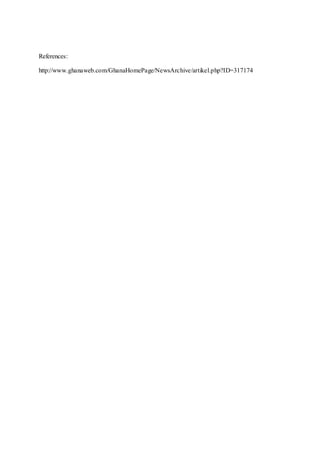
demand for both exports and imports. Ghana’s policies on the exchange rate have been influenced 
by the contrasting political regimes that have been in place since independence in 1957. 
1957-1966 Fixed to British pound 
1966-1982 Fixed to American dollar 
1983-1986 Multiple exchange rate system 
1986-1987 Dual exchange rate system- auction 
determined, dual retail auction rate 
1987-1988 Dutch auction system 
1988-1989 Foreign exchange bureaux 
1990-1992 Wholesale and inter-bank auction system 
1992-2014 Inter-bank market. The Bank of Ghana (BoG) 
selling and buying rates were determined by the 
average daily retail rates of commercial banks 
Whether the devaluation of the country’s currency (cedi) would improve the trade balance? One 
would say that the price elasticises of the export demand and import demand equations in the long 
run are consistent with the theoretical predictions of utility maximisation. However, the 
elasticities of exports and imports relative to the real exchange rate in the short-run are very 
small suggesting supply- and demand-side rigidities in export and import demand flows of Ghana. 
Any nominal devaluation of the cedi is bound to weaken the trade balance at least in the short-to- 
medium term. 
Ghana has no choice therefore, other than to adhere to the fundamentals of the foreign exchange 
rate market to solve its perennial problems of deficit, by applying prudent fiscal and monetary 
policies and exchange rate policies based on purchasing power parity. These policy rules will also 
improve the confidence of consumers and investors in the economy and improve Ghana’s 
competitiveness in the global market. 
Globalisation practices 
Firstly, the IMF and World Bank seem to have great influence over government trade policy. Even 
though the adverse effects of imports on farmers are increasingly evident, these institutions have not 
wavered in their policy insistence that the applied tariffs remain at their low level. 
Secondly the imports of products coming from European countries or the USA were and are 
significantly subsidized. The subsidies have enabled the farms and companies in these 
developed countries to export at prices that are artificially low. 
Ghana is hence a victim of unfair market conditions: it faces competition from subsidized 
products from rich countries, it is legally able to protect itself from such unfair competition 
by raising its tariffs, but it is disallowed from doing so by powerful international financial 
institutions on which the country depends on loans.
References: 
http://www.ghanaweb.com/GhanaHomePage/NewsArchive/artikel.php?ID=317174

Solutions to Ghana's trade imbalance

  • 1.
    Solutions to Ghana’strade imbalance The Chief Executive Officer of the Ghana Export Promotion Authority, Mr. Gideon Quarcoo on July 16th 2014 asked Ghanaians to embrace import substitution as a sure solution to tilting Ghana’s balance of trade in its favour. “Buy, use and sell Ghanaian,” he urged the public, saying it is the categorical economic imperative to pull out the country from the dearth of trade imbalance. Running a balance of trade deficit has been a part of Ghana’s history as a result of the country’s heavy dependence on imports as against exports with its trading partners. Ghana currently has the following Balance of trade -24.8Million USD Capital flows -5.8 Million USD Crude oil production 104 BBL/D/1K Current account -953MillionUSD Current account to GDP 12.3% Exports 3496.6 Million USD Gold Reserves 8.74 Tonnes Imports 3688.6 Million USD Ghana’s total merchandise trade imports were 0.09% of the total world imports share with a value of 17600 million USD (c.i.f) as opposed to the exports of value 13752 million USD (f.o.b). Breakdown of economy's total exports Breakdown of economy's total imports By main commodity group (ITS) By main commodity group (ITS) Agricultural products 42.3 Agricultural products 10.9 Fuels and mining products 24.7 Fuels and mining products 1.50 Manufactures 7.1 Manufactures 43.9 By main destination By main origin 1. European Union (28) 24.0 1. European Union (28) 31.2 2. Iran 20.4 2. China 22.8 3. South Africa 18.2 3. India 6.1 4. United Arab Emirates 10.7 4. Korea, Republic of 4.5 5. Switzerland 7.5 5. South Africa 4.1 Traditional exports products like gold, timber and cocoa have experienced price fluctuations over the years, with non-traditional exports recording some modest, albeit less than expected growth. Over the meeting it was emphasized that to expand the export base the following steps are necessary: 1) Increased productivity to meet the increased demand volumes for enhancing trade base for exports. 2) Quality enhancement for reaching out to more accessible export markets. 3) Adding value to local products , as there is urgent need to put technology to work for industries to add value to the products Ghana seeks to market to the outside world particularly about agro-processing across the broad spectrum of horticultural produce
  • 2.
    4) Rolling outnon-traditional export portfolios like multi-media, medical, business process outsourcing. Exchange rate policy The exchange rate has been used as a tool for regulating flows of trade and capital by many developing countries, which tend to have persistent deficits in the balance of payments because of a structural gap between the volumes of exports and imports. These economies have an inelastic demand for both exports and imports. Ghana’s policies on the exchange rate have been influenced by the contrasting political regimes that have been in place since independence in 1957. 1957-1966 Fixed to British pound 1966-1982 Fixed to American dollar 1983-1986 Multiple exchange rate system 1986-1987 Dual exchange rate system- auction determined, dual retail auction rate 1987-1988 Dutch auction system 1988-1989 Foreign exchange bureaux 1990-1992 Wholesale and inter-bank auction system 1992-2014 Inter-bank market. The Bank of Ghana (BoG) selling and buying rates were determined by the average daily retail rates of commercial banks Whether the devaluation of the country’s currency (cedi) would improve the trade balance? One would say that the price elasticises of the export demand and import demand equations in the long run are consistent with the theoretical predictions of utility maximisation. However, the elasticities of exports and imports relative to the real exchange rate in the short-run are very small suggesting supply- and demand-side rigidities in export and import demand flows of Ghana. Any nominal devaluation of the cedi is bound to weaken the trade balance at least in the short-to- medium term. Ghana has no choice therefore, other than to adhere to the fundamentals of the foreign exchange rate market to solve its perennial problems of deficit, by applying prudent fiscal and monetary policies and exchange rate policies based on purchasing power parity. These policy rules will also improve the confidence of consumers and investors in the economy and improve Ghana’s competitiveness in the global market. Globalisation practices Firstly, the IMF and World Bank seem to have great influence over government trade policy. Even though the adverse effects of imports on farmers are increasingly evident, these institutions have not wavered in their policy insistence that the applied tariffs remain at their low level. Secondly the imports of products coming from European countries or the USA were and are significantly subsidized. The subsidies have enabled the farms and companies in these developed countries to export at prices that are artificially low. Ghana is hence a victim of unfair market conditions: it faces competition from subsidized products from rich countries, it is legally able to protect itself from such unfair competition by raising its tariffs, but it is disallowed from doing so by powerful international financial institutions on which the country depends on loans.
  • 3.