Organization Structure Design
Case Study Analysis
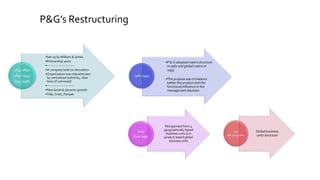
•Set up by William & James
•Partnership years
•-------------------------
•A company built on innovation
•Organization was characterised
by centralized authority, clear
lines of command
•-------------------------
•New lands & dynamic growth
•Tide, Crest, Pamper
1837-1890
1890-1945
1945-1980
•P & G adopted matrix structure
in 1987 and global matrix in
1995
•The purpose was to balance
better the product and the
functional influence in the
management decision
1980-1999
Reorganised from 4
geographically based
business units to 6
product based global
business units
2000
Durk Jager
Global business
units structure
2005
Alan george lafley
P&G’s Restructuring
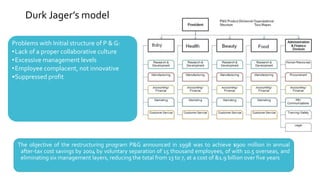
Problems with Initial structure of P & G:
•Lack of a proper collaborative culture
•Excessive management levels
•Employee complacent, not innovative
•Suppressed profit
Durk Jager’s model
The objective of the restructuring program P&G announced in 1998 was to achieve $900 million in annual
after-tax cost savings by 2004 by voluntary separation of 15 thousand employees, of with 10.5 overseas, and
eliminating six management layers, reducing the total from 13 to 7, at a cost of &1.9 billion over five years
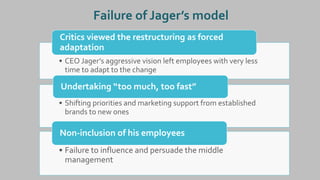
• CEO Jager’s aggressive vision left employees with very less
time to adapt to the change
Critics viewed the restructuring as forced
adaptation
• Shifting priorities and marketing support from established
brands to new ones
Undertaking “too much, too fast”
• Failure to influence and persuade the middle
management
Non-inclusion of his employees
Failure of Jager’s model
NewGBU
model:
Introduced after
Jager’s model
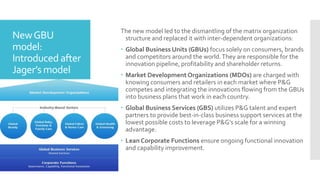
The new model led to the dismantling of the matrix organization
structure and replaced it with inter-dependent organizations:
 Global Business Units (GBUs) focus solely on consumers, brands
and competitors around the world.They are responsible for the
innovation pipeline, profitability and shareholder returns.
 Market Development Organizations (MDOs) are charged with
knowing consumers and retailers in each market where P&G
competes and integrating the innovations flowing from the GBUs
into business plans that work in each country.
 Global Business Services (GBS) utilizes P&G talent and expert
partners to provide best-in-class business support services at the
lowest possible costs to leverage P&G’s scale for a winning
advantage.
 Lean Corporate Functions ensure ongoing functional innovation
and capability improvement.
Modified GBU Structure
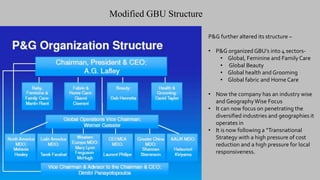
P&G further altered its structure –
• P&G organized GBU’s into 4 sectors-
• Global, Feminine and Family Care
• Global Beauty
• Global health and Grooming
• Global fabric and Home Care
• Now the company has an industry wise
and GeographyWise Focus
• It can now focus on penetrating the
diversified industries and geographies it
operates in
• It is now following a “Transnational
Strategy with a high pressure of cost
reduction and a high pressure for local
responsiveness.
Benefits of New Structure –
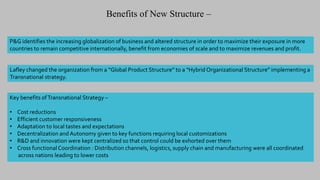
P&G identifies the increasing globalization of business and altered structure in order to maximize their exposure in more
countries to remain competitive internationally, benefit from economies of scale and to maximize revenues and profit.
Lafley changed the organization from a “Global Product Structure” to a “Hybrid Organizational Structure” implementing a
Transnational strategy.
Key benefits ofTransnational Strategy –
• Cost reductions
• Efficient customer responsiveness
• Adaptation to local tastes and expectations
• Decentralization and Autonomy given to key functions requiring local customizations
• R&D and innovation were kept centralized so that control could be exhorted over them
• Cross functional Coordination : Distribution channels, logistics, supply chain and manufacturing were all coordinated
across nations leading to lower costs
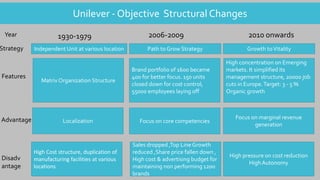
Unilever - Objective Structural Changes
Independent Unit at various location Path to Grow Strategy Growth toVitality
Year 1930-1979 2006-2009 2010 onwards
Strategy
Matrix Organization Structure
Brand portfolio of 1600 became
400 for better focus. 150 units
closed down for cost control,
55000 employees laying off
High concentration on Emerging
markets. It simplified its
management structure, 20000 job
cuts in Europe.Target: 3 - 5 %
Organic growth
Localization
Features
Advantage Focus on core competencies
Focus on marginal revenue
generation
Disadv
antage
High Cost structure, duplication of
manufacturing facilities at various
locations
Sales dropped ,Top Line Growth
reduced ,Share price fallen down ,
High cost & advertising budget for
maintaining non performing 1200
brands
High pressure on cost reduction
HighAutonomy
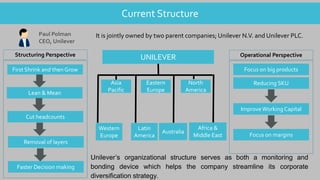
Current Structure
Paul Polman
CEO, Unilever
Reducing SKU
Focus on big products
ImproveWorking Capital
Focus on margins
First Shrink and then Grow
Lean & Mean
Cut headcounts
Removal of layers
Faster Decision making
Structuring Perspective Operational Perspective
It is jointly owned by two parent companies; Unilever N.V. and Unilever PLC.
UNILEVER
Asia
Pacific
Latin
America
Eastern
Europe
North
America
Australia
Africa &
Middle East
Western
Europe
Unilever’s organizational structure serves as both a monitoring and
bonding device which helps the company streamline its corporate
diversification strategy.
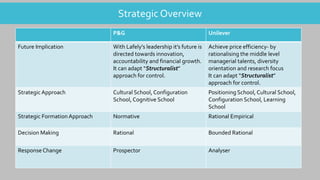
Strategic Overview
P&G Unilever
Future Implication With Lafely’s leadership it’s future is
directed towards innovation,
accountability and financial growth.
It can adapt “Structuralist”
approach for control.
Achieve price efficiency- by
rationalising the middle level
managerial talents, diversity
orientation and research focus
It can adapt “Structuralist”
approach for control.
StrategicApproach Cultural School, Configuration
School, Cognitive School
Positioning School, Cultural School,
Configuration School, Learning
School
Strategic Formation Approach Normative Rational Empirical
Decision Making Rational Bounded Rational
Response Change Prospector Analyser
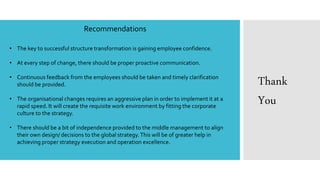
Recommendations
• The key to successful structure transformation is gaining employee confidence.
• At every step of change, there should be proper proactive communication.
• Continuous feedback from the employees should be taken and timely clarification
should be provided.
• The organisational changes requires an aggressive plan in order to implement it at a
rapid speed. It will create the requisite work environment by fitting the corporate
culture to the strategy.
• There should be a bit of independence provided to the middle management to align
their own design/ decisions to the global strategy.This will be of greater help in
achieving proper strategy execution and operation excellence.
Thank
You

HUL and P&G Organization structure design

  • 1.
  • 2.
    •Set up byWilliam & James •Partnership years •------------------------- •A company built on innovation •Organization was characterised by centralized authority, clear lines of command •------------------------- •New lands & dynamic growth •Tide, Crest, Pamper 1837-1890 1890-1945 1945-1980 •P & G adopted matrix structure in 1987 and global matrix in 1995 •The purpose was to balance better the product and the functional influence in the management decision 1980-1999 Reorganised from 4 geographically based business units to 6 product based global business units 2000 Durk Jager Global business units structure 2005 Alan george lafley P&G’s Restructuring
  • 3.
    Problems with Initialstructure of P & G: •Lack of a proper collaborative culture •Excessive management levels •Employee complacent, not innovative •Suppressed profit Durk Jager’s model The objective of the restructuring program P&G announced in 1998 was to achieve $900 million in annual after-tax cost savings by 2004 by voluntary separation of 15 thousand employees, of with 10.5 overseas, and eliminating six management layers, reducing the total from 13 to 7, at a cost of &1.9 billion over five years
  • 4.
    • CEO Jager’saggressive vision left employees with very less time to adapt to the change Critics viewed the restructuring as forced adaptation • Shifting priorities and marketing support from established brands to new ones Undertaking “too much, too fast” • Failure to influence and persuade the middle management Non-inclusion of his employees Failure of Jager’s model
  • 5.
    NewGBU model: Introduced after Jager’s model Thenew model led to the dismantling of the matrix organization structure and replaced it with inter-dependent organizations:  Global Business Units (GBUs) focus solely on consumers, brands and competitors around the world.They are responsible for the innovation pipeline, profitability and shareholder returns.  Market Development Organizations (MDOs) are charged with knowing consumers and retailers in each market where P&G competes and integrating the innovations flowing from the GBUs into business plans that work in each country.  Global Business Services (GBS) utilizes P&G talent and expert partners to provide best-in-class business support services at the lowest possible costs to leverage P&G’s scale for a winning advantage.  Lean Corporate Functions ensure ongoing functional innovation and capability improvement.
  • 6.
    Modified GBU Structure P&Gfurther altered its structure – • P&G organized GBU’s into 4 sectors- • Global, Feminine and Family Care • Global Beauty • Global health and Grooming • Global fabric and Home Care • Now the company has an industry wise and GeographyWise Focus • It can now focus on penetrating the diversified industries and geographies it operates in • It is now following a “Transnational Strategy with a high pressure of cost reduction and a high pressure for local responsiveness.
  • 7.
    Benefits of NewStructure – P&G identifies the increasing globalization of business and altered structure in order to maximize their exposure in more countries to remain competitive internationally, benefit from economies of scale and to maximize revenues and profit. Lafley changed the organization from a “Global Product Structure” to a “Hybrid Organizational Structure” implementing a Transnational strategy. Key benefits ofTransnational Strategy – • Cost reductions • Efficient customer responsiveness • Adaptation to local tastes and expectations • Decentralization and Autonomy given to key functions requiring local customizations • R&D and innovation were kept centralized so that control could be exhorted over them • Cross functional Coordination : Distribution channels, logistics, supply chain and manufacturing were all coordinated across nations leading to lower costs
  • 8.
    Unilever - ObjectiveStructural Changes Independent Unit at various location Path to Grow Strategy Growth toVitality Year 1930-1979 2006-2009 2010 onwards Strategy Matrix Organization Structure Brand portfolio of 1600 became 400 for better focus. 150 units closed down for cost control, 55000 employees laying off High concentration on Emerging markets. It simplified its management structure, 20000 job cuts in Europe.Target: 3 - 5 % Organic growth Localization Features Advantage Focus on core competencies Focus on marginal revenue generation Disadv antage High Cost structure, duplication of manufacturing facilities at various locations Sales dropped ,Top Line Growth reduced ,Share price fallen down , High cost & advertising budget for maintaining non performing 1200 brands High pressure on cost reduction HighAutonomy
  • 9.
    Current Structure Paul Polman CEO,Unilever Reducing SKU Focus on big products ImproveWorking Capital Focus on margins First Shrink and then Grow Lean & Mean Cut headcounts Removal of layers Faster Decision making Structuring Perspective Operational Perspective It is jointly owned by two parent companies; Unilever N.V. and Unilever PLC. UNILEVER Asia Pacific Latin America Eastern Europe North America Australia Africa & Middle East Western Europe Unilever’s organizational structure serves as both a monitoring and bonding device which helps the company streamline its corporate diversification strategy.
  • 10.
    Strategic Overview P&G Unilever FutureImplication With Lafely’s leadership it’s future is directed towards innovation, accountability and financial growth. It can adapt “Structuralist” approach for control. Achieve price efficiency- by rationalising the middle level managerial talents, diversity orientation and research focus It can adapt “Structuralist” approach for control. StrategicApproach Cultural School, Configuration School, Cognitive School Positioning School, Cultural School, Configuration School, Learning School Strategic Formation Approach Normative Rational Empirical Decision Making Rational Bounded Rational Response Change Prospector Analyser
  • 11.
    Recommendations • The keyto successful structure transformation is gaining employee confidence. • At every step of change, there should be proper proactive communication. • Continuous feedback from the employees should be taken and timely clarification should be provided. • The organisational changes requires an aggressive plan in order to implement it at a rapid speed. It will create the requisite work environment by fitting the corporate culture to the strategy. • There should be a bit of independence provided to the middle management to align their own design/ decisions to the global strategy.This will be of greater help in achieving proper strategy execution and operation excellence. Thank You