DR RAJNI SINGH
GROUP
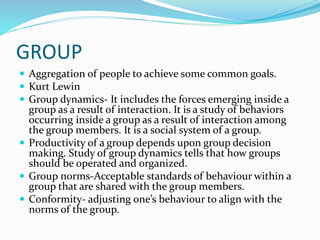
 Aggregation of people to achieve some common goals.
 Kurt Lewin
 Group dynamics- It includes the forces emerging inside a
group as a result of interaction. It is a study of behaviors
occurring inside a group as a result of interaction among
the group members. It is a social system of a group.
 Productivity of a group depends upon group decision
making. Study of group dynamics tells that how groups
should be operated and organized.
 Group norms-Acceptable standards of behaviour within a
group that are shared with the group members.
 Conformity- adjusting one’s behaviour to align with the
norms of the group.
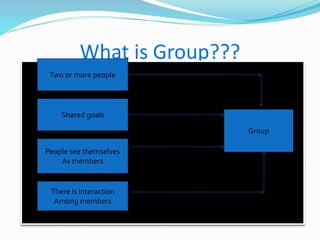
What is Group???
Two or more people
Shared goals
People see themselves
As members
There is interaction
Among members
Group
Team
 Team- it is a group. For a team synergy and
coordination is needed. In a team performance of one
person is affected by others. Collective performance is
required.
 Organizations prefer the use of teams for
organizational performance.
 Teams have specific goals and roles for its team
members.
 A group is able to work as a team only if the goals and
roles of the members are clear and there is no
confusion inside the group.
Types of group
 Formal groups- Groups defined by the organization.
 Informal groups-a group that is neither formally
structured nor organizationally determined; appears
in response to the social contact.
 Informal gps have affect on an ind.s behaviour as well
as on org.s performance.
Types of group
1. FORMAL
a. Command group- groups formed on the basis of
organizational chart (Hierarchy)
b. Committees-to achieve specific goals.
c. Team-specific purpose, specific skills, high level of
interaction.
2. INFORMAL
a. Interest group- have common interests, like trade
unions
b. Friendship group- common characteristics.
Why do people Join group??
The people often join groups since the groups give the members a stability and
enhances their achievement capacity. The main reasons to join a group are:
Have a sense of security
Have a status
Develop Self-esteem
Power
Goal achievement
Group dynamics
Group dynamics is the study of forces emerging inside
a group as a result of interaction. It is a social system of
a group. Productivity of a group depends upon its
decision making.
Functional groups- creativity, new ideas, positive
feeling of belongingness, high cohesiveness
Dysfunctional groups- negative aspect of informal
groups- energy loss, conflict, time waste, diversion
from main goal, feel at home and relaxed.
Group structure
Structure of the group consists of roles, norms,
cohesiveness, status
 Group role- a set of expected behaviour
1. role perception
2. role expectation
3. role conflict
 Norms- acceptable standards of behaviour within a
group that are shared by group’s members. Unwritten
informal rules.
 Cohesiveness- degree to which group members are
attracted to each other and wanted to stay in the
group. Cohesiveness influences productivity.
 Status –socially defined positions given to the groups
by the group members.
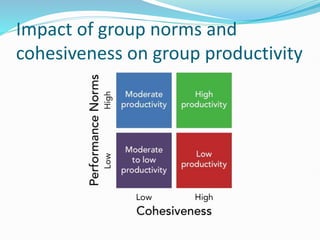
For high productivity both group norms and group
cohesiveness is required.
Group cohesiveness has a negative impact on group
productivity in the absence of group norms.
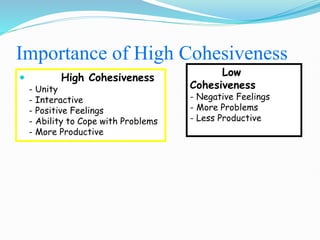
Importance of High Cohesiveness
Low
Cohesiveness
- Negative Feelings
- More Problems
- Less Productive
 High Cohesiveness
- Unity
- Interactive
- Positive Feelings
- Ability to Cope with Problems
- More Productive
Impact of group norms and
cohesiveness on group productivity
Group decision making
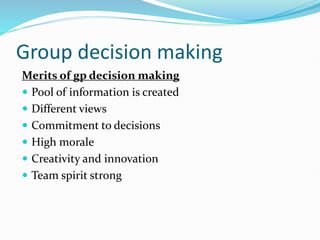
Merits of gp decision making
 Pool of information is created
 Different views
 Commitment to decisions
 High morale
 Creativity and innovation
 Team spirit strong
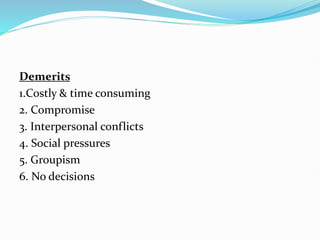
Demerits
1.Costly & time consuming
2. Compromise
3. Interpersonal conflicts
4. Social pressures
5. Groupism
6. No decisions
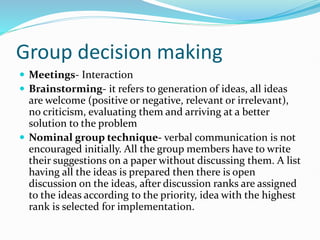
Group decision making
 Meetings- Interaction
 Brainstorming- it refers to generation of ideas, all ideas
are welcome (positive or negative, relevant or irrelevant),
no criticism, evaluating them and arriving at a better
solution to the problem
 Nominal group technique- verbal communication is not
encouraged initially. All the group members have to write
their suggestions on a paper without discussing them. A list
having all the ideas is prepared then there is open
discussion on the ideas, after discussion ranks are assigned
to the ideas according to the priority, idea with the highest
rank is selected for implementation.
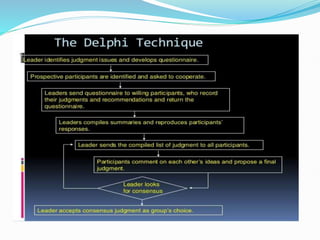
 Delphi technique- it is used when members are
geographically dispersed and cannot assemble at a place to
solve the problems. Saves time and money but it is time
consuming, lack of personal interaction amongst the group
members.
After problem identification a questionnaire is prepared
for respondents, it is sent to the members and then filled
questionnaires are collected and compiled at the central
location, results are sent to the group members and they
are asked to give further suggestions, suggestions are
reviewed and the process is repeated until a consensus is
not arrived.
Group decision making
Impact of group on individual’s Behaviour OR Problems
at the time of group decision making-
 Social loafing- working less in a group then individually
 Group think- process in which the norm for consensus
overrides the realistic appraisal. Decisions taken due to
group pressures.
 Group shift- Risky shift- a change in decision risk between
the group’s decision and individual decision that members
within the group would make; can be either towards
conservatism or greater risk. (Group takes more bold and
daring decisions as responsibility of outcome lies on the
whole group).
Stages of group development
 5 stages of group development
 Forming
 Storming
 Norming
 Performing
 Adjourning
1. FORMING- at this stage there is a great deal of
uncertainty and anxiety about the group’s purpose,
structure and leadership. This stage is complete
when the group members began to think themselves
as a part of the group. (introduction of the group
members)
2. STORMING- in this stage there is intra-group
conflict. There is conflict over power i.e who will
control the group. When this stage is complete there
develops a clear hierarchy of leadership within the
group. (control)
 NORMING- at this stage close relationships and group
cohesiveness develops. There emerges positive feelings and
emotional support. At this stage all the group members
focuses on the task in hand. Standards of behaviour are set.
High group cohesiveness and high group norms. (affection)
 PERFORMING- Actual performance of the task is done.
Group puts its positive energy into the task achievement. It
is the most preferable stage. ( mature group/ performer).
 ADJOURNING- termination of the group after the task
achievement.

GROUPP.pptx

  • 1.
  • 2.
    GROUP  Aggregation ofpeople to achieve some common goals.  Kurt Lewin  Group dynamics- It includes the forces emerging inside a group as a result of interaction. It is a study of behaviors occurring inside a group as a result of interaction among the group members. It is a social system of a group.  Productivity of a group depends upon group decision making. Study of group dynamics tells that how groups should be operated and organized.  Group norms-Acceptable standards of behaviour within a group that are shared with the group members.  Conformity- adjusting one’s behaviour to align with the norms of the group.
  • 3.
    What is Group??? Twoor more people Shared goals People see themselves As members There is interaction Among members Group
  • 4.
    Team  Team- itis a group. For a team synergy and coordination is needed. In a team performance of one person is affected by others. Collective performance is required.  Organizations prefer the use of teams for organizational performance.  Teams have specific goals and roles for its team members.  A group is able to work as a team only if the goals and roles of the members are clear and there is no confusion inside the group.
  • 5.
    Types of group Formal groups- Groups defined by the organization.  Informal groups-a group that is neither formally structured nor organizationally determined; appears in response to the social contact.  Informal gps have affect on an ind.s behaviour as well as on org.s performance.
  • 6.
    Types of group 1.FORMAL a. Command group- groups formed on the basis of organizational chart (Hierarchy) b. Committees-to achieve specific goals. c. Team-specific purpose, specific skills, high level of interaction. 2. INFORMAL a. Interest group- have common interests, like trade unions b. Friendship group- common characteristics.
  • 7.
    Why do peopleJoin group?? The people often join groups since the groups give the members a stability and enhances their achievement capacity. The main reasons to join a group are: Have a sense of security Have a status Develop Self-esteem Power Goal achievement
  • 8.
    Group dynamics Group dynamicsis the study of forces emerging inside a group as a result of interaction. It is a social system of a group. Productivity of a group depends upon its decision making. Functional groups- creativity, new ideas, positive feeling of belongingness, high cohesiveness Dysfunctional groups- negative aspect of informal groups- energy loss, conflict, time waste, diversion from main goal, feel at home and relaxed.
  • 9.
    Group structure Structure ofthe group consists of roles, norms, cohesiveness, status  Group role- a set of expected behaviour 1. role perception 2. role expectation 3. role conflict  Norms- acceptable standards of behaviour within a group that are shared by group’s members. Unwritten informal rules.
  • 10.
     Cohesiveness- degreeto which group members are attracted to each other and wanted to stay in the group. Cohesiveness influences productivity.  Status –socially defined positions given to the groups by the group members. For high productivity both group norms and group cohesiveness is required. Group cohesiveness has a negative impact on group productivity in the absence of group norms.
  • 11.
    Importance of HighCohesiveness Low Cohesiveness - Negative Feelings - More Problems - Less Productive  High Cohesiveness - Unity - Interactive - Positive Feelings - Ability to Cope with Problems - More Productive
  • 12.
    Impact of groupnorms and cohesiveness on group productivity
  • 13.
    Group decision making Meritsof gp decision making  Pool of information is created  Different views  Commitment to decisions  High morale  Creativity and innovation  Team spirit strong
  • 14.
    Demerits 1.Costly & timeconsuming 2. Compromise 3. Interpersonal conflicts 4. Social pressures 5. Groupism 6. No decisions
  • 15.
    Group decision making Meetings- Interaction  Brainstorming- it refers to generation of ideas, all ideas are welcome (positive or negative, relevant or irrelevant), no criticism, evaluating them and arriving at a better solution to the problem  Nominal group technique- verbal communication is not encouraged initially. All the group members have to write their suggestions on a paper without discussing them. A list having all the ideas is prepared then there is open discussion on the ideas, after discussion ranks are assigned to the ideas according to the priority, idea with the highest rank is selected for implementation.
  • 16.
     Delphi technique-it is used when members are geographically dispersed and cannot assemble at a place to solve the problems. Saves time and money but it is time consuming, lack of personal interaction amongst the group members. After problem identification a questionnaire is prepared for respondents, it is sent to the members and then filled questionnaires are collected and compiled at the central location, results are sent to the group members and they are asked to give further suggestions, suggestions are reviewed and the process is repeated until a consensus is not arrived.
  • 18.
    Group decision making Impactof group on individual’s Behaviour OR Problems at the time of group decision making-  Social loafing- working less in a group then individually  Group think- process in which the norm for consensus overrides the realistic appraisal. Decisions taken due to group pressures.  Group shift- Risky shift- a change in decision risk between the group’s decision and individual decision that members within the group would make; can be either towards conservatism or greater risk. (Group takes more bold and daring decisions as responsibility of outcome lies on the whole group).
  • 19.
    Stages of groupdevelopment  5 stages of group development  Forming  Storming  Norming  Performing  Adjourning
  • 20.
    1. FORMING- atthis stage there is a great deal of uncertainty and anxiety about the group’s purpose, structure and leadership. This stage is complete when the group members began to think themselves as a part of the group. (introduction of the group members) 2. STORMING- in this stage there is intra-group conflict. There is conflict over power i.e who will control the group. When this stage is complete there develops a clear hierarchy of leadership within the group. (control)
  • 21.
     NORMING- atthis stage close relationships and group cohesiveness develops. There emerges positive feelings and emotional support. At this stage all the group members focuses on the task in hand. Standards of behaviour are set. High group cohesiveness and high group norms. (affection)  PERFORMING- Actual performance of the task is done. Group puts its positive energy into the task achievement. It is the most preferable stage. ( mature group/ performer).  ADJOURNING- termination of the group after the task achievement.