Group and Team
MADE BY:- ANKIT SINGH
CLASS:-B.COM (H)
SEMESTER:-4
INTRODUCTION
 The topic of this presentation are:-
 Group
 Team
 Difference between group and team
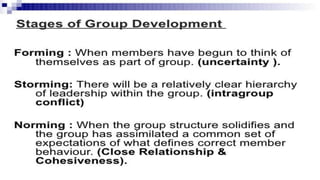
 Stages in Group Development
GROUP
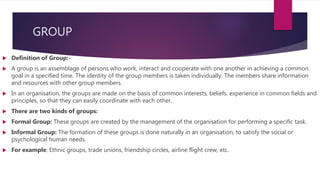
 Definition of Group:-
 A group is an assemblage of persons who work, interact and cooperate with one another in achieving a common
goal in a specified time. The identity of the group members is taken individually. The members share information
and resources with other group members.
 In an organisation, the groups are made on the basis of common interests, beliefs, experience in common fields and
principles, so that they can easily coordinate with each other.
 There are two kinds of groups:
 Formal Group: These groups are created by the management of the organisation for performing a specific task.
 Informal Group: The formation of these groups is done naturally in an organisation, to satisfy the social or
psychological human needs.
 For example: Ethnic groups, trade unions, friendship circles, airline flight crew, etc.
TEAM
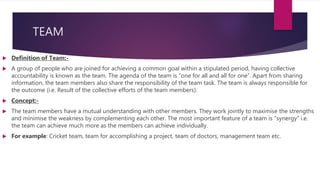
 Definition of Team:-
 A group of people who are joined for achieving a common goal within a stipulated period, having collective
accountability is known as the team. The agenda of the team is “one for all and all for one”. Apart from sharing
information, the team members also share the responsibility of the team task. The team is always responsible for
the outcome (i.e. Result of the collective efforts of the team members).
 Concept:-
 The team members have a mutual understanding with other members. They work jointly to maximise the strengths
and minimise the weakness by complementing each other. The most important feature of a team is “synergy” i.e.
the team can achieve much more as the members can achieve individually.
 For example: Cricket team, team for accomplishing a project, team of doctors, management team etc.
Difference
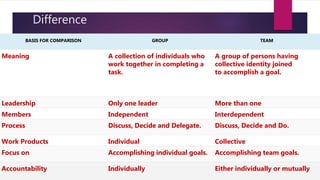
BASIS FOR COMPARISON GROUP TEAM
Meaning A collection of individuals who
work together in completing a
task.
A group of persons having
collective identity joined
to accomplish a goal.
Leadership Only one leader More than one
Members Independent Interdependent
Process Discuss, Decide and Delegate. Discuss, Decide and Do.
Work Products Individual Collective
Focus on Accomplishing individual goals. Accomplishing team goals.
Accountability Individually Either individually or mutually
Group and team
Group and team
Group and team

Group and team

  • 1.
    Group and Team MADEBY:- ANKIT SINGH CLASS:-B.COM (H) SEMESTER:-4
  • 2.
    INTRODUCTION  The topicof this presentation are:-  Group  Team  Difference between group and team  Stages in Group Development
  • 3.
    GROUP  Definition ofGroup:-  A group is an assemblage of persons who work, interact and cooperate with one another in achieving a common goal in a specified time. The identity of the group members is taken individually. The members share information and resources with other group members.  In an organisation, the groups are made on the basis of common interests, beliefs, experience in common fields and principles, so that they can easily coordinate with each other.  There are two kinds of groups:  Formal Group: These groups are created by the management of the organisation for performing a specific task.  Informal Group: The formation of these groups is done naturally in an organisation, to satisfy the social or psychological human needs.  For example: Ethnic groups, trade unions, friendship circles, airline flight crew, etc.
  • 5.
    TEAM  Definition ofTeam:-  A group of people who are joined for achieving a common goal within a stipulated period, having collective accountability is known as the team. The agenda of the team is “one for all and all for one”. Apart from sharing information, the team members also share the responsibility of the team task. The team is always responsible for the outcome (i.e. Result of the collective efforts of the team members).  Concept:-  The team members have a mutual understanding with other members. They work jointly to maximise the strengths and minimise the weakness by complementing each other. The most important feature of a team is “synergy” i.e. the team can achieve much more as the members can achieve individually.  For example: Cricket team, team for accomplishing a project, team of doctors, management team etc.
  • 7.
    Difference BASIS FOR COMPARISONGROUP TEAM Meaning A collection of individuals who work together in completing a task. A group of persons having collective identity joined to accomplish a goal. Leadership Only one leader More than one Members Independent Interdependent Process Discuss, Decide and Delegate. Discuss, Decide and Do. Work Products Individual Collective Focus on Accomplishing individual goals. Accomplishing team goals. Accountability Individually Either individually or mutually