CHAPTER 13
Group Behavior,
Teams and Conflict
Definition of a Group
■ In reviewing the books written on group dynamics, it quickly becomes clear
that there is no agreed-upon definition of a group. Some experts use a
general definition that basically defines a group as two or more people who
perceive themselves as a group and interact in some way. Other definitions
require that a group must involve some degree of structure and
permanency. Gordon (2001), believes that for a collection of people to be
called a group, the following four criteria must be met:
(a) the members of the group must see themselves as a unit;
(b) the group must provide rewards to its members;
(c) anything that happens to one member of the group affects every other
member; and
(d) the members of the group must share a common goal.
Multiple Members Who Perceive
Themselves as a Unit
■ The first criterion is that the group must have multiple members.
Obviously, one person does not constitute a group (even if he is a
multiple personality). Therefore, at least two people are necessary to
form a group. Usually we refer to 2 people as a dyad, to 3 people as a
triad, and to 4 to 20 people as a small group (Forsyth, 2013). To be
considered a group, these two or more people must also see themselves
as a unit. Thus, three individuals walking down the sidewalk would be
considered a group only if they knew one another and were together.
Eight separate customers shopping at a store would not be considered a
group.
Group Rewards
■ The second group criterion is that membership must be rewarding for each
individual in the group. It is important to remember that people will join or
form a group only if it provides some form of reward. To demonstrate this
point, imagine four students studying for an exam. If the four study in
separate rooms and do not share information, they are not a group.
Likewise, consider if the same four people sat at one desk in the library. If
each person studies the book separately and never communicates with the
other three, then the four still will not be a group because none of the
individuals is rewarded by being with the others. But if none of the four
would have otherwise studied independently, then the four students would
be considered a group because being together was rewarding. Even though
they did not talk with one another during their time in the library, the fact
that they were together provided the structure for each of them to study.
Corresponding Effects
■ The third group criterion is that an event that affects one group member
should affect all group members. That is, if something significant happens
to one person and does not affect any of the other people gathered with her,
then the collection of people cannot be considered a group. This
requirement is called corresponding effects. For example, suppose five bank
tellers work side by side, and one teller becomes ill and goes home. If the
activities of the other four change as a result of one teller leaving, the five
might be considered a group. But if the activities of the other four do not
change after one teller leaves, then the tellers cannot be considered a
group.
Common Goals
■ The fourth and final criterion is that all members must have a common goal. In
the teller example, if the goal of one of the tellers is to meet only young, single
customers and the goal of another teller is to serve as many customers as
possible, the tellers are not considered to be a group because they work in
different ways and for different reasons.
Reasons for Joining Groups
1. Assignment
■ In the workplace, the most common reason for joining groups is that
employees are assigned to them. For example, a new employee might
be assigned to a department with 5 other employees, 5 employees
might be appointed to serve on a committee, and 10 employees are
scheduled for the same training class.
Reasons for Joining Groups
2. Physical Proximity
■ One especially strong reason that a person might join a particular group,
especially if the group is informal, is physical proximity (Forsyth, 2013).
That is, people tend to form groups with people who either live or work
nearby. For example, think of the intramural teams on your campus.
Most teams consist of students who live in the same residence halls or
have classes together. At work, employees tend to form groups that
consist of those who work in the same general area. And some
employees seek close physical proximity to people in power, hoping they
will become part of an elite group.
Reasons for Joining Groups
3. Affiliation
■ Affiliation involves our need to be with other people. Thus, one reason
people join groups is to be near and talk to other people.
Reasons for Joining Groups
4.Identification
■ The need to associate ourselves with the image projected by
other people, groups, or objects.
Reasons for Joining Groups
5. Emotional Support
■ We also join groups to obtain emotional support. Alcoholics Anonymous,
Gamblers Anonymous, and Weight Watchers are good examples of
groups that provide emotional support for their members. A quick
perusal of ads in the local paper or a quick surfing of the Internet will
demonstrate the importance of this need, as there are hundreds of
different types of support groups. Survivor, contestants might form
alliances to increase the odds of not being voted off the island.
Reasons for Joining Groups
6. Assistance or Help
■ People often join groups to obtain assistance or help. For example,
students having problems with an algebra class might form a study
group. Or, on the reality show survivor, contestants might form alliances
to increase the odds of not being voted off the island.
Reasons for Joining Groups
6. Common Interests
 People often join groups because they share a common interest. At
school, students joining a geology club share an interest in geology,
students joining a fraternity share an interest in socializing, and students
joining a service club such as Circle Kor Alpha Phi Omega share an
interest in helping people.
Reasons for Joining Groups
7. Common Goals
 People who join political parties exemplify being in pursuit of a common
goal. These people may also share common interests, but their primary
purpose is to get a particular person or members of a particular party
elected to office.
Factors Affecting Group Performance
1. Group cohesiveness. The extent to which members of a group like
and trust one another.
Group Homogeneity.
 Homogeneous groups. Groups whose members share the same
characteristics.
 Heterogeneous groups. Groups whose members share few similarities.
 Slightly heterogeneous groups. Groups in which a few group members
have different characteristics from the rest of the group.
Stability. The extent to which the membership of a group remains
consistent over time.
Factors Affecting Group Performance
 Isolation. is another variable that tends to increase a group’s cohesiveness. Groups that
are isolated or located away from other groups tend to be highly cohesive.
 Outside Pressure. Groups that are pressured by outside forces also tend to become
highly cohesive. To some degree, this response to outside pressure can be explained by
the phenomenon of psychological reactance (Brehm, 1966). When we believe that
someone is trying to intentionally influence us to take some particular action, we often
react by doing the opposite. Consider, for example, a teenaged dating couple. As the boy
arrives to pick up his date, the girl’s father notices the young man’s beard and Harley-
Davidson motorcycle and forbids his daughter to go out with him. Before this order, the
daughter may not have been especially interested in the boy, but after being told she
cannot go on the date, she reacts by liking the boy more.
 Groups are most cohesive and perform best when group size is small. Studies have shown
that large groups have lower productivity (Mullen, Johnson, & Drake, 1987), less
coordination, lower morale (Frank & Anderson, 1971), are less active (Indik, 1965), less
cohesive (Carron, 1990), and more critical (Valacich, Dennis, & Nunamaker, 1992) than
smaller groups.
Factors Affecting Group Performance
 This does not mean, however, that small groups are always best. Although small groups
usually increase cohesiveness, high performance is seen with only certain types of tasks.
1. Additive tasks are those for which the group’s performance is equal to the sum of the
performances by each group member. Examples of groups performing additive tasks
include bowling teams and typing pools. In groups working on additive tasks, each
member’s contribution is important, and larger groups will probably be better than
smaller groups.
2. Conjunctive tasks are those for which the group’s performance depends on the least
effective group member (a chain is only as strong as its weakest link). Examples of
conjunctive tasks include an assembly line and friends going hiking (you can walk only
as fast as the slowest hiker). Because success on a conjunctive task is limited by the
least effective member, smaller groups are usually best.
3. Disjunctive tasks are those for which the group’s performance is based on the most
talented group member. Examples of disjunctive tasks include problem solving,
brainstorming, and a captain’s choice golf tournament (each person plays the best shot
of the four golfers). As with additive tasks, larger groups are probably better at
disjunctive tasks than are smaller groups.
Social impact theory
■ The addition of more members has its greatest effect when the group is
small. Latane (1981) first investigated this idea when he formulated
social impact theory. Imagine that a four-person committee is studying
safety problems at work. If the group is stable and cohesive, adding a
fifth person may be disruptive. But in a factory of 3,000 employees,
hiring 1 new employee is not likely to change the complexion of the
company. That is why sports experts have observed that a single great
player can turn around a poor basketball team—as occurred with Bill
Walton and the Portland Trailblazers, David Robinson and the San
Antonio Spurs, Jason Kidd and the New Jersey Nets, and Steve Nash
and the Phoenix Suns—but not a football or baseball team.
Factors Affecting Group Performance
 Group Status. The higher the group’s status, the greater its cohesiveness. This is an
important point: A group can be made more cohesive by increasing group status. The group
does not actually have to have high status, but it is important that its members believe they
have high status.
2.Group Ability and Confidence. Not surprisingly, groups consisting of high-ability members
outperform those with low-ability members (Devine & Phillips, 2001). Furthermore, groups
whose members believe that their team can be successful both at a specific task (high team
efficacy) and at tasks in general (high team potency) perform better than groups whose
members aren’t as confident about their probability for success (Gully, Incalcaterra, Joshi, &
Beaubien, 2002).
3. Personality of the Group Members. An important factor affecting group performance is the
personality of the group members. Meta-analysis results indicate that in general, groups whose
members have task-related experience and score high in the personality dimensions of
openness to experience and emotional stability will perform better than groups whose members
do not have these characteristics (Bell, 2007). In addition, groups working on intellectual tasks
will do better if their group members are bright, and groups working on physical tasks (e.g.,
sports teams) will do better if their group members score high in the personality dimensions of
conscientiousness, extraversion, and agreeableness (Bell, 2005).
Factors Affecting Group Performance
4. Communication Structure. Another variable that can affect a group’s performance
is its communication structure, or network. For a group to perform successfully, good
communication among members is essential.
5. Group Roles. Another factor that affects the performance of a group is the extent to
which its members assume different roles. For a group to be successful, its members’
roles must fall into one of two categories: task oriented and social oriented (Stewart,
Fulmer, & Barrick, 2005).
Task-oriented roles involve behaviors such as offering new ideas, coordinating
activities, and finding new information. Social-oriented roles involve encouraging
cohesiveness and participation. A third category— the individual role —includes
blocking group activities, calling attention to oneself, and avoiding group interaction.
Individual roles seldom result in higher group productivity. Group members will often
naturally assume these roles on the basis of their individual personalities and
experiences. For example, people high in conscientiousness tend to fill task-oriented
roles, and people high in agreeableness tend to fill social-oriented roles (Stewart et
al., 2005).
Presence of Others: Social Facilitation
and Inhibition
Social facilitation. The positive effects that occur when a person performs a
task in the presence of others.
Social inhibition. The negative effects that occur when a person performs a
task in the presence of others.
Audience Effects. The phenomenon of audience effects takes place when a group of
people passively watch an individual. An example would be a sporting event held in an
arena. The strength of the effect of having an audience present is a function of at least
three factors (Latane, 1981): an audience’s size, its physical proximity to the person or
group, and its status. Thus, groups are most likely to be affected by large audiences of
experts who are physically close to them.
Coaction. The effect on behavior when two or more people are performing the same task
in the presence of one another is called coaction. Examples would be two runners
competing against each other without a crowd present, or two mail clerks sorting
envelopes in the same room. Shalley (1995) found that coaction decreased creativity and
productivity. There are many studies demonstrating interesting examples of coaction-
influenced behavior. For example:
 Rockloff and Dyer (2007) found that gamblers placed larger bets and lost more money
when gambling near others than when gambling alone.
 Sommer, Wynes, and Brinkley (1992) found that when people shopped in groups, they
spent more time in a store and purchased more goods than when alone.
 de Castro and Brewer (1992) discovered that meals eaten in large groups were 75%
larger than those eaten when a person was alone.
Mere presence .Theory stating that the very fact that others happen to be present
naturally produces arousal and thus may affect performance.
Comparison. The effect when an individual working on a task compares his or her
performance with that of another person performing the same task.
Evaluation apprehension. The idea that a person performing a task becomes
aroused because he or she is concerned that others are evaluating his or her
performance.
Distracting . The idea that social inhibition occurs because the presence of others
provides a distraction that interferes with concentration.
Social loafing. The fact that individuals in a group often exert less individual effort
than they would if they were not in a group.
Factors Affecting Group Performance
6. Individual dominance. When one member of a group dominates the group.
7. Groupthink. A state of mind in which a group is so concerned about its own cohesiveness that it
ignores important information.
With groupthink, members become so cohesive and like-minded that they make poor decisions
despite contrary information that might reasonably lead them to other options. Groupthink most often
occurs when the group
 is cohesive;
 is insulated from qualified outsiders;
 has an illusion of invulnerability, infallibility, or both;
 believes that it is morally superior to its adversaries;
 is under great pressure to conform;
 has a leader who promotes a favorite solution; and
 has gatekeepers who keep information from other group members.
Groupthink can be reduced in several ways. First, the group leader should not state his own position
or beliefs until late in the decision-making process. Second, the leader should promote open
discussion and encourage group members to speak. Third, a group or committee can be separated
into subgroups to increase the chance of disagreement. Finally, one group member can be assigned
the job of devil’s advocate—one who questions and disagrees with the group.
Individual Versus Group Performance
■ Nominal group. A collection of individuals whose results are pooled
but who never interact with one another.
■ Interacting group. A collection of individuals who work together to
perform a task.
 Brainstorming . A technique in which ideas are generated by people
in a group setting.
TEAMS
■ What Is a Work Team?
■ According to Devine, Clayton, Philips, Dunford, and Melner (1999), a
work team is “a collection of three or more individuals who interact
intensively to provide an organizational product, plan, decision, or
service”.
TEAMS
■ .Before calling a group of individuals a team, several factors should
be considered (Donnellon,1996).
1. Identification is the extent to which group members identify with the
team rather than with other groups. For example, suppose a committee was
created composed of one representative from each of five different
departments (e.g., accounting, engineering, human resources). During the
meetings, members use such statements as “Our department won’t agree.
2. Interdependence. The extent to which team members need and rely on
other team members.
3. Power differentiation. The extent to which team members have the same
level of power and respect.
4. Social distance. The extent to which team members treat each other in a
friendly, informal manner.
5. Conflict Management Tactics .Team members respond to conflict by
collaborating, whereas nonteam members respond by forcing and
accommodating. In nonteams, members react to conflict by threatening,
directing, or giving in. In teams, members try to understand the others’ views,
make attempts to compromise, and use nonthreatening tones (Donnellon,
1996).
6. Negotiation Process . In teams, members negotiate in a win–win style in
which the goal is for every person to come out ahead. In nonteams, members
negotiate so that they win and the other members lose.
On the basis of this six factors. Donnellon (1996) placed teams in to one of
five categories:
1. Collaborative teams
2. Emergent teams
3. Adversarial teams
4. Nominal teams
5. Doomed teams.
Collaborative teams and emergent teams are what I have referred to as
true teams, whereas nominal teams and doomed teams are what I have
referred to as nonteams. Adversarial teams are some where in between a
true team and a nonteam.
Though not affecting the extent to which a group is officially a team, teams
differ in two other ways.
1. Permanency The extent to which a team will remain together or be disbanded
after a task has been accomplished.
2. Proximity. Physical distance between people.
 Virtual teams . Teams that communicate through email rather than face to
face.
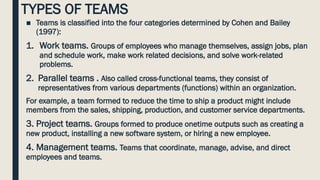
TYPES OF TEAMS
■ Teams is classified into the four categories determined by Cohen and Bailey
(1997):
1. Work teams. Groups of employees who manage themselves, assign jobs, plan
and schedule work, make work related decisions, and solve work-related
problems.
2. Parallel teams . Also called cross-functional teams, they consist of
representatives from various departments (functions) within an organization.
For example, a team formed to reduce the time to ship a product might include
members from the sales, shipping, production, and customer service departments.
3. Project teams. Groups formed to produce onetime outputs such as creating a
new product, installing a new software system, or hiring a new employee.
4. Management teams. Teams that coordinate, manage, advise, and direct
employees and teams.
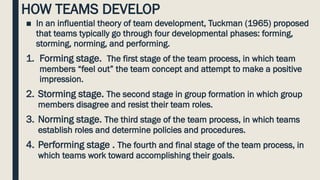
HOW TEAMS DEVELOP
■ In an influential theory of team development, Tuckman (1965) proposed
that teams typically go through four developmental phases: forming,
storming, norming, and performing.
1. Forming stage. The first stage of the team process, in which team
members “feel out” the team concept and attempt to make a positive
impression.
2. Storming stage. The second stage in group formation in which group
members disagree and resist their team roles.
3. Norming stage. The third stage of the team process, in which teams
establish roles and determine policies and procedures.
4. Performing stage . The fourth and final stage of the team process, in
which teams work toward accomplishing their goals.
WHY TEAMS DON’T ALWAYS WORK
■ The Team Is Not a Team
■ Excessive Meeting Requirements
■ Lack of Empowerment
■ Lack of Skill
■ Distrust of the Team Process
■ Unclear Objectives
GROUP CONFLICT
■ CONFLICT . The psychological and behavioral reaction to a perception
that another person is keeping you from reaching a goal, taking away your
right to behave in a particular way, or violating the expectancies of a
relationship.
■ Dysfunctional conflict. Conflict that keeps people from working together,
lessens productivity, spreads to other areas, or increases turnover.
■ Functional conflict. Conflict that results in increased performance or
better interpersonal relations.
TYPES OF CONFLICT
■ Interpersonal conflict . Conflict between two people.
■ Individual–group conflict . Conflict between an individual and the
other members of a group.
■ Group–group conflict. Conflict between two or more groups.
CAUSES OF CONFLICT
1. Competition for resources. A cause of conflict that occurs when the demand for
resources is greater than the resources available.
2. Task interdependence. A potential source of conflict that arises when the
completion of a task by one person affects the completion of a task by another person.
3. Jurisdictional ambiguity. Conflict caused by a disagreement about geographical
territory or lines of authority.
4. Communication barriers. Physical, cultural, and psychological obstacles that
interfere with successful communication and create a source of conflict.
5. Beliefs. A fifth cause of conflict is the belief systems of individuals or groups. Conflict
is most likely to occur when individuals or groups believe that they are superior to other
people or groups; have been mistreated by others; are vulnerable to others and are in
harm’s way; cannot trust others; and/or are helpless or powerless (Eidelson & Eidelson,
2003).
6. Personality. Relatively stable traits possessed by an individual.
CONFLICT STYLES
1. Avoiding style. The conflict style of a person who reacts to
conflict by pretending that it does not exist.
 Withdrawal. An approach to handling conflict in which one of
the parties removes him/herself from the situation to avoid
the conflict.
 Triangling. An employee discusses a conflict with a third party
such as a friend or supervisor. In doing so, the employee
hopes that the third party will talk to the second party and
that the conflict will be resolved without the need for the two
parties to meet.
CONFLICT STYLES
2. Accommodating style. The conflict style of a person who
tends to respond to conflict by giving in to the other person.
3. Forcing style. The conflict style of a person who responds to
conflict by always trying to win.
 Winning at all costs. An approach to handling conflict in which
one side seeks to win regardless of the damage to the other
side.
4. Collaborating style. The conflict style of a person who wants a
conflict resolved in such a way that both sides get what they
want.
CONFLICT STYLES
5. Compromising style. A style of resolving conflicts in which an
individual allows each side to get some of what it wants.
 Negotiation and bargaining. A method of resolving conflict in
which two sides use verbal skill and strategy to reach an
agreement.
 Least acceptable result (LAR). The lowest settlement that a
person is willing to accept in a negotiated agreement.
 Maximum supportable position (MSP). The highest possible
settlement that a person could reasonably ask for and still
maintain credibility in negotiating an agreement.
RESOLVING CONFLICT
Prior to Conflict Occurring
An organization should have a formal policy on how conflict is to
be handled. Usually such a policy will state that employees
should first try to resolve their own conflicts, and if that is not
successful, they can utilize a third-party intervention.
RESOLVING CONFLICT
When Conflict First Occurs
When conflict first occurs between coworkers or between a supervisor and a
subordinate, the two parties should be encouraged to use the conflict
resolution skills they learned in training to resolve the conflict on their own.
These skills include expressing a desire for cooperation, offering
compliments, avoiding negative interaction, emphasizing mutual similarities,
and pointing out common goals. A key to resolving conflict is to reduce
tension and increase trust between the two parties. This can be
accomplished by stating an intention to reduce tension, publicly announcing
what steps will be taken to reduce tension, inviting the other side also to
take action to reduce tension, and making sure that each initiative offered is
unambiguous. By taking these steps early on, minor conflict can be resolved
quickly, and serious conflict can be resolved through negotiation.
RESOLVING CONFLICT
When Conflict First Occurs
If the two can’t agree, the conflict is labeled a dispute, and the parties
should seek third-party intervention. An interesting aspect of this idea is
called cooperative problem solving. An example of this approach is when
the president of an organization forms a task force or committee with
representatives from all of the departments or divisions that will be
affected by the solution. Together these representatives work to define
the problem, identify possible solutions, and arrive at the best one.
Third-party intervention. When a neutral party is asked to help resolve a conflict.
Mediation. A method of resolving conflict in which a neutral third party is asked to
help the two parties reach an agreement.
Arbitration. A method of resolving conflicts in which a neutral third party is asked
to choose which side is correct.

Chapter 13 Group Behavior, Teams and Conflict.pptx

  • 1.
  • 2.
    Definition of aGroup ■ In reviewing the books written on group dynamics, it quickly becomes clear that there is no agreed-upon definition of a group. Some experts use a general definition that basically defines a group as two or more people who perceive themselves as a group and interact in some way. Other definitions require that a group must involve some degree of structure and permanency. Gordon (2001), believes that for a collection of people to be called a group, the following four criteria must be met: (a) the members of the group must see themselves as a unit; (b) the group must provide rewards to its members; (c) anything that happens to one member of the group affects every other member; and (d) the members of the group must share a common goal.
  • 3.
    Multiple Members WhoPerceive Themselves as a Unit ■ The first criterion is that the group must have multiple members. Obviously, one person does not constitute a group (even if he is a multiple personality). Therefore, at least two people are necessary to form a group. Usually we refer to 2 people as a dyad, to 3 people as a triad, and to 4 to 20 people as a small group (Forsyth, 2013). To be considered a group, these two or more people must also see themselves as a unit. Thus, three individuals walking down the sidewalk would be considered a group only if they knew one another and were together. Eight separate customers shopping at a store would not be considered a group.
  • 4.
    Group Rewards ■ Thesecond group criterion is that membership must be rewarding for each individual in the group. It is important to remember that people will join or form a group only if it provides some form of reward. To demonstrate this point, imagine four students studying for an exam. If the four study in separate rooms and do not share information, they are not a group. Likewise, consider if the same four people sat at one desk in the library. If each person studies the book separately and never communicates with the other three, then the four still will not be a group because none of the individuals is rewarded by being with the others. But if none of the four would have otherwise studied independently, then the four students would be considered a group because being together was rewarding. Even though they did not talk with one another during their time in the library, the fact that they were together provided the structure for each of them to study.
  • 5.
    Corresponding Effects ■ Thethird group criterion is that an event that affects one group member should affect all group members. That is, if something significant happens to one person and does not affect any of the other people gathered with her, then the collection of people cannot be considered a group. This requirement is called corresponding effects. For example, suppose five bank tellers work side by side, and one teller becomes ill and goes home. If the activities of the other four change as a result of one teller leaving, the five might be considered a group. But if the activities of the other four do not change after one teller leaves, then the tellers cannot be considered a group.
  • 6.
    Common Goals ■ Thefourth and final criterion is that all members must have a common goal. In the teller example, if the goal of one of the tellers is to meet only young, single customers and the goal of another teller is to serve as many customers as possible, the tellers are not considered to be a group because they work in different ways and for different reasons.
  • 7.
    Reasons for JoiningGroups 1. Assignment ■ In the workplace, the most common reason for joining groups is that employees are assigned to them. For example, a new employee might be assigned to a department with 5 other employees, 5 employees might be appointed to serve on a committee, and 10 employees are scheduled for the same training class.
  • 8.
    Reasons for JoiningGroups 2. Physical Proximity ■ One especially strong reason that a person might join a particular group, especially if the group is informal, is physical proximity (Forsyth, 2013). That is, people tend to form groups with people who either live or work nearby. For example, think of the intramural teams on your campus. Most teams consist of students who live in the same residence halls or have classes together. At work, employees tend to form groups that consist of those who work in the same general area. And some employees seek close physical proximity to people in power, hoping they will become part of an elite group.
  • 9.
    Reasons for JoiningGroups 3. Affiliation ■ Affiliation involves our need to be with other people. Thus, one reason people join groups is to be near and talk to other people.
  • 10.
    Reasons for JoiningGroups 4.Identification ■ The need to associate ourselves with the image projected by other people, groups, or objects.
  • 11.
    Reasons for JoiningGroups 5. Emotional Support ■ We also join groups to obtain emotional support. Alcoholics Anonymous, Gamblers Anonymous, and Weight Watchers are good examples of groups that provide emotional support for their members. A quick perusal of ads in the local paper or a quick surfing of the Internet will demonstrate the importance of this need, as there are hundreds of different types of support groups. Survivor, contestants might form alliances to increase the odds of not being voted off the island.
  • 12.
    Reasons for JoiningGroups 6. Assistance or Help ■ People often join groups to obtain assistance or help. For example, students having problems with an algebra class might form a study group. Or, on the reality show survivor, contestants might form alliances to increase the odds of not being voted off the island.
  • 13.
    Reasons for JoiningGroups 6. Common Interests  People often join groups because they share a common interest. At school, students joining a geology club share an interest in geology, students joining a fraternity share an interest in socializing, and students joining a service club such as Circle Kor Alpha Phi Omega share an interest in helping people.
  • 14.
    Reasons for JoiningGroups 7. Common Goals  People who join political parties exemplify being in pursuit of a common goal. These people may also share common interests, but their primary purpose is to get a particular person or members of a particular party elected to office.
  • 15.
    Factors Affecting GroupPerformance 1. Group cohesiveness. The extent to which members of a group like and trust one another. Group Homogeneity.  Homogeneous groups. Groups whose members share the same characteristics.  Heterogeneous groups. Groups whose members share few similarities.  Slightly heterogeneous groups. Groups in which a few group members have different characteristics from the rest of the group. Stability. The extent to which the membership of a group remains consistent over time.
  • 16.
    Factors Affecting GroupPerformance  Isolation. is another variable that tends to increase a group’s cohesiveness. Groups that are isolated or located away from other groups tend to be highly cohesive.  Outside Pressure. Groups that are pressured by outside forces also tend to become highly cohesive. To some degree, this response to outside pressure can be explained by the phenomenon of psychological reactance (Brehm, 1966). When we believe that someone is trying to intentionally influence us to take some particular action, we often react by doing the opposite. Consider, for example, a teenaged dating couple. As the boy arrives to pick up his date, the girl’s father notices the young man’s beard and Harley- Davidson motorcycle and forbids his daughter to go out with him. Before this order, the daughter may not have been especially interested in the boy, but after being told she cannot go on the date, she reacts by liking the boy more.  Groups are most cohesive and perform best when group size is small. Studies have shown that large groups have lower productivity (Mullen, Johnson, & Drake, 1987), less coordination, lower morale (Frank & Anderson, 1971), are less active (Indik, 1965), less cohesive (Carron, 1990), and more critical (Valacich, Dennis, & Nunamaker, 1992) than smaller groups.
  • 17.
    Factors Affecting GroupPerformance  This does not mean, however, that small groups are always best. Although small groups usually increase cohesiveness, high performance is seen with only certain types of tasks. 1. Additive tasks are those for which the group’s performance is equal to the sum of the performances by each group member. Examples of groups performing additive tasks include bowling teams and typing pools. In groups working on additive tasks, each member’s contribution is important, and larger groups will probably be better than smaller groups. 2. Conjunctive tasks are those for which the group’s performance depends on the least effective group member (a chain is only as strong as its weakest link). Examples of conjunctive tasks include an assembly line and friends going hiking (you can walk only as fast as the slowest hiker). Because success on a conjunctive task is limited by the least effective member, smaller groups are usually best. 3. Disjunctive tasks are those for which the group’s performance is based on the most talented group member. Examples of disjunctive tasks include problem solving, brainstorming, and a captain’s choice golf tournament (each person plays the best shot of the four golfers). As with additive tasks, larger groups are probably better at disjunctive tasks than are smaller groups.
  • 18.
    Social impact theory ■The addition of more members has its greatest effect when the group is small. Latane (1981) first investigated this idea when he formulated social impact theory. Imagine that a four-person committee is studying safety problems at work. If the group is stable and cohesive, adding a fifth person may be disruptive. But in a factory of 3,000 employees, hiring 1 new employee is not likely to change the complexion of the company. That is why sports experts have observed that a single great player can turn around a poor basketball team—as occurred with Bill Walton and the Portland Trailblazers, David Robinson and the San Antonio Spurs, Jason Kidd and the New Jersey Nets, and Steve Nash and the Phoenix Suns—but not a football or baseball team.
  • 19.
    Factors Affecting GroupPerformance  Group Status. The higher the group’s status, the greater its cohesiveness. This is an important point: A group can be made more cohesive by increasing group status. The group does not actually have to have high status, but it is important that its members believe they have high status. 2.Group Ability and Confidence. Not surprisingly, groups consisting of high-ability members outperform those with low-ability members (Devine & Phillips, 2001). Furthermore, groups whose members believe that their team can be successful both at a specific task (high team efficacy) and at tasks in general (high team potency) perform better than groups whose members aren’t as confident about their probability for success (Gully, Incalcaterra, Joshi, & Beaubien, 2002). 3. Personality of the Group Members. An important factor affecting group performance is the personality of the group members. Meta-analysis results indicate that in general, groups whose members have task-related experience and score high in the personality dimensions of openness to experience and emotional stability will perform better than groups whose members do not have these characteristics (Bell, 2007). In addition, groups working on intellectual tasks will do better if their group members are bright, and groups working on physical tasks (e.g., sports teams) will do better if their group members score high in the personality dimensions of conscientiousness, extraversion, and agreeableness (Bell, 2005).
  • 20.
    Factors Affecting GroupPerformance 4. Communication Structure. Another variable that can affect a group’s performance is its communication structure, or network. For a group to perform successfully, good communication among members is essential. 5. Group Roles. Another factor that affects the performance of a group is the extent to which its members assume different roles. For a group to be successful, its members’ roles must fall into one of two categories: task oriented and social oriented (Stewart, Fulmer, & Barrick, 2005). Task-oriented roles involve behaviors such as offering new ideas, coordinating activities, and finding new information. Social-oriented roles involve encouraging cohesiveness and participation. A third category— the individual role —includes blocking group activities, calling attention to oneself, and avoiding group interaction. Individual roles seldom result in higher group productivity. Group members will often naturally assume these roles on the basis of their individual personalities and experiences. For example, people high in conscientiousness tend to fill task-oriented roles, and people high in agreeableness tend to fill social-oriented roles (Stewart et al., 2005).
  • 21.
    Presence of Others:Social Facilitation and Inhibition Social facilitation. The positive effects that occur when a person performs a task in the presence of others. Social inhibition. The negative effects that occur when a person performs a task in the presence of others.
  • 22.
    Audience Effects. Thephenomenon of audience effects takes place when a group of people passively watch an individual. An example would be a sporting event held in an arena. The strength of the effect of having an audience present is a function of at least three factors (Latane, 1981): an audience’s size, its physical proximity to the person or group, and its status. Thus, groups are most likely to be affected by large audiences of experts who are physically close to them. Coaction. The effect on behavior when two or more people are performing the same task in the presence of one another is called coaction. Examples would be two runners competing against each other without a crowd present, or two mail clerks sorting envelopes in the same room. Shalley (1995) found that coaction decreased creativity and productivity. There are many studies demonstrating interesting examples of coaction- influenced behavior. For example:  Rockloff and Dyer (2007) found that gamblers placed larger bets and lost more money when gambling near others than when gambling alone.  Sommer, Wynes, and Brinkley (1992) found that when people shopped in groups, they spent more time in a store and purchased more goods than when alone.  de Castro and Brewer (1992) discovered that meals eaten in large groups were 75% larger than those eaten when a person was alone.
  • 23.
    Mere presence .Theorystating that the very fact that others happen to be present naturally produces arousal and thus may affect performance. Comparison. The effect when an individual working on a task compares his or her performance with that of another person performing the same task. Evaluation apprehension. The idea that a person performing a task becomes aroused because he or she is concerned that others are evaluating his or her performance. Distracting . The idea that social inhibition occurs because the presence of others provides a distraction that interferes with concentration. Social loafing. The fact that individuals in a group often exert less individual effort than they would if they were not in a group.
  • 24.
    Factors Affecting GroupPerformance 6. Individual dominance. When one member of a group dominates the group. 7. Groupthink. A state of mind in which a group is so concerned about its own cohesiveness that it ignores important information. With groupthink, members become so cohesive and like-minded that they make poor decisions despite contrary information that might reasonably lead them to other options. Groupthink most often occurs when the group  is cohesive;  is insulated from qualified outsiders;  has an illusion of invulnerability, infallibility, or both;  believes that it is morally superior to its adversaries;  is under great pressure to conform;  has a leader who promotes a favorite solution; and  has gatekeepers who keep information from other group members. Groupthink can be reduced in several ways. First, the group leader should not state his own position or beliefs until late in the decision-making process. Second, the leader should promote open discussion and encourage group members to speak. Third, a group or committee can be separated into subgroups to increase the chance of disagreement. Finally, one group member can be assigned the job of devil’s advocate—one who questions and disagrees with the group.
  • 25.
    Individual Versus GroupPerformance ■ Nominal group. A collection of individuals whose results are pooled but who never interact with one another. ■ Interacting group. A collection of individuals who work together to perform a task.  Brainstorming . A technique in which ideas are generated by people in a group setting.
  • 26.
    TEAMS ■ What Isa Work Team? ■ According to Devine, Clayton, Philips, Dunford, and Melner (1999), a work team is “a collection of three or more individuals who interact intensively to provide an organizational product, plan, decision, or service”.
  • 27.
    TEAMS ■ .Before callinga group of individuals a team, several factors should be considered (Donnellon,1996). 1. Identification is the extent to which group members identify with the team rather than with other groups. For example, suppose a committee was created composed of one representative from each of five different departments (e.g., accounting, engineering, human resources). During the meetings, members use such statements as “Our department won’t agree. 2. Interdependence. The extent to which team members need and rely on other team members. 3. Power differentiation. The extent to which team members have the same level of power and respect. 4. Social distance. The extent to which team members treat each other in a friendly, informal manner.
  • 28.
    5. Conflict ManagementTactics .Team members respond to conflict by collaborating, whereas nonteam members respond by forcing and accommodating. In nonteams, members react to conflict by threatening, directing, or giving in. In teams, members try to understand the others’ views, make attempts to compromise, and use nonthreatening tones (Donnellon, 1996). 6. Negotiation Process . In teams, members negotiate in a win–win style in which the goal is for every person to come out ahead. In nonteams, members negotiate so that they win and the other members lose.
  • 29.
    On the basisof this six factors. Donnellon (1996) placed teams in to one of five categories: 1. Collaborative teams 2. Emergent teams 3. Adversarial teams 4. Nominal teams 5. Doomed teams. Collaborative teams and emergent teams are what I have referred to as true teams, whereas nominal teams and doomed teams are what I have referred to as nonteams. Adversarial teams are some where in between a true team and a nonteam.
  • 30.
    Though not affectingthe extent to which a group is officially a team, teams differ in two other ways. 1. Permanency The extent to which a team will remain together or be disbanded after a task has been accomplished. 2. Proximity. Physical distance between people.  Virtual teams . Teams that communicate through email rather than face to face.
  • 31.
    TYPES OF TEAMS ■Teams is classified into the four categories determined by Cohen and Bailey (1997): 1. Work teams. Groups of employees who manage themselves, assign jobs, plan and schedule work, make work related decisions, and solve work-related problems. 2. Parallel teams . Also called cross-functional teams, they consist of representatives from various departments (functions) within an organization. For example, a team formed to reduce the time to ship a product might include members from the sales, shipping, production, and customer service departments. 3. Project teams. Groups formed to produce onetime outputs such as creating a new product, installing a new software system, or hiring a new employee. 4. Management teams. Teams that coordinate, manage, advise, and direct employees and teams.
  • 32.
    HOW TEAMS DEVELOP ■In an influential theory of team development, Tuckman (1965) proposed that teams typically go through four developmental phases: forming, storming, norming, and performing. 1. Forming stage. The first stage of the team process, in which team members “feel out” the team concept and attempt to make a positive impression. 2. Storming stage. The second stage in group formation in which group members disagree and resist their team roles. 3. Norming stage. The third stage of the team process, in which teams establish roles and determine policies and procedures. 4. Performing stage . The fourth and final stage of the team process, in which teams work toward accomplishing their goals.
  • 33.
    WHY TEAMS DON’TALWAYS WORK ■ The Team Is Not a Team ■ Excessive Meeting Requirements ■ Lack of Empowerment ■ Lack of Skill ■ Distrust of the Team Process ■ Unclear Objectives
  • 34.
    GROUP CONFLICT ■ CONFLICT. The psychological and behavioral reaction to a perception that another person is keeping you from reaching a goal, taking away your right to behave in a particular way, or violating the expectancies of a relationship. ■ Dysfunctional conflict. Conflict that keeps people from working together, lessens productivity, spreads to other areas, or increases turnover. ■ Functional conflict. Conflict that results in increased performance or better interpersonal relations.
  • 35.
    TYPES OF CONFLICT ■Interpersonal conflict . Conflict between two people. ■ Individual–group conflict . Conflict between an individual and the other members of a group. ■ Group–group conflict. Conflict between two or more groups.
  • 36.
    CAUSES OF CONFLICT 1.Competition for resources. A cause of conflict that occurs when the demand for resources is greater than the resources available. 2. Task interdependence. A potential source of conflict that arises when the completion of a task by one person affects the completion of a task by another person. 3. Jurisdictional ambiguity. Conflict caused by a disagreement about geographical territory or lines of authority. 4. Communication barriers. Physical, cultural, and psychological obstacles that interfere with successful communication and create a source of conflict. 5. Beliefs. A fifth cause of conflict is the belief systems of individuals or groups. Conflict is most likely to occur when individuals or groups believe that they are superior to other people or groups; have been mistreated by others; are vulnerable to others and are in harm’s way; cannot trust others; and/or are helpless or powerless (Eidelson & Eidelson, 2003). 6. Personality. Relatively stable traits possessed by an individual.
  • 37.
    CONFLICT STYLES 1. Avoidingstyle. The conflict style of a person who reacts to conflict by pretending that it does not exist.  Withdrawal. An approach to handling conflict in which one of the parties removes him/herself from the situation to avoid the conflict.  Triangling. An employee discusses a conflict with a third party such as a friend or supervisor. In doing so, the employee hopes that the third party will talk to the second party and that the conflict will be resolved without the need for the two parties to meet.
  • 38.
    CONFLICT STYLES 2. Accommodatingstyle. The conflict style of a person who tends to respond to conflict by giving in to the other person. 3. Forcing style. The conflict style of a person who responds to conflict by always trying to win.  Winning at all costs. An approach to handling conflict in which one side seeks to win regardless of the damage to the other side. 4. Collaborating style. The conflict style of a person who wants a conflict resolved in such a way that both sides get what they want.
  • 39.
    CONFLICT STYLES 5. Compromisingstyle. A style of resolving conflicts in which an individual allows each side to get some of what it wants.  Negotiation and bargaining. A method of resolving conflict in which two sides use verbal skill and strategy to reach an agreement.  Least acceptable result (LAR). The lowest settlement that a person is willing to accept in a negotiated agreement.  Maximum supportable position (MSP). The highest possible settlement that a person could reasonably ask for and still maintain credibility in negotiating an agreement.
  • 40.
    RESOLVING CONFLICT Prior toConflict Occurring An organization should have a formal policy on how conflict is to be handled. Usually such a policy will state that employees should first try to resolve their own conflicts, and if that is not successful, they can utilize a third-party intervention.
  • 41.
    RESOLVING CONFLICT When ConflictFirst Occurs When conflict first occurs between coworkers or between a supervisor and a subordinate, the two parties should be encouraged to use the conflict resolution skills they learned in training to resolve the conflict on their own. These skills include expressing a desire for cooperation, offering compliments, avoiding negative interaction, emphasizing mutual similarities, and pointing out common goals. A key to resolving conflict is to reduce tension and increase trust between the two parties. This can be accomplished by stating an intention to reduce tension, publicly announcing what steps will be taken to reduce tension, inviting the other side also to take action to reduce tension, and making sure that each initiative offered is unambiguous. By taking these steps early on, minor conflict can be resolved quickly, and serious conflict can be resolved through negotiation.
  • 42.
    RESOLVING CONFLICT When ConflictFirst Occurs If the two can’t agree, the conflict is labeled a dispute, and the parties should seek third-party intervention. An interesting aspect of this idea is called cooperative problem solving. An example of this approach is when the president of an organization forms a task force or committee with representatives from all of the departments or divisions that will be affected by the solution. Together these representatives work to define the problem, identify possible solutions, and arrive at the best one. Third-party intervention. When a neutral party is asked to help resolve a conflict. Mediation. A method of resolving conflict in which a neutral third party is asked to help the two parties reach an agreement. Arbitration. A method of resolving conflicts in which a neutral third party is asked to choose which side is correct.