Group Dynamics & Team
Building
Dr Parul Sinha
MEU AIIMS
Raebareli
Teamwork
“Create A Story”
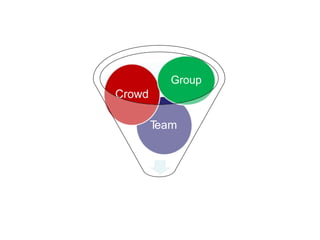
T
eam
Crowd
Group
Crowd – Group - Team
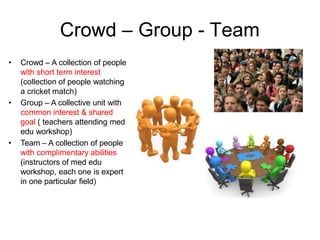
• Crowd – A collection of people
with short term interest
(collection of people watching
a cricket match)
• Group – A collective unit with
common interest & shared
goal ( teachers attending med
edu workshop)
• Team – A collection of people
with complimentary abilities
(instructors of med edu
workshop, each one is expert
in one particular field)
• Man is a social animal
• In day to day life at every step you interact with people –
family, friends, colleagues, patients, students
• Many a times these interactions turn unpleasant
• Why ?
• Either bad interpersonal relationship or failure to attain
desired outcome
• What goes wrong?
• It is group dynamics which creates problem
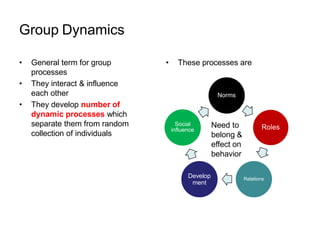
Group Dynamics
• General term for group
processes
• They interact & influence
each other
• They develop number of
dynamic processes which
separate them from random
collection of individuals
• These processes are
Norms
Roles
Relations
Develop
ment
Social
influence
Need to
belong &
effect on
behavior
Group
• Able to share experiences
• Provide feedback
• Pool ideas
• Generate insight
• Provide opportunities for
analysis of experiences
• Provides a measure of support
& reassurance
• Groups are not inert entities
• They are lively & vibrant
• Groups form, grow & die
• Groups can be strength or
weaknesses
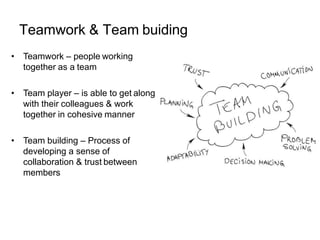
Teamwork & Team buiding
• Teamwork – people working
together as a team
• Team player – is able to get along
with their colleagues & work
together in cohesive manner
• Team building – Process of
developing a sense of
collaboration & trust between
members
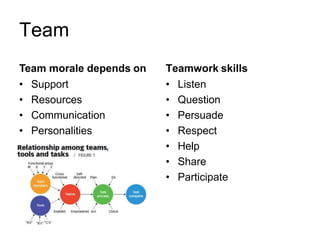
Team
Team morale depends on
• Support
• Resources
• Communication
• Personalities
Teamwork skills
• Listen
• Question
• Persuade
• Respect
• Help
• Share
• Participate
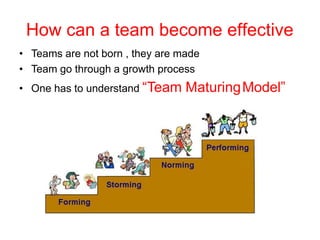
How can a team become effective
• Teams are not born , they are made
• Team go through a growth process
• One has to understand “Team MaturingModel”
Team roles
• Leader
• Initiator
• Recorder
• Devils advocate – someone whose responsibility is to look for
potential flaws in idea
• Optimist – someone who maintains a positive frame of mind
• Timekeeper
• Gatekeeper – someone who sees that every member gives input
• Summarizer
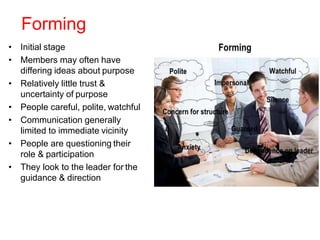
Forming
• Initial stage
• Members may often have
differing ideas about purpose
• Relatively little trust &
uncertainty of purpose
• People careful, polite, watchful
• Communication generally
limited to immediate vicinity
• People are questioning their
role & participation
• They look to the leader for the
guidance & direction
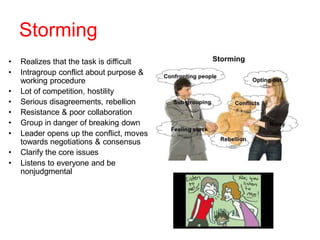
Storming
• Realizes that the task is difficult
• Intragroup conflict about purpose &
working procedure
• Lot of competition, hostility
• Serious disagreements, rebellion
• Resistance & poor collaboration
• Group in danger of breaking down
• Leader opens up the conflict, moves
towards negotiations & consensus
• Clarify the core issues
• Listens to everyone and be
nonjudgmental
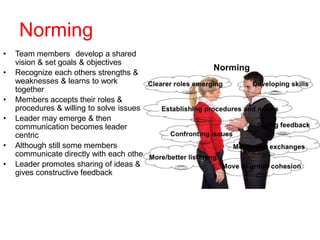
Norming
• Team members develop a shared
vision & set goals & objectives
• Recognize each others strengths &
weaknesses & learns to work
together
• Members accepts their roles &
procedures & willing to solve issues
• Leader may emerge & then
communication becomes leader
centric
• Although still some members
communicate directly with each other
• Leader promotes sharing of ideas &
gives constructive feedback
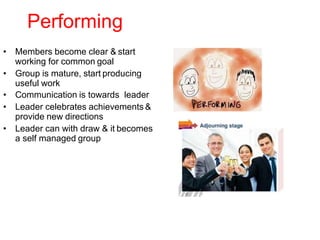
Performing
• Members become clear & start
working for common goal
• Group is mature, start producing
useful work
• Communication is towards leader
• Leader celebrates achievements &
provide new directions
• Leader can with draw & it becomes
a self managed group
Effective Team Characteristics
• Appropriate Leadership
• Clear goals
• Operation on a definite time schedule
• Welfare and growth of team members are kept in mind
• Resources of all team members are utilized
• Evaluation of results and team processes done
periodically.
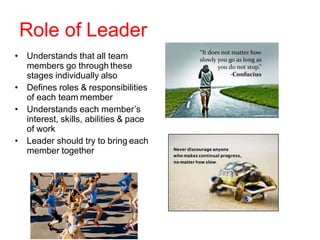
Role of Leader
• Understands that all team
members go through these
stages individually also
• Defines roles & responsibilities
of each team member
• Understands each member’s
interest, skills, abilities & pace
of work
• Leader should try to bring each
member together
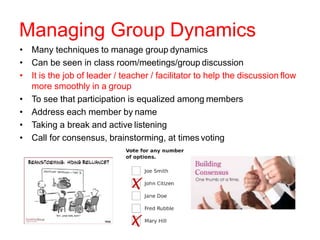
Managing Group Dynamics
• Many techniques to manage group dynamics
• Can be seen in class room/meetings/group discussion
• It is the job of leader / teacher / facilitator to help the discussion flow
more smoothly in a group
• To see that participation is equalized among members
• Address each member by name
• Taking a break and active listening
• Call for consensus, brainstorming, at times voting
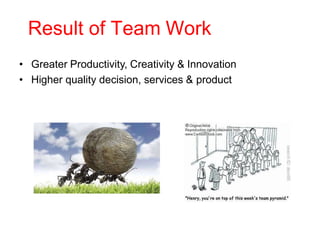
Result of Team Work
• Greater Productivity, Creativity & Innovation
• Higher quality decision, services & product
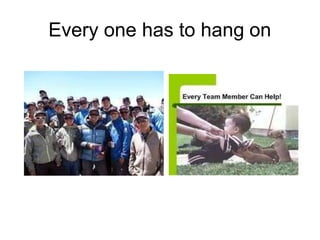
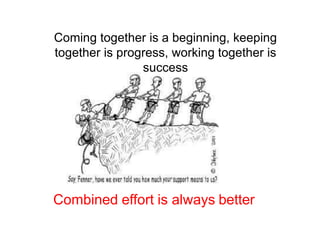
Every one has to hang on
Coming together is a beginning, keeping
together is progress, working together is
success
Combined effort is always better

D1 Final Group Dynamics & Team BuildingBasic MCI Coursr.pptx

  • 1.
    Group Dynamics &Team Building Dr Parul Sinha MEU AIIMS Raebareli
  • 2.
  • 3.
  • 4.
    Crowd – Group- Team • Crowd – A collection of people with short term interest (collection of people watching a cricket match) • Group – A collective unit with common interest & shared goal ( teachers attending med edu workshop) • Team – A collection of people with complimentary abilities (instructors of med edu workshop, each one is expert in one particular field)
  • 5.
    • Man isa social animal • In day to day life at every step you interact with people – family, friends, colleagues, patients, students • Many a times these interactions turn unpleasant • Why ? • Either bad interpersonal relationship or failure to attain desired outcome • What goes wrong? • It is group dynamics which creates problem
  • 6.
    Group Dynamics • Generalterm for group processes • They interact & influence each other • They develop number of dynamic processes which separate them from random collection of individuals • These processes are Norms Roles Relations Develop ment Social influence Need to belong & effect on behavior
  • 7.
    Group • Able toshare experiences • Provide feedback • Pool ideas • Generate insight • Provide opportunities for analysis of experiences • Provides a measure of support & reassurance • Groups are not inert entities • They are lively & vibrant • Groups form, grow & die • Groups can be strength or weaknesses
  • 8.
    Teamwork & Teambuiding • Teamwork – people working together as a team • Team player – is able to get along with their colleagues & work together in cohesive manner • Team building – Process of developing a sense of collaboration & trust between members
  • 9.
    Team Team morale dependson • Support • Resources • Communication • Personalities Teamwork skills • Listen • Question • Persuade • Respect • Help • Share • Participate
  • 10.
    How can ateam become effective • Teams are not born , they are made • Team go through a growth process • One has to understand “Team MaturingModel”
  • 11.
    Team roles • Leader •Initiator • Recorder • Devils advocate – someone whose responsibility is to look for potential flaws in idea • Optimist – someone who maintains a positive frame of mind • Timekeeper • Gatekeeper – someone who sees that every member gives input • Summarizer
  • 12.
    Forming • Initial stage •Members may often have differing ideas about purpose • Relatively little trust & uncertainty of purpose • People careful, polite, watchful • Communication generally limited to immediate vicinity • People are questioning their role & participation • They look to the leader for the guidance & direction
  • 13.
    Storming • Realizes thatthe task is difficult • Intragroup conflict about purpose & working procedure • Lot of competition, hostility • Serious disagreements, rebellion • Resistance & poor collaboration • Group in danger of breaking down • Leader opens up the conflict, moves towards negotiations & consensus • Clarify the core issues • Listens to everyone and be nonjudgmental
  • 14.
    Norming • Team membersdevelop a shared vision & set goals & objectives • Recognize each others strengths & weaknesses & learns to work together • Members accepts their roles & procedures & willing to solve issues • Leader may emerge & then communication becomes leader centric • Although still some members communicate directly with each other • Leader promotes sharing of ideas & gives constructive feedback
  • 15.
    Performing • Members becomeclear & start working for common goal • Group is mature, start producing useful work • Communication is towards leader • Leader celebrates achievements & provide new directions • Leader can with draw & it becomes a self managed group
  • 16.
    Effective Team Characteristics •Appropriate Leadership • Clear goals • Operation on a definite time schedule • Welfare and growth of team members are kept in mind • Resources of all team members are utilized • Evaluation of results and team processes done periodically.
  • 17.
    Role of Leader •Understands that all team members go through these stages individually also • Defines roles & responsibilities of each team member • Understands each member’s interest, skills, abilities & pace of work • Leader should try to bring each member together
  • 18.
    Managing Group Dynamics •Many techniques to manage group dynamics • Can be seen in class room/meetings/group discussion • It is the job of leader / teacher / facilitator to help the discussion flow more smoothly in a group • To see that participation is equalized among members • Address each member by name • Taking a break and active listening • Call for consensus, brainstorming, at times voting
  • 19.
    Result of TeamWork • Greater Productivity, Creativity & Innovation • Higher quality decision, services & product
  • 20.
    Every one hasto hang on
  • 21.
    Coming together isa beginning, keeping together is progress, working together is success Combined effort is always better