ABRASIVE MACHINING PROCESSES
(GRINDING)
Abrasive Machining
Why a smooth surface?
Reduction in Friction
Heat - Bearings
Reduction in Wear
Bushings/Bearings
Appearance
Car Body, Furniture
Clearance
Disk Head
Sharpness
Cutting Tools
Abrasive Machining
How do we get a smooth surface?
Remove Material
Abrasive Machining
Flatten
Burnishing
Fill in Voids
Add material
Paint
Finish
Wax
Abrasive (Grinding)
 Abrasive that scraps or rubs.
 Substance used for grinding or polishing
surface.
 Abrasive machining is a material removal
process that involves the interaction of
abrasive grits with the workpiece at high
speeds and shallow penetration depths.
Abrasive (Grinding)
 Many abrasives are used for abrasive
machining proceses but popular is grinding
wheel, and operation related to grinding
wheel is grinding process.
 Grinding is a metal cutting operation
performed by means of a rotative abrasive
wheel that act a cutting tool. This is used
to finish workpieces which must show a
high surface quality, accuracy of shape and
dimension.
Abrasive (Grinding)
 Mostly grinding is the finishing operation
because it removes comparatively little
metal usually 0.25 to 0.50mm in most
operation and the accuracy is in the order
of 0.000025mm.
Grinding Wheels
 These wheels are made of abrasive grains,
held together by means of suitable binding
material called ‘bond,. They are used in the
machining operation known as ‘ Grinding’.
Wheel Materials – (Abrasive and Bonds)
A grinding wheel essentially consists of two
materials:
1. Abrasive: It is the material of the grinding
wheel which does the cutting action.
2. Bond: This material of the grinding wheel
acts as a binder to hold the abrasive grain
together.
Wheel Materials – (Abrasive and Bonds)
Abrasives: These are extremely hard
materials consisting of very small particles
called grains, which carry a number of
sharp cutting edges and corners.
The abrasive are of two types:
a. Natural
b. Artificial or Manufactured
Types of Abrasives
Conventional Abrasives
a. Aluminum oxide (Al2O3)
b. Silicon carbide (SiC)
Super abrasives
c. Cubic Boron Nitride (cBN)
d. Diamond
Abrasives are harder than conventional tool
materials
Abrasive Types
• Abrasives commonly
found in nature
include:
– Emery
– Corundum
– Quartz
– Garnet
– Diamond
Bonded Abrasives/
Grinding Wheels
Bonded Abrasives
Most grinding wheels are made of abrasive
grains held together by a bonding material
Types of bonding material:
Vitrified (glass)
Resinoid (thermosetting resin)
Rubber
Metal (the wheel itself is metal; the grains are
bonded to its surface
Bond Types
• Vitrified: a glass bond,
most commonly used
bonding material.
– However, it is a brittle bond.
• Resinoid: bond consiting
of thermosetting resins,
bond is an organic
compound.
– More flexible bond than
vitrified, also more resistant
to higher temps.
Bond Types
• Reinforced Wheels: bond consisting of
one or more layers of fiberglass.
– Prevents breakage rather than improving
strength.
• Rubber: flexible bond type, inexpensive.
• Metal: different metals can be used for
strength, ductility, etc.
– Most inexpensive bond type.
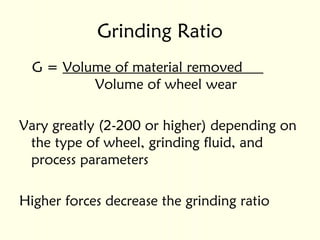
Grinding Ratio
G = Volume of material removed
Volume of wheel wear
Vary greatly (2-200 or higher) depending on
the type of wheel, grinding fluid, and
process parameters
Higher forces decrease the grinding ratio
WHEEL STRUCTURE
 The term wheel structure refers to the spacing of
the abrasive grains.
 Two wheel of the same grade and grain size
but of different grain spacing will have different
cutting actions.
 Wheels with close spacing should be used on
hard materials or when a fine finish is to be
given to the work.
Grinding Wheel
Structure
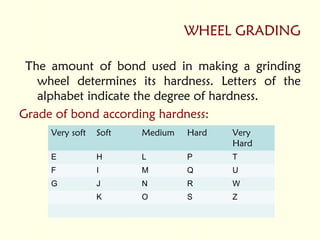
WHEEL GRADING
The amount of bond used in making a grinding
wheel determines its hardness. Letters of the
alphabet indicate the degree of hardness.
Grade of bond according hardness:
Very soft Soft Medium Hard Very
Hard
E H L P T
F I M Q U
G J N R W
K O S Z
Abrasive Grain Size
• Abrasives are usually much smaller than
the cutting tools in manufacturing
processes.
• Size of abrasive grain measured by grit
number.
– Smaller grain size, the larger the grit number.
– Ex: with sandpaper 10 is very coarse, 100 is
fine, and 500 is very fine grain.
WHEEL IDENTIFICATION IN THE NORTON SYSTEM
In the Norton system, a wheel marked 3060-K5BE
the has following characteristics:
30 indicates the kind of abrasive (Aluminum oxide)
60 is the grain size
K indicates the grade of the bond, which is soft
5 indicates the wheel structure (medium)
BE indicates the kind of bond (which is vitrified)
S Silicate bond
T resinoid bond
R rubber, I Shellac bond
ABRASIVE GRAIN SIZE
Coarse 8,10,12,14,16,20,24
Medium 30,36,46,54,60
Fine 70,80.90.100,120,150,180
Very fine 220,240,280,320,400,500,600
CORRECT WHEEL SELECTED
Several factors affect the selection of a grinding
wheel.
a. The kind of material to be ground.
b. The amount of stock to be removed.
c. The accuracy as to size.
d. The kind of finish required.
e. The area of contact between the wheel and the
work.
f. the kind of grinding machine to be used.
Kinds of Grinding)
Grinding may be classified broadly into two
categories:
1. Rough or non precision grinding
2. Precision grinding
Kinds of Grinding)
1. Rough or non precision grinding: The
common forms of rough grinding are
snagging and off-hand grinding where the
work is held in the operator hand.
Snagging: is done where a considerable of
material removed without the regard of
the accuracy of the finished surface.
Examples: of snag grinding are trimming the
surface left by sprue and risers on casting
Kinds of Grinding)
2. Precision grinding: This is concerned with
producing good surface finish and high
degree of accuracy. The wheel or work
both are guided in precise paths.
Kinds of Grinding
Grinding in accordance with the type of
surface to be ground is classified as:
1. External cylindrical grinding
2. Internal cylindrical grinding
3. Surface grinding
4. Form grinding
1. External Cylindrical Grinding Produces a
straight or tapered surface on a
workpiece.
2. Internal Cylindrical Grinding: produces
internal cylindrical holes and tapers.
3. Surface Grinding: Produce flat surface.
4. Form Grinding: is specially used for giving
proper shaped to gear teeth and threads
etc.
Truing and Dressing
Grinding
TYPES OF GRINDING
TYPES OF GRINDING
Centerless Grinding
TYPES OF GRINDING
TYPES OF GRINDING
TYPES OF GRINDING

Grinding

  • 1.
  • 2.
    Abrasive Machining Why asmooth surface? Reduction in Friction Heat - Bearings Reduction in Wear Bushings/Bearings Appearance Car Body, Furniture Clearance Disk Head Sharpness Cutting Tools
  • 3.
    Abrasive Machining How dowe get a smooth surface? Remove Material Abrasive Machining Flatten Burnishing Fill in Voids Add material Paint Finish Wax
  • 4.
    Abrasive (Grinding)  Abrasivethat scraps or rubs.  Substance used for grinding or polishing surface.  Abrasive machining is a material removal process that involves the interaction of abrasive grits with the workpiece at high speeds and shallow penetration depths.
  • 5.
    Abrasive (Grinding)  Manyabrasives are used for abrasive machining proceses but popular is grinding wheel, and operation related to grinding wheel is grinding process.  Grinding is a metal cutting operation performed by means of a rotative abrasive wheel that act a cutting tool. This is used to finish workpieces which must show a high surface quality, accuracy of shape and dimension.
  • 6.
    Abrasive (Grinding)  Mostlygrinding is the finishing operation because it removes comparatively little metal usually 0.25 to 0.50mm in most operation and the accuracy is in the order of 0.000025mm.
  • 7.
    Grinding Wheels  Thesewheels are made of abrasive grains, held together by means of suitable binding material called ‘bond,. They are used in the machining operation known as ‘ Grinding’.
  • 8.
    Wheel Materials –(Abrasive and Bonds) A grinding wheel essentially consists of two materials: 1. Abrasive: It is the material of the grinding wheel which does the cutting action. 2. Bond: This material of the grinding wheel acts as a binder to hold the abrasive grain together.
  • 9.
    Wheel Materials –(Abrasive and Bonds) Abrasives: These are extremely hard materials consisting of very small particles called grains, which carry a number of sharp cutting edges and corners. The abrasive are of two types: a. Natural b. Artificial or Manufactured
  • 10.
    Types of Abrasives ConventionalAbrasives a. Aluminum oxide (Al2O3) b. Silicon carbide (SiC) Super abrasives c. Cubic Boron Nitride (cBN) d. Diamond Abrasives are harder than conventional tool materials
  • 11.
    Abrasive Types • Abrasivescommonly found in nature include: – Emery – Corundum – Quartz – Garnet – Diamond
  • 12.
    Bonded Abrasives/ Grinding Wheels BondedAbrasives Most grinding wheels are made of abrasive grains held together by a bonding material Types of bonding material: Vitrified (glass) Resinoid (thermosetting resin) Rubber Metal (the wheel itself is metal; the grains are bonded to its surface
  • 13.
    Bond Types • Vitrified:a glass bond, most commonly used bonding material. – However, it is a brittle bond. • Resinoid: bond consiting of thermosetting resins, bond is an organic compound. – More flexible bond than vitrified, also more resistant to higher temps.
  • 14.
    Bond Types • ReinforcedWheels: bond consisting of one or more layers of fiberglass. – Prevents breakage rather than improving strength. • Rubber: flexible bond type, inexpensive. • Metal: different metals can be used for strength, ductility, etc. – Most inexpensive bond type.
  • 15.
    Grinding Ratio G =Volume of material removed Volume of wheel wear Vary greatly (2-200 or higher) depending on the type of wheel, grinding fluid, and process parameters Higher forces decrease the grinding ratio
  • 16.
    WHEEL STRUCTURE  Theterm wheel structure refers to the spacing of the abrasive grains.  Two wheel of the same grade and grain size but of different grain spacing will have different cutting actions.  Wheels with close spacing should be used on hard materials or when a fine finish is to be given to the work.
  • 17.
  • 18.
    WHEEL GRADING The amountof bond used in making a grinding wheel determines its hardness. Letters of the alphabet indicate the degree of hardness. Grade of bond according hardness: Very soft Soft Medium Hard Very Hard E H L P T F I M Q U G J N R W K O S Z
  • 19.
    Abrasive Grain Size •Abrasives are usually much smaller than the cutting tools in manufacturing processes. • Size of abrasive grain measured by grit number. – Smaller grain size, the larger the grit number. – Ex: with sandpaper 10 is very coarse, 100 is fine, and 500 is very fine grain.
  • 20.
    WHEEL IDENTIFICATION INTHE NORTON SYSTEM In the Norton system, a wheel marked 3060-K5BE the has following characteristics: 30 indicates the kind of abrasive (Aluminum oxide) 60 is the grain size K indicates the grade of the bond, which is soft 5 indicates the wheel structure (medium) BE indicates the kind of bond (which is vitrified) S Silicate bond T resinoid bond R rubber, I Shellac bond
  • 22.
    ABRASIVE GRAIN SIZE Coarse8,10,12,14,16,20,24 Medium 30,36,46,54,60 Fine 70,80.90.100,120,150,180 Very fine 220,240,280,320,400,500,600
  • 23.
    CORRECT WHEEL SELECTED Severalfactors affect the selection of a grinding wheel. a. The kind of material to be ground. b. The amount of stock to be removed. c. The accuracy as to size. d. The kind of finish required. e. The area of contact between the wheel and the work. f. the kind of grinding machine to be used.
  • 24.
    Kinds of Grinding) Grindingmay be classified broadly into two categories: 1. Rough or non precision grinding 2. Precision grinding
  • 25.
    Kinds of Grinding) 1.Rough or non precision grinding: The common forms of rough grinding are snagging and off-hand grinding where the work is held in the operator hand. Snagging: is done where a considerable of material removed without the regard of the accuracy of the finished surface. Examples: of snag grinding are trimming the surface left by sprue and risers on casting
  • 26.
    Kinds of Grinding) 2.Precision grinding: This is concerned with producing good surface finish and high degree of accuracy. The wheel or work both are guided in precise paths.
  • 27.
    Kinds of Grinding Grindingin accordance with the type of surface to be ground is classified as: 1. External cylindrical grinding 2. Internal cylindrical grinding 3. Surface grinding 4. Form grinding
  • 28.
    1. External CylindricalGrinding Produces a straight or tapered surface on a workpiece. 2. Internal Cylindrical Grinding: produces internal cylindrical holes and tapers. 3. Surface Grinding: Produce flat surface. 4. Form Grinding: is specially used for giving proper shaped to gear teeth and threads etc.
  • 29.
  • 30.
  • 31.
  • 32.
  • 33.
  • 34.
  • 35.
  • 36.