Cover crops for row crop
 systems in Northern IL

        Dr. Joel Gruver
      WIU – Agriculture
      j-gruver@wiu.edu
Corn production on land classified as HEL by NRCS


Acres per county
   200 - 12,000
   12,000 – 37,000
   37,000 - 62,000
   > 62,000
                             https://www.agronomy.org/publications/aj/articles/96/1/1
Erosion is a serious issue in some
       parts of northern IL
  County      < 1 *T   1-2*T   > 2*T
   Boone       91       6       2
   Bureau      99       1       0
   Caroll      84       12      4
   DeKalb      94       6       0
   Henry       83       10      6
  JoDavies     83       12      5
   Kendall     97       2       0
   LaSalle     97       3       0
    Lee        97       2       0
  McHenry      93       6       1
    Ogle       88       11      1
 Stephenson    87       11      3
 Winnebago     93       6       1
http://www.swcs.org/documents/filelibrary/BeyondTreport.pdf
5-10% OM
45-50% highly resistant to decomposition
     30-35% slowly decomposable
   About 15% rapidly decomposable
2-5% OM
> 75% highly resistant to decomposition
     <20% slowly decomposable
     <5 % rapidly decomposable
Prairie soil   Farm field
Have you observed the impact of management on your farm?
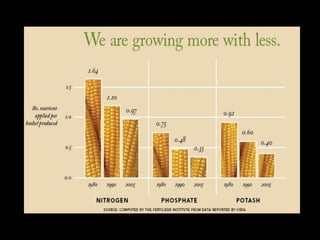
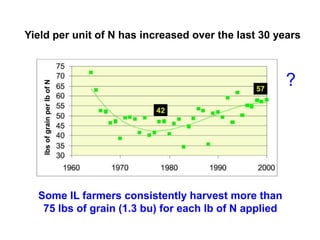
Yield per unit of N has increased over the last 30 years


                                                       ?
    lbs of grain per lb of N


  Some IL farmers consistently harvest more than
   75 lbs of grain (1.3 bu) for each lb of N applied
So why does
   nutrient
pollution from
  agriculture
continue to be
such a serious
   problem
    in IL?
Has your farm ever
looked like this in the last
         3 years?
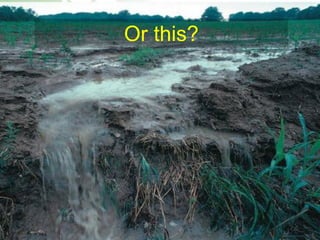
Or this?

      Dissipate large amounts of ag
    chemicals into the environment…
    sometimes the consequences are
                 severe !


http://mckusicklake.org/wp-content/uploads/2008/04/2007_0327image0001.JPG
Could this story be about your farm?

             Increasing yield by installing drainage
             By Mindy Ward, Missouri Farmer Today

             BOONVILLE --- For more than 100 years, the
             Hoff family has fought to farm wet areas of their
             fields.

             For Eddie Hoff, the fourth generation to farm the
             creek bottom ground in Cooper County, the loss
             of yield and added expense of working the
             ground was ultimately affecting his bottom line.

             “We were losing 60 to 70 bushels per acre in
             some spots,” he says.

             We were working the ground over and over. I
             just wanted to no-till and save some cost.”

             So, he decided to drain the soils with pattern tile.
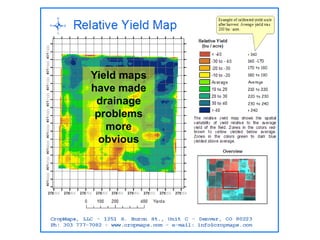
Yield maps
have made
 drainage
 problems
   more
  obvious
Northern IL
contains a
lot of soils
  that are
 prone to
   nitrate
 leaching
Peak uptake > 10 lbs of
N/ac/day for high yield corn
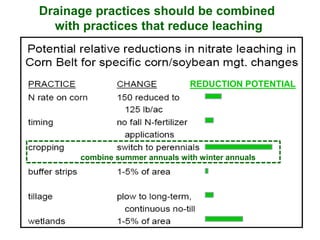
Drainage practices should be combined
  with practices that reduce leaching


                                REDUCTION POTENTIAL


      combine summer annuals with winter annuals
Cover crops


              Less loss
 Less loss
The science is clear - cover crops can reduce nitrate
 leaching at lower cost than most other practices!


                               Bare fallow


             Kaspar et al. J. Environ. Qual. 36:1503-1511
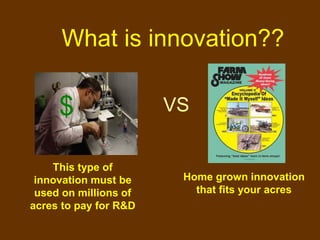
What is innovation??

     $                 VS


    This type of
 innovation must be     Home grown innovation
 used on millions of      that fits your acres
acres to pay for R&D
Are you an early adopter?

 adopt ≠ adapt
  Are you a master adapter?
Farmers that make cover crops work
    tend to be master adapters!
Have you
               attended a
               cover crop
               field day?


If not, make
   plans to
 attend one
   in 2012
If you can’t make it to a field day,
   learn about cover crop innovation
      through participating in on-line
               discussions

How many of you are “Ag Talkers”?
Cover crops are
       not idiot-proof!


 Using cover crops to capture multiple benefits
          requires more management

There are few profits in idiot-proof systems
Traditional cover cropping in the Midwest


                  The
          most tried and true
       cover cropping system
        in the Midwest region

         Frost seeded red
              clover
A lot more cover crops would get planted if we all had a several
  month window of opportunity following small grain harvest
Corn and soybeans now cover > 90% of some IL counties


                                            corn
                                            soy
Spreading cover crop seed with fertilizer
Seeding cover
crops with liquid
manure
Seeding cover crops with a vertical tillage tool
The CC planting methods shown on the
previous slides are only feasible for a limited #
    of acres after harvest in the Corn Belt
           Other options are clearly needed!
 Student: Which cover crops have you tried? how many acres?
 following/preceding which crops?

 Joe Nester replied:

 We just inter-seeded 14,000 acres of corn and soybeans with annual
 ryegrass. We used a helicopter service out of Minnesota to seed it. We
 used annual ryegrass a year ago, seeding with drills after wheat and
 soybeans, but the planting date was too late to wait after beans. Excellent
 where seeded after wheat about Sept. 1. Our experience is limited, but
 the idea is really taking off, to hold the soil in place over the winter, keep
 nutrients within the field, and help with timely no-till planting in the
 spring.
Photo from Joe Nester
Farmers have been using aerial seeding
 to improve post-harvest grazing for a
              long time
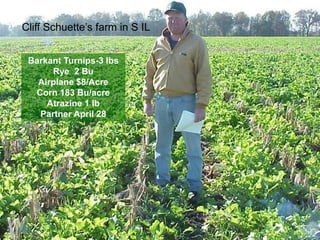
Cliff Schuette’s farm in S IL


 Barkant Turnips-3 lbs
      Rye 2 Bu
   Airplane $8/Acre
  Corn 183 Bu/acre
     Atrazine 1 lb
   Partner April 28
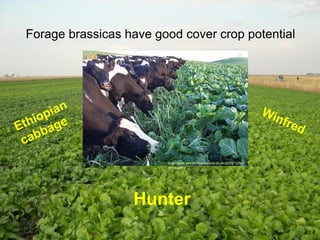
Forage brassicas have good cover crop potential


                        http://www.jennifermackenzie.co.uk/2005/12/bra
                        ssicas.html


                  Hunter
Set-up for efficient aerial seeding in SE IA


Steve Nebel
Steve
Nebel
Steve Nebel
IA and IL Aerial Applicator Survey (May-June 2010)
Name                 Location          Experience w/CC        Cost
                                       no exp., no customer
Cady Aerial Spray    Rock Falls, IL    interest               $8.00/a norm app $8.50/a cc
Benoit Aerial
Spraying             Kankakee, IL      turnips and rye        $8.00/a norm app $10.00/a cc
Franks Flying
Service              Morrison, IL      ryegrass and c. rye    $8.00/a norm app $10.00/a cc
Reeds Fly-on                           yes, c. rye, small part
Farming              Mattoon, IL       of business             $8.00/a norm app $12.00/a cc
Killiam Flying                         rye, wheat on beans,    $8.00/a norm app $10.00/ac
Service              Carlinville, IL   rye on corn             or 10/lb
Curless Flying
Service              Astoria, IL       ryegrass and turnips   $8-15.00/a all app.
Klein Flying         St. Francisville,                        ~$12.50/a cc,
Service              IL                annual rye and turnips $9.00/a liquid app
Agriflite Services   Wakarusa, IN      rye, wheat, ryegrass   ave $15.00/a for cc app.
Al's Aerial                                                   $10-15.00/a cc
Spraying             Ovid, MI          rye and wheat          $10.00/a liquid
Don Birky’s
 seeder in
 Central IL
Don and Matt Birky’s unique
highboy with 10 feet and six
inches of clearance could attract
a crowd for its high-rising
maneuvers, but the father-son
team created the special
equipment for a tough job.

The highboy, dubbed High Roller,
was developed to air seed
legumes and other cover crops
into standing corn in August. The
Birkys, who operate On Track
Farming Inc. in rural Gibson City,
put the highboy through its paces
last week.
“I have been building
                  a seeder to overseed
                  cover crops into corn
                  & beans. I'm using a
                  Hagie STS 12 with a
                  Gandy Orbit Air seed
                  box. I can cover 90
                  feet / 36 rows and the
                  hopper holds 65 bu. “


Andy Ambriole’s
  Highboy air
    seeder
“This is the last and greenest field I did. Still has a little time to go yet, but
   it should make some corn. Most other fields are brown with grain
moisture, I'm guessing, in the low 20's. The ground is getting more light,
                 so we'll see if that makes a difference.”
“It's kinda hard to tell the seed from the corn pollen. The
 big lighter pieces are pollen. The smaller darker ones are
ryegrass and the little orange balls are crimson clover. The
             seed mix was 80/20 ryegrass/clover”
Rig for mid-summer over-seeding into corn in Ontario
New bulletin from Penn State


 Red clover can be frost seeded into small
grains in early spring, over seeded into corn
   in early-summer and over seeded into
       soybeans just before leaf drop.
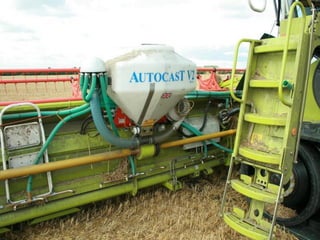
Planting while harvesting
Dwayne Beck’s set-up
for planting while
harvesting
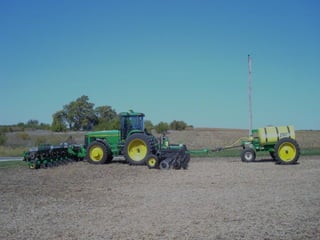
Combining striptill with cover crops
   on Ron Neumiller’s farm
Cover crops planted while stripping
    on Joe Rothermel’s farm
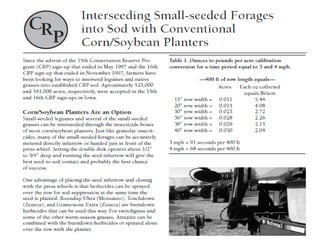
Small-seeded legumes and grasses can be
planted using the insecticide boxes of most
          corn/soybean planters.

   Just like granular insecticides, many of the
    small-seeded forages can be accurately
   metered directly in-furrow or banded just in
front of the press wheel. Setting the double disk
  openers about 1/2” to 3/4” deep and running
the seed in-furrow will give the best seed-to-soil
    contact and probably the best chance of
                     success.
Cereal rye inter-seeded with soybean
       for in-row weed control


Cereal rye and several other CC species that require
  vernalization will be planted over soybeans rows
 using the insecticide boxes on our planter in 2012
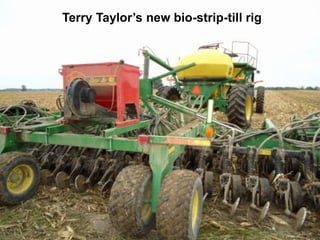
Terry Taylor planted radishes on 30” rows w/ hairy vetch,
  crimson clover and Austrian winter peas in fall 2010
Terry Taylor’s new bio-strip-till rig
Planters do a much
better job than a drill
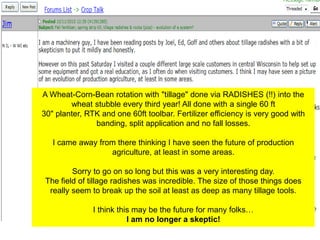
A Wheat-Corn-Bean rotation with "tillage" done via RADISHES (!!) into the
        wheat stubble every third year! All done with a single 60 ft
30" planter, RTK and one 60ft toolbar. Fertilizer efficiency is very good with
               banding, split application and no fall losses.

   I came away from there thinking I have seen the future of production
                  agriculture, at least in some areas.

         Sorry to go on so long but this was a very interesting day.
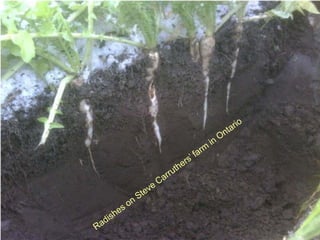
 The field of tillage radishes was incredible. The size of those things does
  really seem to break up the soil at least as deep as many tillage tools.

               I think this may be the future for many folks…
                          I am no longer a skeptic!
A Wheat-Corn-Bean rotation with "tillage" done via
 RADISHES (!!) into the wheat stubble every third year! All
  done with a single 60 ft 30" planter, RTK and one 60ft
toolbar. Fertilizer efficiency is very good with banding, split
                 application and no fall losses.

I came away from there thinking I have seen the future of
     production agriculture, at least in some areas.

Sorry to go on so long but this was a very interesting day.
  The field of tillage radishes was incredible. The size of
those things does really seem to break up the soil at least
                as deep as many tillage tools.
A Wheat-Corn-Bean rotation with "tillage" done via
 RADISHES (!!) into the wheat stubble every third year! All
  done with a single 60 ft 30" planter, RTK and one 60ft
toolbar. Fertilizer efficiency is very good with banding, split
                  8625
                 application and no fall losses.


                 views!!
I came away from there thinking I have seen the future of
     production agriculture, at least in some areas.

Sorry to go on so long but this was a very interesting day.
  The field of tillage radishes was incredible. The size of
those things does really seem to break up the soil at least
                as deep as many tillage tools.
November 2010


Radishes planted on the WIU/Allison
Organic Research farm on 30” rows
using milo plates in our corn planter
Some 2011 data

 Cover crop system          Relative
                           corn yield
    Volunteer oats           79%
Radishes planted on 30”      99%
Radishes drilled on 7.5”     91%
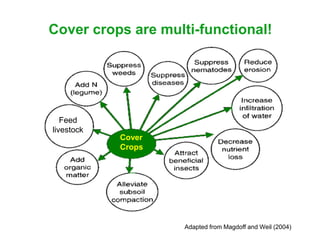
Cover crops are multi-functional!


   Feed
livestock
            Cover
            Crops


                    Adapted from Magdoff and Weil (2004)
Matching specific objectives with species
      #1 way to make CC pay    Grazing
    brassicas, clovers, small grains, a. ryegrass, sorghum-sudan

                     Nutrient scavenging/cycling
               brassicas, small grains, annual ryegrass

                              Bio-drilling
                   brassicas, sugarbeet, sunflower,
                 sorghum-sudan sweet clover, alfalfa

                                 N-fixation
clovers, vetches, lentil, winter pea, chickling vetch, sun hemp, cowpea,
                                  soybean

                       Bio-activation/fumigation
            brassicas, sorghum-sudan, sun hemp, sesame

                         Weed suppression
          brassicas, sorghum-sudan, cereal rye, buckwheat
Managing cover crops profitably, 3rd edition
Be realistic about
  potential cover crop
      challenges
Start planning today for next fall!
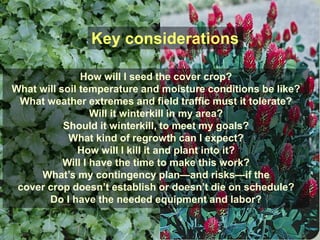
Key considerations

               How will I seed the cover crop?
What will soil temperature and moisture conditions be like?
 What weather extremes and field traffic must it tolerate?
                  Will it winterkill in my area?
           Should it winterkill, to meet my goals?
            What kind of regrowth can I expect?
              How will I kill it and plant into it?
           Will I have the time to make this work?
     What’s my contingency plan—and risks—if the
 cover crop doesn’t establish or doesn’t die on schedule?
       Do I have the needed equipment and labor?

Northern IL 2012

  • 1.
    Cover crops forrow crop systems in Northern IL Dr. Joel Gruver WIU – Agriculture j-gruver@wiu.edu
  • 3.
    Corn production onland classified as HEL by NRCS Acres per county 200 - 12,000 12,000 – 37,000 37,000 - 62,000 > 62,000 https://www.agronomy.org/publications/aj/articles/96/1/1
  • 4.
    Erosion is aserious issue in some parts of northern IL County < 1 *T 1-2*T > 2*T Boone 91 6 2 Bureau 99 1 0 Caroll 84 12 4 DeKalb 94 6 0 Henry 83 10 6 JoDavies 83 12 5 Kendall 97 2 0 LaSalle 97 3 0 Lee 97 2 0 McHenry 93 6 1 Ogle 88 11 1 Stephenson 87 11 3 Winnebago 93 6 1
  • 5.
  • 6.
    5-10% OM 45-50% highlyresistant to decomposition 30-35% slowly decomposable About 15% rapidly decomposable
  • 7.
    2-5% OM > 75%highly resistant to decomposition <20% slowly decomposable <5 % rapidly decomposable
  • 8.
    Prairie soil Farm field
  • 9.
    Have you observedthe impact of management on your farm?
  • 11.
    Yield per unitof N has increased over the last 30 years ? lbs of grain per lb of N Some IL farmers consistently harvest more than 75 lbs of grain (1.3 bu) for each lb of N applied
  • 12.
    So why does nutrient pollution from agriculture continue to be such a serious problem in IL?
  • 13.
    Has your farmever looked like this in the last 3 years?
  • 14.
    Or this? Dissipate large amounts of ag chemicals into the environment… sometimes the consequences are severe ! http://mckusicklake.org/wp-content/uploads/2008/04/2007_0327image0001.JPG
  • 15.
    Could this storybe about your farm? Increasing yield by installing drainage By Mindy Ward, Missouri Farmer Today BOONVILLE --- For more than 100 years, the Hoff family has fought to farm wet areas of their fields. For Eddie Hoff, the fourth generation to farm the creek bottom ground in Cooper County, the loss of yield and added expense of working the ground was ultimately affecting his bottom line. “We were losing 60 to 70 bushels per acre in some spots,” he says. We were working the ground over and over. I just wanted to no-till and save some cost.” So, he decided to drain the soils with pattern tile.
  • 16.
    Yield maps have made drainage problems more obvious
  • 18.
    Northern IL contains a lotof soils that are prone to nitrate leaching
  • 19.
    Peak uptake >10 lbs of N/ac/day for high yield corn
  • 20.
    Drainage practices shouldbe combined with practices that reduce leaching REDUCTION POTENTIAL combine summer annuals with winter annuals
  • 22.
    Cover crops Less loss Less loss
  • 23.
    The science isclear - cover crops can reduce nitrate leaching at lower cost than most other practices! Bare fallow Kaspar et al. J. Environ. Qual. 36:1503-1511
  • 24.
    What is innovation?? $ VS This type of innovation must be Home grown innovation used on millions of that fits your acres acres to pay for R&D
  • 25.
    Are you anearly adopter? adopt ≠ adapt Are you a master adapter? Farmers that make cover crops work tend to be master adapters!
  • 26.
    Have you attended a cover crop field day? If not, make plans to attend one in 2012
  • 27.
    If you can’tmake it to a field day, learn about cover crop innovation through participating in on-line discussions How many of you are “Ag Talkers”?
  • 28.
    Cover crops are not idiot-proof! Using cover crops to capture multiple benefits requires more management There are few profits in idiot-proof systems
  • 29.
    Traditional cover croppingin the Midwest The most tried and true cover cropping system in the Midwest region Frost seeded red clover
  • 30.
    A lot morecover crops would get planted if we all had a several month window of opportunity following small grain harvest
  • 31.
    Corn and soybeansnow cover > 90% of some IL counties corn soy
  • 32.
    Spreading cover cropseed with fertilizer
  • 33.
  • 34.
    Seeding cover cropswith a vertical tillage tool
  • 35.
    The CC plantingmethods shown on the previous slides are only feasible for a limited # of acres after harvest in the Corn Belt Other options are clearly needed! Student: Which cover crops have you tried? how many acres? following/preceding which crops? Joe Nester replied: We just inter-seeded 14,000 acres of corn and soybeans with annual ryegrass. We used a helicopter service out of Minnesota to seed it. We used annual ryegrass a year ago, seeding with drills after wheat and soybeans, but the planting date was too late to wait after beans. Excellent where seeded after wheat about Sept. 1. Our experience is limited, but the idea is really taking off, to hold the soil in place over the winter, keep nutrients within the field, and help with timely no-till planting in the spring.
  • 36.
  • 37.
    Farmers have beenusing aerial seeding to improve post-harvest grazing for a long time
  • 38.
    Cliff Schuette’s farmin S IL Barkant Turnips-3 lbs Rye 2 Bu Airplane $8/Acre Corn 183 Bu/acre Atrazine 1 lb Partner April 28
  • 39.
    Forage brassicas havegood cover crop potential http://www.jennifermackenzie.co.uk/2005/12/bra ssicas.html Hunter
  • 40.
    Set-up for efficientaerial seeding in SE IA Steve Nebel
  • 41.
  • 42.
  • 43.
    IA and ILAerial Applicator Survey (May-June 2010) Name Location Experience w/CC Cost no exp., no customer Cady Aerial Spray Rock Falls, IL interest $8.00/a norm app $8.50/a cc Benoit Aerial Spraying Kankakee, IL turnips and rye $8.00/a norm app $10.00/a cc Franks Flying Service Morrison, IL ryegrass and c. rye $8.00/a norm app $10.00/a cc Reeds Fly-on yes, c. rye, small part Farming Mattoon, IL of business $8.00/a norm app $12.00/a cc Killiam Flying rye, wheat on beans, $8.00/a norm app $10.00/ac Service Carlinville, IL rye on corn or 10/lb Curless Flying Service Astoria, IL ryegrass and turnips $8-15.00/a all app. Klein Flying St. Francisville, ~$12.50/a cc, Service IL annual rye and turnips $9.00/a liquid app Agriflite Services Wakarusa, IN rye, wheat, ryegrass ave $15.00/a for cc app. Al's Aerial $10-15.00/a cc Spraying Ovid, MI rye and wheat $10.00/a liquid
  • 44.
    Don Birky’s seederin Central IL
  • 45.
    Don and MattBirky’s unique highboy with 10 feet and six inches of clearance could attract a crowd for its high-rising maneuvers, but the father-son team created the special equipment for a tough job. The highboy, dubbed High Roller, was developed to air seed legumes and other cover crops into standing corn in August. The Birkys, who operate On Track Farming Inc. in rural Gibson City, put the highboy through its paces last week.
  • 46.
    “I have beenbuilding a seeder to overseed cover crops into corn & beans. I'm using a Hagie STS 12 with a Gandy Orbit Air seed box. I can cover 90 feet / 36 rows and the hopper holds 65 bu. “ Andy Ambriole’s Highboy air seeder
  • 47.
    “This is thelast and greenest field I did. Still has a little time to go yet, but it should make some corn. Most other fields are brown with grain moisture, I'm guessing, in the low 20's. The ground is getting more light, so we'll see if that makes a difference.”
  • 48.
    “It's kinda hardto tell the seed from the corn pollen. The big lighter pieces are pollen. The smaller darker ones are ryegrass and the little orange balls are crimson clover. The seed mix was 80/20 ryegrass/clover”
  • 50.
    Rig for mid-summerover-seeding into corn in Ontario
  • 51.
    New bulletin fromPenn State Red clover can be frost seeded into small grains in early spring, over seeded into corn in early-summer and over seeded into soybeans just before leaf drop.
  • 52.
  • 54.
    Dwayne Beck’s set-up forplanting while harvesting
  • 56.
    Combining striptill withcover crops on Ron Neumiller’s farm
  • 57.
    Cover crops plantedwhile stripping on Joe Rothermel’s farm
  • 61.
    Small-seeded legumes andgrasses can be planted using the insecticide boxes of most corn/soybean planters. Just like granular insecticides, many of the small-seeded forages can be accurately metered directly in-furrow or banded just in front of the press wheel. Setting the double disk openers about 1/2” to 3/4” deep and running the seed in-furrow will give the best seed-to-soil contact and probably the best chance of success.
  • 63.
    Cereal rye inter-seededwith soybean for in-row weed control Cereal rye and several other CC species that require vernalization will be planted over soybeans rows using the insecticide boxes on our planter in 2012
  • 64.
    Terry Taylor plantedradishes on 30” rows w/ hairy vetch, crimson clover and Austrian winter peas in fall 2010
  • 65.
    Terry Taylor’s newbio-strip-till rig
  • 66.
    Planters do amuch better job than a drill
  • 67.
    A Wheat-Corn-Bean rotationwith "tillage" done via RADISHES (!!) into the wheat stubble every third year! All done with a single 60 ft 30" planter, RTK and one 60ft toolbar. Fertilizer efficiency is very good with banding, split application and no fall losses. I came away from there thinking I have seen the future of production agriculture, at least in some areas. Sorry to go on so long but this was a very interesting day. The field of tillage radishes was incredible. The size of those things does really seem to break up the soil at least as deep as many tillage tools. I think this may be the future for many folks… I am no longer a skeptic!
  • 68.
    A Wheat-Corn-Bean rotationwith "tillage" done via RADISHES (!!) into the wheat stubble every third year! All done with a single 60 ft 30" planter, RTK and one 60ft toolbar. Fertilizer efficiency is very good with banding, split application and no fall losses. I came away from there thinking I have seen the future of production agriculture, at least in some areas. Sorry to go on so long but this was a very interesting day. The field of tillage radishes was incredible. The size of those things does really seem to break up the soil at least as deep as many tillage tools.
  • 69.
    A Wheat-Corn-Bean rotationwith "tillage" done via RADISHES (!!) into the wheat stubble every third year! All done with a single 60 ft 30" planter, RTK and one 60ft toolbar. Fertilizer efficiency is very good with banding, split 8625 application and no fall losses. views!! I came away from there thinking I have seen the future of production agriculture, at least in some areas. Sorry to go on so long but this was a very interesting day. The field of tillage radishes was incredible. The size of those things does really seem to break up the soil at least as deep as many tillage tools.
  • 70.
    November 2010 Radishes plantedon the WIU/Allison Organic Research farm on 30” rows using milo plates in our corn planter
  • 73.
    Some 2011 data Cover crop system Relative corn yield Volunteer oats 79% Radishes planted on 30” 99% Radishes drilled on 7.5” 91%
  • 74.
    Cover crops aremulti-functional! Feed livestock Cover Crops Adapted from Magdoff and Weil (2004)
  • 75.
    Matching specific objectiveswith species #1 way to make CC pay Grazing brassicas, clovers, small grains, a. ryegrass, sorghum-sudan Nutrient scavenging/cycling brassicas, small grains, annual ryegrass Bio-drilling brassicas, sugarbeet, sunflower, sorghum-sudan sweet clover, alfalfa N-fixation clovers, vetches, lentil, winter pea, chickling vetch, sun hemp, cowpea, soybean Bio-activation/fumigation brassicas, sorghum-sudan, sun hemp, sesame Weed suppression brassicas, sorghum-sudan, cereal rye, buckwheat
  • 76.
    Managing cover cropsprofitably, 3rd edition
  • 81.
    Be realistic about potential cover crop challenges Start planning today for next fall!
  • 82.
    Key considerations How will I seed the cover crop? What will soil temperature and moisture conditions be like? What weather extremes and field traffic must it tolerate? Will it winterkill in my area? Should it winterkill, to meet my goals? What kind of regrowth can I expect? How will I kill it and plant into it? Will I have the time to make this work? What’s my contingency plan—and risks—if the cover crop doesn’t establish or doesn’t die on schedule? Do I have the needed equipment and labor?