Wild Bee Abundance and Diversity in
Relation to Landscapes Surrounding
Iowa Vegetable Farms
Jarrett Jensen
Introduction
• Iowa vegetable farmers rely heavily on pollinators to produce
crop
• Wild pollination is free but bee diversity and abundance is
declining
• As a result farmers are looking for new ways to prevent this
• There is also not much data on where wild bees are or how
they are being affected
• The landscape on and surrounding the farms can have major
affects on the bees
• We looked at the impact of landscape factors on wild bee
abundance and diversity at vegetable farms in central and
eastern Iowa
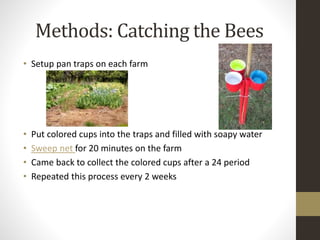
Methods: Catching the Bees
• Setup pan traps on each farm
• Put colored cups into the traps and filled with soapy water
• Sweep net for 20 minutes on the farm
• Came back to collect the colored cups after a 24 period
• Repeated this process every 2 weeks
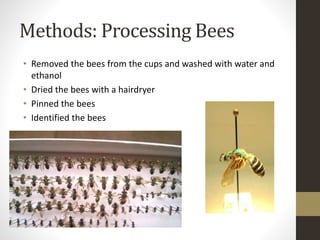
Methods: Processing Bees
• Removed the bees from the cups and washed with water and
ethanol
• Dried the bees with a hairdryer
• Pinned the bees
• Identified the bees
Methods: GIS/GPS
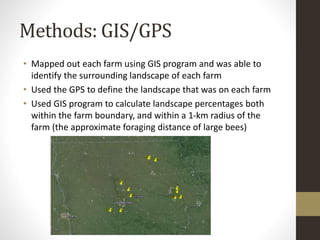
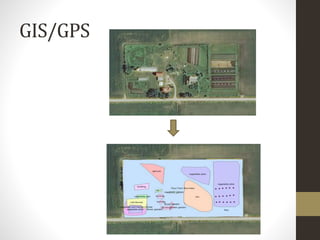
• Mapped out each farm using GIS program and was able to
identify the surrounding landscape of each farm
• Used the GPS to define the landscape that was on each farm
• Used GIS program to calculate landscape percentages both
within the farm boundary, and within a 1-km radius of the
farm (the approximate foraging distance of large bees)
GIS/GPS
Results
• Total number of Bees caught = 809
• 7 different families
• 10 different farms(5 in the Des Moines area, 3 in Iowa City
Area, 2 North of Cedar Falls Area)
• 3 different collections from each farm
Results
Farm 1
Farm 2
Farm 3
Farm 4
Farm 5
Farm 6
Farm 7 Farm 8
Farm 9
Farm 10
0
50
100
150
200
250
0 10 20 30 40 50 60 70 80 90 100
TotalNumberofBees
Percent of Natural Landscape on Farm
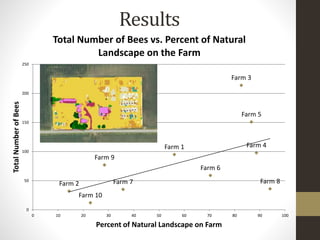
Total Number of Bees vs. Percent of Natural
Landscape on the Farm
Results
Farm 1
Farm 2
Farm 3
Farm 4
Farm 5
Farm 6
Farm 7 Farm 8
Farm 9
Farm 10
0
50
100
150
200
250
0 5 10 15 20 25 30 35 40 45
TotalNumberofBees
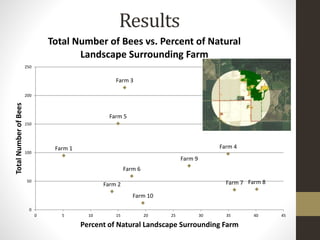
Percent of Natural Landscape Surrounding Farm
Total Number of Bees vs. Percent of Natural
Landscape Surrounding Farm
Results
Conclusions
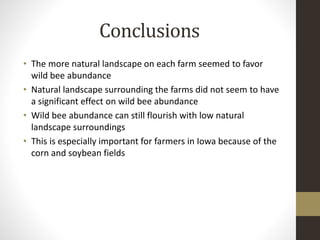
• The more natural landscape on each farm seemed to favor
wild bee abundance
• Natural landscape surrounding the farms did not seem to have
a significant effect on wild bee abundance
• Wild bee abundance can still flourish with low natural
landscape surroundings
• This is especially important for farmers in Iowa because of the
corn and soybean fields
Conclusions
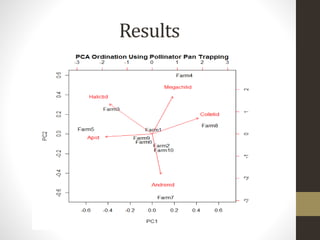
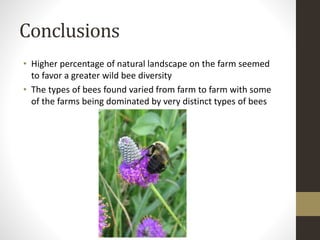
• Higher percentage of natural landscape on the farm seemed
to favor a greater wild bee diversity
• The types of bees found varied from farm to farm with some
of the farms being dominated by very distinct types of bees
Acknowledgements
• Thank you to Andrew Ridgway, Ai Wen, and Kenneth
Elgersma for mentoring me through this entire project
and to Ben Nettleton for helping with bee collection and
identification.
• Funding was made possible by the National Science
Foundation and Iowa EPSCoR.
• This opportunity was made possible by the Department
of Biology at the University of Northern Iowa and their
Summer Undergradate Research Program.

Undergrad Presentation

  • 1.
    Wild Bee Abundanceand Diversity in Relation to Landscapes Surrounding Iowa Vegetable Farms Jarrett Jensen
  • 2.
    Introduction • Iowa vegetablefarmers rely heavily on pollinators to produce crop • Wild pollination is free but bee diversity and abundance is declining • As a result farmers are looking for new ways to prevent this • There is also not much data on where wild bees are or how they are being affected • The landscape on and surrounding the farms can have major affects on the bees • We looked at the impact of landscape factors on wild bee abundance and diversity at vegetable farms in central and eastern Iowa
  • 3.
    Methods: Catching theBees • Setup pan traps on each farm • Put colored cups into the traps and filled with soapy water • Sweep net for 20 minutes on the farm • Came back to collect the colored cups after a 24 period • Repeated this process every 2 weeks
  • 4.
    Methods: Processing Bees •Removed the bees from the cups and washed with water and ethanol • Dried the bees with a hairdryer • Pinned the bees • Identified the bees
  • 5.
    Methods: GIS/GPS • Mappedout each farm using GIS program and was able to identify the surrounding landscape of each farm • Used the GPS to define the landscape that was on each farm • Used GIS program to calculate landscape percentages both within the farm boundary, and within a 1-km radius of the farm (the approximate foraging distance of large bees)
  • 6.
  • 7.
    Results • Total numberof Bees caught = 809 • 7 different families • 10 different farms(5 in the Des Moines area, 3 in Iowa City Area, 2 North of Cedar Falls Area) • 3 different collections from each farm
  • 8.
    Results Farm 1 Farm 2 Farm3 Farm 4 Farm 5 Farm 6 Farm 7 Farm 8 Farm 9 Farm 10 0 50 100 150 200 250 0 10 20 30 40 50 60 70 80 90 100 TotalNumberofBees Percent of Natural Landscape on Farm Total Number of Bees vs. Percent of Natural Landscape on the Farm
  • 9.
    Results Farm 1 Farm 2 Farm3 Farm 4 Farm 5 Farm 6 Farm 7 Farm 8 Farm 9 Farm 10 0 50 100 150 200 250 0 5 10 15 20 25 30 35 40 45 TotalNumberofBees Percent of Natural Landscape Surrounding Farm Total Number of Bees vs. Percent of Natural Landscape Surrounding Farm
  • 10.
  • 11.
    Conclusions • The morenatural landscape on each farm seemed to favor wild bee abundance • Natural landscape surrounding the farms did not seem to have a significant effect on wild bee abundance • Wild bee abundance can still flourish with low natural landscape surroundings • This is especially important for farmers in Iowa because of the corn and soybean fields
  • 12.
    Conclusions • Higher percentageof natural landscape on the farm seemed to favor a greater wild bee diversity • The types of bees found varied from farm to farm with some of the farms being dominated by very distinct types of bees
  • 13.
    Acknowledgements • Thank youto Andrew Ridgway, Ai Wen, and Kenneth Elgersma for mentoring me through this entire project and to Ben Nettleton for helping with bee collection and identification. • Funding was made possible by the National Science Foundation and Iowa EPSCoR. • This opportunity was made possible by the Department of Biology at the University of Northern Iowa and their Summer Undergradate Research Program.