Green Radio Communication in a Heterogeneous
Wireless Medium
Under the guidance Of
M.S.Harish
Asso. Prof.
E&C Department
From
Rajath Gowda S N
USN:4A12EC073
SEC: ‘B’ sec
Department of Electronics and Communication
Adichunchanagiri Institute of Technology
Chikamagluru-577102
CONTENT
INTRODUCTION
• Need For Energy Conservation
• Green Radio
• Base Station
Energy efficiency
• Energy saving in Base station
• New communication Strategies
 RELY
APPLICATION
• FUTURE SCOPE
• CONCLUSION
• REFERENCES
 Abstract
 Objective
 Literature Survey
Abstract
 Recently, there has been a growing interest in developing energy efficient wireless
communication networks, due to environmental, financial, and quality-of-experience
considerations, for both mobile users and network operators.
 The developed solutions in this regard are referred to as green communications,
so as to reflect the importance of their environmental dimension.
 Great potentials for energy efficient communications lie in the today’s
heterogeneous wireless medium with overlapped coverage from different networks,
given the vast diversity in adding channels and propagation losses among mobile
terminals and base stations, and in available resources and operating frequency
bands at different networks.
 In addition, we present a case study of uplink communications for illustration
purposes.
Objective
 To protect environment from harmful EM radiation
 reducing green house gas
 Reducing operational cost for wireless network.
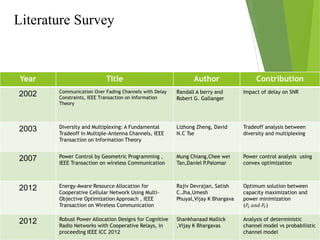
Year Title Author Contribution
2002 Communication Over Fading Channels with Delay
Constraints, IEEE Transaction on Information
Theory
Randall A berry and
Robert G. Gallanger
Impact of delay on SNR
2003 Diversity and Multiplexing: A Fundamental
Tradeoff in Multiple-Antenna Channels, IEEE
Transaction on Information Theory
Lizhong Zheng, David
N.C Tse
Tradeoff analysis between
diversity and multiplexing
2007 Power Control by Geometric Programming ,
IEEE Transaction on wireless Communication
Mung Chiang,Chee wei
Tan,Daniel P.Palomar
Power control analysis using
convex optimization
2012 Energy-Aware Resource Allocation for
Cooperative Cellular Network Using Multi-
Objective Optimization Approach , IEEE
Transaction on Wireless Communication
Rajiv Devrajan, Satish
C.Jha,Umesh
Phuyal,Vijay K Bhargava
Optimum solution between
capacity maximization and
power minimization
(𝑃𝑠 𝑎𝑛𝑑 𝑃𝑟)
2012 Robust Power Allocation Designs for Cognitive
Radio Networks with Cooperative Relays, in
proceeding IEEE ICC 2012
Shankhanaad Mallick
,Vijay K Bhargavas
Analysis of deterministic
channel model vs probabilistic
channel model
Literature Survey
INTRODUCTION
NEED FOR ENERGY CONSUMPTION
 Emission of Green House Gases.
 Consumption of non-renewable energy resources.
ENERGY CONSUMPTION IN WIRELESS APPLICATIONS.
 Energy consumed by the network in operation
 Embedded emissions of the network equipment, for example, emissions
associated with the manufacturing and deployment of network equipment
 Energy consumed by mobile handsets and other devices, when they are
manufactured, distributed and used.
 Emissions associated with buildings run by mobile operators, and emissions
from transport.
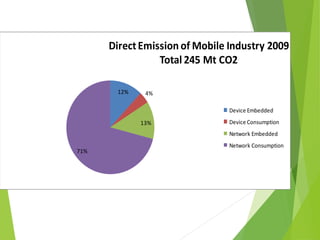
12% 4%
13%
71%
DirectEmission of Mobile Industry 2009
Total 245 Mt CO2
Device Embedded
Device Consumption
Network Embedded
Network Consumption
Energy Consumption Survey
ICT) industry include the energy requirements as follows;
PCs and monitor == 40% , Data Centre == 23% , Fixed and mobile
telecommunication == 24%
----------------------------------------------------------------------------------
40% Power requirement == Grid Electricity
60% Power requirement == Diesel Gen-Set
1 litre petrol ==2.3Kgs CO2
Total number of tower==3.1 Lac (2010) (10-15KVA gen-set – 2lit/hr)
-----------------------------------------------------------------------------------
9 million tones of CO2/year==Diesel Gen-set
5 million tones of CO2/𝑦𝑒𝑎𝑟== Power grid
Green Radio
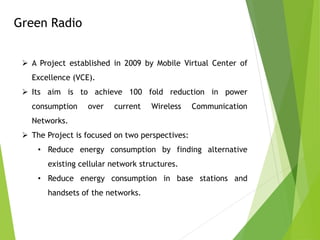
 A Project established in 2009 by Mobile Virtual Center of
Excellence (VCE).
 Its aim is to achieve 100 fold reduction in power
consumption over current Wireless Communication
Networks.
 The Project is focused on two perspectives:
• Reduce energy consumption by finding alternative
existing cellular network structures.
• Reduce energy consumption in base stations and
handsets of the networks.
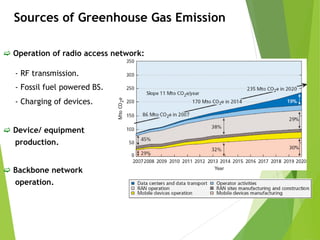
Sources of Greenhouse Gas Emission
 Operation of radio access network:
- RF transmission.
- Fossil fuel powered BS.
- Charging of devices.
 Device/ equipment
production.
 Backbone network
operation.
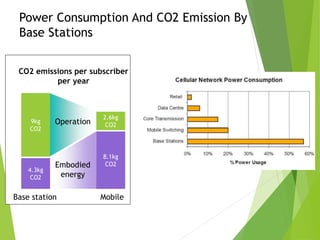
Power Consumption And CO2 Emission By
Base Stations
9kg
CO2
4.3kg
CO2
2.6kg
CO2
8.1kg
CO2
Mobile
CO2 emissions per subscriber
per year
Operation
Embodied
energy
Base station
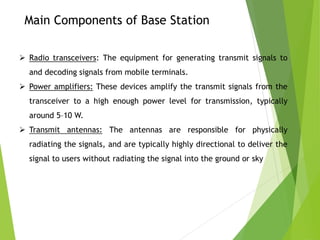
Main Components of Base Station
 Radio transceivers: The equipment for generating transmit signals to
and decoding signals from mobile terminals.
 Power amplifiers: These devices amplify the transmit signals from the
transceiver to a high enough power level for transmission, typically
around 5–10 W.
 Transmit antennas: The antennas are responsible for physically
radiating the signals, and are typically highly directional to deliver the
signal to users without radiating the signal into the ground or sky
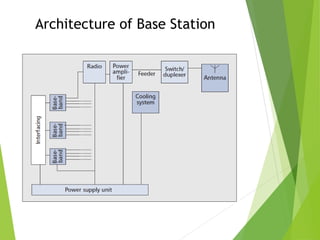
Architecture of Base Station
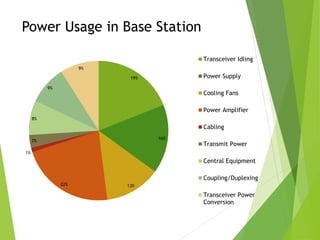
Power Usage in Base Station
19%
16%
13%22%
1%
3%
8%
9%
9%
Transceiver Idling
Power Supply
Cooling Fans
Power Amplifier
Cabling
Transmit Power
Central Equipment
Coupling/Duplexing
Transceiver Power
Conversion
Energy Efficiency – How?
Energy Savings in Base Stations
Improvements in PA:
- Linear PAs → 90% wastage.
- DPD, Doherty, GaN based PA.
 Power saving mode:
- Sleep mode, discontinuous Tx/ Rx.
 Optimization:
- BS placement, cell size
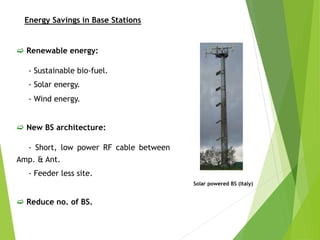
 Renewable energy:
- Sustainable bio-fuel.
- Solar energy.
- Wind energy.
 New BS architecture:
- Short, low power RF cable between
Amp. & Ant.
- Feeder less site.
 Reduce no. of BS.
Solar powered BS (Italy)
Energy Savings in Base Stations
New Communication Strategies
 MIMO / beamforming:
- Diversity.
- More sectors per cell site.
 Cognitive radio:
- Find unused spectrum, BW traded off for power.
 Use a third node:
- Reduce effective transmission distance.
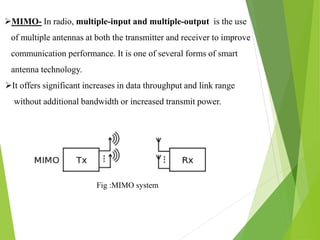
MIMO- In radio, multiple-input and multiple-output is the use
of multiple antennas at both the transmitter and receiver to improve
communication performance. It is one of several forms of smart
antenna technology.
It offers significant increases in data throughput and link range
without additional bandwidth or increased transmit power.
Fig :MIMO system
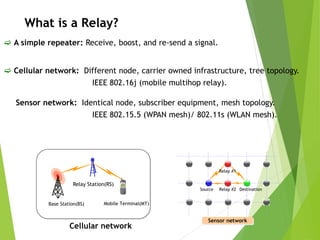
What is a Relay?
 A simple repeater: Receive, boost, and re-send a signal.
 Cellular network: Different node, carrier owned infrastructure, tree topology.
IEEE 802.16j (mobile multihop relay).
Sensor network: Identical node, subscriber equipment, mesh topology.
IEEE 802.15.5 (WPAN mesh)/ 802.11s (WLAN mesh).
Relay Station(RS)
Base Station(BS) Mobile Terminal(MT)
Relay #1
Relay #2 DestinationSource
Sensor network
Cellular network
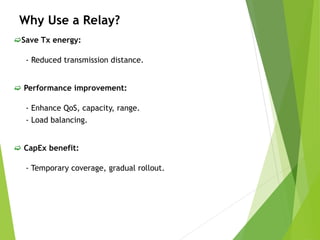
Why Use a Relay?
Save Tx energy:
- Reduced transmission distance.
 Performance improvement:
- Enhance QoS, capacity, range.
- Load balancing.
 CapEx benefit:
- Temporary coverage, gradual rollout.
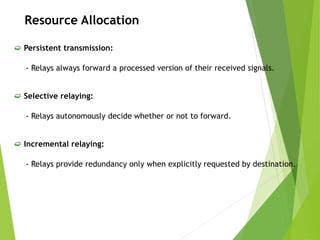
Resource Allocation
 Persistent transmission:
- Relays always forward a processed version of their received signals.
 Selective relaying:
- Relays autonomously decide whether or not to forward.
 Incremental relaying:
- Relays provide redundancy only when explicitly requested by destination.
APPLICATION
 Vodafone – Group: target to reduce CO2 emissions by 50% by 2020,
from 2006/07 levels.
 Orange: Reduce greenhouse emissions per customer by 20%
between 2006 and 2020.
 Ericsson: has reduced the annual direct CO 2 emissions per
subscriber in the mobile broadband base stations it supplies from
31 kg in 2001 to 17 kg in 2005 and to 8 kg in 2007.
 Nokia Siemens Networks: announced in 2009 a new SM/WCDMA
cabinet-based BTS with a power consumption of 790 W, vs
4,100 W for the equivalent model from 2005.
 Alcatel-Lucent: has developed innovative techniques such as the
Dynamic Power Save feature on their GSM/EDGE mobile networking
portfolio, which reduces power consumption when the traffic
drops with no impact on service quality.
FUTURE SCOPE
 In Resource Allocation : study of the best combination of scheduling
techniques from an energy efficiency perspective across the range of
traffic loads experienced in future LTE networks.
 In Interference Management and Mitigation: more intelligent methods to
cancel adjacent cell interference to be studied, along with consideration
of the most energy-efficient combination of Interference cancellation
techniques at both base stations and mobile terminals.
 In Energy Efficient Routing and Multihop: to compare the energy
efficiency of relay techniques with the use of femtocells.
CONCLUSION
 Thus, we have studied the Mobile VCE Green Radio project, for the
study novel approaches to reducing the energy consumption of
wireless links, in particular the improving the design and operation
of wireless base stations.
 Also has been studied that base stations have a much higher
operational energy budget than mobile terminals.
 The three techniques of resource allocation, interference
management and mitigation, and energy efficient routing and
multihop have been studied and the means by which these
methods can lead to energy savings have been described.
REFERENCES
 Congzheng Han, et al, “Green Radio: Radio Techniques to Enable Energy-
Efficient Wireless Networks”, IEEE Communications Magazine, May 2011.
 J. Nicholas Laneman, David N. C. Tse, and Gregory W. Wornell, “Cooperative
Diversity in Wireless Networks: Efficient Protocols and Outage Behavior”, IEEE
Transactions on Information Technology, Vol. 50, No. 12, December 2004
 Stefan Videv and Harald Haa, “Energy-Efficient Scheduling and Bandwidth–
Energy Efficiency Trade-Off with Low Load”, IEEE ICC Transactions 2011.
 K. Bumman, M. Junghwan, and K. Ildu “EfficientlyAmplified”, IEEE
Microwave Mag., Vol. 11, No. 5, Aug.2010.
 Javier Gozalvez, “Green Radio Technologies”, IEEE Vehicular Technology
Magazine, March 2010
Thank you

Green radio communication

  • 1.
    Green Radio Communicationin a Heterogeneous Wireless Medium Under the guidance Of M.S.Harish Asso. Prof. E&C Department From Rajath Gowda S N USN:4A12EC073 SEC: ‘B’ sec Department of Electronics and Communication Adichunchanagiri Institute of Technology Chikamagluru-577102
  • 2.
    CONTENT INTRODUCTION • Need ForEnergy Conservation • Green Radio • Base Station Energy efficiency • Energy saving in Base station • New communication Strategies  RELY APPLICATION • FUTURE SCOPE • CONCLUSION • REFERENCES  Abstract  Objective  Literature Survey
  • 3.
    Abstract  Recently, therehas been a growing interest in developing energy efficient wireless communication networks, due to environmental, financial, and quality-of-experience considerations, for both mobile users and network operators.  The developed solutions in this regard are referred to as green communications, so as to reflect the importance of their environmental dimension.  Great potentials for energy efficient communications lie in the today’s heterogeneous wireless medium with overlapped coverage from different networks, given the vast diversity in adding channels and propagation losses among mobile terminals and base stations, and in available resources and operating frequency bands at different networks.  In addition, we present a case study of uplink communications for illustration purposes.
  • 4.
    Objective  To protectenvironment from harmful EM radiation  reducing green house gas  Reducing operational cost for wireless network.
  • 5.
    Year Title AuthorContribution 2002 Communication Over Fading Channels with Delay Constraints, IEEE Transaction on Information Theory Randall A berry and Robert G. Gallanger Impact of delay on SNR 2003 Diversity and Multiplexing: A Fundamental Tradeoff in Multiple-Antenna Channels, IEEE Transaction on Information Theory Lizhong Zheng, David N.C Tse Tradeoff analysis between diversity and multiplexing 2007 Power Control by Geometric Programming , IEEE Transaction on wireless Communication Mung Chiang,Chee wei Tan,Daniel P.Palomar Power control analysis using convex optimization 2012 Energy-Aware Resource Allocation for Cooperative Cellular Network Using Multi- Objective Optimization Approach , IEEE Transaction on Wireless Communication Rajiv Devrajan, Satish C.Jha,Umesh Phuyal,Vijay K Bhargava Optimum solution between capacity maximization and power minimization (𝑃𝑠 𝑎𝑛𝑑 𝑃𝑟) 2012 Robust Power Allocation Designs for Cognitive Radio Networks with Cooperative Relays, in proceeding IEEE ICC 2012 Shankhanaad Mallick ,Vijay K Bhargavas Analysis of deterministic channel model vs probabilistic channel model Literature Survey
  • 6.
    INTRODUCTION NEED FOR ENERGYCONSUMPTION  Emission of Green House Gases.  Consumption of non-renewable energy resources. ENERGY CONSUMPTION IN WIRELESS APPLICATIONS.  Energy consumed by the network in operation  Embedded emissions of the network equipment, for example, emissions associated with the manufacturing and deployment of network equipment  Energy consumed by mobile handsets and other devices, when they are manufactured, distributed and used.  Emissions associated with buildings run by mobile operators, and emissions from transport.
  • 7.
    12% 4% 13% 71% DirectEmission ofMobile Industry 2009 Total 245 Mt CO2 Device Embedded Device Consumption Network Embedded Network Consumption
  • 8.
    Energy Consumption Survey ICT)industry include the energy requirements as follows; PCs and monitor == 40% , Data Centre == 23% , Fixed and mobile telecommunication == 24% ---------------------------------------------------------------------------------- 40% Power requirement == Grid Electricity 60% Power requirement == Diesel Gen-Set 1 litre petrol ==2.3Kgs CO2 Total number of tower==3.1 Lac (2010) (10-15KVA gen-set – 2lit/hr) ----------------------------------------------------------------------------------- 9 million tones of CO2/year==Diesel Gen-set 5 million tones of CO2/𝑦𝑒𝑎𝑟== Power grid
  • 9.
    Green Radio  AProject established in 2009 by Mobile Virtual Center of Excellence (VCE).  Its aim is to achieve 100 fold reduction in power consumption over current Wireless Communication Networks.  The Project is focused on two perspectives: • Reduce energy consumption by finding alternative existing cellular network structures. • Reduce energy consumption in base stations and handsets of the networks.
  • 10.
    Sources of GreenhouseGas Emission  Operation of radio access network: - RF transmission. - Fossil fuel powered BS. - Charging of devices.  Device/ equipment production.  Backbone network operation.
  • 11.
    Power Consumption AndCO2 Emission By Base Stations 9kg CO2 4.3kg CO2 2.6kg CO2 8.1kg CO2 Mobile CO2 emissions per subscriber per year Operation Embodied energy Base station
  • 12.
    Main Components ofBase Station  Radio transceivers: The equipment for generating transmit signals to and decoding signals from mobile terminals.  Power amplifiers: These devices amplify the transmit signals from the transceiver to a high enough power level for transmission, typically around 5–10 W.  Transmit antennas: The antennas are responsible for physically radiating the signals, and are typically highly directional to deliver the signal to users without radiating the signal into the ground or sky
  • 13.
  • 14.
    Power Usage inBase Station 19% 16% 13%22% 1% 3% 8% 9% 9% Transceiver Idling Power Supply Cooling Fans Power Amplifier Cabling Transmit Power Central Equipment Coupling/Duplexing Transceiver Power Conversion
  • 15.
    Energy Efficiency –How? Energy Savings in Base Stations Improvements in PA: - Linear PAs → 90% wastage. - DPD, Doherty, GaN based PA.  Power saving mode: - Sleep mode, discontinuous Tx/ Rx.  Optimization: - BS placement, cell size
  • 16.
     Renewable energy: -Sustainable bio-fuel. - Solar energy. - Wind energy.  New BS architecture: - Short, low power RF cable between Amp. & Ant. - Feeder less site.  Reduce no. of BS. Solar powered BS (Italy) Energy Savings in Base Stations
  • 17.
    New Communication Strategies MIMO / beamforming: - Diversity. - More sectors per cell site.  Cognitive radio: - Find unused spectrum, BW traded off for power.  Use a third node: - Reduce effective transmission distance.
  • 18.
    MIMO- In radio,multiple-input and multiple-output is the use of multiple antennas at both the transmitter and receiver to improve communication performance. It is one of several forms of smart antenna technology. It offers significant increases in data throughput and link range without additional bandwidth or increased transmit power. Fig :MIMO system
  • 19.
    What is aRelay?  A simple repeater: Receive, boost, and re-send a signal.  Cellular network: Different node, carrier owned infrastructure, tree topology. IEEE 802.16j (mobile multihop relay). Sensor network: Identical node, subscriber equipment, mesh topology. IEEE 802.15.5 (WPAN mesh)/ 802.11s (WLAN mesh). Relay Station(RS) Base Station(BS) Mobile Terminal(MT) Relay #1 Relay #2 DestinationSource Sensor network Cellular network
  • 20.
    Why Use aRelay? Save Tx energy: - Reduced transmission distance.  Performance improvement: - Enhance QoS, capacity, range. - Load balancing.  CapEx benefit: - Temporary coverage, gradual rollout.
  • 21.
    Resource Allocation  Persistenttransmission: - Relays always forward a processed version of their received signals.  Selective relaying: - Relays autonomously decide whether or not to forward.  Incremental relaying: - Relays provide redundancy only when explicitly requested by destination.
  • 22.
    APPLICATION  Vodafone –Group: target to reduce CO2 emissions by 50% by 2020, from 2006/07 levels.  Orange: Reduce greenhouse emissions per customer by 20% between 2006 and 2020.  Ericsson: has reduced the annual direct CO 2 emissions per subscriber in the mobile broadband base stations it supplies from 31 kg in 2001 to 17 kg in 2005 and to 8 kg in 2007.  Nokia Siemens Networks: announced in 2009 a new SM/WCDMA cabinet-based BTS with a power consumption of 790 W, vs 4,100 W for the equivalent model from 2005.  Alcatel-Lucent: has developed innovative techniques such as the Dynamic Power Save feature on their GSM/EDGE mobile networking portfolio, which reduces power consumption when the traffic drops with no impact on service quality.
  • 23.
    FUTURE SCOPE  InResource Allocation : study of the best combination of scheduling techniques from an energy efficiency perspective across the range of traffic loads experienced in future LTE networks.  In Interference Management and Mitigation: more intelligent methods to cancel adjacent cell interference to be studied, along with consideration of the most energy-efficient combination of Interference cancellation techniques at both base stations and mobile terminals.  In Energy Efficient Routing and Multihop: to compare the energy efficiency of relay techniques with the use of femtocells.
  • 24.
    CONCLUSION  Thus, wehave studied the Mobile VCE Green Radio project, for the study novel approaches to reducing the energy consumption of wireless links, in particular the improving the design and operation of wireless base stations.  Also has been studied that base stations have a much higher operational energy budget than mobile terminals.  The three techniques of resource allocation, interference management and mitigation, and energy efficient routing and multihop have been studied and the means by which these methods can lead to energy savings have been described.
  • 25.
    REFERENCES  Congzheng Han,et al, “Green Radio: Radio Techniques to Enable Energy- Efficient Wireless Networks”, IEEE Communications Magazine, May 2011.  J. Nicholas Laneman, David N. C. Tse, and Gregory W. Wornell, “Cooperative Diversity in Wireless Networks: Efficient Protocols and Outage Behavior”, IEEE Transactions on Information Technology, Vol. 50, No. 12, December 2004  Stefan Videv and Harald Haa, “Energy-Efficient Scheduling and Bandwidth– Energy Efficiency Trade-Off with Low Load”, IEEE ICC Transactions 2011.  K. Bumman, M. Junghwan, and K. Ildu “EfficientlyAmplified”, IEEE Microwave Mag., Vol. 11, No. 5, Aug.2010.  Javier Gozalvez, “Green Radio Technologies”, IEEE Vehicular Technology Magazine, March 2010
  • 26.