

GREEN REVOLUTION
FIRST AGRICULTURE REVOLUTION
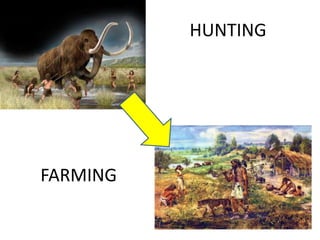
HUNTING
FARMING
First Agriculture Revolution
• It is also known as the Neolithic Revolution, is
the transformation of human societies from
hunting and gathering to farming. This
transition occurred worldwide between
10,000 BC and 2000 BC, with the earliest
known developments taking place in the
Middle East.
SECOND AGRICULTURE REVOLUTION
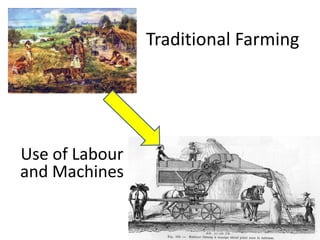
Traditional Farming
Use of Labour
and Machines
Second Agriculture Revolution
• The British Agricultural Revolution, or Second Agricultural
Revolution, was the unprecedented increase in agricultural
production in Britain due to increases in labour and land
productivity between the mid-17th and late 19th centuries.
• Agricultural output grew faster than the population over the
century to 1770, and thereafter productivity remained among the
highest in the world. This increase in the food supply contributed to
the rapid growth of population in England and Wales, from 5.5
million in 1700 to over 9 million by 1801, though domestic
production gave way increasingly to food imports in the nineteenth
century as the population more than tripled to over 32 million.
• The rise in productivity accelerated the decline of the agricultural
share of the labour force, adding to the urban workforce on which
industrialization depended: the Agricultural Revolution has
therefore been cited as a cause of the Industrial Revolution
Third Agriculture Revolution
Green Revolution / Third Agriculture
Revolution
• It was the Third Agricultural Revolution which
was set for research technology transfer
initiatives occurring between 1950 and the
late 1960s.
Organization which were involved in
the initiative of Green Revolution
1. The Ford Foundation
2. The Rockefeller Foundation
• The Ford Foundation is an
American private foundation with
the mission of advancing human
welfare. It was Created in
1936 by Edsel Ford and Henry Ford,
it was originally funded by a
US$25,000 gift from Edsel Ford.
• The Foundation was started by Standard
Oil owner John D. Rockefeller ("Senior"), along
with his son John D. Rockefeller Jr. ("Junior"),
and Senior's principal oil and gas business and
philanthropic advisor, Frederick Taylor Gates,
in New York State on May 14, 1913, when its
charter was formally accepted by the New
York State Legislature.
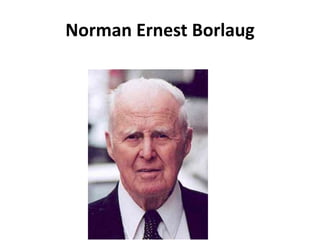
Norman Ernest Borlaug
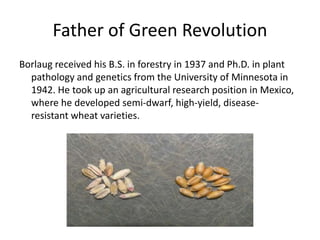
Father of Green Revolution
Borlaug received his B.S. in forestry in 1937 and Ph.D. in plant
pathology and genetics from the University of Minnesota in
1942. He took up an agricultural research position in Mexico,
where he developed semi-dwarf, high-yield, disease-
resistant wheat varieties.
• One key leader was Norman Borlaug, the "Father
of the Green Revolution", who received
the Nobel Peace Prize in 1970.
• He is credited with saving over a billion people
from starvation.
• The basic approach was the development of high-
yielding varieties of cereal grains, expansion of
irrigation infrastructure, modernization of
management techniques, distribution
of hybridized seeds, synthetic fertilizers,
and pesticides to farmers.
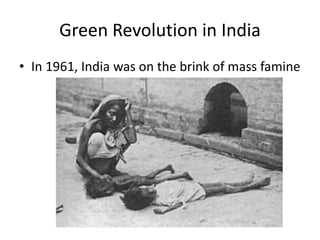
Green Revolution in India
• In 1961, India was on the brink of mass famine
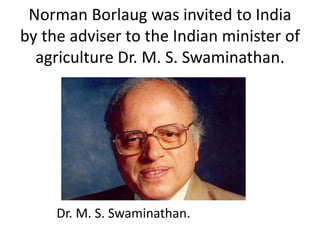
Norman Borlaug was invited to India
by the adviser to the Indian minister of
agriculture Dr. M. S. Swaminathan.
Dr. M. S. Swaminathan.
• Despite bureaucratic hurdles imposed by
India's grain monopolies, the Ford Foundation
and Indian government collaborated to import
wheat seed from the International Maize and
Wheat Improvement Center (CIMMYT).
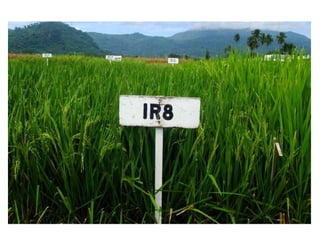
• India soon adopted IR8 – a semi-dwarf rice variety
developed by the International Rice Research Institute
(IRRI) that could produce more grains of rice per plant
when grown with certain fertilizers and irrigation.
• In 1968, Indian agronomist S.K. De Datta published his
findings that IR8 rice yielded about 5 tons per hectare
with no fertilizer, and almost 10 tons per hectare under
optimal conditions. This was 10 times the yield of
traditional rice.
• IR8 was a success throughout Asia, and dubbed the
"Miracle Rice". IR8 was also developed into Semi-dwarf
IR36
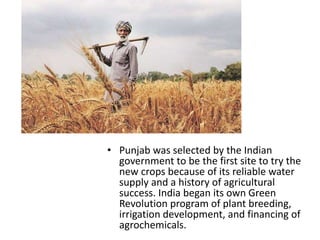
• Punjab was selected by the Indian
government to be the first site to try the
new crops because of its reliable water
supply and a history of agricultural
success. India began its own Green
Revolution program of plant breeding,
irrigation development, and financing of
agrochemicals.
GREEN
REVOLUTION
ADOPTTING
NEW
TECHNOLOGY
USE OF HYV
SEEDS
USE OF
CHEMICAL
AND AGRO
CHEMICAL
FERTILIZERS
CONTROLLED
WATER
SUPPLY
MECHANIZA
TION OF
FARMING
PRICE
INCENTIVES
BETTER
FINANCIAL
ASSISTANCE
Impact of Green Revolution
• The green revolution resulted quantitative and
qualitative development in the agriculture in
India.
1. The quantitative improvement occurs as a
result of steep increase in the production of
agriculture output.
2. The qualitative improvement resulted into
adoption of modernized technology in the
agriculture
1. Spectacular increase in agriculture
production
• The dependence on food imports is eliminated
with the increase in agriculture production.
• The country becomes self-sufficient in
foodgrains. In fact India was the second largest
importer in 1966 and it imported no foodgrain in
subsequent decades except during late 80’s and
early 90’s mainly due to failure of monsoons or
untimely rains or floods in different regions.
• However, it may be noted that in recent years
annual growth in the food grain production is
losing its momentum.
2. Improvement in productivity
• The tremendous increase in agriculture
production occurred as a result of
improvements in productivity.
• The productivity was quite low in the pre-
green revolution period. The substantial
increase in the productivity occurred in wheat
and rice in the earlier periods but later on it
spread to other crops also.
3. Increase in Employment
• Green revolution generated employment
opportunities into diverse activities which
were created as a result of multiple cropping
and mechanization of farming.
• It helped to stimulate non-farm economy
that generated newer employment in various
services such as milling, marketing,
warehousing etc.
4. Food grain Price Stability
• The adoption of new agricultural technology
has led to the increased production and
marketable surplus of crops especially food
grains that have resulted into price stability of
food items.
5. Strengthening of forward and
backward linkages with industry
• The increase in agriculture production has
strengthened the forward linkage of
agriculture sector with industry in the sense of
supplying inputs to the industry.
• The backward linkage with the industry has
also received a boost as agricultural
modernization created larger demand for
inputs produced by industry.
Problems with Green Revolution
(1) Increase in personal inequalities
in rural areas
The income inequality between rich and poor increases due to:
(i) The owners of large farms were the main adopters’ of new technology because of
their better access to irrigation water, fertilizers, seeds and credit. In other words,
given the need for complex agricultural techniques and inputs, the green
revolution benefits the large farmers. The small farmers lagged behind the larger
farmer as small farmers had to depend upon traditional production method. Since
the rich farmers were already better equipped, the green revolution accentuate
the income inequalities between rich and poor.
(ii) Green revolution resulted into lower product price and higher input prices which
also encouraged landlords to increase rents or force tenants to evict the land.
(iii) The mechanization pushed down the wages of and employment opportunities for
unskilled labor in the rural areas thereby further widening the income disparities.
(2) Increased Regional disparities
Green revolution spread only in irrigated and high-
potential rain fed areas. The villages or regions without the
access of sufficient water were left out that widened the
regional disparities between adopters and non-adopters.
Since, the HYV seeds technically can be applied only in land
with assured water supply and availability of other inputs
like chemicals, fertilizers etc. The application of the new
technology in the dry-land areas is simply ruled out.
The states like Punjab, Haryana, Western UP etc. having
good irrigation and other infrastructure facilities were able
to derive the benefits of green revolution and achieve
faster economic development while other states have
recorded slow growth in agriculture production.
(3) Environmental Damage
Excessive and inappropriate use of fertilizers
and pesticides has polluted waterway, killed
beneficial insects and wild life. It has caused over-
use of soil and rapidly depleted its nutrients. The
rampant irrigation practices have led to
eventually soil degradation. Groundwater
practices have fallen dramatically. Further, heavy
dependence on few major crops has led to loss of
biodiversity of farmers. These problems were
aggravated due to absence of training to use
modern technology and vast illiteracy leading to
excessive use of chemicals.
(4) Restrictive Crop Coverage
The new agriculture strategy involving use of HYV seeds was initially
limited to wheat, maize and bajra. The other major crop i.e. rice
responded much later. The progress of developing and application of HYV
seeds in other crops especially commercial crops like oilseeds, jute etc has
been very slow. In fact, in certain period a decline in the output of
commercial crops is witnessed because of diversion of area under
commercial crop to food crop production. The basic factor for non-spread
of green revolution to many crops was that in the early 1960’s the severe
shortage in food grains existed and imports were resorted to overcame
the shortage. Government initiated green revolution to increase food
grain productivity and non-food grain crops were not covered. The
substantial rise in one or two food grain crop cannot make big difference
in the total agricultural production. Thus new technology contributed
insignificantly in raising the overall agricultural production due to limited
crop coverage. So it is important that the revolutionary efforts should be
made in all major crops.
Presented By: Mr. Shahab Ud Din
Asst. Professor,
D.C.B.M.,
Integral University,
Lucknow.
Contact Info: sudin@iul.ac.in
958624322

Green revolution

  • 1.
  • 2.
  • 3.
  • 4.
    First Agriculture Revolution •It is also known as the Neolithic Revolution, is the transformation of human societies from hunting and gathering to farming. This transition occurred worldwide between 10,000 BC and 2000 BC, with the earliest known developments taking place in the Middle East.
  • 5.
  • 6.
    Traditional Farming Use ofLabour and Machines
  • 7.
    Second Agriculture Revolution •The British Agricultural Revolution, or Second Agricultural Revolution, was the unprecedented increase in agricultural production in Britain due to increases in labour and land productivity between the mid-17th and late 19th centuries. • Agricultural output grew faster than the population over the century to 1770, and thereafter productivity remained among the highest in the world. This increase in the food supply contributed to the rapid growth of population in England and Wales, from 5.5 million in 1700 to over 9 million by 1801, though domestic production gave way increasingly to food imports in the nineteenth century as the population more than tripled to over 32 million. • The rise in productivity accelerated the decline of the agricultural share of the labour force, adding to the urban workforce on which industrialization depended: the Agricultural Revolution has therefore been cited as a cause of the Industrial Revolution
  • 8.
  • 9.
    Green Revolution /Third Agriculture Revolution • It was the Third Agricultural Revolution which was set for research technology transfer initiatives occurring between 1950 and the late 1960s.
  • 10.
    Organization which wereinvolved in the initiative of Green Revolution 1. The Ford Foundation 2. The Rockefeller Foundation
  • 11.
    • The FordFoundation is an American private foundation with the mission of advancing human welfare. It was Created in 1936 by Edsel Ford and Henry Ford, it was originally funded by a US$25,000 gift from Edsel Ford.
  • 12.
    • The Foundationwas started by Standard Oil owner John D. Rockefeller ("Senior"), along with his son John D. Rockefeller Jr. ("Junior"), and Senior's principal oil and gas business and philanthropic advisor, Frederick Taylor Gates, in New York State on May 14, 1913, when its charter was formally accepted by the New York State Legislature.
  • 13.
  • 14.
    Father of GreenRevolution Borlaug received his B.S. in forestry in 1937 and Ph.D. in plant pathology and genetics from the University of Minnesota in 1942. He took up an agricultural research position in Mexico, where he developed semi-dwarf, high-yield, disease- resistant wheat varieties.
  • 15.
    • One keyleader was Norman Borlaug, the "Father of the Green Revolution", who received the Nobel Peace Prize in 1970. • He is credited with saving over a billion people from starvation. • The basic approach was the development of high- yielding varieties of cereal grains, expansion of irrigation infrastructure, modernization of management techniques, distribution of hybridized seeds, synthetic fertilizers, and pesticides to farmers.
  • 16.
    Green Revolution inIndia • In 1961, India was on the brink of mass famine
  • 17.
    Norman Borlaug wasinvited to India by the adviser to the Indian minister of agriculture Dr. M. S. Swaminathan. Dr. M. S. Swaminathan.
  • 18.
    • Despite bureaucratichurdles imposed by India's grain monopolies, the Ford Foundation and Indian government collaborated to import wheat seed from the International Maize and Wheat Improvement Center (CIMMYT).
  • 20.
    • India soonadopted IR8 – a semi-dwarf rice variety developed by the International Rice Research Institute (IRRI) that could produce more grains of rice per plant when grown with certain fertilizers and irrigation. • In 1968, Indian agronomist S.K. De Datta published his findings that IR8 rice yielded about 5 tons per hectare with no fertilizer, and almost 10 tons per hectare under optimal conditions. This was 10 times the yield of traditional rice. • IR8 was a success throughout Asia, and dubbed the "Miracle Rice". IR8 was also developed into Semi-dwarf IR36
  • 22.
    • Punjab wasselected by the Indian government to be the first site to try the new crops because of its reliable water supply and a history of agricultural success. India began its own Green Revolution program of plant breeding, irrigation development, and financing of agrochemicals.
  • 23.
    GREEN REVOLUTION ADOPTTING NEW TECHNOLOGY USE OF HYV SEEDS USEOF CHEMICAL AND AGRO CHEMICAL FERTILIZERS CONTROLLED WATER SUPPLY MECHANIZA TION OF FARMING PRICE INCENTIVES BETTER FINANCIAL ASSISTANCE
  • 24.
    Impact of GreenRevolution • The green revolution resulted quantitative and qualitative development in the agriculture in India. 1. The quantitative improvement occurs as a result of steep increase in the production of agriculture output. 2. The qualitative improvement resulted into adoption of modernized technology in the agriculture
  • 25.
    1. Spectacular increasein agriculture production • The dependence on food imports is eliminated with the increase in agriculture production. • The country becomes self-sufficient in foodgrains. In fact India was the second largest importer in 1966 and it imported no foodgrain in subsequent decades except during late 80’s and early 90’s mainly due to failure of monsoons or untimely rains or floods in different regions. • However, it may be noted that in recent years annual growth in the food grain production is losing its momentum.
  • 26.
    2. Improvement inproductivity • The tremendous increase in agriculture production occurred as a result of improvements in productivity. • The productivity was quite low in the pre- green revolution period. The substantial increase in the productivity occurred in wheat and rice in the earlier periods but later on it spread to other crops also.
  • 27.
    3. Increase inEmployment • Green revolution generated employment opportunities into diverse activities which were created as a result of multiple cropping and mechanization of farming. • It helped to stimulate non-farm economy that generated newer employment in various services such as milling, marketing, warehousing etc.
  • 28.
    4. Food grainPrice Stability • The adoption of new agricultural technology has led to the increased production and marketable surplus of crops especially food grains that have resulted into price stability of food items.
  • 29.
    5. Strengthening offorward and backward linkages with industry • The increase in agriculture production has strengthened the forward linkage of agriculture sector with industry in the sense of supplying inputs to the industry. • The backward linkage with the industry has also received a boost as agricultural modernization created larger demand for inputs produced by industry.
  • 30.
  • 31.
    (1) Increase inpersonal inequalities in rural areas The income inequality between rich and poor increases due to: (i) The owners of large farms were the main adopters’ of new technology because of their better access to irrigation water, fertilizers, seeds and credit. In other words, given the need for complex agricultural techniques and inputs, the green revolution benefits the large farmers. The small farmers lagged behind the larger farmer as small farmers had to depend upon traditional production method. Since the rich farmers were already better equipped, the green revolution accentuate the income inequalities between rich and poor. (ii) Green revolution resulted into lower product price and higher input prices which also encouraged landlords to increase rents or force tenants to evict the land. (iii) The mechanization pushed down the wages of and employment opportunities for unskilled labor in the rural areas thereby further widening the income disparities.
  • 32.
    (2) Increased Regionaldisparities Green revolution spread only in irrigated and high- potential rain fed areas. The villages or regions without the access of sufficient water were left out that widened the regional disparities between adopters and non-adopters. Since, the HYV seeds technically can be applied only in land with assured water supply and availability of other inputs like chemicals, fertilizers etc. The application of the new technology in the dry-land areas is simply ruled out. The states like Punjab, Haryana, Western UP etc. having good irrigation and other infrastructure facilities were able to derive the benefits of green revolution and achieve faster economic development while other states have recorded slow growth in agriculture production.
  • 33.
    (3) Environmental Damage Excessiveand inappropriate use of fertilizers and pesticides has polluted waterway, killed beneficial insects and wild life. It has caused over- use of soil and rapidly depleted its nutrients. The rampant irrigation practices have led to eventually soil degradation. Groundwater practices have fallen dramatically. Further, heavy dependence on few major crops has led to loss of biodiversity of farmers. These problems were aggravated due to absence of training to use modern technology and vast illiteracy leading to excessive use of chemicals.
  • 34.
    (4) Restrictive CropCoverage The new agriculture strategy involving use of HYV seeds was initially limited to wheat, maize and bajra. The other major crop i.e. rice responded much later. The progress of developing and application of HYV seeds in other crops especially commercial crops like oilseeds, jute etc has been very slow. In fact, in certain period a decline in the output of commercial crops is witnessed because of diversion of area under commercial crop to food crop production. The basic factor for non-spread of green revolution to many crops was that in the early 1960’s the severe shortage in food grains existed and imports were resorted to overcame the shortage. Government initiated green revolution to increase food grain productivity and non-food grain crops were not covered. The substantial rise in one or two food grain crop cannot make big difference in the total agricultural production. Thus new technology contributed insignificantly in raising the overall agricultural production due to limited crop coverage. So it is important that the revolutionary efforts should be made in all major crops.
  • 35.
    Presented By: Mr.Shahab Ud Din Asst. Professor, D.C.B.M., Integral University, Lucknow. Contact Info: sudin@iul.ac.in 958624322