PRESENTED BY
PRAKASH CHANDRA
ROLL NO – 43 (P.U)
GREEN REVOLUTION
IN INDIA
CONTENT
1) Introduction
2) Background of Green Revolution in
India
3) Objectives of Green Revolution
4) Basic elements of Green Revolution
5) Components of Green Revolution
6) Implications
7) Conclusion
1) Introduction
● The green revolution is referred to as the process of
increasing agricultural production by incorporating modern
tools and techniques.
● The green revolution was an endeavor initiated by Norman
E Borloug in the 1960s.He is known as the father of green
revolution in the world.
● In India , The green revolution was mainly led by M.S
Swaminathan .
● The green revolution resulted in a great increase in
production of food grains especially wheat and rice.
● The green revolution , spreading over the period from
1967- 68 to 1977- 78, changed India status from food deficit
country to one of the world's leading agricultural nation.
2) Background of Green Revolution in India
● In 1943, India's suffered from the world's worst recorded
food crisis, the Bengal feminine, which lead to the death of a
proximately four million people in eastern India due to
hunger.
● even after independence in 1947 until 1967 the
government largely concentrated on expanding the farming
areas.
● But the population was growing at a much faster rate than
food production .
● This called for an immediate and drastic action to increase
yield the accent came in the form of green revolution.
3) Objective of green revolution
The main objective of green revolution are follows:
● Short term : The revolution was launched to address
India's hunger crisis during the second five year plan.
● Long term : The long term objectives included overall
agriculture modernisation based on ruler development,
industrial development, infrastructure, raw material etc.
● Employment : To provide employment to both agricultural
and industrial workers .
● Scientific studies : producing a stronger plants which
could with stand steam climate and diseases.
● Globalisation of the Agricultural world : By spreading
technology to non industrized nations and setting up many
corporations in major agriculture areas.
4) Basic elements of green revolution
● expansion of Farming Areas: Although the area of land under
cultivation was being increased from 1947 itself, this was not
enough to meet the rising demand.
The Green Revolution provided assistance in this quantitative
expansion of farmlands.
● Double-cropping System: Double cropping was a primary
feature of the Green Revolution. The decision was made to have
two crop seasons per year instead of just one.
The one-season-per-year practice was based on the fact that there
is only one rainy season annually.
Water for the second phase now came from huge irrigation
projects. Dams were built and other simple irrigation techniques
were also adopted.
● Using seeds with improved genetics: Using seeds with superior
genetics was the scientific aspect of the Green Revolution.
The Indian Council for Agricultural Research developed new strains
of high yield variety seeds, mainly wheat and rice, millet and corn.
5) Components of Green Revolution
●The main components of Green revolution are as follows:
● High Yielding Varieties of seeds : These are the genetically
modified seeds which can yield 2 to 3 times more than normal
crop.
● Irrigation : irrigation is the second most important component
of Green Revolution technology after HYV seeds assured and
regular supply of sufficient water to crops not only adds
production it also assures stability in production.
● Use of Fertilizer ( Chemical ): the use of chemical fertilizers has
been the third most important input of the green revolution after
HYV seeds and irrigation in fact use of hyv seeds needs a heavy
dose of irrigation and fertilizers to give high yeild HYVseeds
irrigation and fertilizers are called the trio of the Green
Revolution.
● Use of Insecticides and Pesticides
● Consolidation of Holdings
● Land reforms
● Supply of Agricultural Credit
● Rural Electrification
● Rural Roads and Marketing
● Farm Mechanisation
● Agricultural Universities .
6) Implications
1. Positive socio- Economic Implications
● Some of important positive socio-economic implications of
the Green Revolution are as follows:
● Increase in Agricultural Production : the introduction of
green revolution in 1967 to 68 has resulted in phenomenal
increase in production of agriculture crops specially in food
grains it result in a grain output of 131 million tons in the year
1978 and to 1979 and established India as one of the world
biggest agriculture producer.
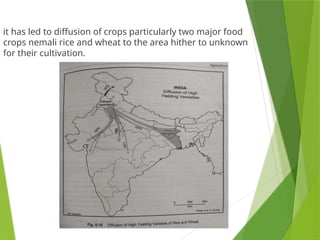
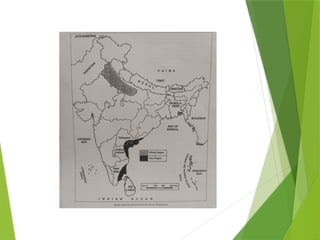
● Diffusion of Rice and Wheat Cultivation to Non-
Traditional Areas:
since the success of the Green Revolution depends on the
basic inputs like waiter seeds fertilizers and irrigation,
it has led to diffusion of crops particularly two major food
crops nemali rice and wheat to the area hither to unknown
for their cultivation.
● Prosperity of farmers : With the increased farm
production the earnings of the farmers also increased and
they become prosperous this has especially in the case with
big farmers having more than 10 hectares of land.
● Reduction in import of Foodgrains : The main benefit of
Green revolution was the increase in the production of food
grains as a result of which there was drastic deduction in
their imports presently India is a self sufficient in food
grains.
● Industrial growth : green revolution brought about large
scale form mechanization which created demand for
different types of machine like tractor,
harvester,tractor,combines, diesel engine ,electric motors,
pumping sets etc.
● Rural Employment
● Change in the attitude of farmers
2) Negative socio-economic implications
some important negative socio-economic implications of the green
revolution are as follows:
● Inter- crop Imbalances: Wheat which has benefited the most.
measure commercial crops like cotton jute tea and silver can are
also almost untouched by the green revolution.
● Regional Disparities : Green Revolution technology has given
birth to growing disparities in economic development at inter and
intra regional levels.
● Increase in Interpersonal Inequalities : it has been observed
that it is the big farmers having 10 hectares or more land who have
benefited the most from the Green Revolution .
● Unemployment : except in Punjab and to some extent in
Haryana Farm mechanization under Green Revolution has created
wide spread and employment among agricultural laborers in the
ruler areas .The most heat or the poor and the landless people.
Ecological Implications
1. some of the major ecological problems created by the green revolution
are soil salinity and alkalinity water logging desertification , soil erosion ,
degradation deforestation, depletion of underground water environmental
pollution health hazards etc.
● Deforestation : more cultivable land is needed to increase agriculture
production and forests are the main victims as trees are failed recklessly
to make more land available for agriculture.
● Punjab and Haryana the grainery of India are almost completely devoid
of forest.
● Depletion of underground water
● Environmental Pollution
● Noise pollution
● Health Hazards
●some of the poisonous chemicals enter the food chain through fruits and
vegetables and resulting in ill health.
7) Conclusion
Overall, the Green Revolution was a major achievement for many
developing countries, specially India and gave them an
unprecedented level of national food security.
It represented the successful adaptation and transfer of the same
scientific revolution in agriculture that the industrial countries had
already appropriated for themselves.
However, lesser heed was paid to factors other than ensuring food
security such as environment, the poor farmers and their education
about the know-how of such chemicals.
As a way forward, the policymakers must target the poor more
precisely to ensure that they receive greater direct benefits from new
technologies and those technologies will also need to be more
environmentally sustainable.
Also, taking lessons from the past, it must be ensured that such
initiatives include all of the beneficiaries covering all the regions
rather than sticking to a limited field.
THANK YOU

Green revolution classification and characteristics

  • 1.
    PRESENTED BY PRAKASH CHANDRA ROLLNO – 43 (P.U) GREEN REVOLUTION IN INDIA
  • 2.
    CONTENT 1) Introduction 2) Backgroundof Green Revolution in India 3) Objectives of Green Revolution 4) Basic elements of Green Revolution 5) Components of Green Revolution 6) Implications 7) Conclusion
  • 3.
    1) Introduction ● Thegreen revolution is referred to as the process of increasing agricultural production by incorporating modern tools and techniques. ● The green revolution was an endeavor initiated by Norman E Borloug in the 1960s.He is known as the father of green revolution in the world. ● In India , The green revolution was mainly led by M.S Swaminathan . ● The green revolution resulted in a great increase in production of food grains especially wheat and rice. ● The green revolution , spreading over the period from 1967- 68 to 1977- 78, changed India status from food deficit country to one of the world's leading agricultural nation.
  • 4.
    2) Background ofGreen Revolution in India ● In 1943, India's suffered from the world's worst recorded food crisis, the Bengal feminine, which lead to the death of a proximately four million people in eastern India due to hunger. ● even after independence in 1947 until 1967 the government largely concentrated on expanding the farming areas. ● But the population was growing at a much faster rate than food production . ● This called for an immediate and drastic action to increase yield the accent came in the form of green revolution.
  • 5.
    3) Objective ofgreen revolution The main objective of green revolution are follows: ● Short term : The revolution was launched to address India's hunger crisis during the second five year plan. ● Long term : The long term objectives included overall agriculture modernisation based on ruler development, industrial development, infrastructure, raw material etc. ● Employment : To provide employment to both agricultural and industrial workers . ● Scientific studies : producing a stronger plants which could with stand steam climate and diseases. ● Globalisation of the Agricultural world : By spreading technology to non industrized nations and setting up many corporations in major agriculture areas.
  • 6.
    4) Basic elementsof green revolution ● expansion of Farming Areas: Although the area of land under cultivation was being increased from 1947 itself, this was not enough to meet the rising demand. The Green Revolution provided assistance in this quantitative expansion of farmlands. ● Double-cropping System: Double cropping was a primary feature of the Green Revolution. The decision was made to have two crop seasons per year instead of just one. The one-season-per-year practice was based on the fact that there is only one rainy season annually. Water for the second phase now came from huge irrigation projects. Dams were built and other simple irrigation techniques were also adopted. ● Using seeds with improved genetics: Using seeds with superior genetics was the scientific aspect of the Green Revolution. The Indian Council for Agricultural Research developed new strains of high yield variety seeds, mainly wheat and rice, millet and corn.
  • 7.
    5) Components ofGreen Revolution ●The main components of Green revolution are as follows: ● High Yielding Varieties of seeds : These are the genetically modified seeds which can yield 2 to 3 times more than normal crop. ● Irrigation : irrigation is the second most important component of Green Revolution technology after HYV seeds assured and regular supply of sufficient water to crops not only adds production it also assures stability in production. ● Use of Fertilizer ( Chemical ): the use of chemical fertilizers has been the third most important input of the green revolution after HYV seeds and irrigation in fact use of hyv seeds needs a heavy dose of irrigation and fertilizers to give high yeild HYVseeds irrigation and fertilizers are called the trio of the Green Revolution. ● Use of Insecticides and Pesticides ● Consolidation of Holdings ● Land reforms
  • 8.
    ● Supply ofAgricultural Credit ● Rural Electrification ● Rural Roads and Marketing ● Farm Mechanisation ● Agricultural Universities . 6) Implications 1. Positive socio- Economic Implications ● Some of important positive socio-economic implications of the Green Revolution are as follows: ● Increase in Agricultural Production : the introduction of green revolution in 1967 to 68 has resulted in phenomenal increase in production of agriculture crops specially in food grains it result in a grain output of 131 million tons in the year 1978 and to 1979 and established India as one of the world biggest agriculture producer. ● Diffusion of Rice and Wheat Cultivation to Non- Traditional Areas: since the success of the Green Revolution depends on the basic inputs like waiter seeds fertilizers and irrigation,
  • 9.
    it has ledto diffusion of crops particularly two major food crops nemali rice and wheat to the area hither to unknown for their cultivation.
  • 10.
    ● Prosperity offarmers : With the increased farm production the earnings of the farmers also increased and they become prosperous this has especially in the case with big farmers having more than 10 hectares of land. ● Reduction in import of Foodgrains : The main benefit of Green revolution was the increase in the production of food grains as a result of which there was drastic deduction in their imports presently India is a self sufficient in food grains. ● Industrial growth : green revolution brought about large scale form mechanization which created demand for different types of machine like tractor, harvester,tractor,combines, diesel engine ,electric motors, pumping sets etc. ● Rural Employment ● Change in the attitude of farmers
  • 11.
    2) Negative socio-economicimplications some important negative socio-economic implications of the green revolution are as follows: ● Inter- crop Imbalances: Wheat which has benefited the most. measure commercial crops like cotton jute tea and silver can are also almost untouched by the green revolution. ● Regional Disparities : Green Revolution technology has given birth to growing disparities in economic development at inter and intra regional levels. ● Increase in Interpersonal Inequalities : it has been observed that it is the big farmers having 10 hectares or more land who have benefited the most from the Green Revolution . ● Unemployment : except in Punjab and to some extent in Haryana Farm mechanization under Green Revolution has created wide spread and employment among agricultural laborers in the ruler areas .The most heat or the poor and the landless people.
  • 13.
    Ecological Implications 1. someof the major ecological problems created by the green revolution are soil salinity and alkalinity water logging desertification , soil erosion , degradation deforestation, depletion of underground water environmental pollution health hazards etc. ● Deforestation : more cultivable land is needed to increase agriculture production and forests are the main victims as trees are failed recklessly to make more land available for agriculture. ● Punjab and Haryana the grainery of India are almost completely devoid of forest. ● Depletion of underground water ● Environmental Pollution ● Noise pollution ● Health Hazards ●some of the poisonous chemicals enter the food chain through fruits and vegetables and resulting in ill health.
  • 14.
    7) Conclusion Overall, theGreen Revolution was a major achievement for many developing countries, specially India and gave them an unprecedented level of national food security. It represented the successful adaptation and transfer of the same scientific revolution in agriculture that the industrial countries had already appropriated for themselves. However, lesser heed was paid to factors other than ensuring food security such as environment, the poor farmers and their education about the know-how of such chemicals. As a way forward, the policymakers must target the poor more precisely to ensure that they receive greater direct benefits from new technologies and those technologies will also need to be more environmentally sustainable. Also, taking lessons from the past, it must be ensured that such initiatives include all of the beneficiaries covering all the regions rather than sticking to a limited field.
  • 15.