Reward Management
Mr. Shahab Ud Din
Assistant Professor
DCBM
Integral University
9580624322
Rewards
 A reward system has the following important
features:
– an incentive plan may consist of both
‘monetary’ and ‘non monetary’ elements
– the timing, accuracy and frequency of
incentives are the very basis of a
successful incentive plan
– the plan requires that it should be properly
communicated to the employees to
encourage individual performances,
provide feedback and encourage
redirection
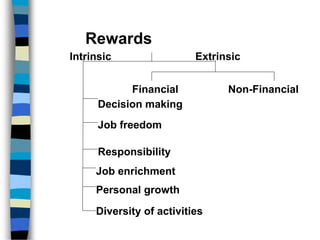
Financial Non-Financial
Intrinsic Extrinsic
Decision making
Job freedom
Responsibility
Job enrichment
Personal growth
Diversity of activities
Rewards
Rewards
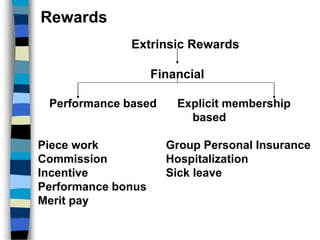
Extrinsic Rewards
Financial
Performance based Explicit membership
based
Piece work Group Personal Insurance
Commission Hospitalization
Incentive Sick leave
Performance bonus
Merit pay
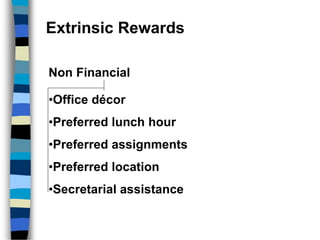
Extrinsic Rewards
Non Financial
•Office décor
•Preferred lunch hour
•Preferred assignments
•Preferred location
•Secretarial assistance
Rewards and Expectancy Theory
According to the expectancy theory the
tendency to act in a particular way
depends upon the strength of an
expectation that the act will be followed
by a given outcome and how attractive
that outcome will be
Rewards and Expectancy Theory
There are two variables involved here
Attractiveness of the reward / outcome
Performance - reward linkage—the degree to
which an individual feels that a certain level of
job performance will lead to a certain job
outcome
Effort - performance linkage—the probability
that a given effort will lead to a certain
performance
Types of Rewards
Intrinsic vs extrinsic rewards
Financial vs non-financial rewards
Performance based vs membership
based rewards
Intrinsic Rewards
 Intrinsic rewards come from the
satisfaction one gets from the job itself
 This satisfaction comes from self-
initiated rewards, such as having pride
in one’s work, having a feeling of
accomplishment, or being part of a team
Extrinsic Rewards
 Extrinsic rewards include money,
promotions, or fringe benefits
 For money or other extrinsic rewards
to be used as effective motivators,
they should be made contingent on the
employee’s performance
Extrinsic Rewards
 Rewards may enhance the employee’s
financial well being
directly
– through wages, bonuses, profit-sharing,
or indirectly
– through supportive benefits such as
pension plans, paid vacations, paid sick
leave, and purchase discounts
Non-financial Rewards
 Non-financial rewards emphasize making
life on the job more attractive
 Care must be taken in providing the
‘right’ non - financial reward for each
person
 For example: a paneled office, a carpeted
floor, or a private bathroom may be just
the office furnishings that stimulate an
employee towards top performance
Non-financial Rewards
 Performance-based rewards are
exemplified by the use of commissions,
piecework pay plans, incentive systems,
group bonuses, or other forms of merit
pay plans
 Membership - based rewards include cost-
of- living increases, profit sharing,
benefits and salary increases attributable
to labour market conditions, seniority or
time in rank, or future potential
Qualities of Effective Rewards
Significance
Equitable distribution – fairness
Visibility
Flexibility, e.g. annual performance bonus
Low cost—cost benefit of reward
Criteria for Determining Rewards
• Performance
• Effort- hard work but average performance
 Seniority
 Skill levels
 Job complexity

Reward management

  • 1.
    Reward Management Mr. ShahabUd Din Assistant Professor DCBM Integral University 9580624322
  • 2.
    Rewards  A rewardsystem has the following important features: – an incentive plan may consist of both ‘monetary’ and ‘non monetary’ elements – the timing, accuracy and frequency of incentives are the very basis of a successful incentive plan – the plan requires that it should be properly communicated to the employees to encourage individual performances, provide feedback and encourage redirection
  • 3.
    Financial Non-Financial Intrinsic Extrinsic Decisionmaking Job freedom Responsibility Job enrichment Personal growth Diversity of activities Rewards
  • 4.
    Rewards Extrinsic Rewards Financial Performance basedExplicit membership based Piece work Group Personal Insurance Commission Hospitalization Incentive Sick leave Performance bonus Merit pay
  • 5.
    Extrinsic Rewards Non Financial •Officedécor •Preferred lunch hour •Preferred assignments •Preferred location •Secretarial assistance
  • 6.
    Rewards and ExpectancyTheory According to the expectancy theory the tendency to act in a particular way depends upon the strength of an expectation that the act will be followed by a given outcome and how attractive that outcome will be
  • 7.
    Rewards and ExpectancyTheory There are two variables involved here Attractiveness of the reward / outcome Performance - reward linkage—the degree to which an individual feels that a certain level of job performance will lead to a certain job outcome Effort - performance linkage—the probability that a given effort will lead to a certain performance
  • 8.
    Types of Rewards Intrinsicvs extrinsic rewards Financial vs non-financial rewards Performance based vs membership based rewards
  • 9.
    Intrinsic Rewards  Intrinsicrewards come from the satisfaction one gets from the job itself  This satisfaction comes from self- initiated rewards, such as having pride in one’s work, having a feeling of accomplishment, or being part of a team
  • 10.
    Extrinsic Rewards  Extrinsicrewards include money, promotions, or fringe benefits  For money or other extrinsic rewards to be used as effective motivators, they should be made contingent on the employee’s performance
  • 11.
    Extrinsic Rewards  Rewardsmay enhance the employee’s financial well being directly – through wages, bonuses, profit-sharing, or indirectly – through supportive benefits such as pension plans, paid vacations, paid sick leave, and purchase discounts
  • 12.
    Non-financial Rewards  Non-financialrewards emphasize making life on the job more attractive  Care must be taken in providing the ‘right’ non - financial reward for each person  For example: a paneled office, a carpeted floor, or a private bathroom may be just the office furnishings that stimulate an employee towards top performance
  • 13.
    Non-financial Rewards  Performance-basedrewards are exemplified by the use of commissions, piecework pay plans, incentive systems, group bonuses, or other forms of merit pay plans  Membership - based rewards include cost- of- living increases, profit sharing, benefits and salary increases attributable to labour market conditions, seniority or time in rank, or future potential
  • 14.
    Qualities of EffectiveRewards Significance Equitable distribution – fairness Visibility Flexibility, e.g. annual performance bonus Low cost—cost benefit of reward
  • 15.
    Criteria for DeterminingRewards • Performance • Effort- hard work but average performance  Seniority  Skill levels  Job complexity