Presented by:
Shreya Sharma
What is Green Revolution??
The Green Revolution was a period when the
productivity of global agriculture increased
drastically as a result of new advances.
During this time period, new chemical fertilizers
and pesticides were created.
The chemical fertilizers made it possible to supply
crops with extra nutrients and, therefore, increase
yield.
The newly developed pesticides controlled weeds,
deterred or kill insects, and prevented diseases,
which also resulted in higher productivity.
History and development of
Green Revolution
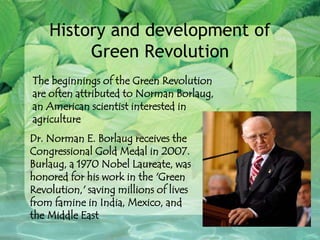
The beginnings of the Green Revolution
are often attributed to Norman Borlaug,
an American scientist interested in
agriculture
Dr. Norman E. Borlaug receives the
Congressional Gold Medal in 2007.
Burlaug, a 1970 Nobel Laureate, was
honored for his work in the 'Green
Revolution,' saving millions of lives
from famine in India, Mexico, and
the Middle East
Green Revolution in India
• In 1965 the government of Mrs. Indira Gandhi
decided to major steps on agriculture conditions.
•Thus Green Revolution was applied to the period
from 1967 to 1978 basically in the parts or Haryana
and Punjab.
• At this stage concern was on Wheat and Rice.
•Dr. MS Swaminathan from India led Green
Revolution as a Project.
Traditional ways of farming
Methods used in Green
Revolution
1. Multiple Cropping System
2. Seeds with superior genetics
3. Proper irrigation system
4. HYV seeds
5. Pesticides and fertilizers
6. Modern machines
7. Expansion of farming areas
Effect of Green Revolution
 Increase in production
Capitalistic farming
Rural employment
Import of food grains
Development of industries
Economic growth
Thinking of farmers
0%
20%
40%
60%
80%
100%
2005 2015
modern farming
techinque
incearse in production of
agricultural goods
year
Important aspect of Green
Revolution
In addition to producing larger quantities of food, the
Green Revolution was also beneficial because it made
it possible to grow more crops on roughly the same
amount of land with a similar amount of effort. This
reduced production costs and also resulted in cheaper
prices for food in the market.
The ability to grow more food on the same amount
of land was also beneficial to the environment
because it meant that less forest or natural land
needed to be converted to farmland to produce more
food.
Issues regarding Green
Revolution
 Pollution and erosion of soil
Pollution of water
Unemployment among
uneducated farmers
Deadly disease
Harmful for farmers
Consumption may be adverse
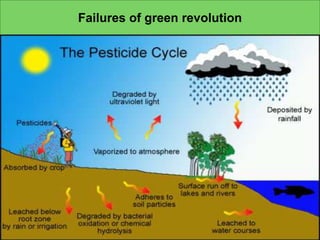
Failures of green revolution
Conclusion
Green Revolution has done a lot of positive
things, saving the lives of millions peoples and
exponentially increasing the yield of food crops.
But environmental degradation makes the Green
Revolution an overall inefficient, short-term
solution to the problem of food insecurity.
So, more sustainable and environmental
friendly system of cultivation needs to be
practiced.
The world needs green Revolution 2, which
promises to feed a growing world population
sustainably –without compromising the needs
of future generations
Need for second green
revolution
India has tremendous export potential in
agriculture in present era of globalization .
In second Green Revolution emphasis should be
laid on
1. Non food grains
2. Improving global market opportunities
3. Improving rural infrastructure
4. Improving rural roads and electrifications
THANK YOU

ppt green revolution

  • 1.
  • 2.
    What is GreenRevolution?? The Green Revolution was a period when the productivity of global agriculture increased drastically as a result of new advances. During this time period, new chemical fertilizers and pesticides were created. The chemical fertilizers made it possible to supply crops with extra nutrients and, therefore, increase yield. The newly developed pesticides controlled weeds, deterred or kill insects, and prevented diseases, which also resulted in higher productivity.
  • 3.
    History and developmentof Green Revolution The beginnings of the Green Revolution are often attributed to Norman Borlaug, an American scientist interested in agriculture Dr. Norman E. Borlaug receives the Congressional Gold Medal in 2007. Burlaug, a 1970 Nobel Laureate, was honored for his work in the 'Green Revolution,' saving millions of lives from famine in India, Mexico, and the Middle East
  • 5.
    Green Revolution inIndia • In 1965 the government of Mrs. Indira Gandhi decided to major steps on agriculture conditions. •Thus Green Revolution was applied to the period from 1967 to 1978 basically in the parts or Haryana and Punjab. • At this stage concern was on Wheat and Rice. •Dr. MS Swaminathan from India led Green Revolution as a Project.
  • 6.
  • 7.
    Methods used inGreen Revolution 1. Multiple Cropping System 2. Seeds with superior genetics 3. Proper irrigation system 4. HYV seeds 5. Pesticides and fertilizers 6. Modern machines 7. Expansion of farming areas
  • 9.
    Effect of GreenRevolution  Increase in production Capitalistic farming Rural employment Import of food grains Development of industries Economic growth Thinking of farmers
  • 11.
  • 12.
    Important aspect ofGreen Revolution In addition to producing larger quantities of food, the Green Revolution was also beneficial because it made it possible to grow more crops on roughly the same amount of land with a similar amount of effort. This reduced production costs and also resulted in cheaper prices for food in the market. The ability to grow more food on the same amount of land was also beneficial to the environment because it meant that less forest or natural land needed to be converted to farmland to produce more food.
  • 13.
    Issues regarding Green Revolution Pollution and erosion of soil Pollution of water Unemployment among uneducated farmers Deadly disease Harmful for farmers Consumption may be adverse
  • 14.
  • 16.
    Conclusion Green Revolution hasdone a lot of positive things, saving the lives of millions peoples and exponentially increasing the yield of food crops. But environmental degradation makes the Green Revolution an overall inefficient, short-term solution to the problem of food insecurity. So, more sustainable and environmental friendly system of cultivation needs to be practiced. The world needs green Revolution 2, which promises to feed a growing world population sustainably –without compromising the needs of future generations
  • 17.
    Need for secondgreen revolution India has tremendous export potential in agriculture in present era of globalization . In second Green Revolution emphasis should be laid on 1. Non food grains 2. Improving global market opportunities 3. Improving rural infrastructure 4. Improving rural roads and electrifications
  • 18.