Planning and Development
DEFINITION
• Planning (also called forethought) is the
process of thinking about an organizing the
activities required to achieve a desired goal.
• It is a conscious as well as sub-conscious activity.
• It is "an anticipatory decision making process"
that helps in coping with complexities.
• It is deciding future course of action from
amongst alternatives.
• It is a process that involves making and evaluating
each set of interrelated decisions.
• It is selection of missions, objectives and
"translation of knowledge into action."
• A planned performance brings better results
compared to an unplanned one.
• A manager's job is planning, monitoring and
controlling. Planning and goal setting are
important traits of an organization. It is done at
all levels of the organization.
• Planning includes the plan, the thought process,
action, and implementation.
• Planning gives more power over the future.
• Planning is deciding in advance what to do, how
to do it, when to do it, and who should do it.
• This bridges the gap from where the organization
is to where it wants to be. The planning function
involves establishing goals and arranging them in
logical order
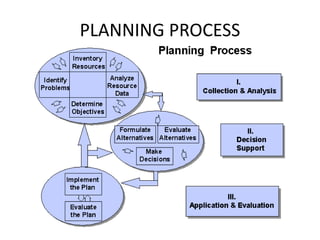
PLANNING PROCESS
NEUROPSYCHOLOGICAL TEST ( TOWER
OF HANOI)
• A puzzle invented in 1883 by the French
mathematician Édouard Lucas. There are
different variations of the puzzle, the classic
version consists of three rods and usually
seven to nine discs of subsequently smaller
size.
• Planning is a key component of the problem
solving skills necessary to achieve the objective,
which is to move the entire stack to another rod,
obeying the following rules
• Only one disk may be moved at a time.
• Each move consists of taking the upper disk from
one of the rods and sliding it onto another rod,
on top of the other disks that may already be
present on that rod.
• No disk may be placed on top of a smaller disk
Planning and Development

Planning and Development

  • 1.
  • 2.
    DEFINITION • Planning (alsocalled forethought) is the process of thinking about an organizing the activities required to achieve a desired goal.
  • 3.
    • It isa conscious as well as sub-conscious activity. • It is "an anticipatory decision making process" that helps in coping with complexities. • It is deciding future course of action from amongst alternatives. • It is a process that involves making and evaluating each set of interrelated decisions. • It is selection of missions, objectives and "translation of knowledge into action." • A planned performance brings better results compared to an unplanned one.
  • 4.
    • A manager'sjob is planning, monitoring and controlling. Planning and goal setting are important traits of an organization. It is done at all levels of the organization. • Planning includes the plan, the thought process, action, and implementation. • Planning gives more power over the future. • Planning is deciding in advance what to do, how to do it, when to do it, and who should do it. • This bridges the gap from where the organization is to where it wants to be. The planning function involves establishing goals and arranging them in logical order
  • 5.
  • 6.
    NEUROPSYCHOLOGICAL TEST (TOWER OF HANOI) • A puzzle invented in 1883 by the French mathematician Édouard Lucas. There are different variations of the puzzle, the classic version consists of three rods and usually seven to nine discs of subsequently smaller size.
  • 7.
    • Planning isa key component of the problem solving skills necessary to achieve the objective, which is to move the entire stack to another rod, obeying the following rules • Only one disk may be moved at a time. • Each move consists of taking the upper disk from one of the rods and sliding it onto another rod, on top of the other disks that may already be present on that rod. • No disk may be placed on top of a smaller disk