Green Growth
– Addressing Climate Change
Lecture Presentation of DENR during
the Luzon-Wide TEAMshop (2011) at
Hotel Consuelo, Lingayen, Pangasinan
Outline of Presentation
I. Overview of Green Growth
II. The Green Growth Paths/Components
III. Green Growth Strategies To Address Climate
Change
IV. Promotion of Green Growth Through Clean
Development Mechanism (CDM)
V. Challenges of Green Growth Strategies in the
Philippines
Growth for the sake of growth is
the ideology of the cancer cell.
~Edward Abbey
What is Green Growth?
 is a departure from the traditional economic strategy of
“grow first, clean up later” to a more responsible
economic growth with emphasis on environmental and
social concerns;
 a low carbon economic growth;
 holistic approach designed to integrate the three pillars
of sustainable development:
 economic development;
 social development; and
 environmental sustainability.
What is Green Growth?
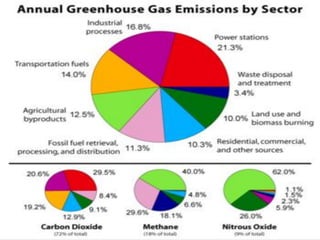
 a sustainable growth which aims to reduce greenhouse
gas emission and environmental pollution;
 Carbon Dioxide
 Methane
 Nitrous Oxide
Green Growth Paths/Components
A. Eco-efficiency
 Concept of creating more goods and services while
using fewer resources and creating less waste and
pollution;
 Production of economically valuable goods and
services while reducing the ecological impacts of
production;
 Costs are reduced while revenues are increased.
Critical Aspects of Eco-Efficiency
1. Reduction
 Material and energy intensity of goods or services
 Dispersion of toxic materials
 Wastes and by-products
2. Improvement/Maximization
 Improved use of recycling
 Maximized use of renewable resources
 Greater durability of products
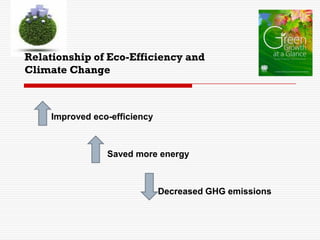
Improved eco-efficiency
Relationship of Eco-Efficiency and
Climate Change
Saved more energy
Decreased GHG emissions
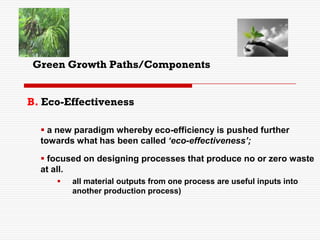
B. Eco-Effectiveness
 a new paradigm whereby eco-efficiency is pushed further
towards what has been called ‘eco-effectiveness’;
 focused on designing processes that produce no or zero waste
at all.
 all material outputs from one process are useful inputs into
another production process)
Green Growth Paths/Components
Eco-Effectiveness
Example
Fuji Xerox has produced/designed products that are
99.97% recyclable.
 Component parts are reusable.
Green Growth Paths/Components
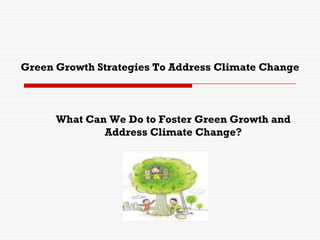
Green Growth Strategies To Address Climate Change
What Can We Do to Foster Green Growth and
Address Climate Change?
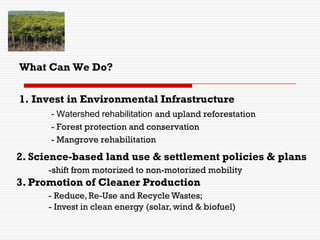
1. Invest in Environmental Infrastructure
- Watershed rehabilitation and upland reforestation
- Forest protection and conservation
- Mangrove rehabilitation
What Can We Do?
2. Science-based land use & settlement policies & plans
-shift from motorized to non-motorized mobility
3. Promotion of Cleaner Production
- Reduce, Re-Use and Recycle Wastes;
- Invest in clean energy (solar, wind & biofuel)
4. Stricter implementation of environmental laws;
5. Invest in sanitation (i.e. STP);
6. Mainstreaming green growth in government
programs
- Clean Air and Water Acts
- Hazardous Wastes & Toxic Substances Act
- Renewable Energy Act
- Biofuels Act
- Climate Change Act
7. Develop a core of green growth trainors through
capacity building in the bureaucracy.
What Can We Do?
ESCAP Capacity Building Programs on Green Growth
• Sustainable Consumption and Production (SCP)
• Greening Business and Markets
• Sustainable Infrastructure
• Green Tax and Budget Reform
• Development of Eco-efficiency Indicators
• Investment in Natural Capital
8. Implement a Compliance Assistance Center
(CAC)System
CAC is system of assisting industrial and commercial establishments
to comply with environmental policies, regulations and standards, as
complementary mechanism to the government’s enforcement work.
Pilot Agency: LLDA (CAC for hog farms and
slaughterhouses)
What Can We Do?
What Can We Do?
9. Polluter pays principle (for commercial and industrial
establishment)
10. Implementation of Green Procurement Program
pursuant to E.O. No. 301
 All Departments, Bureaus, Offices and Agencies of All Executive
Branch of Government
 Aims to promote a culture of making environmentally-informed
decisions in government in the purchase and use of different
products;
 Develop incentive programs for suppliers with environmentally
sound products and services.
CDM Eligible Projects
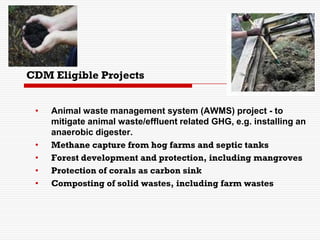
• Animal waste management system (AWMS) project - to
mitigate animal waste/effluent related GHG, e.g. installing an
anaerobic digester.
• Methane capture from hog farms and septic tanks
• Forest development and protection, including mangroves
• Protection of corals as carbon sink
• Composting of solid wastes, including farm wastes
Promotion of Green Growth through
The Clean Development Mechanism (CDM)
The CDM is an arrangement under the Kyoto Protocol which
encourages initiatives to meet the challenges of threat of climate
change.
 assist developing countries with their sustainable development
projects; and
 provide opportunity for developed countries to reduce its GHG
emissions at a lesser cost.
 CDM-compliant projects can then be credited as certified
emission reduction (CER), which can be sold to developed
economies.
GEF financed climate change-related projects (up to $14B)
CDM Eligible Projects
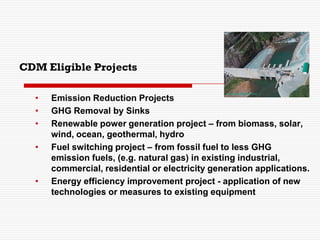
• Emission Reduction Projects
• GHG Removal by Sinks
• Renewable power generation project – from biomass, solar,
wind, ocean, geothermal, hydro
• Fuel switching project – from fossil fuel to less GHG
emission fuels, (e.g. natural gas) in existing industrial,
commercial, residential or electricity generation applications.
• Energy efficiency improvement project - application of new
technologies or measures to existing equipment
Clean Development Mechanism
in the Philippines
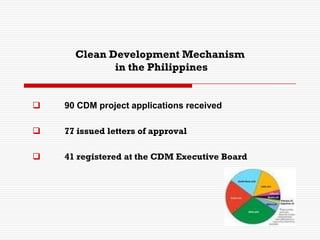
 90 CDM project applications received
 77 issued letters of approval
 41 registered at the CDM Executive Board
Challenges of Green Growth Strategies
in the Philippines
1. Failure in balancing the relationship between economic
activities and the use of the environment;
a. “Grow now, clean later” behavior;
b. Compromising environmental interests in favor of business
interests;
2. Failure in the strict implementation of environmental laws;
3. Graft and corruption; and
4. Lack of experts and professional opportunities.
Act Now, Act Together, Act Differently
THANK YOU

Green Growth

  • 1.
    Green Growth – AddressingClimate Change Lecture Presentation of DENR during the Luzon-Wide TEAMshop (2011) at Hotel Consuelo, Lingayen, Pangasinan
  • 2.
    Outline of Presentation I.Overview of Green Growth II. The Green Growth Paths/Components III. Green Growth Strategies To Address Climate Change IV. Promotion of Green Growth Through Clean Development Mechanism (CDM) V. Challenges of Green Growth Strategies in the Philippines
  • 3.
    Growth for thesake of growth is the ideology of the cancer cell. ~Edward Abbey
  • 4.
    What is GreenGrowth?  is a departure from the traditional economic strategy of “grow first, clean up later” to a more responsible economic growth with emphasis on environmental and social concerns;  a low carbon economic growth;  holistic approach designed to integrate the three pillars of sustainable development:  economic development;  social development; and  environmental sustainability.
  • 5.
    What is GreenGrowth?  a sustainable growth which aims to reduce greenhouse gas emission and environmental pollution;  Carbon Dioxide  Methane  Nitrous Oxide
  • 7.
    Green Growth Paths/Components A.Eco-efficiency  Concept of creating more goods and services while using fewer resources and creating less waste and pollution;  Production of economically valuable goods and services while reducing the ecological impacts of production;  Costs are reduced while revenues are increased.
  • 8.
    Critical Aspects ofEco-Efficiency 1. Reduction  Material and energy intensity of goods or services  Dispersion of toxic materials  Wastes and by-products 2. Improvement/Maximization  Improved use of recycling  Maximized use of renewable resources  Greater durability of products
  • 9.
    Improved eco-efficiency Relationship ofEco-Efficiency and Climate Change Saved more energy Decreased GHG emissions
  • 10.
    B. Eco-Effectiveness  anew paradigm whereby eco-efficiency is pushed further towards what has been called ‘eco-effectiveness’;  focused on designing processes that produce no or zero waste at all.  all material outputs from one process are useful inputs into another production process) Green Growth Paths/Components
  • 11.
    Eco-Effectiveness Example Fuji Xerox hasproduced/designed products that are 99.97% recyclable.  Component parts are reusable. Green Growth Paths/Components
  • 12.
    Green Growth StrategiesTo Address Climate Change What Can We Do to Foster Green Growth and Address Climate Change?
  • 13.
    1. Invest inEnvironmental Infrastructure - Watershed rehabilitation and upland reforestation - Forest protection and conservation - Mangrove rehabilitation What Can We Do? 2. Science-based land use & settlement policies & plans -shift from motorized to non-motorized mobility 3. Promotion of Cleaner Production - Reduce, Re-Use and Recycle Wastes; - Invest in clean energy (solar, wind & biofuel)
  • 14.
    4. Stricter implementationof environmental laws; 5. Invest in sanitation (i.e. STP); 6. Mainstreaming green growth in government programs - Clean Air and Water Acts - Hazardous Wastes & Toxic Substances Act - Renewable Energy Act - Biofuels Act - Climate Change Act 7. Develop a core of green growth trainors through capacity building in the bureaucracy. What Can We Do?
  • 15.
    ESCAP Capacity BuildingPrograms on Green Growth • Sustainable Consumption and Production (SCP) • Greening Business and Markets • Sustainable Infrastructure • Green Tax and Budget Reform • Development of Eco-efficiency Indicators • Investment in Natural Capital
  • 16.
    8. Implement aCompliance Assistance Center (CAC)System CAC is system of assisting industrial and commercial establishments to comply with environmental policies, regulations and standards, as complementary mechanism to the government’s enforcement work. Pilot Agency: LLDA (CAC for hog farms and slaughterhouses) What Can We Do?
  • 17.
    What Can WeDo? 9. Polluter pays principle (for commercial and industrial establishment) 10. Implementation of Green Procurement Program pursuant to E.O. No. 301  All Departments, Bureaus, Offices and Agencies of All Executive Branch of Government  Aims to promote a culture of making environmentally-informed decisions in government in the purchase and use of different products;  Develop incentive programs for suppliers with environmentally sound products and services.
  • 18.
    CDM Eligible Projects •Animal waste management system (AWMS) project - to mitigate animal waste/effluent related GHG, e.g. installing an anaerobic digester. • Methane capture from hog farms and septic tanks • Forest development and protection, including mangroves • Protection of corals as carbon sink • Composting of solid wastes, including farm wastes
  • 19.
    Promotion of GreenGrowth through The Clean Development Mechanism (CDM) The CDM is an arrangement under the Kyoto Protocol which encourages initiatives to meet the challenges of threat of climate change.  assist developing countries with their sustainable development projects; and  provide opportunity for developed countries to reduce its GHG emissions at a lesser cost.  CDM-compliant projects can then be credited as certified emission reduction (CER), which can be sold to developed economies. GEF financed climate change-related projects (up to $14B)
  • 20.
    CDM Eligible Projects •Emission Reduction Projects • GHG Removal by Sinks • Renewable power generation project – from biomass, solar, wind, ocean, geothermal, hydro • Fuel switching project – from fossil fuel to less GHG emission fuels, (e.g. natural gas) in existing industrial, commercial, residential or electricity generation applications. • Energy efficiency improvement project - application of new technologies or measures to existing equipment
  • 21.
    Clean Development Mechanism inthe Philippines  90 CDM project applications received  77 issued letters of approval  41 registered at the CDM Executive Board
  • 22.
    Challenges of GreenGrowth Strategies in the Philippines 1. Failure in balancing the relationship between economic activities and the use of the environment; a. “Grow now, clean later” behavior; b. Compromising environmental interests in favor of business interests; 2. Failure in the strict implementation of environmental laws; 3. Graft and corruption; and 4. Lack of experts and professional opportunities.
  • 23.
    Act Now, ActTogether, Act Differently
  • 24.