FERRER, EDRICK KEVIN A. BSED SS 2
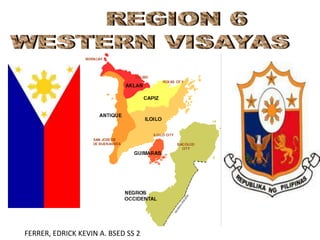
AREA AND LOCATION

Typically western
Visayas is found on
the west part of the
major island of the
Philippines which is
Visayas it is
surrounded by water
that’s why one major
livelihood found in
this certain island is
fishing.
GEOGRAPHICAL PROFILE
AKLAN
- The youngest of the 4 provinces of panay
island. It is bounded on the northwestern
portion of the province has mountains and
dense vegetation.
ANTIQUE
- Shaped like a seahorse, antique is the
oversized serrated hemline of the western
boarders of the 3 cornered scarf like land mass
that is panay.
CAPIZ
- The basic plantations found in this part of the
region are coconut, vegetables and sugarcane
GUIMARAS
- Lies southeast of panay island and northwest
of negros island in western visayas.
ILO ILO CITY
- Mountain ranges with peaks as high as 7,000 feet
provided natural boundaries that separates ilo ilo
from antique on the west and the capiz on the
north.
NEGROS OCCIDENTAL
- Bacolod, the capital city, lies in the northwestern
part of negros occidental, in a sprawling 16,000
hectars.
POLITICAL PROFILE
Region 6 has 5 provinces namely:
• AKLAN- 558,146 in population
• ANTIQUE- 605,110 in population
• CAPIZ-800,920 in population
• ILOILO-2,371,648 in population
• NEGROS OCCIDENTAL- 3,203,523 in
population
PROVINCES IN REGION 6
A. Antique
B. Aklan
C. Capiz

D. ILO ILO
E. GUIMARAS
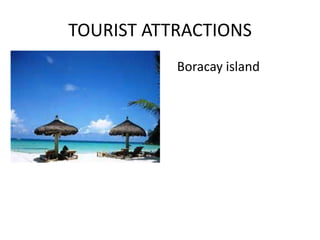
TOURIST ATTRACTIONS
Boracay island
ati –atihan in aklan
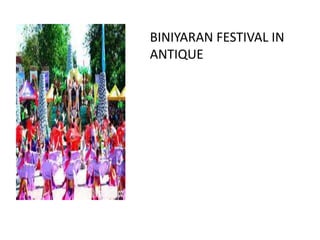
BINIYARAN FESTIVAL IN
ANTIQUE
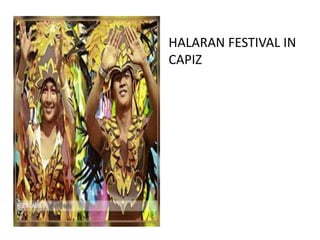
HALARAN FESTIVAL IN
CAPIZ
MACOPO FALLS IN
GUIMARAS
Macopo Falls in Guimaras
makes a great spot for
swimming and picnic. You can
also take a hike on the hilly
trail. At the end of snaky trail of
the falls, you’ll find the pool of
water surrounded by rocky
terrain which is cool all year
round that is a good place in
swimming you can also enjoy
the beautiful scenery view in
the top of the hill.
HOLIFENA ANCESTRAL
HOUSE IN NEGROS
OCCIDENTAL
Holifena ancestral house - There are
paintings and sketches of Juan Luna,
Jose Rizal and Fernando Amorsolo.
Aside from art during the Spanish
invasion, there are also paintings and
sculptures by Silay artists. Truly, this is
a place where you will appreciate
Philippine art.
Historical Places in Region 6
• Kalibo, aklan

FREEDOM SHRINE

Site of a shrine dedicated
to the brave Aklanons
who were martyred by
the Spaniards
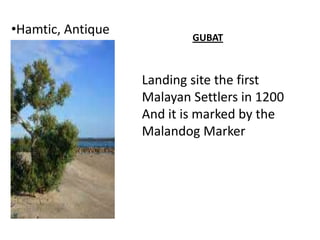
•Hamtic, Antique

GUBAT

Landing site the first
Malayan Settlers in 1200
And it is marked by the
Malandog Marker
Roxas city, capiz
Central business district of capiz
foreseeing the santa monica
church

Birthplace of the
President Manuel
Roxas
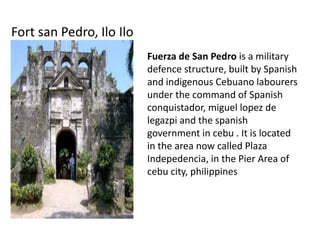
Fort san Pedro, Ilo Ilo
Fuerza de San Pedro is a military
defence structure, built by Spanish
and indigenous Cebuano labourers
under the command of Spanish
conquistador, miguel lopez de
legazpi and the spanish
government in cebu . It is located
in the area now called Plaza
Indepedencia, in the Pier Area of
cebu city, philippines
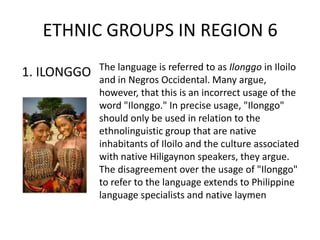
ETHNIC GROUPS IN REGION 6
1. ILONGGO

The language is referred to as Ilonggo in Iloilo
and in Negros Occidental. Many argue,
however, that this is an incorrect usage of the
word "Ilonggo." In precise usage, "Ilonggo"
should only be used in relation to the
ethnolinguistic group that are native
inhabitants of Iloilo and the culture associated
with native Hiligaynon speakers, they argue.
The disagreement over the usage of "Ilonggo"
to refer to the language extends to Philippine
language specialists and native laymen
• SOME ETHNICITY IS ALSO FOUND IN THE
WESTERN VISAYAS REGION AND THIS ARE....
2. CEBUANO

Cebuano, referred to by most of its speakers as
Binisaya (or Visayan in English), is an
austronesian laguage spoken in the philippines
by about 20 million people, mostly in the
central visayas, most of whom belong to the
bisaya ethnic group. It is the most widely
spoken of the languages within the so-named
Bisayan subgroup and is closely related to
other Filipino languages.
It has the largest native language-speaking
population of the Philippines despite not being
taught formally in schools and universities. It is
the lingua franca of the Central Visayas and
parts of Mindanao. The name Cebuano is
derived from the island of Cebu where the
prestige language is spoken.
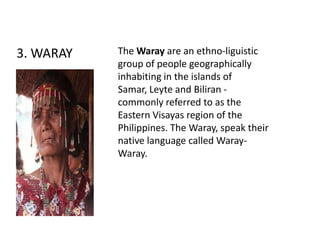
3. WARAY

The Waray are an ethno-liguistic
group of people geographically
inhabiting in the islands of
Samar, Leyte and Biliran commonly referred to as the
Eastern Visayas region of the
Philippines. The Waray, speak their
native language called WarayWaray.
FAMOUS PEOPLE FROM REGION 6

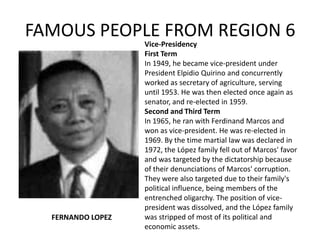
FERNANDO LOPEZ

Vice-Presidency
First Term
In 1949, he became vice-president under
President Elpidio Quirino and concurrently
worked as secretary of agriculture, serving
until 1953. He was then elected once again as
senator, and re-elected in 1959.
Second and Third Term
In 1965, he ran with Ferdinand Marcos and
won as vice-president. He was re-elected in
1969. By the time martial law was declared in
1972, the López family fell out of Marcos' favor
and was targeted by the dictatorship because
of their denunciations of Marcos' corruption.
They were also targeted due to their family's
political influence, being members of the
entrenched oligarchy. The position of vicepresident was dissolved, and the López family
was stripped of most of its political and
economic assets.
PRODUCTS FROM REGION 6
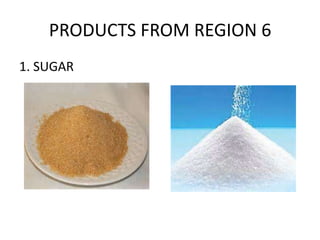
1. SUGAR
2. Abaca
3. Shell craft
4. Pina clothes

Powerpoint presentation region 6

  • 1.
  • 2.
    AREA AND LOCATION Typicallywestern Visayas is found on the west part of the major island of the Philippines which is Visayas it is surrounded by water that’s why one major livelihood found in this certain island is fishing.
  • 3.
    GEOGRAPHICAL PROFILE AKLAN - Theyoungest of the 4 provinces of panay island. It is bounded on the northwestern portion of the province has mountains and dense vegetation.
  • 4.
    ANTIQUE - Shaped likea seahorse, antique is the oversized serrated hemline of the western boarders of the 3 cornered scarf like land mass that is panay. CAPIZ - The basic plantations found in this part of the region are coconut, vegetables and sugarcane GUIMARAS - Lies southeast of panay island and northwest of negros island in western visayas.
  • 5.
    ILO ILO CITY -Mountain ranges with peaks as high as 7,000 feet provided natural boundaries that separates ilo ilo from antique on the west and the capiz on the north. NEGROS OCCIDENTAL - Bacolod, the capital city, lies in the northwestern part of negros occidental, in a sprawling 16,000 hectars.
  • 6.
    POLITICAL PROFILE Region 6has 5 provinces namely: • AKLAN- 558,146 in population • ANTIQUE- 605,110 in population • CAPIZ-800,920 in population • ILOILO-2,371,648 in population • NEGROS OCCIDENTAL- 3,203,523 in population
  • 7.
    PROVINCES IN REGION6 A. Antique B. Aklan C. Capiz D. ILO ILO E. GUIMARAS
  • 8.
  • 9.
  • 10.
  • 11.
  • 12.
    MACOPO FALLS IN GUIMARAS MacopoFalls in Guimaras makes a great spot for swimming and picnic. You can also take a hike on the hilly trail. At the end of snaky trail of the falls, you’ll find the pool of water surrounded by rocky terrain which is cool all year round that is a good place in swimming you can also enjoy the beautiful scenery view in the top of the hill.
  • 13.
    HOLIFENA ANCESTRAL HOUSE INNEGROS OCCIDENTAL Holifena ancestral house - There are paintings and sketches of Juan Luna, Jose Rizal and Fernando Amorsolo. Aside from art during the Spanish invasion, there are also paintings and sculptures by Silay artists. Truly, this is a place where you will appreciate Philippine art.
  • 15.
    Historical Places inRegion 6 • Kalibo, aklan FREEDOM SHRINE Site of a shrine dedicated to the brave Aklanons who were martyred by the Spaniards
  • 16.
    •Hamtic, Antique GUBAT Landing sitethe first Malayan Settlers in 1200 And it is marked by the Malandog Marker
  • 17.
    Roxas city, capiz Centralbusiness district of capiz foreseeing the santa monica church Birthplace of the President Manuel Roxas
  • 18.
    Fort san Pedro,Ilo Ilo Fuerza de San Pedro is a military defence structure, built by Spanish and indigenous Cebuano labourers under the command of Spanish conquistador, miguel lopez de legazpi and the spanish government in cebu . It is located in the area now called Plaza Indepedencia, in the Pier Area of cebu city, philippines
  • 19.
    ETHNIC GROUPS INREGION 6 1. ILONGGO The language is referred to as Ilonggo in Iloilo and in Negros Occidental. Many argue, however, that this is an incorrect usage of the word "Ilonggo." In precise usage, "Ilonggo" should only be used in relation to the ethnolinguistic group that are native inhabitants of Iloilo and the culture associated with native Hiligaynon speakers, they argue. The disagreement over the usage of "Ilonggo" to refer to the language extends to Philippine language specialists and native laymen
  • 20.
    • SOME ETHNICITYIS ALSO FOUND IN THE WESTERN VISAYAS REGION AND THIS ARE....
  • 21.
    2. CEBUANO Cebuano, referredto by most of its speakers as Binisaya (or Visayan in English), is an austronesian laguage spoken in the philippines by about 20 million people, mostly in the central visayas, most of whom belong to the bisaya ethnic group. It is the most widely spoken of the languages within the so-named Bisayan subgroup and is closely related to other Filipino languages. It has the largest native language-speaking population of the Philippines despite not being taught formally in schools and universities. It is the lingua franca of the Central Visayas and parts of Mindanao. The name Cebuano is derived from the island of Cebu where the prestige language is spoken.
  • 22.
    3. WARAY The Warayare an ethno-liguistic group of people geographically inhabiting in the islands of Samar, Leyte and Biliran commonly referred to as the Eastern Visayas region of the Philippines. The Waray, speak their native language called WarayWaray.
  • 23.
    FAMOUS PEOPLE FROMREGION 6 FERNANDO LOPEZ Vice-Presidency First Term In 1949, he became vice-president under President Elpidio Quirino and concurrently worked as secretary of agriculture, serving until 1953. He was then elected once again as senator, and re-elected in 1959. Second and Third Term In 1965, he ran with Ferdinand Marcos and won as vice-president. He was re-elected in 1969. By the time martial law was declared in 1972, the López family fell out of Marcos' favor and was targeted by the dictatorship because of their denunciations of Marcos' corruption. They were also targeted due to their family's political influence, being members of the entrenched oligarchy. The position of vicepresident was dissolved, and the López family was stripped of most of its political and economic assets.
  • 24.
  • 25.
  • 26.
  • 27.