Performance
Indicators
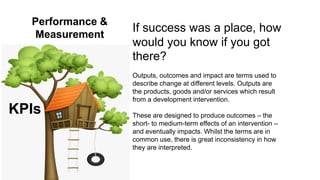
KPIs
If success was a place, how
would you know if you got
there?
Outputs, outcomes and impact are terms used to
describe change at different levels. Outputs are
the products, goods and/or services which result
from a development intervention.
These are designed to produce outcomes – the
short- to medium-term effects of an intervention –
and eventually impacts. Whilst the terms are in
common use, there is great inconsistency in how
they are interpreted.
Performance &
Measurement
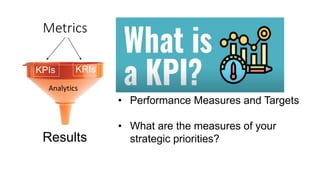
Metrics
KPIs KRIs
Analytics
Results
• Performance Measures and Targets
• What are the measures of your
strategic priorities?
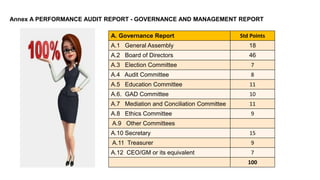
Annex A PERFORMANCE AUDIT REPORT - GOVERNANCE AND MANAGEMENT REPORT
A. Governance Report Std Points
A.1 General Assembly 18
A.2 Board of Directors 46
A.3 Election Committee 7
A.4 Audit Committee 8
A.5 Education Committee 11
A.6. GAD Committee 10
A.7 Mediation and Conciliation Committee 11
A.8 Ethics Committee 9
A.9 Other Committees
A.10 Secretary 15
A.11 Treasurer 9
A.12 CEO/GM or its equivalent 7
100
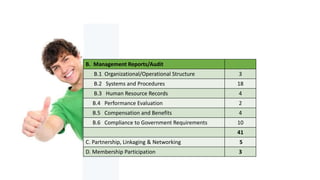
B. Management Reports/Audit
B.1 Organizational/Operational Structure 3
B.2 Systems and Procedures 18
B.3 Human Resource Records 4
B.4 Performance Evaluation 2
B.5 Compensation and Benefits 4
B.6 Compliance to Government Requirements 10
41
C. Partnership, Linkaging & Networking 5
D. Membership Participation 3
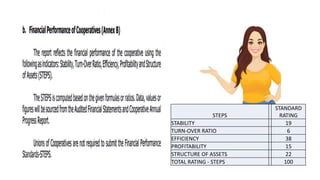
STEPS
STANDARD
RATING
STABILITY 19
TURN-OVER RATIO 6
EFFICIENCY 38
PROFITABILITY 15
STRUCTURE OF ASSETS 22
TOTAL RATING - STEPS 100
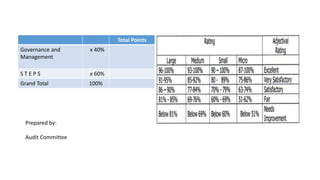
Prepared by:
Audit Committee
Total Points
Governance and
Management
x 40%
S T E P S x 60%
Grand Total 100%
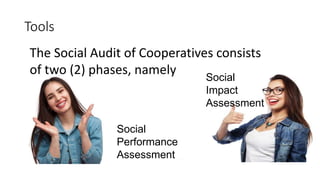
Social
Impact
Assessment
Social
Performance
Assessment
The Social Audit of Cooperatives consists
of two (2) phases, namely
Tools
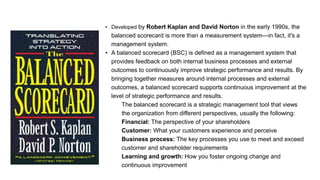
• Developed by Robert Kaplan and David Norton in the early 1990s, the
balanced scorecard is more than a measurement system—in fact, it's a
management system.
• A balanced scorecard (BSC) is defined as a management system that
provides feedback on both internal business processes and external
outcomes to continuously improve strategic performance and results. By
bringing together measures around internal processes and external
outcomes, a balanced scorecard supports continuous improvement at the
level of strategic performance and results.
The balanced scorecard is a strategic management tool that views
the organization from different perspectives, usually the following:
Financial: The perspective of your shareholders
Customer: What your customers experience and perceive
Business process: The key processes you use to meet and exceed
customer and shareholder requirements
Learning and growth: How you foster ongoing change and
continuous improvement
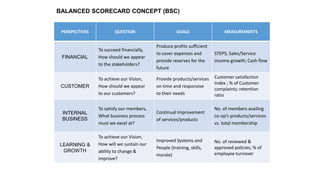
BALANCED SCORECARD CONCEPT (BSC)
PERSPECTIVES QUESTION GOALS MEASUREMENTS
FINANCIAL
To succeed financially,
How should we appear
to the stakeholders?
Produce profits sufficient
to cover expenses and
provide reserves for the
future
STEPS; Sales/Service
income growth; Cash flow
CUSTOMER
To achieve our Vision,
How should we appear
to our customers?
Provide products/services
on time and responsive
to their needs
Customer satisfaction
Index ; % of Customer
complaints; retention
ratio
INTERNAL
BUSINESS
To satisfy our members,
What business process
must we excel at?
Continual Improvement
of services/products
No. of members availing
co-op’s products/services
vs. total membership
LEARNING &
GROWTH
To achieve our Vision,
How will we sustain our
ability to change &
improve?
Improved Systems and
People (training, skills,
morale)
No. of reviewed &
approved policies; % of
employee turnover
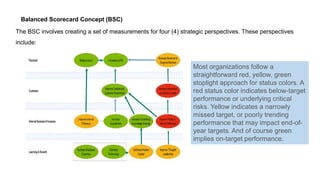
Balanced Scorecard Concept (BSC)
The BSC involves creating a set of measurements for four (4) strategic perspectives. These perspectives
include:
Most organizations follow a
straightforward red, yellow, green
stoplight approach for status colors. A
red status color indicates below-target
performance or underlying critical
risks. Yellow indicates a narrowly
missed target, or poorly trending
performance that may impact end-of-
year targets. And of course green
implies on-target performance.
6 Performance Indicators in Ope Mgmt.pptx

6 Performance Indicators in Ope Mgmt.pptx

  • 1.
  • 2.
    KPIs If success wasa place, how would you know if you got there? Outputs, outcomes and impact are terms used to describe change at different levels. Outputs are the products, goods and/or services which result from a development intervention. These are designed to produce outcomes – the short- to medium-term effects of an intervention – and eventually impacts. Whilst the terms are in common use, there is great inconsistency in how they are interpreted. Performance & Measurement
  • 3.
    Metrics KPIs KRIs Analytics Results • PerformanceMeasures and Targets • What are the measures of your strategic priorities?
  • 4.
    Annex A PERFORMANCEAUDIT REPORT - GOVERNANCE AND MANAGEMENT REPORT A. Governance Report Std Points A.1 General Assembly 18 A.2 Board of Directors 46 A.3 Election Committee 7 A.4 Audit Committee 8 A.5 Education Committee 11 A.6. GAD Committee 10 A.7 Mediation and Conciliation Committee 11 A.8 Ethics Committee 9 A.9 Other Committees A.10 Secretary 15 A.11 Treasurer 9 A.12 CEO/GM or its equivalent 7 100
  • 5.
    B. Management Reports/Audit B.1Organizational/Operational Structure 3 B.2 Systems and Procedures 18 B.3 Human Resource Records 4 B.4 Performance Evaluation 2 B.5 Compensation and Benefits 4 B.6 Compliance to Government Requirements 10 41 C. Partnership, Linkaging & Networking 5 D. Membership Participation 3
  • 6.
    STEPS STANDARD RATING STABILITY 19 TURN-OVER RATIO6 EFFICIENCY 38 PROFITABILITY 15 STRUCTURE OF ASSETS 22 TOTAL RATING - STEPS 100
  • 7.
    Prepared by: Audit Committee TotalPoints Governance and Management x 40% S T E P S x 60% Grand Total 100%
  • 8.
    Social Impact Assessment Social Performance Assessment The Social Auditof Cooperatives consists of two (2) phases, namely Tools
  • 10.
    • Developed byRobert Kaplan and David Norton in the early 1990s, the balanced scorecard is more than a measurement system—in fact, it's a management system. • A balanced scorecard (BSC) is defined as a management system that provides feedback on both internal business processes and external outcomes to continuously improve strategic performance and results. By bringing together measures around internal processes and external outcomes, a balanced scorecard supports continuous improvement at the level of strategic performance and results. The balanced scorecard is a strategic management tool that views the organization from different perspectives, usually the following: Financial: The perspective of your shareholders Customer: What your customers experience and perceive Business process: The key processes you use to meet and exceed customer and shareholder requirements Learning and growth: How you foster ongoing change and continuous improvement
  • 11.
    BALANCED SCORECARD CONCEPT(BSC) PERSPECTIVES QUESTION GOALS MEASUREMENTS FINANCIAL To succeed financially, How should we appear to the stakeholders? Produce profits sufficient to cover expenses and provide reserves for the future STEPS; Sales/Service income growth; Cash flow CUSTOMER To achieve our Vision, How should we appear to our customers? Provide products/services on time and responsive to their needs Customer satisfaction Index ; % of Customer complaints; retention ratio INTERNAL BUSINESS To satisfy our members, What business process must we excel at? Continual Improvement of services/products No. of members availing co-op’s products/services vs. total membership LEARNING & GROWTH To achieve our Vision, How will we sustain our ability to change & improve? Improved Systems and People (training, skills, morale) No. of reviewed & approved policies; % of employee turnover
  • 13.
    Balanced Scorecard Concept(BSC) The BSC involves creating a set of measurements for four (4) strategic perspectives. These perspectives include: Most organizations follow a straightforward red, yellow, green stoplight approach for status colors. A red status color indicates below-target performance or underlying critical risks. Yellow indicates a narrowly missed target, or poorly trending performance that may impact end-of- year targets. And of course green implies on-target performance.