CARBON FOOTPRINT
&
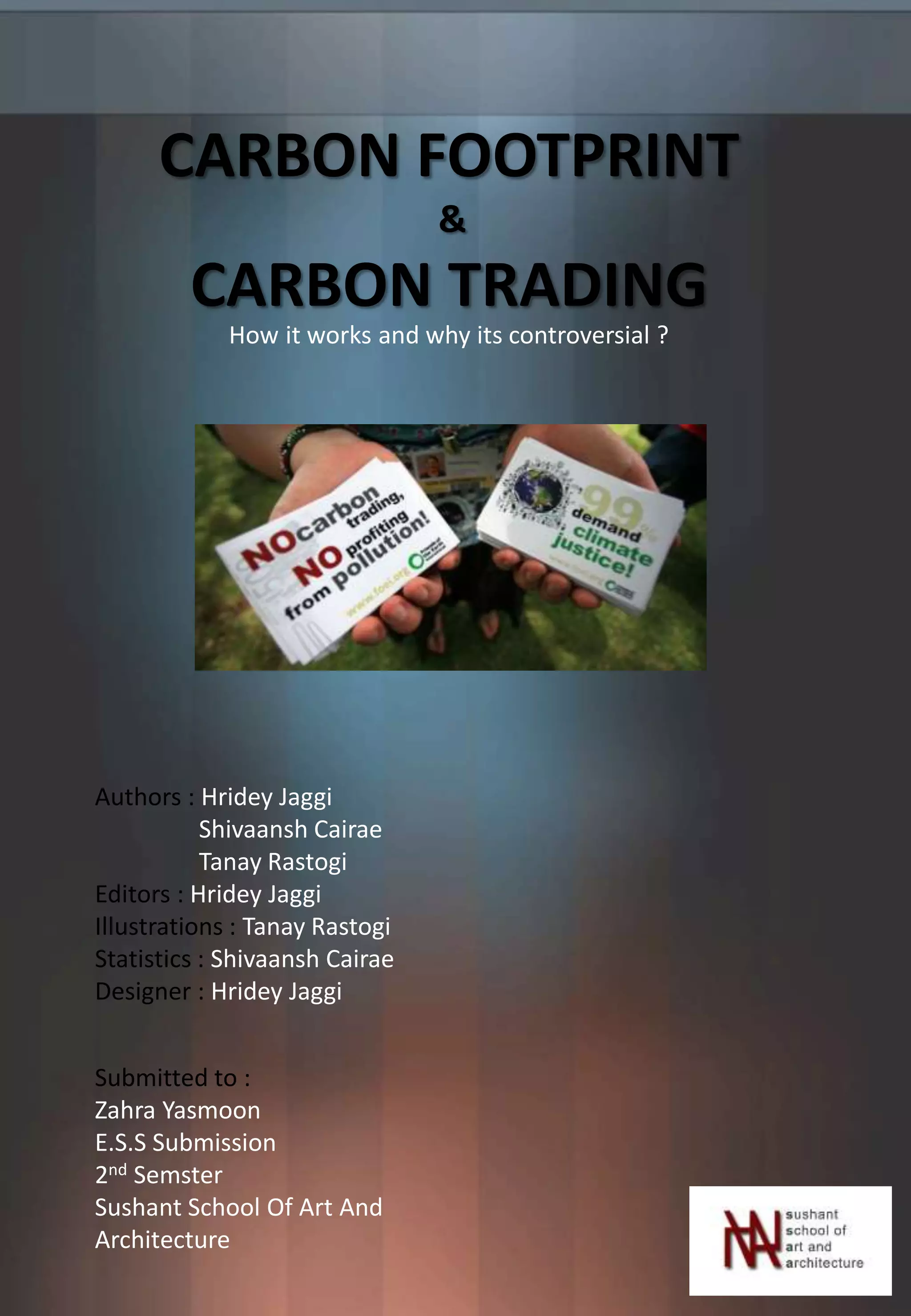
CARBON TRADING
How it works and why its controversial ?
Authors : Hridey Jaggi
Shivaansh Cairae
Tanay Rastogi
Editors : Hridey Jaggi
Illustrations : Tanay Rastogi
Statistics : Shivaansh Cairae
Designer : Hridey Jaggi
Submitted to :
Zahra Yasmoon
E.S.S Submission
2nd Semster
Sushant School Of Art And
Architecture
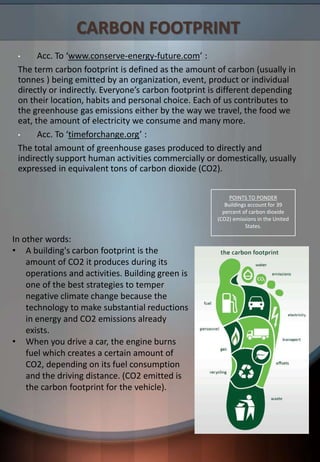
CARBON FOOTPRINT
• Acc. To ‘www.conserve-energy-future.com’ :
The term carbon footprint is defined as the amount of carbon (usually in
tonnes ) being emitted by an organization, event, product or individual
directly or indirectly. Everyone’s carbon footprint is different depending
on their location, habits and personal choice. Each of us contributes to
the greenhouse gas emissions either by the way we travel, the food we
eat, the amount of electricity we consume and many more.
• Acc. To ‘timeforchange.org’ :
The total amount of greenhouse gases produced to directly and
indirectly support human activities commercially or domestically, usually
expressed in equivalent tons of carbon dioxide (CO2).
In other words:
• A building's carbon footprint is the
amount of CO2 it produces during its
operations and activities. Building green is
one of the best strategies to temper
negative climate change because the
technology to make substantial reductions
in energy and CO2 emissions already
exists.
• When you drive a car, the engine burns
fuel which creates a certain amount of
CO2, depending on its fuel consumption
and the driving distance. (CO2 emitted is
the carbon footprint for the vehicle).
POINTS TO PONDER
Buildings account for 39
percent of carbon dioxide
(CO2) emissions in the United
States.
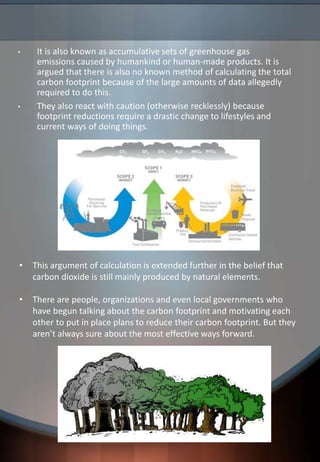
• It is also known as accumulative sets of greenhouse gas
emissions caused by humankind or human-made products. It is
argued that there is also no known method of calculating the total
carbon footprint because of the large amounts of data allegedly
required to do this.
• They also react with caution (otherwise recklessly) because
footprint reductions require a drastic change to lifestyles and
current ways of doing things.
• This argument of calculation is extended further in the belief that
carbon dioxide is still mainly produced by natural elements.
• There are people, organizations and even local governments who
have begun talking about the carbon footprint and motivating each
other to put in place plans to reduce their carbon footprint. But they
aren’t always sure about the most effective ways forward.
MOST HARMFUL CONTRIBUTORS
• Hundreds of companies from around the world are making
concerted efforts to reduce their own carbon footprints. But the
biggest culprits numbering no more than one hundred of the world’s
largest companies have been the most reluctant to change. Also,
they continue to resist legislative attempts to do so through legal
means. But they have been responsible for two thirds of CO2
emissions so far.
• In the last twenty five to thirty years at least half of estimated
emissions have come from these oil and coal burning companies
alone. In some places, mandated by governments to do so, they are
also holding large reserves of fossil fuels. If these are burned, the
earth is placed at even greater risk.
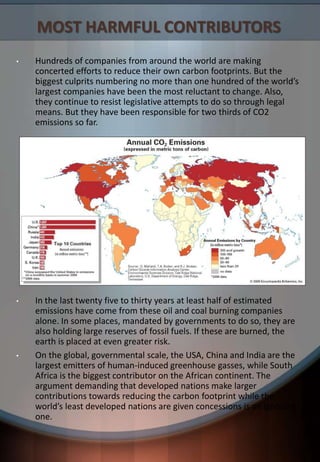
• On the global, governmental scale, the USA, China and India are the
largest emitters of human-induced greenhouse gasses, while South
Africa is the biggest contributor on the African continent. The
argument demanding that developed nations make larger
contributions towards reducing the carbon footprint while the
world’s least developed nations are given concessions is an ignorant
one.
HOW GREEN ARE OUR CITIES?
• The key number in measuring that now is the per capita emission or
how big a carbon footprint an individual leaves.
• The developed world pegs lndia's per capita emission at 1.7 tonnes. But
a study by a non-profit organization of 40 Indian cities says it is much
lower at less than 1 tonne.
• The worst big city in India is Kolkata, at 1.83 tonnes, but it is nothing
compared to Washington DC, which has per capita emission of 19.7
tonnes, or China's Shanghai and Canada's Toronto, both over 8 tonnes
• Both Chennai and Bangalore have per capita emission lower than 1
tonne.
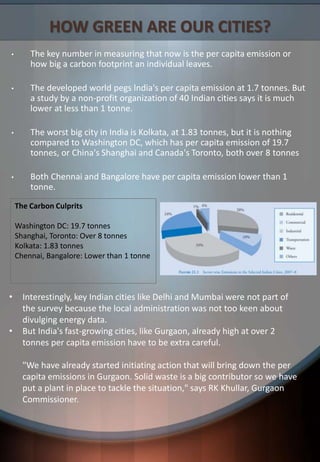
The Carbon Culprits
Washington DC: 19.7 tonnes
Shanghai, Toronto: Over 8 tonnes
Kolkata: 1.83 tonnes
Chennai, Bangalore: Lower than 1 tonne
• Interestingly, key Indian cities like Delhi and Mumbai were not part of
the survey because the local administration was not too keen about
divulging energy data.
• But India's fast-growing cities, like Gurgaon, already high at over 2
tonnes per capita emission have to be extra careful.
"We have already started initiating action that will bring down the per
capita emissions in Gurgaon. Solid waste is a big contributor so we have
put a plant in place to tackle the situation," says RK Khullar, Gurgaon
Commissioner.
Ways to Reduce Your Carbon Footprint
The situation of annual (large) increases in greenhouse gas emissions is
serious. It warrants immediate action, no delays and without compromise.
Huge gatherings (in their thousands) at conferences designed to have a
conversation about the carbon footprint are encouraging. Here are some
of the most effective ways to make an immediate impact on reducing your
carbon footprint, whether individually, domestically or commercially.
• Driving – Hybrids may still be out of reach of most drivers, mainly due
to its price, but it is a necessary alternative to conventional vehicles
run on petrol or diesel. Also, when driving, motorists should avoid
heavily congested road networks. How well they drive also makes an
impact on reducing their carbon footprint.
• Instead of driving – The popular and healthy advice is to walk instead
of driving. Those who have too far to travel can also use rapid bus
transport networks and urban rail networks.
• Energy efficiency at home – All appliances that are not being used
must be switched off immediately. And all electrical outlets not in use
must also be switched off. Hot-water geysers should be switched off
for the entire day and only turned on when needed. These are
simple, yet practical lifestyle habits which are easy to adopt.
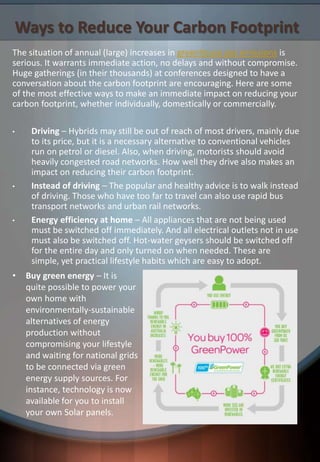
• Buy green energy – It is
quite possible to power your
own home with
environmentally-sustainable
alternatives of energy
production without
compromising your lifestyle
and waiting for national grids
to be connected via green
energy supply sources. For
instance, technology is now
available for you to install
your own Solar panels.
• Recycle and re-use – Vegetable produce can be converted into
compost (or manure) for gardens, even vegetable gardens. Instead
of buying more food containers, plastic containers sourced from the
supermarket can be refashioned as ideal kitchen utensils. Also,
where plastic waste is no longer required, seek out recycling depots
rather than relying on your supplied garbage disposal units.
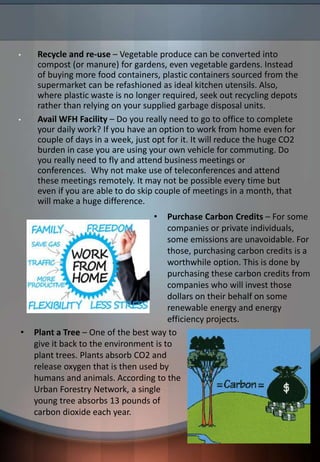
• Avail WFH Facility – Do you really need to go to office to complete
your daily work? If you have an option to work from home even for
couple of days in a week, just opt for it. It will reduce the huge CO2
burden in case you are using your own vehicle for commuting. Do
you really need to fly and attend business meetings or
conferences. Why not make use of teleconferences and attend
these meetings remotely. It may not be possible every time but
even if you are able to do skip couple of meetings in a month, that
will make a huge difference.
• Plant a Tree – One of the best way to
give it back to the environment is to
plant trees. Plants absorb CO2 and
release oxygen that is then used by
humans and animals. According to the
Urban Forestry Network, a single
young tree absorbs 13 pounds of
carbon dioxide each year.
• Purchase Carbon Credits – For some
companies or private individuals,
some emissions are unavoidable. For
those, purchasing carbon credits is a
worthwhile option. This is done by
purchasing these carbon credits from
companies who will invest those
dollars on their behalf on some
renewable energy and energy
efficiency projects.
CARBON TRADING
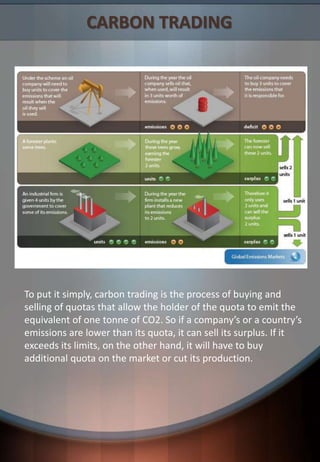
To put it simply, carbon trading is the process of buying and
selling of quotas that allow the holder of the quota to emit the
equivalent of one tonne of CO2. So if a company’s or a country’s
emissions are lower than its quota, it can sell its surplus. If it
exceeds its limits, on the other hand, it will have to buy
additional quota on the market or cut its production.
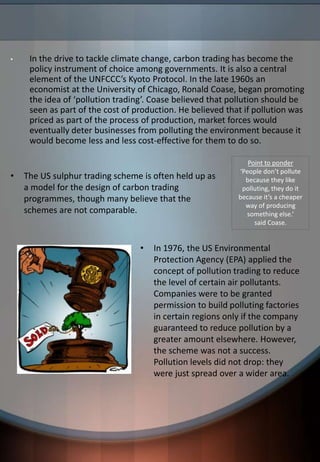
• In the drive to tackle climate change, carbon trading has become the
policy instrument of choice among governments. It is also a central
element of the UNFCCC’s Kyoto Protocol. In the late 1960s an
economist at the University of Chicago, Ronald Coase, began promoting
the idea of ‘pollution trading’. Coase believed that pollution should be
seen as part of the cost of production. He believed that if pollution was
priced as part of the process of production, market forces would
eventually deter businesses from polluting the environment because it
would become less and less cost-effective for them to do so.
Point to ponder
‘People don’t pollute
because they like
polluting, they do it
because it’s a cheaper
way of producing
something else.’
said Coase.
• The US sulphur trading scheme is often held up as
a model for the design of carbon trading
programmes, though many believe that the
schemes are not comparable.
• In 1976, the US Environmental
Protection Agency (EPA) applied the
concept of pollution trading to reduce
the level of certain air pollutants.
Companies were to be granted
permission to build polluting factories
in certain regions only if the company
guaranteed to reduce pollution by a
greater amount elsewhere. However,
the scheme was not a success.
Pollution levels did not drop: they
were just spread over a wider area.
CAP - OFFSET - TRADE
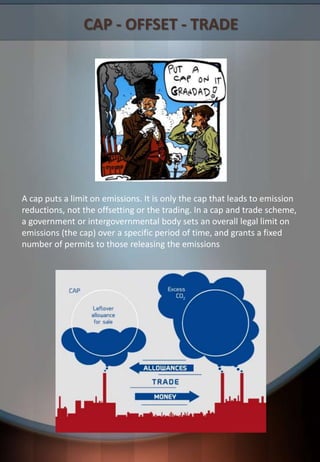
A cap puts a limit on emissions. It is only the cap that leads to emission
reductions, not the offsetting or the trading. In a cap and trade scheme,
a government or intergovernmental body sets an overall legal limit on
emissions (the cap) over a specific period of time, and grants a fixed
number of permits to those releasing the emissions
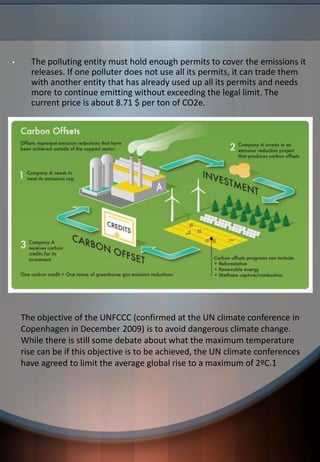
• The polluting entity must hold enough permits to cover the emissions it
releases. If one polluter does not use all its permits, it can trade them
with another entity that has already used up all its permits and needs
more to continue emitting without exceeding the legal limit. The
current price is about 8.71 $ per ton of CO2e.
The objective of the UNFCCC (confirmed at the UN climate conference in
Copenhagen in December 2009) is to avoid dangerous climate change.
While there is still some debate about what the maximum temperature
rise can be if this objective is to be achieved, the UN climate conferences
have agreed to limit the average global rise to a maximum of 2ºC.1
ARCHITECTURAL APPROACH
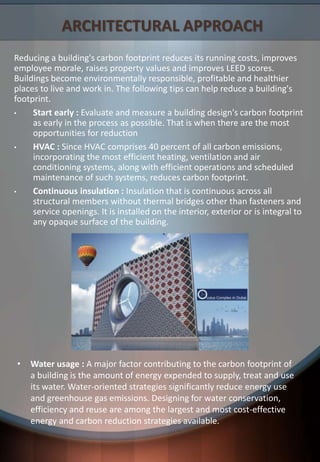
Reducing a building's carbon footprint reduces its running costs, improves
employee morale, raises property values and improves LEED scores.
Buildings become environmentally responsible, profitable and healthier
places to live and work in. The following tips can help reduce a building's
footprint.
• Start early : Evaluate and measure a building design's carbon footprint
as early in the process as possible. That is when there are the most
opportunities for reduction
• HVAC : Since HVAC comprises 40 percent of all carbon emissions,
incorporating the most efficient heating, ventilation and air
conditioning systems, along with efficient operations and scheduled
maintenance of such systems, reduces carbon footprint.
• Continuous insulation : Insulation that is continuous across all
structural members without thermal bridges other than fasteners and
service openings. It is installed on the interior, exterior or is integral to
any opaque surface of the building.
• Water usage : A major factor contributing to the carbon footprint of
a building is the amount of energy expended to supply, treat and use
its water. Water-oriented strategies significantly reduce energy use
and greenhouse gas emissions. Designing for water conservation,
efficiency and reuse are among the largest and most cost-effective
energy and carbon reduction strategies available.
• Lighting : Use state-of-the-art lighting and optimize daylighting. It
accounts for approximately 40 percent of the energy used in a typical
commercial building. Solar thermal gain lowers carbon footprints, but
too much solar gain in summer causes overheating and increases the
need for cooling. Too little solar gain in winter increases the need for
heating. Solar control window films can reduce carbon footprints by
cutting energy expenditures by up to 30 percent.
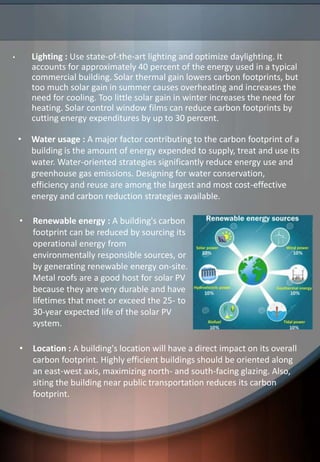
• Renewable energy : A building's carbon
footprint can be reduced by sourcing its
operational energy from
environmentally responsible sources, or
by generating renewable energy on-site.
Metal roofs are a good host for solar PV
because they are very durable and have
lifetimes that meet or exceed the 25- to
30-year expected life of the solar PV
system.
• Location : A building's location will have a direct impact on its overall
carbon footprint. Highly efficient buildings should be oriented along
an east-west axis, maximizing north- and south-facing glazing. Also,
siting the building near public transportation reduces its carbon
footprint.
• Water usage : A major factor contributing to the carbon footprint of a
building is the amount of energy expended to supply, treat and use its
water. Water-oriented strategies significantly reduce energy use and
greenhouse gas emissions. Designing for water conservation,
efficiency and reuse are among the largest and most cost-effective
energy and carbon reduction strategies available.
SCHEMES TO CONTROL FOOTPRINT
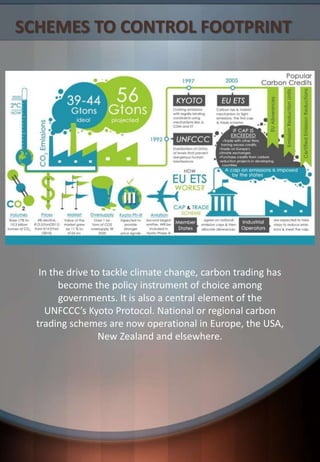
In the drive to tackle climate change, carbon trading has
become the policy instrument of choice among
governments. It is also a central element of the
UNFCCC’s Kyoto Protocol. National or regional carbon
trading schemes are now operational in Europe, the USA,
New Zealand and elsewhere.
REFERENCES
• http://www.youtube.com/user/CarbonFees#play/all
• The US is a signatory to the Convention on Long-Range Transboundary Air Pollution
but never signed its protocol on Further Reduction of Sulphur Emissions (see
http://www.unece.org/env/lrtap/fsulf_h1.htm). The protocol was signed in 1994, a
year before utilities in the US were subjected to a cap on SO2 emissions. Annex II
of the protocol shows the reduction commitments of the individual OECD
countries.
• Reflections on the Kyoto Protocol – looking back to see ahead. International
Review of Environmental Strategies 5: 61-70
• Reitze AW (2001) Air Pollution Control Law: Compliance and Enforcement.
Environmental Law Institute 9 Ibid.
• Carbon Trade Watch: www.carbontradewatch.org
• Environmental Data Service ENDS: http://www.ends.co.uk/
• Ecosystem Market Place Forest Portal for info on forest carbon market: http://
www.forestcarbonportal.com/
• FERN: www.fern.org
• Point Carbon: http://www.pointcarbon.com/
• REDD Monitor: www.redd-monitor.org
• SinksWatch: www.sinkswatch.org
• The Corner House: www.thecornerhouse.org.uk
• UN Risoe: http://uneprisoe.org/
• UNFCCC CDM database: http://cdm.unfccc.int/index.html
• World Bank State of the Carbon Market annual report: http://siteresources.
worldbank.org/INTCARBONFINANCE/Resources/State_and_Trends_of_the_
Carbon_Market_2010_low_res.pdf
• https://www.idfc.com/pdf/report/Chapter-21.pdf
• https://www.ndtv.com/environment/how-green-are-our-cities-404315
THANK YOU

Carbon footprint final

  • 1.
    CARBON FOOTPRINT & CARBON TRADING Howit works and why its controversial ? Authors : Hridey Jaggi Shivaansh Cairae Tanay Rastogi Editors : Hridey Jaggi Illustrations : Tanay Rastogi Statistics : Shivaansh Cairae Designer : Hridey Jaggi Submitted to : Zahra Yasmoon E.S.S Submission 2nd Semster Sushant School Of Art And Architecture
  • 2.
    CARBON FOOTPRINT • Acc.To ‘www.conserve-energy-future.com’ : The term carbon footprint is defined as the amount of carbon (usually in tonnes ) being emitted by an organization, event, product or individual directly or indirectly. Everyone’s carbon footprint is different depending on their location, habits and personal choice. Each of us contributes to the greenhouse gas emissions either by the way we travel, the food we eat, the amount of electricity we consume and many more. • Acc. To ‘timeforchange.org’ : The total amount of greenhouse gases produced to directly and indirectly support human activities commercially or domestically, usually expressed in equivalent tons of carbon dioxide (CO2). In other words: • A building's carbon footprint is the amount of CO2 it produces during its operations and activities. Building green is one of the best strategies to temper negative climate change because the technology to make substantial reductions in energy and CO2 emissions already exists. • When you drive a car, the engine burns fuel which creates a certain amount of CO2, depending on its fuel consumption and the driving distance. (CO2 emitted is the carbon footprint for the vehicle). POINTS TO PONDER Buildings account for 39 percent of carbon dioxide (CO2) emissions in the United States.
  • 3.
    • It isalso known as accumulative sets of greenhouse gas emissions caused by humankind or human-made products. It is argued that there is also no known method of calculating the total carbon footprint because of the large amounts of data allegedly required to do this. • They also react with caution (otherwise recklessly) because footprint reductions require a drastic change to lifestyles and current ways of doing things. • This argument of calculation is extended further in the belief that carbon dioxide is still mainly produced by natural elements. • There are people, organizations and even local governments who have begun talking about the carbon footprint and motivating each other to put in place plans to reduce their carbon footprint. But they aren’t always sure about the most effective ways forward.
  • 4.
    MOST HARMFUL CONTRIBUTORS •Hundreds of companies from around the world are making concerted efforts to reduce their own carbon footprints. But the biggest culprits numbering no more than one hundred of the world’s largest companies have been the most reluctant to change. Also, they continue to resist legislative attempts to do so through legal means. But they have been responsible for two thirds of CO2 emissions so far. • In the last twenty five to thirty years at least half of estimated emissions have come from these oil and coal burning companies alone. In some places, mandated by governments to do so, they are also holding large reserves of fossil fuels. If these are burned, the earth is placed at even greater risk. • On the global, governmental scale, the USA, China and India are the largest emitters of human-induced greenhouse gasses, while South Africa is the biggest contributor on the African continent. The argument demanding that developed nations make larger contributions towards reducing the carbon footprint while the world’s least developed nations are given concessions is an ignorant one.
  • 5.
    HOW GREEN AREOUR CITIES? • The key number in measuring that now is the per capita emission or how big a carbon footprint an individual leaves. • The developed world pegs lndia's per capita emission at 1.7 tonnes. But a study by a non-profit organization of 40 Indian cities says it is much lower at less than 1 tonne. • The worst big city in India is Kolkata, at 1.83 tonnes, but it is nothing compared to Washington DC, which has per capita emission of 19.7 tonnes, or China's Shanghai and Canada's Toronto, both over 8 tonnes • Both Chennai and Bangalore have per capita emission lower than 1 tonne. The Carbon Culprits Washington DC: 19.7 tonnes Shanghai, Toronto: Over 8 tonnes Kolkata: 1.83 tonnes Chennai, Bangalore: Lower than 1 tonne • Interestingly, key Indian cities like Delhi and Mumbai were not part of the survey because the local administration was not too keen about divulging energy data. • But India's fast-growing cities, like Gurgaon, already high at over 2 tonnes per capita emission have to be extra careful. "We have already started initiating action that will bring down the per capita emissions in Gurgaon. Solid waste is a big contributor so we have put a plant in place to tackle the situation," says RK Khullar, Gurgaon Commissioner.
  • 6.
    Ways to ReduceYour Carbon Footprint The situation of annual (large) increases in greenhouse gas emissions is serious. It warrants immediate action, no delays and without compromise. Huge gatherings (in their thousands) at conferences designed to have a conversation about the carbon footprint are encouraging. Here are some of the most effective ways to make an immediate impact on reducing your carbon footprint, whether individually, domestically or commercially. • Driving – Hybrids may still be out of reach of most drivers, mainly due to its price, but it is a necessary alternative to conventional vehicles run on petrol or diesel. Also, when driving, motorists should avoid heavily congested road networks. How well they drive also makes an impact on reducing their carbon footprint. • Instead of driving – The popular and healthy advice is to walk instead of driving. Those who have too far to travel can also use rapid bus transport networks and urban rail networks. • Energy efficiency at home – All appliances that are not being used must be switched off immediately. And all electrical outlets not in use must also be switched off. Hot-water geysers should be switched off for the entire day and only turned on when needed. These are simple, yet practical lifestyle habits which are easy to adopt. • Buy green energy – It is quite possible to power your own home with environmentally-sustainable alternatives of energy production without compromising your lifestyle and waiting for national grids to be connected via green energy supply sources. For instance, technology is now available for you to install your own Solar panels.
  • 7.
    • Recycle andre-use – Vegetable produce can be converted into compost (or manure) for gardens, even vegetable gardens. Instead of buying more food containers, plastic containers sourced from the supermarket can be refashioned as ideal kitchen utensils. Also, where plastic waste is no longer required, seek out recycling depots rather than relying on your supplied garbage disposal units. • Avail WFH Facility – Do you really need to go to office to complete your daily work? If you have an option to work from home even for couple of days in a week, just opt for it. It will reduce the huge CO2 burden in case you are using your own vehicle for commuting. Do you really need to fly and attend business meetings or conferences. Why not make use of teleconferences and attend these meetings remotely. It may not be possible every time but even if you are able to do skip couple of meetings in a month, that will make a huge difference. • Plant a Tree – One of the best way to give it back to the environment is to plant trees. Plants absorb CO2 and release oxygen that is then used by humans and animals. According to the Urban Forestry Network, a single young tree absorbs 13 pounds of carbon dioxide each year. • Purchase Carbon Credits – For some companies or private individuals, some emissions are unavoidable. For those, purchasing carbon credits is a worthwhile option. This is done by purchasing these carbon credits from companies who will invest those dollars on their behalf on some renewable energy and energy efficiency projects.
  • 8.
    CARBON TRADING To putit simply, carbon trading is the process of buying and selling of quotas that allow the holder of the quota to emit the equivalent of one tonne of CO2. So if a company’s or a country’s emissions are lower than its quota, it can sell its surplus. If it exceeds its limits, on the other hand, it will have to buy additional quota on the market or cut its production.
  • 9.
    • In thedrive to tackle climate change, carbon trading has become the policy instrument of choice among governments. It is also a central element of the UNFCCC’s Kyoto Protocol. In the late 1960s an economist at the University of Chicago, Ronald Coase, began promoting the idea of ‘pollution trading’. Coase believed that pollution should be seen as part of the cost of production. He believed that if pollution was priced as part of the process of production, market forces would eventually deter businesses from polluting the environment because it would become less and less cost-effective for them to do so. Point to ponder ‘People don’t pollute because they like polluting, they do it because it’s a cheaper way of producing something else.’ said Coase. • The US sulphur trading scheme is often held up as a model for the design of carbon trading programmes, though many believe that the schemes are not comparable. • In 1976, the US Environmental Protection Agency (EPA) applied the concept of pollution trading to reduce the level of certain air pollutants. Companies were to be granted permission to build polluting factories in certain regions only if the company guaranteed to reduce pollution by a greater amount elsewhere. However, the scheme was not a success. Pollution levels did not drop: they were just spread over a wider area.
  • 10.
    CAP - OFFSET- TRADE A cap puts a limit on emissions. It is only the cap that leads to emission reductions, not the offsetting or the trading. In a cap and trade scheme, a government or intergovernmental body sets an overall legal limit on emissions (the cap) over a specific period of time, and grants a fixed number of permits to those releasing the emissions
  • 11.
    • The pollutingentity must hold enough permits to cover the emissions it releases. If one polluter does not use all its permits, it can trade them with another entity that has already used up all its permits and needs more to continue emitting without exceeding the legal limit. The current price is about 8.71 $ per ton of CO2e. The objective of the UNFCCC (confirmed at the UN climate conference in Copenhagen in December 2009) is to avoid dangerous climate change. While there is still some debate about what the maximum temperature rise can be if this objective is to be achieved, the UN climate conferences have agreed to limit the average global rise to a maximum of 2ºC.1
  • 12.
    ARCHITECTURAL APPROACH Reducing abuilding's carbon footprint reduces its running costs, improves employee morale, raises property values and improves LEED scores. Buildings become environmentally responsible, profitable and healthier places to live and work in. The following tips can help reduce a building's footprint. • Start early : Evaluate and measure a building design's carbon footprint as early in the process as possible. That is when there are the most opportunities for reduction • HVAC : Since HVAC comprises 40 percent of all carbon emissions, incorporating the most efficient heating, ventilation and air conditioning systems, along with efficient operations and scheduled maintenance of such systems, reduces carbon footprint. • Continuous insulation : Insulation that is continuous across all structural members without thermal bridges other than fasteners and service openings. It is installed on the interior, exterior or is integral to any opaque surface of the building. • Water usage : A major factor contributing to the carbon footprint of a building is the amount of energy expended to supply, treat and use its water. Water-oriented strategies significantly reduce energy use and greenhouse gas emissions. Designing for water conservation, efficiency and reuse are among the largest and most cost-effective energy and carbon reduction strategies available.
  • 13.
    • Lighting :Use state-of-the-art lighting and optimize daylighting. It accounts for approximately 40 percent of the energy used in a typical commercial building. Solar thermal gain lowers carbon footprints, but too much solar gain in summer causes overheating and increases the need for cooling. Too little solar gain in winter increases the need for heating. Solar control window films can reduce carbon footprints by cutting energy expenditures by up to 30 percent. • Renewable energy : A building's carbon footprint can be reduced by sourcing its operational energy from environmentally responsible sources, or by generating renewable energy on-site. Metal roofs are a good host for solar PV because they are very durable and have lifetimes that meet or exceed the 25- to 30-year expected life of the solar PV system. • Location : A building's location will have a direct impact on its overall carbon footprint. Highly efficient buildings should be oriented along an east-west axis, maximizing north- and south-facing glazing. Also, siting the building near public transportation reduces its carbon footprint. • Water usage : A major factor contributing to the carbon footprint of a building is the amount of energy expended to supply, treat and use its water. Water-oriented strategies significantly reduce energy use and greenhouse gas emissions. Designing for water conservation, efficiency and reuse are among the largest and most cost-effective energy and carbon reduction strategies available.
  • 14.
    SCHEMES TO CONTROLFOOTPRINT In the drive to tackle climate change, carbon trading has become the policy instrument of choice among governments. It is also a central element of the UNFCCC’s Kyoto Protocol. National or regional carbon trading schemes are now operational in Europe, the USA, New Zealand and elsewhere.
  • 15.
    REFERENCES • http://www.youtube.com/user/CarbonFees#play/all • TheUS is a signatory to the Convention on Long-Range Transboundary Air Pollution but never signed its protocol on Further Reduction of Sulphur Emissions (see http://www.unece.org/env/lrtap/fsulf_h1.htm). The protocol was signed in 1994, a year before utilities in the US were subjected to a cap on SO2 emissions. Annex II of the protocol shows the reduction commitments of the individual OECD countries. • Reflections on the Kyoto Protocol – looking back to see ahead. International Review of Environmental Strategies 5: 61-70 • Reitze AW (2001) Air Pollution Control Law: Compliance and Enforcement. Environmental Law Institute 9 Ibid. • Carbon Trade Watch: www.carbontradewatch.org • Environmental Data Service ENDS: http://www.ends.co.uk/ • Ecosystem Market Place Forest Portal for info on forest carbon market: http:// www.forestcarbonportal.com/ • FERN: www.fern.org • Point Carbon: http://www.pointcarbon.com/ • REDD Monitor: www.redd-monitor.org • SinksWatch: www.sinkswatch.org • The Corner House: www.thecornerhouse.org.uk • UN Risoe: http://uneprisoe.org/ • UNFCCC CDM database: http://cdm.unfccc.int/index.html • World Bank State of the Carbon Market annual report: http://siteresources. worldbank.org/INTCARBONFINANCE/Resources/State_and_Trends_of_the_ Carbon_Market_2010_low_res.pdf • https://www.idfc.com/pdf/report/Chapter-21.pdf • https://www.ndtv.com/environment/how-green-are-our-cities-404315 THANK YOU