SUSTAINABILITY
AND SUSTAINABLE
DEVELOPMENT
by yamini
Sustainability:
Sustainability can be defined as a
socio -ecological process
characterized by the pursuit of
a common ideal.
Sustainable
development :
Sustainable development is defined as the
“development that meets the needs of the
present without compromising the ability
of future generations to meet their own
needs.”
“
Sustainability seem to have
a stronger focus on the
present moment and on
keeping things above a
certain level whereas
sustainable development
focuses more on a long
term vision.
4
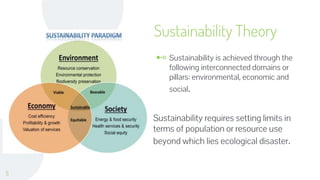
Sustainability Theory
⊷ Sustainability is achieved through the
following interconnected domains or
pillars: environmental, economic and
social.
Sustainability requires setting limits in
terms of population or resource use
beyond which lies ecological disaster.
5
The underlying
ecological imperative
The ecological imperative is a complex set of
restrictions on human activity; non-fulfilment of
which can soon turn out to disastrous
consequences for mankind.
The ecological imperative is essentially
combined with the idea of integrative ideology
(in a sense of vision) and the ethical result of
understanding of the ecological crisis.
6
⊷ A human should be in the
spotlight, because s/he has the
right for a healthy and fruitful life
in harmony with nature;
⊷ The right for development
should be directed in order to
preserve the environment for
present and future generations;
⊷ The environment should
become an integral feature of
the social and economic process
and shouldn’t be considered in
isolation from it.
Ecological imperative is described in a few points, which are at the
same time, an essential requirement of its realization. They are:
⊷ It is necessary to put into
practice the ecologisation of
industry, in order to
eliminate the negative
anthropogenic impacts on
the environment;
⊷ Social and economic
development must improve
the quality of people’s life in
acceptable limits of the
economy’s and ecosystem’s
capacity
7
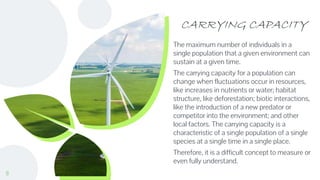
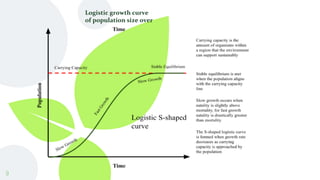
CARRYING CAPACITY
The maximum number of individuals in a
single population that a given environment can
sustain at a given time.
The carrying capacity for a population can
change when fluctuations occur in resources,
like increases in nutrients or water; habitat
structure, like deforestation; biotic interactions,
like the introduction of a new predator or
competitor into the environment; and other
local factors. The carrying capacity is a
characteristic of a single population of a single
species at a single time in a single place.
Therefore, it is a difficult concept to measure or
even fully understand.
8
Logistic growth curve
of population size over
9
Sustainability and Society:
A sustainable society is one that has learned to live within the
boundaries established by ecological limits.
Social justice:
Social justice is based
on equal rights of any
person and the
possibility of all human
beings, without any
discrimination, to
benefit from economic
and social progress,
irrespective of the
political or social-
economic doctrine.
Development:
We have SDGs for
social and
sustainable
development which
are integrated to
balance the three
dimensions of
sustainable
development: the
economic, social and
environmental.
Economy:
Economic
sustainability
refers to practices
that support long-
term economic
growth without
negatively
impacting social,
environmental,
and cultural
aspects of the
community.
10
SUSTAINABLE FOREST
MANAGEMENT
⊷ Sustainable forest management (SFM) is
the management of forests according to
the principles of sustainable development.
Sustainable forest management has to
keep the balance between three main
pillars: ecological, economic and socio-
cultural.
⊷ Successfully achieving sustainable forest
management will provide integrated
benefits to all, ranging from safeguarding
local livelihoods to protecting biodiversity
and ecosystems provided by forests,
reducing rural poverty and mitigating some
of the effects of climate change
11
Features:
⊷ Maintenance, conservation and enhancement of ecosystem biodiversity
⊷ Protection of ecologically important forest areas
⊷ Prohibition of forest conversions
⊷ Promotion of gender equality and commitment to equal treatment of workers
⊷ Recognition of free, prior and informed consent of indigenous peoples
⊷ Promotion of the health and well-being of forest communities
⊷ Respect for human rights in forest operations
⊷ Respect for the multiple functions of forests to society
⊷ Provisions for consultation with local people, communities and other stakeholders
⊷ Respect for property and land tenure rights as well as customary and traditional rights
⊷ Prohibition of genetically modified trees and most hazardous chemicals
⊷ Climate positive practices such as reduction of GHG emissions in forest operations
12
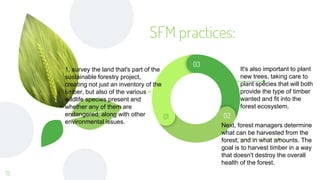
SFM practices:
13
03
01 02
1. survey the land that's part of the
sustainable forestry project,
creating not just an inventory of the
timber, but also of the various
wildlife species present and
whether any of them are
endangered, along with other
environmental issues.
Next, forest managers determine
what can be harvested from the
forest, and in what amounts. The
goal is to harvest timber in a way
that doesn't destroy the overall
health of the forest.
It's also important to plant
new trees, taking care to
plant species that will both
provide the type of timber
wanted and fit into the
forest ecosystem.
Place your screenshot here
14
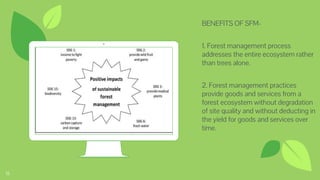
⊷ BENEFITS OF SFM-
⊷ 1. Forest management process
addresses the entire ecosystem rather
than trees alone.
⊷ 2. Forest management practices
provide goods and services from a
forest ecosystem without degradation
of site quality and without deducting in
the yield for goods and services over
time.
⊷
15
Thanks!

Sustainable development

  • 1.
  • 2.
    Sustainability: Sustainability can bedefined as a socio -ecological process characterized by the pursuit of a common ideal.
  • 3.
    Sustainable development : Sustainable developmentis defined as the “development that meets the needs of the present without compromising the ability of future generations to meet their own needs.”
  • 4.
    “ Sustainability seem tohave a stronger focus on the present moment and on keeping things above a certain level whereas sustainable development focuses more on a long term vision. 4
  • 5.
    Sustainability Theory ⊷ Sustainabilityis achieved through the following interconnected domains or pillars: environmental, economic and social. Sustainability requires setting limits in terms of population or resource use beyond which lies ecological disaster. 5
  • 6.
    The underlying ecological imperative Theecological imperative is a complex set of restrictions on human activity; non-fulfilment of which can soon turn out to disastrous consequences for mankind. The ecological imperative is essentially combined with the idea of integrative ideology (in a sense of vision) and the ethical result of understanding of the ecological crisis. 6
  • 7.
    ⊷ A humanshould be in the spotlight, because s/he has the right for a healthy and fruitful life in harmony with nature; ⊷ The right for development should be directed in order to preserve the environment for present and future generations; ⊷ The environment should become an integral feature of the social and economic process and shouldn’t be considered in isolation from it. Ecological imperative is described in a few points, which are at the same time, an essential requirement of its realization. They are: ⊷ It is necessary to put into practice the ecologisation of industry, in order to eliminate the negative anthropogenic impacts on the environment; ⊷ Social and economic development must improve the quality of people’s life in acceptable limits of the economy’s and ecosystem’s capacity 7
  • 8.
    CARRYING CAPACITY The maximumnumber of individuals in a single population that a given environment can sustain at a given time. The carrying capacity for a population can change when fluctuations occur in resources, like increases in nutrients or water; habitat structure, like deforestation; biotic interactions, like the introduction of a new predator or competitor into the environment; and other local factors. The carrying capacity is a characteristic of a single population of a single species at a single time in a single place. Therefore, it is a difficult concept to measure or even fully understand. 8
  • 9.
    Logistic growth curve ofpopulation size over 9
  • 10.
    Sustainability and Society: Asustainable society is one that has learned to live within the boundaries established by ecological limits. Social justice: Social justice is based on equal rights of any person and the possibility of all human beings, without any discrimination, to benefit from economic and social progress, irrespective of the political or social- economic doctrine. Development: We have SDGs for social and sustainable development which are integrated to balance the three dimensions of sustainable development: the economic, social and environmental. Economy: Economic sustainability refers to practices that support long- term economic growth without negatively impacting social, environmental, and cultural aspects of the community. 10
  • 11.
    SUSTAINABLE FOREST MANAGEMENT ⊷ Sustainableforest management (SFM) is the management of forests according to the principles of sustainable development. Sustainable forest management has to keep the balance between three main pillars: ecological, economic and socio- cultural. ⊷ Successfully achieving sustainable forest management will provide integrated benefits to all, ranging from safeguarding local livelihoods to protecting biodiversity and ecosystems provided by forests, reducing rural poverty and mitigating some of the effects of climate change 11
  • 12.
    Features: ⊷ Maintenance, conservationand enhancement of ecosystem biodiversity ⊷ Protection of ecologically important forest areas ⊷ Prohibition of forest conversions ⊷ Promotion of gender equality and commitment to equal treatment of workers ⊷ Recognition of free, prior and informed consent of indigenous peoples ⊷ Promotion of the health and well-being of forest communities ⊷ Respect for human rights in forest operations ⊷ Respect for the multiple functions of forests to society ⊷ Provisions for consultation with local people, communities and other stakeholders ⊷ Respect for property and land tenure rights as well as customary and traditional rights ⊷ Prohibition of genetically modified trees and most hazardous chemicals ⊷ Climate positive practices such as reduction of GHG emissions in forest operations 12
  • 13.
    SFM practices: 13 03 01 02 1.survey the land that's part of the sustainable forestry project, creating not just an inventory of the timber, but also of the various wildlife species present and whether any of them are endangered, along with other environmental issues. Next, forest managers determine what can be harvested from the forest, and in what amounts. The goal is to harvest timber in a way that doesn't destroy the overall health of the forest. It's also important to plant new trees, taking care to plant species that will both provide the type of timber wanted and fit into the forest ecosystem.
  • 14.
    Place your screenshothere 14 ⊷ BENEFITS OF SFM- ⊷ 1. Forest management process addresses the entire ecosystem rather than trees alone. ⊷ 2. Forest management practices provide goods and services from a forest ecosystem without degradation of site quality and without deducting in the yield for goods and services over time. ⊷
  • 15.