HRM System
Part III:
Josefina B. Bitonio
Associate Professor
Institure of Graduate School and
Professional Studies
IntegratingTheory and Practice
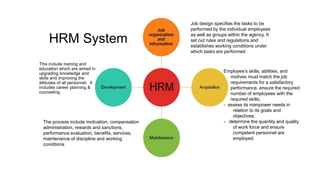
This include training and
education which are aimed in
upgrading knowledge and
skills and improving the
attitudes of all personnel. It
includes career planning &
counseling
Job design specifies the tasks to be
performed by the individual employees
as well as groups within the agency. It
set out rules and regulations and
establishes working conditions under
which tasks are performed
Employee’s skills, abilities, and
motives must match the job
requirements for a satisfactory
performance. ensure the required
number of employees with the
required skills;
- assess its manpower needs in
relation to its goals and
objectives;
- determine the quantity and quality
of work force and ensure
competent personnel are
employed.
The process include motivation, compensation
administration, rewards and sanctions,
performance evaluation, benefits, services,
maintenance of discipline and working
conditions
HRM System
Harry L. Wylie defines "Job analysis deals with the anatomy of the job. This is the
complete study of the job embodying every known and determinable factor, including the
duties and responsibilities involved in its performance; the conditions under which
performance is carried on; the nature of the task; the qualifications required in the worker;
and the conditions of employment such as pay, hours, opportunities and privileges"
Job Organization and Information
• Job Design is the process of deciding on the content of a job in terms of its duties and
responsibilities; on the methods to be used in carrying out the job, in terms of techniques, systems
and procedures and on the relationships that should exist between the job holder and the superiors,
subordinates and colleagues.
• Job enlargement, job enrichment, job rotation, and job simplification are the various techniques
used in a job design exercise. Job design goal is to minimize physical strain on the worker by
structuring physical work environment around the way the human body works.
Job enrichment means
improvement, or an increase
with the help of upgrading and
development, whereas
Job enlargement means to
add more duties, and an
increased workload
Acquisition
Internal Development
External Hiring
Managers
Managing
Organization
Managers
Managing
Managers
Managers
Managing
Teams
Employees
Managing
their job
The Problem of Talent
Management
Management layers differ
completely with regards to
context and duties
Many organization go for high
internal placement rate when it
comes to manager and
executive position
Dr. Armin Trost
100% internal placement not healthy.
Rule of thumb at lesser 70-80%
Demographic shifts.
How to attract the right
people?
If you recruit the wrong people, you
will feel miserable, stressful,
unhappy and they limit
organizational growth
Not good in selecting People
• Bad hire 30% - drain your happiness, increase stress, become miserable and limits
growth
• Bad Performance 67% - creativity lost (Macintosh)
• Recruit people more
smarter and brighter than
you
• Right people at the right
position, right motivation,
right leadership
Relax
Some consideration
• Aging work force – Succession
planning. Build talent pipeline so
that when there’s a vacancy there
is a talent ready for the job
• The issue of transgender. PWD,
Gender Equality, equal
opportunity
The major
activities of
Human resource
planning include:
• Placement of
employee in the job
where he exactly fit
forecasting (future
requirements - )
• inventorying (present
strength),
• anticipating
(comparison of
present and future
requirements) and
• planning (necessary
program to meet
future requirements).
An induction refers to
the process of getting
new employees
acquainted with your
cooperative, helping
them to settle in and
giving them the
information required for
them to become a
valuable team member.
After hiring
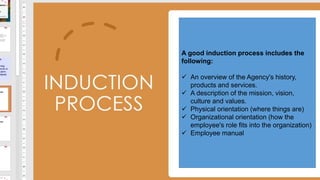
A good induction process includes the
following:
 An overview of the Agency's history,
products and services.
 A description of the mission, vision,
culture and values.
 Physical orientation (where things are)
 Organizational orientation (how the
employee's role fits into the organization)
 Employee manual
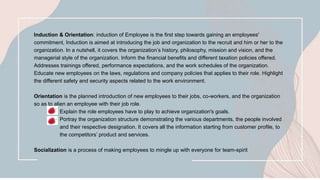
Induction & Orientation: induction of Employee is the first step towards gaining an employees'
commitment, Induction is aimed at introducing the job and organization to the recruit and him or her to the
organization. In a nutshell, it covers the organization’s history, philosophy, mission and vision, and the
managerial style of the organization. Inform the financial benefits and different taxation policies offered.
Addresses trainings offered, performance expectations, and the work schedules of the organization.
Educate new employees on the laws, regulations and company policies that applies to their role. Highlight
the different safety and security aspects related to the work environment.
Orientation is the planned introduction of new employees to their jobs, co-workers, and the organization
so as to alien an employee with their job role.
• Explain the role employees have to play to achieve organization's goals.
• Portray the organization structure demonstrating the various departments, the people involved
and their respective designation. It covers all the information starting from customer profile, to
the competitors’ product and services.
Socialization is a process of making employees to mingle up with everyone for team-spirit
Maintenance
Modern Methods
• MBO/MBR
• Behavioral anchored rating
scales
• Financial Performance
• ISO – KPIs, Risk
• BSC –Score Card
Behaviors
• People oriented
• Coping
• Stretch
• Customer relationship
• Stakeholder relationship
• Self correcting
• Teamwork
• Forward looking
• Ethical
Development
• Employee development is almost
universally recognized as a strategic
tool for an organization’s continuing
growth, productivity and ability to
retain valuable employees.
• Employees have to go through a
development plan which is specifically
designed as per strengths and areas of
improvement.
Develop Talents
• The process of articulating necessary skill sets and
competencies for key positions may lead to the
identification of skill gaps and training needs among
workers, thus interventions (i.e. cognitive and behavioral
training programs) can be developed to address the
gap/need.
• Integrating with talent management. Collaborative effort
• Collaborative effort of HR, CSO, Board to have
ownership
• Development of talents is key element for successful
planning to be effective from general competency to
sophisticated, intentional and formalized not only for top
roles but in between roles.
• Development not for development say but for retention
and relationship that are long lasting.
Development
• Career Planning and Career
Development; process of establishing
personal career objectives by employees
and acting in a manner intended to bring
them about.
• HR managers should help their employees
in knowing their strengths for placing them
in suitable job, guide employees what skills
and knowledge should be acquired for
attaining higher positions, planning for
suitable training for polishing existing skill
set and providing good work-life-balance
to make balance between career and
personal life, after all, every one work for
their personal life .
Career development according to Schuler, "It is an activity to
identify the individual needs, abilities and goals and the
organization’s job demands and job rewards and then through
well designed programs of career development matching
abilities with demands and rewards".
Career development does not guarantee success but without it
employees would not be ready for a job when the opportunity
arises. HR managers should encourage their employees by
providing them suitable opportunities to grow for promoting
them to higher jobs according to their skills and knowledge,
identify and provide opportunities to employees to learn new
skills in the job and compensate accordingly and guiding
employees in right career path to develop in their career.

3-HRM-and-Development.pptx

  • 1.
    HRM System Part III: JosefinaB. Bitonio Associate Professor Institure of Graduate School and Professional Studies
  • 2.
    IntegratingTheory and Practice Thisinclude training and education which are aimed in upgrading knowledge and skills and improving the attitudes of all personnel. It includes career planning & counseling Job design specifies the tasks to be performed by the individual employees as well as groups within the agency. It set out rules and regulations and establishes working conditions under which tasks are performed Employee’s skills, abilities, and motives must match the job requirements for a satisfactory performance. ensure the required number of employees with the required skills; - assess its manpower needs in relation to its goals and objectives; - determine the quantity and quality of work force and ensure competent personnel are employed. The process include motivation, compensation administration, rewards and sanctions, performance evaluation, benefits, services, maintenance of discipline and working conditions HRM System
  • 3.
    Harry L. Wyliedefines "Job analysis deals with the anatomy of the job. This is the complete study of the job embodying every known and determinable factor, including the duties and responsibilities involved in its performance; the conditions under which performance is carried on; the nature of the task; the qualifications required in the worker; and the conditions of employment such as pay, hours, opportunities and privileges" Job Organization and Information
  • 4.
    • Job Designis the process of deciding on the content of a job in terms of its duties and responsibilities; on the methods to be used in carrying out the job, in terms of techniques, systems and procedures and on the relationships that should exist between the job holder and the superiors, subordinates and colleagues. • Job enlargement, job enrichment, job rotation, and job simplification are the various techniques used in a job design exercise. Job design goal is to minimize physical strain on the worker by structuring physical work environment around the way the human body works. Job enrichment means improvement, or an increase with the help of upgrading and development, whereas Job enlargement means to add more duties, and an increased workload
  • 5.
  • 6.
    Internal Development External Hiring Managers Managing Organization Managers Managing Managers Managers Managing Teams Employees Managing theirjob The Problem of Talent Management Management layers differ completely with regards to context and duties Many organization go for high internal placement rate when it comes to manager and executive position Dr. Armin Trost 100% internal placement not healthy. Rule of thumb at lesser 70-80%
  • 7.
    Demographic shifts. How toattract the right people? If you recruit the wrong people, you will feel miserable, stressful, unhappy and they limit organizational growth
  • 8.
    Not good inselecting People • Bad hire 30% - drain your happiness, increase stress, become miserable and limits growth • Bad Performance 67% - creativity lost (Macintosh)
  • 9.
    • Recruit peoplemore smarter and brighter than you • Right people at the right position, right motivation, right leadership Relax
  • 10.
    Some consideration • Agingwork force – Succession planning. Build talent pipeline so that when there’s a vacancy there is a talent ready for the job • The issue of transgender. PWD, Gender Equality, equal opportunity
  • 11.
    The major activities of Humanresource planning include: • Placement of employee in the job where he exactly fit forecasting (future requirements - ) • inventorying (present strength), • anticipating (comparison of present and future requirements) and • planning (necessary program to meet future requirements).
  • 12.
    An induction refersto the process of getting new employees acquainted with your cooperative, helping them to settle in and giving them the information required for them to become a valuable team member. After hiring
  • 13.
    A good inductionprocess includes the following:  An overview of the Agency's history, products and services.  A description of the mission, vision, culture and values.  Physical orientation (where things are)  Organizational orientation (how the employee's role fits into the organization)  Employee manual
  • 14.
    Induction & Orientation:induction of Employee is the first step towards gaining an employees' commitment, Induction is aimed at introducing the job and organization to the recruit and him or her to the organization. In a nutshell, it covers the organization’s history, philosophy, mission and vision, and the managerial style of the organization. Inform the financial benefits and different taxation policies offered. Addresses trainings offered, performance expectations, and the work schedules of the organization. Educate new employees on the laws, regulations and company policies that applies to their role. Highlight the different safety and security aspects related to the work environment. Orientation is the planned introduction of new employees to their jobs, co-workers, and the organization so as to alien an employee with their job role. • Explain the role employees have to play to achieve organization's goals. • Portray the organization structure demonstrating the various departments, the people involved and their respective designation. It covers all the information starting from customer profile, to the competitors’ product and services. Socialization is a process of making employees to mingle up with everyone for team-spirit
  • 15.
    Maintenance Modern Methods • MBO/MBR •Behavioral anchored rating scales • Financial Performance • ISO – KPIs, Risk • BSC –Score Card
  • 16.
    Behaviors • People oriented •Coping • Stretch • Customer relationship • Stakeholder relationship • Self correcting • Teamwork • Forward looking • Ethical
  • 17.
    Development • Employee developmentis almost universally recognized as a strategic tool for an organization’s continuing growth, productivity and ability to retain valuable employees. • Employees have to go through a development plan which is specifically designed as per strengths and areas of improvement.
  • 18.
    Develop Talents • Theprocess of articulating necessary skill sets and competencies for key positions may lead to the identification of skill gaps and training needs among workers, thus interventions (i.e. cognitive and behavioral training programs) can be developed to address the gap/need. • Integrating with talent management. Collaborative effort • Collaborative effort of HR, CSO, Board to have ownership • Development of talents is key element for successful planning to be effective from general competency to sophisticated, intentional and formalized not only for top roles but in between roles. • Development not for development say but for retention and relationship that are long lasting.
  • 19.
    Development • Career Planningand Career Development; process of establishing personal career objectives by employees and acting in a manner intended to bring them about. • HR managers should help their employees in knowing their strengths for placing them in suitable job, guide employees what skills and knowledge should be acquired for attaining higher positions, planning for suitable training for polishing existing skill set and providing good work-life-balance to make balance between career and personal life, after all, every one work for their personal life .
  • 20.
    Career development accordingto Schuler, "It is an activity to identify the individual needs, abilities and goals and the organization’s job demands and job rewards and then through well designed programs of career development matching abilities with demands and rewards". Career development does not guarantee success but without it employees would not be ready for a job when the opportunity arises. HR managers should encourage their employees by providing them suitable opportunities to grow for promoting them to higher jobs according to their skills and knowledge, identify and provide opportunities to employees to learn new skills in the job and compensate accordingly and guiding employees in right career path to develop in their career.