Green Credit Guidance
A formal framework of the link between
Finance, Growth and the Environment

Giovanni Bernardo
Giorgos Galanis
New Economics Foundation
London
Outline
1.
2.
3.
4.
5.

6.

Why we need a new economic modeling
framework
Our approach
The basic model
How to include environmental variables
Simulations.
Contribution to the relevant literature.

Giovanni Bernardo – Giorgos Galanis - New Economics Foundation
nef macro modeling
• nef has been developing a model which links growth, finance and
environment.
• We use a methodology called system dynamics to build theories
concerning the dynamic functioning of the system and run
numerical simulations of possible macro scenarios.
• This is an ongoing research project, but we feel the modeling tools
we have developed are already able to show some original results
and contribute to the current economic debate.
• In a previous presentation we have presented the way we model
the banking system (LINK), employing it to analyze the debate
between Krugman and Keen regarding debt and aggregate
demand (LINK) .

• In this presentation, we deal instead with the way we
include environmental variables in the core model.
A new modeling framework
• Understand the links between finance,

output, income distribution and
environment.
• Study the effects of different policies on the
above.
• Aim to influence discussions in both
academia and in policy making.

Giovanni Bernardo – Giorgos Galanis - New Economics Foundation
Why we need a new modeling framework
 Conventional modeling framework treats:

Macroeconomic phenomena (such as output) and
microeconomic issues (such as finance) separately.
2. All kinds of markets as perfect such that prices clear to
ensure the full employment of resources. In this way
supply drives the economy:
1.






Does not take into account issues of inequality, unemployment etc.
Total spending on investment and climate mitigation is determined by
available savings.
Full capacity utilization of resources, including labour, raises questions
like: Will labour be fully employed if global warming significantly
reduces the level of output?

Giovanni Bernardo – Giorgos Galanis - New Economics Foundation
Why we need a new modeling framework
 Unconventional (Post) Keynesian Stock Flow Consistent (SFC)

models provide an integrated approach to finance, income,
production and wealth (Godley and Lavoie 2007).
SFC models:




Investment decisions are not dependent on savings decisions and
financial institutions are a key component of the modeling framework.
Economic factors are not working in full capacity and income and
wealth distribution has important effects on economic and financial
stability .

BUT there is no role of the environment.
 Environmental models which take into account issues like
employment (ex. E3MG, LOW GROW) do not take into account
the implications of the financial sector.
Giovanni Bernardo – Giorgos Galanis - New Economics Foundation
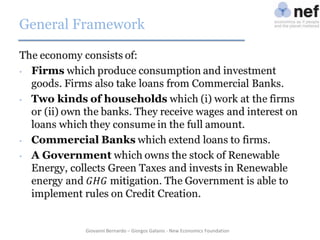
General Framework

Giovanni Bernardo – Giorgos Galanis - New Economics Foundation
Real- Financial Interactions
(Main Assumptions)
•
•
•
•
•
•

Savings do not lead to investment but it works the other way
round.
Investment decisions depend on the firms’ profits and on their
propensity to invest.
If the propensity to invest is higher than the current profits
then firms ask for loans.
Commercial banks create money when they extend a loan. This
amount of new money is destroyed when the loan is repaid.
Banks are not passive in extending loans as in most Post
Keynesian models.
Commercial banks extend loans based on their confidence on
the ability of the firms to repay the loans.

Giovanni Bernardo – Giorgos Galanis - New Economics Foundation
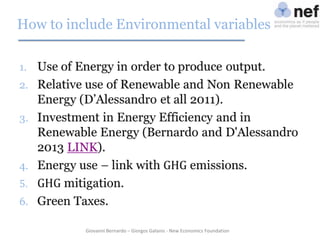
How to include Environmental variables

Giovanni Bernardo – Giorgos Galanis - New Economics Foundation
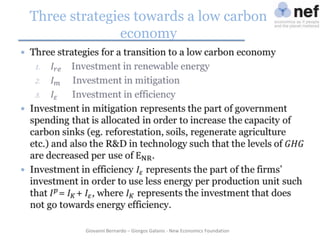
Three strategies towards a low carbon
economy

Giovanni Bernardo – Giorgos Galanis - New Economics Foundation
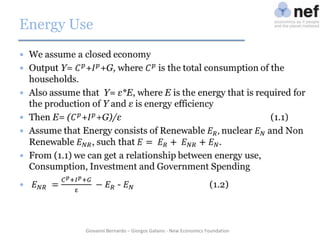
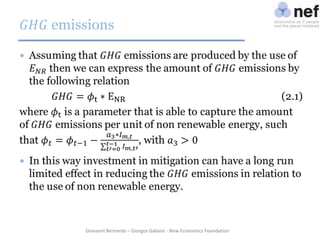
Energy Use

Giovanni Bernardo – Giorgos Galanis - New Economics Foundation
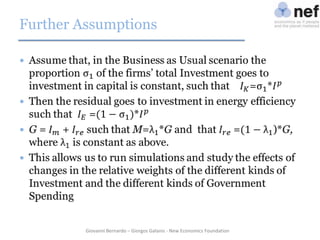
Further Assumptions

Giovanni Bernardo – Giorgos Galanis - New Economics Foundation
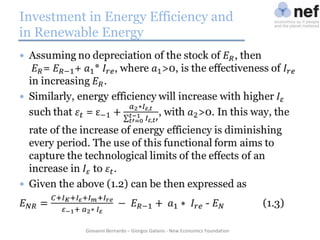
Investment in Energy Efficiency and
in Renewable Energy

Giovanni Bernardo – Giorgos Galanis - New Economics Foundation
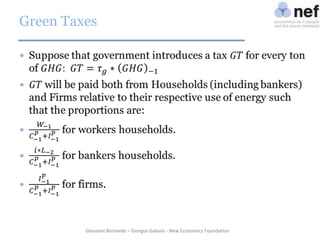
Green Taxes

Giovanni Bernardo – Giorgos Galanis - New Economics Foundation
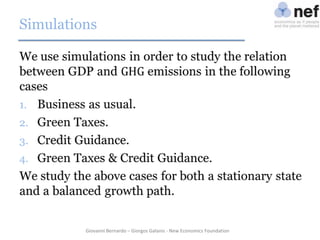
Simulations

Giovanni Bernardo – Giorgos Galanis - New Economics Foundation
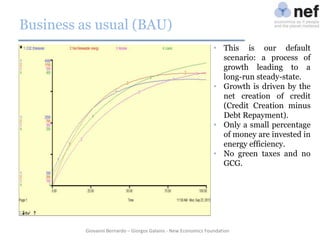
Business as usual (BAU)
• This is our default
scenario: a process of
growth leading to a
long-run steady-state.
• Growth is driven by the
net creation of credit
(Credit Creation minus
Debt Repayment).
• Only a small percentage
of money are invested in
energy efficiency.
• No green taxes and no
GCG.

Giovanni Bernardo – Giorgos Galanis - New Economics Foundation
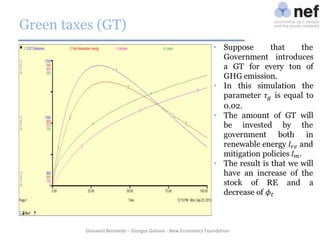
Green taxes (GT)

Giovanni Bernardo – Giorgos Galanis - New Economics Foundation
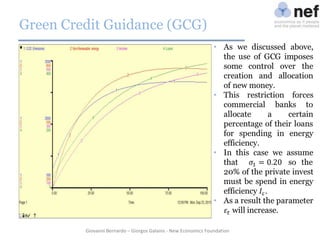
Green Credit Guidance (GCG)

Giovanni Bernardo – Giorgos Galanis - New Economics Foundation
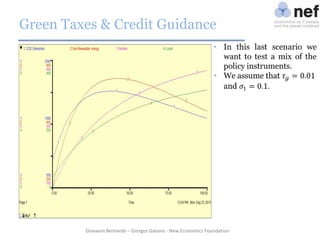
Green Taxes & Credit Guidance

Giovanni Bernardo – Giorgos Galanis - New Economics Foundation
Comparison: Output
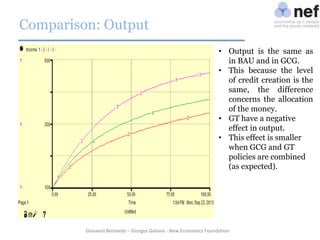
• Output is the same as
in BAU and in GCG.
• This because the level
of credit creation is the
same, the difference
concerns the allocation
of the money.
• GT have a negative
effect in output.
• This effect is smaller
when GCG and GT
policies are combined
(as expected).

Giovanni Bernardo – Giorgos Galanis - New Economics Foundation
Comparison: GHG Emissions
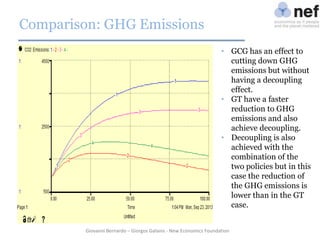
• GCG has an effect to
cutting down GHG
emissions but without
having a decoupling
effect.
• GT have a faster
reduction to GHG
emissions and also
achieve decoupling.
• Decoupling is also
achieved with the
combination of the
two policies but in this
case the reduction of
the GHG emissions is
lower than in the GT
case.
Giovanni Bernardo – Giorgos Galanis - New Economics Foundation
Exponential growth scenario
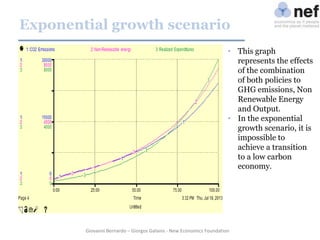
• This graph
represents the effects
of the combination
of both policies to
GHG emissions, Non
Renewable Energy
and Output.
• In the exponential
growth scenario, it is
impossible to
achieve a transition
to a low carbon
economy.

Giovanni Bernardo – Giorgos Galanis - New Economics Foundation
Concluding Remarks
• Use different forms of Energy and different forms of Investment can
provide a link between SFC and Environmental Economics
Research.
• Monetary Policy instruments can be used for climate change
mitigation.
• In the case of a stationary state both GT and GCG can have
important effects for the reduction of both the use of non renewable
energy and the GHG emissions.
• The use of GT only is negative for output.
• The use of GCG only, has limited effects on reducing GHG
emissions.
• A combination of the two policies has the best overall effects in the
case of steady state growth.
• In the case of a balanced growth path the same policies are not
efficient in reducing the GHG emissions and the use of non
renewable energy.
Giovanni Bernardo – Giorgos Galanis - New Economics Foundation

Green credit guidance

  • 1.
    Green Credit Guidance Aformal framework of the link between Finance, Growth and the Environment Giovanni Bernardo Giorgos Galanis New Economics Foundation London
  • 2.
    Outline 1. 2. 3. 4. 5. 6. Why we needa new economic modeling framework Our approach The basic model How to include environmental variables Simulations. Contribution to the relevant literature. Giovanni Bernardo – Giorgos Galanis - New Economics Foundation
  • 3.
    nef macro modeling •nef has been developing a model which links growth, finance and environment. • We use a methodology called system dynamics to build theories concerning the dynamic functioning of the system and run numerical simulations of possible macro scenarios. • This is an ongoing research project, but we feel the modeling tools we have developed are already able to show some original results and contribute to the current economic debate. • In a previous presentation we have presented the way we model the banking system (LINK), employing it to analyze the debate between Krugman and Keen regarding debt and aggregate demand (LINK) . • In this presentation, we deal instead with the way we include environmental variables in the core model.
  • 4.
    A new modelingframework • Understand the links between finance, output, income distribution and environment. • Study the effects of different policies on the above. • Aim to influence discussions in both academia and in policy making. Giovanni Bernardo – Giorgos Galanis - New Economics Foundation
  • 5.
    Why we needa new modeling framework  Conventional modeling framework treats: Macroeconomic phenomena (such as output) and microeconomic issues (such as finance) separately. 2. All kinds of markets as perfect such that prices clear to ensure the full employment of resources. In this way supply drives the economy: 1.    Does not take into account issues of inequality, unemployment etc. Total spending on investment and climate mitigation is determined by available savings. Full capacity utilization of resources, including labour, raises questions like: Will labour be fully employed if global warming significantly reduces the level of output? Giovanni Bernardo – Giorgos Galanis - New Economics Foundation
  • 6.
    Why we needa new modeling framework  Unconventional (Post) Keynesian Stock Flow Consistent (SFC) models provide an integrated approach to finance, income, production and wealth (Godley and Lavoie 2007). SFC models:   Investment decisions are not dependent on savings decisions and financial institutions are a key component of the modeling framework. Economic factors are not working in full capacity and income and wealth distribution has important effects on economic and financial stability . BUT there is no role of the environment.  Environmental models which take into account issues like employment (ex. E3MG, LOW GROW) do not take into account the implications of the financial sector. Giovanni Bernardo – Giorgos Galanis - New Economics Foundation
  • 7.
    General Framework Giovanni Bernardo– Giorgos Galanis - New Economics Foundation
  • 8.
    Real- Financial Interactions (MainAssumptions) • • • • • • Savings do not lead to investment but it works the other way round. Investment decisions depend on the firms’ profits and on their propensity to invest. If the propensity to invest is higher than the current profits then firms ask for loans. Commercial banks create money when they extend a loan. This amount of new money is destroyed when the loan is repaid. Banks are not passive in extending loans as in most Post Keynesian models. Commercial banks extend loans based on their confidence on the ability of the firms to repay the loans. Giovanni Bernardo – Giorgos Galanis - New Economics Foundation
  • 9.
    How to includeEnvironmental variables Giovanni Bernardo – Giorgos Galanis - New Economics Foundation
  • 10.
    Three strategies towardsa low carbon economy Giovanni Bernardo – Giorgos Galanis - New Economics Foundation
  • 11.
    Energy Use Giovanni Bernardo– Giorgos Galanis - New Economics Foundation
  • 12.
    Further Assumptions Giovanni Bernardo– Giorgos Galanis - New Economics Foundation
  • 13.
    Investment in EnergyEfficiency and in Renewable Energy Giovanni Bernardo – Giorgos Galanis - New Economics Foundation
  • 14.
    Giovanni Bernardo –Giorgos Galanis - New Economics Foundation
  • 15.
    Green Taxes Giovanni Bernardo– Giorgos Galanis - New Economics Foundation
  • 16.
    Simulations Giovanni Bernardo –Giorgos Galanis - New Economics Foundation
  • 17.
    Business as usual(BAU) • This is our default scenario: a process of growth leading to a long-run steady-state. • Growth is driven by the net creation of credit (Credit Creation minus Debt Repayment). • Only a small percentage of money are invested in energy efficiency. • No green taxes and no GCG. Giovanni Bernardo – Giorgos Galanis - New Economics Foundation
  • 18.
    Green taxes (GT) GiovanniBernardo – Giorgos Galanis - New Economics Foundation
  • 19.
    Green Credit Guidance(GCG) Giovanni Bernardo – Giorgos Galanis - New Economics Foundation
  • 20.
    Green Taxes &Credit Guidance Giovanni Bernardo – Giorgos Galanis - New Economics Foundation
  • 21.
    Comparison: Output • Outputis the same as in BAU and in GCG. • This because the level of credit creation is the same, the difference concerns the allocation of the money. • GT have a negative effect in output. • This effect is smaller when GCG and GT policies are combined (as expected). Giovanni Bernardo – Giorgos Galanis - New Economics Foundation
  • 22.
    Comparison: GHG Emissions •GCG has an effect to cutting down GHG emissions but without having a decoupling effect. • GT have a faster reduction to GHG emissions and also achieve decoupling. • Decoupling is also achieved with the combination of the two policies but in this case the reduction of the GHG emissions is lower than in the GT case. Giovanni Bernardo – Giorgos Galanis - New Economics Foundation
  • 23.
    Exponential growth scenario •This graph represents the effects of the combination of both policies to GHG emissions, Non Renewable Energy and Output. • In the exponential growth scenario, it is impossible to achieve a transition to a low carbon economy. Giovanni Bernardo – Giorgos Galanis - New Economics Foundation
  • 24.
    Concluding Remarks • Usedifferent forms of Energy and different forms of Investment can provide a link between SFC and Environmental Economics Research. • Monetary Policy instruments can be used for climate change mitigation. • In the case of a stationary state both GT and GCG can have important effects for the reduction of both the use of non renewable energy and the GHG emissions. • The use of GT only is negative for output. • The use of GCG only, has limited effects on reducing GHG emissions. • A combination of the two policies has the best overall effects in the case of steady state growth. • In the case of a balanced growth path the same policies are not efficient in reducing the GHG emissions and the use of non renewable energy. Giovanni Bernardo – Giorgos Galanis - New Economics Foundation