Public 
Economics 
2013-­‐2014 
Manon 
Cuylits 
Topic 
5 
: 
Mitigation 
options 
“Reaching 
80% 
to 
95% 
GHG 
emissions 
reduction 
[...] 
is 
possible. 
Nevertheless, 
reaching 
this 
target 
is 
very 
challenging, 
will 
imply 
large 
reductions 
in 
all 
sectors 
and 
a 
thorough 
understanding 
of 
the 
various 
interconnected 
dimensions 
is 
key.” 
Pestiaux 
et 
al. 
(2013), 
Scenarios 
for 
a 
low 
carbon 
Belgium 
by 
2050, 
Forthcoming 
1. 
Introduction 
Objective 
of 
this 
topic: 
analyse 
what 
can 
be 
done 
to 
reduce 
GHG 
emissions 
and 
analyse 
economic 
impacts 
of 
these 
actions 
Models 
are 
used 
to: 
28 
• Assess 
the 
emission 
reduction 
possibilities 
at 
the 
level 
of 
a 
sector/country/region/world 
• Assess 
the 
impacts 
of 
emission 
reductions 
on 
several 
indicators 
such 
as 
costs, 
employment, 
air 
pollution, 
etc... 
This 
requires 
to 
begin 
with 
a 
clear 
view 
on: 
• Possible 
technological 
levers 
• Possible 
behavioural 
levers 
• Their 
combination 
2. 
Case-­‐study 
on 
Belgium 
: 
OPEERA 
accounting 
model 
2.1. 
Overall 
approach 
• Establish 
historical 
GHG 
emissions 
per 
sector 
(starting 
point, 
e.g. 
2010) 
• Establish 
a 
mid-­‐term 
or 
long-­‐term 
“business-­‐as-­‐usual” 
scenario 
(e.g. 
up 
to 
2020 
or 
2050), 
i.e. 
under 
no 
additional 
policies/measures/actions, 
to 
be 
used 
as 
a 
benchmark/reference 
against 
which 
the 
impact 
of 
targets/policies/ 
actions 
(levers) 
are 
to 
be 
assessed; 
• In 
each 
(sub)sector, 
identify 
emission 
reduction 
levers 
and 
possible 
ambition 
levels 
for 
each 
lever: 
o Possible 
technologies 
aimed 
at 
reducing 
GHG 
emissions, 
with 
due 
attention 
to 
the 
level 
of 
deployment 
(existing, 
in 
demonstration 
phase, 
in 
R&D 
phase, 
...) 
o Activity 
levels, 
such 
as 
travel 
demand 
per 
person 
or 
industrial 
production 
• Build 
scenarios, 
i.e. 
coherent 
set 
of 
assumptions 
and 
levers 
leading 
to 
required 
level 
of 
total 
emission 
reductions 
in 
2050 
• Analyse 
the 
impacts 
of 
each 
scenario 
on 
e.g. 
energy 
security, 
final 
energy 
demand, 
costs, 
etc... 
Source: 
Pestiaux 
et 
al. 
(2013)
Public 
Economics 
2013-­‐2014 
Manon 
Cuylits 
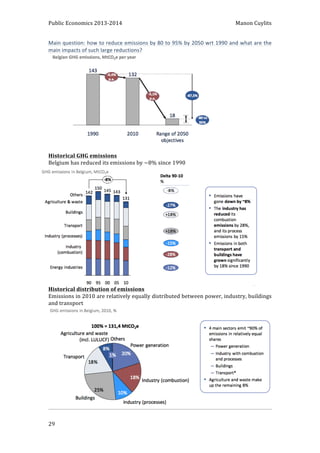
Main 
question: 
how 
to 
reduce 
emissions 
by 
80 
to 
95% 
by 
2050 
wrt 
1990 
and 
what 
are 
the 
main 
impacts 
of 
such 
large 
reductions? 
Historical 
GHG 
emissions 
Belgium 
has 
reduced 
its 
emissions 
by 
~8% 
since 
1990 
Historical 
distribution 
of 
emissions 
Emissions 
in 
2010 
are 
relatively 
equally 
distributed 
between 
power, 
industry, 
buildings 
and 
transport 
29
Public 
Economics 
2013-­‐2014 
Manon 
Cuylits 
Methodology 
Based 
on 
open 
and 
transparent 
tool 
OPE2RA 
developed 
by 
CLIMACT 
and 
VITO 
on 
the 
basis 
of 
DECC 
(UK) 
pathways 
calculator 
Building 
scenarios 
2.2. 
Sectoral 
analysis 
2.2.1. 
Transport 
Observations: 
30 
1. Transport 
represents 
about 
a 
quarter 
of 
the 
overall 
energy 
consumption 
in 
Belgium 
2. The 
Belgian 
motorized 
transport 
is 
somewhat 
less 
car-­‐based 
than 
the 
European 
average 
3. The 
density 
of 
the 
Belgian 
highway 
network 
is 
far 
above 
European 
average 
4. The 
overall 
distances 
covered 
by 
passengers 
since 
1990 
increased 
by 
30%, 
cars 
represent 
~80% 
5. Between 
1990 
and 
2008, 
cars 
lost 
some 
share 
to 
buses 
and 
rail 
transport 
6. The 
CO2 
emissions 
of 
new 
vehicles 
have 
been 
decreasing 
in 
recent 
years
Public 
Economics 
2013-­‐2014 
Manon 
Cuylits 
31 
7. Urbanization 
levels 
and 
land 
planning 
play 
a 
crucial 
role 
in 
GHG 
mitigation 
policies 
8. The 
availability 
of 
public 
transport 
influences 
the 
choice 
of 
transport 
modes 
9. The 
Belgian 
modal 
split 
for 
goods 
is 
somewhat 
less 
road-­‐oriented 
than 
the 
European 
average 
10. Road 
transport 
represents 
the 
bulk 
of 
energy 
consumption 
across 
passenger 
and 
goods, 
and 
across 
transport 
modes 
Levers 
for 
domestic 
passenger 
transport 
(ambition 
levels 
1 
and 
4)
Public 
Economics 
2013-­‐2014 
Manon 
Cuylits 
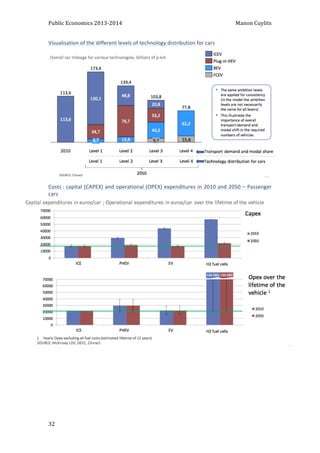
Visualisation 
of 
the 
different 
levels 
of 
technology 
distribution 
for 
cars 
Costs 
: 
capital 
(CAPEX) 
and 
operational 
(OPEX) 
expenditures 
in 
2010 
and 
2050 
– 
Passenger 
cars 
32
Public 
Economics 
2013-­‐2014 
Manon 
Cuylits 
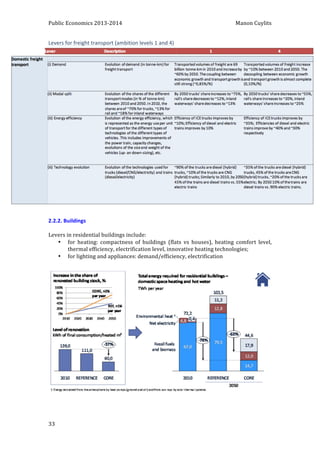
Levers 
for 
freight 
transport 
(ambition 
levels 
1 
and 
4) 
2.2.2. 
Buildings 
Levers 
in 
residential 
buildings 
include: 
33 
• for 
heating: 
compactness 
of 
buildings 
(flats 
vs 
houses), 
heating 
comfort 
level, 
thermal 
efficiency, 
electrification 
level, 
innovative 
heating 
technologies; 
• for 
lighting 
and 
appliances: 
demand/efficiency, 
electrification
Public 
Economics 
2013-­‐2014 
Manon 
Cuylits 
2.2.3. 
Agriculture 
Levers 
include: 
number 
of 
animals 
and 
meat 
consumption, 
emissions 
intensity 
per 
animal 
(enteric 
fermentation 
+ 
manure 
management), 
evolution 
of 
soil 
emissions 
2.2.4. 
Industry 
34
Public 
Economics 
2013-­‐2014 
Manon 
Cuylits 
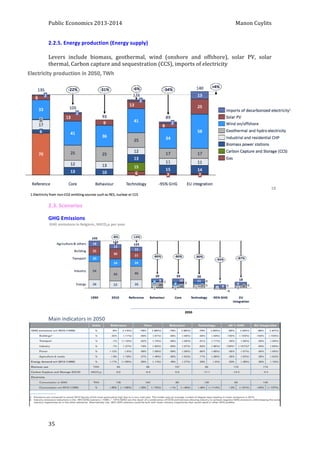
2.2.5. 
Energy 
production 
(Energy 
supply) 
Levers 
include 
biomass, 
geothermal, 
wind 
(onshore 
and 
offshore), 
solar 
PV, 
solar 
thermal, 
Carbon 
capture 
and 
sequestration 
(CCS), 
imports 
of 
electricity 
2.3. 
Scenarios 
GHG 
Emissions 
Main 
indicators 
in 
2050 
35
Public 
Economics 
2013-­‐2014 
Manon 
Cuylits 
2.4. 
Costs 
of 
mitigation 
scenarios 
Undiscounted 
costs 
=> 
does 
not 
assess 
‘private 
profitability’ 
of 
investments 
With 
discounting 
of 
10% 
(thus 
rather 
high 
rate): 
More 
on 
discounting 
36 
è 
See 
topic 
8
Public 
Economics 
2013-­‐2014 
Manon 
Cuylits 
2.5. 
Build 
and 
assess 
your 
own 
low 
carbon 
scenario 
37 
• UK: 
http://2050-­‐calculator-­‐tool.decc.gov.uk 
• BE: 
forthcoming 
on 
www.climatechange.be/2050 
• Walloon 
region: 
http://www.wbc2050.be 
• China: 
http://2050pathway-­‐en.chinaenergyoutlook.org 
• Others 
... 
3. 
Various 
approaches 
3.1. 
Modelling 
approaches 
Accounting 
models 
(e.g. 
OPE2RA, 
SAVER-­‐LEAP, 
EPM, 
Anonymous 
model 
of 
FPB) 
• Central 
modelling 
logic: 
to 
guarantee 
consistency 
in 
energy 
accounting. 
• Defining 
activity 
drivers 
and 
pathways 
for 
energy 
efficiency 
or 
carbon 
intensity 
improvements 
at 
the 
sectoral 
levels 
are 
the 
core 
elements 
of 
the 
methodology. 
• Technologies 
are 
implicit 
(no 
‘production 
function’) 
and 
costs 
are 
often 
considered 
in 
an 
ex-­‐post 
calculation. 
• The 
particular 
strength 
of 
accounting 
models 
is: 
o Their 
transparency 
and 
flexibility 
in 
presenting 
energy 
analysis 
concepts 
whilst 
guaranteeing 
consistency 
in 
energy 
accounting. 
o They 
can 
be 
useful 
to 
explore 
possible 
pathways 
and 
provide 
more 
quantitative 
analysis 
on 
the 
required 
targets 
to 
be 
reached 
by 
the 
underlying 
hypothesis 
at 
sectoral 
levels 
o Can 
be 
useful 
to 
explore 
the 
social 
acceptance 
of 
the 
transition 
as 
well 
as 
its 
contours 
by 
stakeholder 
consultation 
as 
they 
provide 
powerful 
reporting 
capabilities. 
Macro-­‐economic 
models: 
General 
equilibrium 
macro-­‐economic 
model, 
econometric 
macro-­‐economic 
models 
(e.g. 
GEM-­‐E3, 
HERMES, 
NEMESIS) 
• Macroeconomic 
models 
represent 
the 
whole 
economy 
and 
include 
feedback 
mechanisms 
from 
and 
to 
the 
energy 
system. 
• These 
models 
are 
based 
on 
the 
same 
type 
of 
behavioural 
assumptions 
for 
the 
economic 
agents 
but 
they 
differ 
regarding 
o the 
market 
equilibrium 
assumptions 
and 
o the 
dynamic 
path 
modelling. 
• Econometric 
models 
are 
more 
oriented 
towards 
the 
adjustment 
path 
in 
the 
short 
to 
medium 
term 
allowing 
market 
disequilibrium; 
basis 
is 
: 
Y 
= 
C 
+I+G+X-­‐M 
• General 
equilibrium 
model 
are 
medium 
to 
long 
term 
oriented 
evaluating 
the 
impact 
of 
a 
policy 
when 
the 
full 
effect 
are 
accounted 
for; 
based 
on 
maximisation 
of 
Utility 
functions. 
Partial 
equilibrium 
models 
of 
the 
energy 
system 
(e.g. 
TIMES 
and 
PRIMES) 
• Have 
a 
detailed 
representation 
of 
technologies 
in 
a 
consistent 
framework 
• Partial 
equilibrium 
means 
that 
the 
energy 
demand 
(curve) 
is 
fixed 
(which 
is 
NOT 
the 
case 
in 
macroeconomic 
models) 
• PRIMES 
and 
TIMES 
differ 
in 
their 
mathematical 
formulations:
Public 
Economics 
2013-­‐2014 
Manon 
Cuylits 
38 
o PRIMES 
models 
the 
economic 
agent’s 
behaviour 
(describing 
what 
would 
happen 
if); 
this 
takes 
place 
through, 
a.o. 
high 
discount 
rates 
for 
consumers 
reflecting 
some 
form 
of 
information 
failure 
(private 
discount 
rate 
=> 
see 
topic 
8) 
o TIMES 
is 
more 
normative 
from 
the 
point 
of 
view 
of 
the 
public 
authority 
(prescribing 
what 
optimally 
should 
happen) 
through, 
a.o. 
low 
discount 
rates 
(close 
to 
social 
discount 
rate 
=> 
see 
topic 
8) 
• Example: 
on 
blackboard 
Trade-­‐offs 
3.2. 
What 
do 
we 
mean 
by 
« 
costs 
» 
? 
Macroeconomic 
models: 
GDP 
and/or 
welfare: 
• Macroeconom(étr)ic 
models 
and 
some 
CGE 
models, 
i.e. 
required 
feedback 
of, 
typically, 
changes 
in 
energy 
system 
on 
the 
whole 
economy, 
including 
public 
sector 
(taxes, 
revenues, 
...) 
• Thus 
level 
of 
economic 
activity 
(GDP), 
also 
per 
sector, 
employment 
effects, 
possibly 
competitiveness, 
... 
• Computable 
general 
equilibrium 
(CGE) 
models, 
i.e. 
based 
on 
utility 
function, 
thus 
relative 
change 
in 
Utility 
(%) 
is 
computed 
Partial 
equilibrium 
models: 
energy 
system 
including 
loss 
of 
consumer 
surplus: 
• Costs 
of 
technologies 
• Possibly, 
loss 
of 
consumer 
surplus 
Accounting 
models: 
energy 
system 
costs: 
Capex 
– 
Opex 
– 
Fuel 
Other 
important 
costs 
(or 
benefits) 
are 
usually 
not 
included 
in 
models 
and 
must 
be 
computed 
separately: 
health 
effects 
of 
changes 
in 
emissions, 
energy 
security, 
traffic 
congestion, 
...
Public 
Economics 
2013-­‐2014 
Manon 
Cuylits 
4. 
Appendix 
A.1 
Global 
GHG 
emissions 
and 
their 
distribution 
GHG 
emissions 
by 
sector 
in 
2010 
(cfr. 
Topic 
1) 
Shares 
of 
GHG 
emissions 
per 
sector 
in 
2010 
(selection 
of 
countries) 
39
Public 
Economics 
2013-­‐2014 
Manon 
Cuylits 
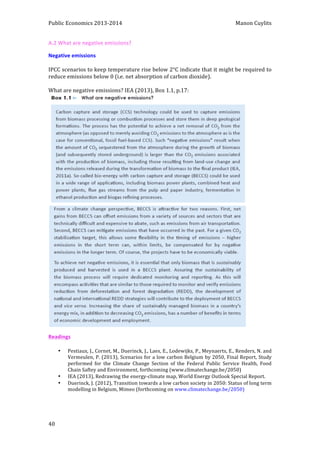
A.2 
What 
are 
negative 
emissions? 
Negative 
emissions 
IPCC 
scenarios 
to 
keep 
temperature 
rise 
below 
2°C 
indicate 
that 
it 
might 
be 
required 
to 
reduce 
emissions 
below 
0 
(i.e. 
net 
absorption 
of 
carbon 
dioxide). 
What 
are 
negative 
emissions? 
IEA 
(2013), 
Box 
1.1, 
p.17: 
Readings 
40 
• Pestiaux, 
J., 
Cornet, 
M., 
Duerinck, 
J., 
Laes, 
E., 
Lodewijks, 
P., 
Meynaerts, 
E., 
Renders, 
N. 
and 
Vermeulen, 
P. 
(2013), 
Scenarios 
for 
a 
low 
carbon 
Belgium 
by 
2050, 
Final 
Report, 
Study 
performed 
for 
the 
Climate 
Change 
Section 
of 
the 
Federal 
Public 
Service 
Health, 
Food 
Chain 
Saftey 
and 
Environment, 
forthcoming 
(www.climatechange.be/2050) 
• IEA 
(2013), 
Redrawing 
the 
energy-­‐climate 
map, 
World 
Energy 
Outlook 
Special 
Report. 
• Duerinck, 
J. 
(2012), 
Transition 
towards 
a 
low 
carbon 
society 
in 
2050: 
Status 
of 
long 
term 
modelling 
in 
Belgium, 
Mimeo 
(forthcoming 
on 
www.climatechange.be/2050)

Topic 5 mitigation options

  • 1.
    Public Economics 2013-­‐2014 Manon Cuylits Topic 5 : Mitigation options “Reaching 80% to 95% GHG emissions reduction [...] is possible. Nevertheless, reaching this target is very challenging, will imply large reductions in all sectors and a thorough understanding of the various interconnected dimensions is key.” Pestiaux et al. (2013), Scenarios for a low carbon Belgium by 2050, Forthcoming 1. Introduction Objective of this topic: analyse what can be done to reduce GHG emissions and analyse economic impacts of these actions Models are used to: 28 • Assess the emission reduction possibilities at the level of a sector/country/region/world • Assess the impacts of emission reductions on several indicators such as costs, employment, air pollution, etc... This requires to begin with a clear view on: • Possible technological levers • Possible behavioural levers • Their combination 2. Case-­‐study on Belgium : OPEERA accounting model 2.1. Overall approach • Establish historical GHG emissions per sector (starting point, e.g. 2010) • Establish a mid-­‐term or long-­‐term “business-­‐as-­‐usual” scenario (e.g. up to 2020 or 2050), i.e. under no additional policies/measures/actions, to be used as a benchmark/reference against which the impact of targets/policies/ actions (levers) are to be assessed; • In each (sub)sector, identify emission reduction levers and possible ambition levels for each lever: o Possible technologies aimed at reducing GHG emissions, with due attention to the level of deployment (existing, in demonstration phase, in R&D phase, ...) o Activity levels, such as travel demand per person or industrial production • Build scenarios, i.e. coherent set of assumptions and levers leading to required level of total emission reductions in 2050 • Analyse the impacts of each scenario on e.g. energy security, final energy demand, costs, etc... Source: Pestiaux et al. (2013)
  • 2.
    Public Economics 2013-­‐2014 Manon Cuylits Main question: how to reduce emissions by 80 to 95% by 2050 wrt 1990 and what are the main impacts of such large reductions? Historical GHG emissions Belgium has reduced its emissions by ~8% since 1990 Historical distribution of emissions Emissions in 2010 are relatively equally distributed between power, industry, buildings and transport 29
  • 3.
    Public Economics 2013-­‐2014 Manon Cuylits Methodology Based on open and transparent tool OPE2RA developed by CLIMACT and VITO on the basis of DECC (UK) pathways calculator Building scenarios 2.2. Sectoral analysis 2.2.1. Transport Observations: 30 1. Transport represents about a quarter of the overall energy consumption in Belgium 2. The Belgian motorized transport is somewhat less car-­‐based than the European average 3. The density of the Belgian highway network is far above European average 4. The overall distances covered by passengers since 1990 increased by 30%, cars represent ~80% 5. Between 1990 and 2008, cars lost some share to buses and rail transport 6. The CO2 emissions of new vehicles have been decreasing in recent years
  • 4.
    Public Economics 2013-­‐2014 Manon Cuylits 31 7. Urbanization levels and land planning play a crucial role in GHG mitigation policies 8. The availability of public transport influences the choice of transport modes 9. The Belgian modal split for goods is somewhat less road-­‐oriented than the European average 10. Road transport represents the bulk of energy consumption across passenger and goods, and across transport modes Levers for domestic passenger transport (ambition levels 1 and 4)
  • 5.
    Public Economics 2013-­‐2014 Manon Cuylits Visualisation of the different levels of technology distribution for cars Costs : capital (CAPEX) and operational (OPEX) expenditures in 2010 and 2050 – Passenger cars 32
  • 6.
    Public Economics 2013-­‐2014 Manon Cuylits Levers for freight transport (ambition levels 1 and 4) 2.2.2. Buildings Levers in residential buildings include: 33 • for heating: compactness of buildings (flats vs houses), heating comfort level, thermal efficiency, electrification level, innovative heating technologies; • for lighting and appliances: demand/efficiency, electrification
  • 7.
    Public Economics 2013-­‐2014 Manon Cuylits 2.2.3. Agriculture Levers include: number of animals and meat consumption, emissions intensity per animal (enteric fermentation + manure management), evolution of soil emissions 2.2.4. Industry 34
  • 8.
    Public Economics 2013-­‐2014 Manon Cuylits 2.2.5. Energy production (Energy supply) Levers include biomass, geothermal, wind (onshore and offshore), solar PV, solar thermal, Carbon capture and sequestration (CCS), imports of electricity 2.3. Scenarios GHG Emissions Main indicators in 2050 35
  • 9.
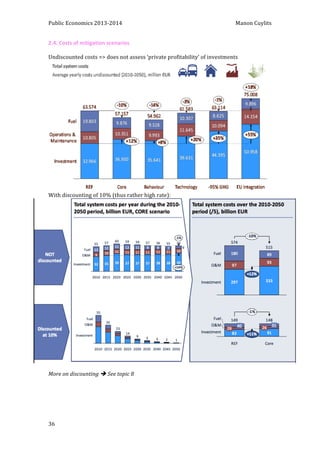
    Public Economics 2013-­‐2014 Manon Cuylits 2.4. Costs of mitigation scenarios Undiscounted costs => does not assess ‘private profitability’ of investments With discounting of 10% (thus rather high rate): More on discounting 36 è See topic 8
  • 10.
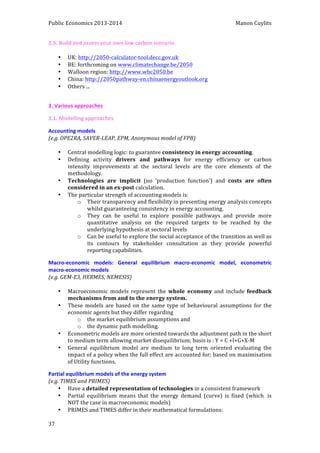
    Public Economics 2013-­‐2014 Manon Cuylits 2.5. Build and assess your own low carbon scenario 37 • UK: http://2050-­‐calculator-­‐tool.decc.gov.uk • BE: forthcoming on www.climatechange.be/2050 • Walloon region: http://www.wbc2050.be • China: http://2050pathway-­‐en.chinaenergyoutlook.org • Others ... 3. Various approaches 3.1. Modelling approaches Accounting models (e.g. OPE2RA, SAVER-­‐LEAP, EPM, Anonymous model of FPB) • Central modelling logic: to guarantee consistency in energy accounting. • Defining activity drivers and pathways for energy efficiency or carbon intensity improvements at the sectoral levels are the core elements of the methodology. • Technologies are implicit (no ‘production function’) and costs are often considered in an ex-­‐post calculation. • The particular strength of accounting models is: o Their transparency and flexibility in presenting energy analysis concepts whilst guaranteeing consistency in energy accounting. o They can be useful to explore possible pathways and provide more quantitative analysis on the required targets to be reached by the underlying hypothesis at sectoral levels o Can be useful to explore the social acceptance of the transition as well as its contours by stakeholder consultation as they provide powerful reporting capabilities. Macro-­‐economic models: General equilibrium macro-­‐economic model, econometric macro-­‐economic models (e.g. GEM-­‐E3, HERMES, NEMESIS) • Macroeconomic models represent the whole economy and include feedback mechanisms from and to the energy system. • These models are based on the same type of behavioural assumptions for the economic agents but they differ regarding o the market equilibrium assumptions and o the dynamic path modelling. • Econometric models are more oriented towards the adjustment path in the short to medium term allowing market disequilibrium; basis is : Y = C +I+G+X-­‐M • General equilibrium model are medium to long term oriented evaluating the impact of a policy when the full effect are accounted for; based on maximisation of Utility functions. Partial equilibrium models of the energy system (e.g. TIMES and PRIMES) • Have a detailed representation of technologies in a consistent framework • Partial equilibrium means that the energy demand (curve) is fixed (which is NOT the case in macroeconomic models) • PRIMES and TIMES differ in their mathematical formulations:
  • 11.
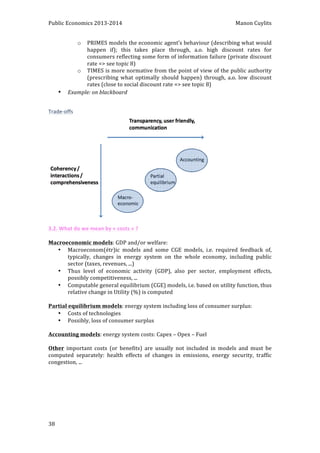
    Public Economics 2013-­‐2014 Manon Cuylits 38 o PRIMES models the economic agent’s behaviour (describing what would happen if); this takes place through, a.o. high discount rates for consumers reflecting some form of information failure (private discount rate => see topic 8) o TIMES is more normative from the point of view of the public authority (prescribing what optimally should happen) through, a.o. low discount rates (close to social discount rate => see topic 8) • Example: on blackboard Trade-­‐offs 3.2. What do we mean by « costs » ? Macroeconomic models: GDP and/or welfare: • Macroeconom(étr)ic models and some CGE models, i.e. required feedback of, typically, changes in energy system on the whole economy, including public sector (taxes, revenues, ...) • Thus level of economic activity (GDP), also per sector, employment effects, possibly competitiveness, ... • Computable general equilibrium (CGE) models, i.e. based on utility function, thus relative change in Utility (%) is computed Partial equilibrium models: energy system including loss of consumer surplus: • Costs of technologies • Possibly, loss of consumer surplus Accounting models: energy system costs: Capex – Opex – Fuel Other important costs (or benefits) are usually not included in models and must be computed separately: health effects of changes in emissions, energy security, traffic congestion, ...
  • 12.
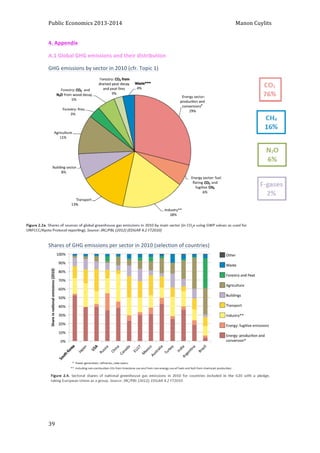
    Public Economics 2013-­‐2014 Manon Cuylits 4. Appendix A.1 Global GHG emissions and their distribution GHG emissions by sector in 2010 (cfr. Topic 1) Shares of GHG emissions per sector in 2010 (selection of countries) 39
  • 13.
    Public Economics 2013-­‐2014 Manon Cuylits A.2 What are negative emissions? Negative emissions IPCC scenarios to keep temperature rise below 2°C indicate that it might be required to reduce emissions below 0 (i.e. net absorption of carbon dioxide). What are negative emissions? IEA (2013), Box 1.1, p.17: Readings 40 • Pestiaux, J., Cornet, M., Duerinck, J., Laes, E., Lodewijks, P., Meynaerts, E., Renders, N. and Vermeulen, P. (2013), Scenarios for a low carbon Belgium by 2050, Final Report, Study performed for the Climate Change Section of the Federal Public Service Health, Food Chain Saftey and Environment, forthcoming (www.climatechange.be/2050) • IEA (2013), Redrawing the energy-­‐climate map, World Energy Outlook Special Report. • Duerinck, J. (2012), Transition towards a low carbon society in 2050: Status of long term modelling in Belgium, Mimeo (forthcoming on www.climatechange.be/2050)