Shardul Agrawala
Head of Environment and Economy Integration Division
Environment Directorate
Bocconi University, Milan
May 18 2015
TRANSFORMATION OF THE ECONOMIC SYSTEM,
GREEN FISCAL REFORM AND GREEN GROWTH:
Some Observations from recent OECD work
2
Outline
 The green transformation challenge (focus on climate)
 Misalignments in tax structures for a low carbon transformation
 Concerns about equity, competitiveness and growth
3
1. The transformation challenge on climate
IPCC Working Group III Fifth
Assessment report (2014)
 Clear, credible, stringent and economy wide GHG mitigation
targets
 Covering all major emission sources, sectors, countries would lower costs and
competitiveness concerns
 Putting a visible and credible price on CO2 and other GHGs
 Foster innovation and support for clean technologies
 Targeted government support for R&D
 Policies to reduce financial risks for investing and deploying low carbon
technologies
 Complement carbon pricing with well designed regulations (e.g.
fuel, vehicle and building efficiency standards)
Strong climate policy signals clearly needed
But … climate policy comes on top of existing goals and
instruments, developed for a fossil-fuel based economy
ECONOMIC
TRADE
COMPETITION
FISCAL
DEVELOPMENT
COOPERATION
SOCIAL
INVESTMENT
CLIMATE
2. Misalignments between fiscal structures and
green transformation
 Most tax systems were set up when environmental damage and scarcity
were low on the policy agenda
 The primary motivation of many green taxes was often revenue raising
than environmental protection
 Increasing number of countries are making progress on environmental
tax reforms
 But a number of misalignments persist between tax structures and
incentives needed for green transformation
Source: Taxing Energy Use in the OECD & Key Partner & Associate Countries (OECD, 2015, forthcoming)
7
2.2 Energy taxes lack a consistent carbon price signal
Weighted average
effective tax rates
Transport Heating & process Electricity All fuels
Energy
EUR/GJ 5.0 0.3 0.3 1.1
Carbon emissions
EUR/tonne CO2
70.1 3.1 3.4 14.8
Effective tax rates on energy and carbon in OECD 34 and 7 Partner countries
EXAMPLE – ENERGY MAP FOR THE UK
• Source | OECD | Taxing Energy Use | 2013
Source: Taxing Energy Use in the OECD & Key Partner & Associate Countries (OECD, 2015, forthcoming)
DEU
CHE
POL
IND
BRA
ZAF
0
25
50
75
100
100 300 500 700 900
Economy-wide effective tax rate on carbon emissions from energy (EUR per tonne CO2)
Carbon emissions per unit of PPP-adjusted GDP (tonnes CO2 per million USD)
AUS
AUT
BEL
CAN
CHL
CZE
DNK
EST
FIN
FRA
DEU
GRC
HUN
ISL
IRL
ITA
ISR
JPN
KOR
LUX
MEX
NLD
NZL
NOR
POL
PRT
SVK
ESP
SVN
SWE
CHE
TUR
GBR
USA
ARG
BRA CHN
IND
IDN RUS
ZAF
0
25
50
75
100
100 300 500 700 900
Economy-wide effective tax rate on carbon emissions from energy (EUR per tonne CO2)
Carbon emissions per unit of PPP-adjusted GDP (tonnes CO2 per million USD)
9
2.3 Economy-wide effective tax rates on carbon vary
widely … and correlate with with carbon intensity of GDP
2.4 Diesel is consistently taxed much lower than gasoline
0
10
20
30
TUR
NLD
NOR
ITA
GBR
GRC
DEU
FIN
SWE
BEL
FRA
CHE
IRL
DNK
ISR
PRT
JPN
AUT
SVK
CZE
KOR
SVN
ESP
=>ARG
LUX
EST
ISL
HUN
POL
NZL
CHL
=>ZAF
AUS
=>IND
=>CHN
CAN
USA
MEX
=>RUS
=>IDN
=>BRA
Gasoline (road use) Diesel (road use)
Tax rate (EUR per GJ)
Source: OECD calculations
10
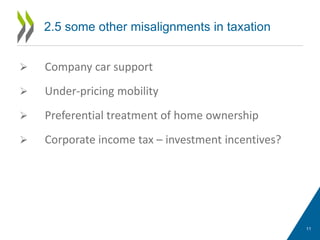
 Company car support
 Under-pricing mobility
 Preferential treatment of home ownership
 Corporate income tax – investment incentives?
11
2.5 some other misalignments in taxation
12
III. Concerns about equity, competitiveness and
growth
 Many misalignments at least partly motivated by real or
perceived concerns about social equity, competitiveness and
economic growth
 Work by OECD on these aspects has involved a number of
techniques including meta-analysis, micro-simulation and
CGE models, and ex post empirical studies.
 Some highlights from recent work follow
13
III a. Income distribution concerns: OECD
experiences
 Environmental taxes can have significant effects on low income
households.
 Distributional effects depend upon the tax (Flues et al. 2014).
 Transport fuel taxes not regressive
 Heating fuel taxes slightly regressive
 Electricity taxes more regressive than
heating fuel taxes
 Some empirical evidence (1990-2011) that environmentally related
taxes in OECD countries associated with slight increase in
inequality in income sources (Oueslati et al. 2015)
 However this effect is fully offset if revenue recycling was part of the reform
-6
-4
-2
0
2
4
6
8
10
12
14
1 11 21 31 41 51 61 71 81 91
Income centile groups
Real income variation in 2020 (% baseline)
Cash transfers
Labour support
Food subsidies
Commodity price effect
Source: ENV-Linkages
Total effect
An Emerging Economy case: Modelling distributional effects of fossil
fuel subsidy phase out by 2020 in Indonesia
Durand Lasserve et al. 2015
15
III b. Competitiveness concerns
 Environmentally related taxes are intended to affect production
decisions and will have a disproportionate impact on large polluters
 Possible competitiveness impacts, however, are often overstated
 German electricity tax: no robust impact of the reduced marginal tax rate
on firm’s turnover, investments, value-added, turnover abroad and
employment (Flues and Lutz, 2015)
 UK Climate Change Levy: reductions in energy intensity and electricity use,
without discernible impact on employment, gross output or productivity
(Martin et al., 2011)
 Carbon tax in British Columbia: no competitive disadvantage for trade in
the agricultural sector (Rivers and Schaufele, 2014
16
III b. Competitiveness concerns
 Lead-in time for affected firms to undertake mitigation
measures can alleviate some competitiveness concerns
 … As can recycling revenues from environmental taxes
back to affected firms (while maintaining the marginal
abatement incentive)
 However rate reductions and exemptions, for example for
heavy industry, shift some of the abatement burden to
others, or result in an inferior environmental outcome
0
2
4
6
8
10
12
14
EUacting
alone
AnnexI
AnnexIand
Brazil,
Indiaand
China
Leakagerates,%
2050
Source: OECD (2009), The Economics of Climate Change Mitigation; Lanzi et al. 2014
The most effective response to competitiveness and leakage
concerns is coordinated action across countries
 Environmental policies aim primarily at environmental outcomes.
 But, will also affect economic outcomes:
 e.g. they change relative prices and incentives to innovate and
invest.
 e.g. they can distort competition.
 Empirical study across 24 OECD countries to examine:
 What is the effect of more stringent environmental policies on productivity growth ?
 What is the relationship between environmental policy stringency and the
administrative and other burdens it might impose ?
18
IIIc. Concerns about productivity growth
Environmental policy stringency and burdens
vary considerably across countries (and over
time)
B. Environmental policy stringency proxy (OECD, de jure)
AUS
AUT
BEL
CAN
CHE
DEU
DNK
ESP
GBR
GRC
HUN
ITA
JPN
NLD
NOR
POL
PRT
SVK
SWE
USA
IRL
KOR
FRA
1
2
3
4
5
0,5 1 1,5 2 2,5 3 3,5 4 4,5
Total BEEP indicator
OECD EPS
(de jure, 2012)
Morestringentenvironmentalpolicies
Policies more burdensome to entry and competition
Negative
anticipation
effect
Positive rebound
effect
Increasing Environmental Policy Stringency
does not harm productivity growth
Stringent environmental policies can be
designed without imposing burdens to entry
and competition
Some insights on environmental policies and economic outcomes
21
Thank you
shardul.agrawala@oecd.org

Transofmation of the economic system: green reform and green growth

  • 1.
    Shardul Agrawala Head ofEnvironment and Economy Integration Division Environment Directorate Bocconi University, Milan May 18 2015 TRANSFORMATION OF THE ECONOMIC SYSTEM, GREEN FISCAL REFORM AND GREEN GROWTH: Some Observations from recent OECD work
  • 2.
    2 Outline  The greentransformation challenge (focus on climate)  Misalignments in tax structures for a low carbon transformation  Concerns about equity, competitiveness and growth
  • 3.
    3 1. The transformationchallenge on climate IPCC Working Group III Fifth Assessment report (2014)
  • 4.
     Clear, credible,stringent and economy wide GHG mitigation targets  Covering all major emission sources, sectors, countries would lower costs and competitiveness concerns  Putting a visible and credible price on CO2 and other GHGs  Foster innovation and support for clean technologies  Targeted government support for R&D  Policies to reduce financial risks for investing and deploying low carbon technologies  Complement carbon pricing with well designed regulations (e.g. fuel, vehicle and building efficiency standards) Strong climate policy signals clearly needed
  • 5.
    But … climatepolicy comes on top of existing goals and instruments, developed for a fossil-fuel based economy ECONOMIC TRADE COMPETITION FISCAL DEVELOPMENT COOPERATION SOCIAL INVESTMENT CLIMATE
  • 6.
    2. Misalignments betweenfiscal structures and green transformation  Most tax systems were set up when environmental damage and scarcity were low on the policy agenda  The primary motivation of many green taxes was often revenue raising than environmental protection  Increasing number of countries are making progress on environmental tax reforms  But a number of misalignments persist between tax structures and incentives needed for green transformation
  • 7.
    Source: Taxing EnergyUse in the OECD & Key Partner & Associate Countries (OECD, 2015, forthcoming) 7 2.2 Energy taxes lack a consistent carbon price signal Weighted average effective tax rates Transport Heating & process Electricity All fuels Energy EUR/GJ 5.0 0.3 0.3 1.1 Carbon emissions EUR/tonne CO2 70.1 3.1 3.4 14.8 Effective tax rates on energy and carbon in OECD 34 and 7 Partner countries
  • 8.
    EXAMPLE – ENERGYMAP FOR THE UK • Source | OECD | Taxing Energy Use | 2013
  • 9.
    Source: Taxing EnergyUse in the OECD & Key Partner & Associate Countries (OECD, 2015, forthcoming) DEU CHE POL IND BRA ZAF 0 25 50 75 100 100 300 500 700 900 Economy-wide effective tax rate on carbon emissions from energy (EUR per tonne CO2) Carbon emissions per unit of PPP-adjusted GDP (tonnes CO2 per million USD) AUS AUT BEL CAN CHL CZE DNK EST FIN FRA DEU GRC HUN ISL IRL ITA ISR JPN KOR LUX MEX NLD NZL NOR POL PRT SVK ESP SVN SWE CHE TUR GBR USA ARG BRA CHN IND IDN RUS ZAF 0 25 50 75 100 100 300 500 700 900 Economy-wide effective tax rate on carbon emissions from energy (EUR per tonne CO2) Carbon emissions per unit of PPP-adjusted GDP (tonnes CO2 per million USD) 9 2.3 Economy-wide effective tax rates on carbon vary widely … and correlate with with carbon intensity of GDP
  • 10.
    2.4 Diesel isconsistently taxed much lower than gasoline 0 10 20 30 TUR NLD NOR ITA GBR GRC DEU FIN SWE BEL FRA CHE IRL DNK ISR PRT JPN AUT SVK CZE KOR SVN ESP =>ARG LUX EST ISL HUN POL NZL CHL =>ZAF AUS =>IND =>CHN CAN USA MEX =>RUS =>IDN =>BRA Gasoline (road use) Diesel (road use) Tax rate (EUR per GJ) Source: OECD calculations 10
  • 11.
     Company carsupport  Under-pricing mobility  Preferential treatment of home ownership  Corporate income tax – investment incentives? 11 2.5 some other misalignments in taxation
  • 12.
    12 III. Concerns aboutequity, competitiveness and growth  Many misalignments at least partly motivated by real or perceived concerns about social equity, competitiveness and economic growth  Work by OECD on these aspects has involved a number of techniques including meta-analysis, micro-simulation and CGE models, and ex post empirical studies.  Some highlights from recent work follow
  • 13.
    13 III a. Incomedistribution concerns: OECD experiences  Environmental taxes can have significant effects on low income households.  Distributional effects depend upon the tax (Flues et al. 2014).  Transport fuel taxes not regressive  Heating fuel taxes slightly regressive  Electricity taxes more regressive than heating fuel taxes  Some empirical evidence (1990-2011) that environmentally related taxes in OECD countries associated with slight increase in inequality in income sources (Oueslati et al. 2015)  However this effect is fully offset if revenue recycling was part of the reform
  • 14.
    -6 -4 -2 0 2 4 6 8 10 12 14 1 11 2131 41 51 61 71 81 91 Income centile groups Real income variation in 2020 (% baseline) Cash transfers Labour support Food subsidies Commodity price effect Source: ENV-Linkages Total effect An Emerging Economy case: Modelling distributional effects of fossil fuel subsidy phase out by 2020 in Indonesia Durand Lasserve et al. 2015
  • 15.
    15 III b. Competitivenessconcerns  Environmentally related taxes are intended to affect production decisions and will have a disproportionate impact on large polluters  Possible competitiveness impacts, however, are often overstated  German electricity tax: no robust impact of the reduced marginal tax rate on firm’s turnover, investments, value-added, turnover abroad and employment (Flues and Lutz, 2015)  UK Climate Change Levy: reductions in energy intensity and electricity use, without discernible impact on employment, gross output or productivity (Martin et al., 2011)  Carbon tax in British Columbia: no competitive disadvantage for trade in the agricultural sector (Rivers and Schaufele, 2014
  • 16.
    16 III b. Competitivenessconcerns  Lead-in time for affected firms to undertake mitigation measures can alleviate some competitiveness concerns  … As can recycling revenues from environmental taxes back to affected firms (while maintaining the marginal abatement incentive)  However rate reductions and exemptions, for example for heavy industry, shift some of the abatement burden to others, or result in an inferior environmental outcome
  • 17.
    0 2 4 6 8 10 12 14 EUacting alone AnnexI AnnexIand Brazil, Indiaand China Leakagerates,% 2050 Source: OECD (2009),The Economics of Climate Change Mitigation; Lanzi et al. 2014 The most effective response to competitiveness and leakage concerns is coordinated action across countries
  • 18.
     Environmental policiesaim primarily at environmental outcomes.  But, will also affect economic outcomes:  e.g. they change relative prices and incentives to innovate and invest.  e.g. they can distort competition.  Empirical study across 24 OECD countries to examine:  What is the effect of more stringent environmental policies on productivity growth ?  What is the relationship between environmental policy stringency and the administrative and other burdens it might impose ? 18 IIIc. Concerns about productivity growth
  • 19.
    Environmental policy stringencyand burdens vary considerably across countries (and over time)
  • 20.
    B. Environmental policystringency proxy (OECD, de jure) AUS AUT BEL CAN CHE DEU DNK ESP GBR GRC HUN ITA JPN NLD NOR POL PRT SVK SWE USA IRL KOR FRA 1 2 3 4 5 0,5 1 1,5 2 2,5 3 3,5 4 4,5 Total BEEP indicator OECD EPS (de jure, 2012) Morestringentenvironmentalpolicies Policies more burdensome to entry and competition Negative anticipation effect Positive rebound effect Increasing Environmental Policy Stringency does not harm productivity growth Stringent environmental policies can be designed without imposing burdens to entry and competition Some insights on environmental policies and economic outcomes
  • 21.