LECTURE:08 Energy Planning & Sustainability M. A. Kamal, Ph.D Director General National Academy for Planning and Development
 
Outline: Introduction Sustainable energy Energy Sources Pillars of sustainable energy Sustainable energy sources Consumable Energy Energy planning  Energy Planning Framework Principles of sustainable development Sustainability dimensions in relationship with energy Sustainable energy planning Characteristics of sustainable energy planning Energy and the Millennium Development Goals Recommendations for LDC PRINCIPLES AND GOALS  OF ENERGY POLICY Conclusion
1.1 Energy is central to sustainable development and  poverty  reduction efforts. 1.2 It affects all aspects of development --social, economic,  and environmental-- including livelihoods, access to  water, agricultural productivity, health, population levels,  education, and gender-related issues.  1.3 None of the Millennium Development Goals (MDGs) can  be met without major improvement in the quality  and  quantity of energy services in developing countries. 1.4 Provision of energy services, from the supply side to  transmission/distribution and use, must include  management, and good management requires tools.  Energy planning is a tool for managing the community  energy system through assessing and balancing supply  and demand. 1. Introduction
1.5 Energy has strong relationships with all the three  main dimensions of sustainable development. 1.6 Human well-being and improvement of social  welfare greatly depend upon affordable access to  energy services. 1.7  Almost all the goods and services that are necessary  for communities’ development are linked to the  provision of sufficient energy supply. 1.8 Energy is also among the important driving  forces  that can affect the environment both by extraction  of energy from natural resources and by energy use.
2. Sustainable Energy 2.1 Right from the beginning in the 1980s, when the  term ‘sustainable development’ came into global  consideration, energy was seen as an important  aspect.  2.2 The key role of energy in future development  is  emphasized in the book ‘Our Common Future’ (1987),  reflecting its relationship with environmental,  economic, social and institutional aspects, as well as  the dilemmas associated with its contribution to a  sustainable future. 2.3 Sustainable energy is the provision of energy that  meets the needs of the present without compromising  the ability of future generations to meet their needs .
3.1 The primary energy sources that are used for  providing these services are mainly non-renewable  (oil, natural gas, coal, peat). Utilization of renewable  energy sources (wind, solar, geothermal, hydro  power, wood, tidal, etc.) has also been developed  over the last decades; however, their share in total  primary energy supply is still low.  3.  ENERGY SOURCES
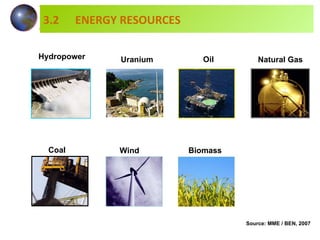
Hydropower Uranium Coal Natural Gas Oil Biomass Wind Source: MME / BEN, 2007 3.2 ENERGY RESOURCES
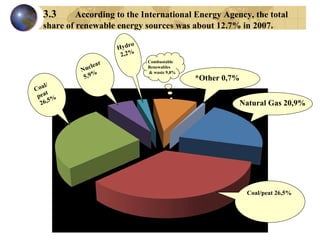
Natural Gas 20,9% *Other 0,7%  Combustable  Renewables & waste 9,8%  Hydro 2,2% Nuclear  5,9%  Coal/ peat  26,5% Coal/peat 26,5%  3.3 According to the International Energy Agency, the total  share of renewable energy sources was about 12.7% in 2007.
4. Pillars of sustainable energy 4.1 The twin pillars of sustainable energy are:  Energy efficiency : "Any energy generation, efficiency & conservation source where: Resources are available to enable massive scaling to become a significant portion of energy generation, long term, preferably 100 years.." – Invest, a green technology non-profit organization. Energy Intensity is the amount of energy consumed per unit of service or activity. Embodied energy may be reduced by designing durable, adaptable products and buildings which are made from local, renewable materials. Renewable energy: naturally replenished
5.1 Sustainable energy sources are most  often regarded as  all renewable energy  sources, such as hydroelectricity, solar  energy, wind energy, wave power,  geothermal energy, bio-energy, and tidal  power.  5.2 It usually also includes technologies  that improve energy efficiency. 5.  SUSTAINABLE ENERGY SOURCES
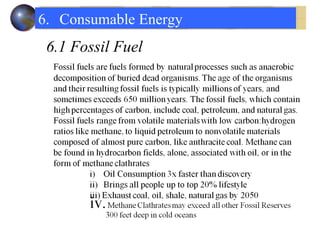
6.1 Fossil Fuel 6. Consumable Energy
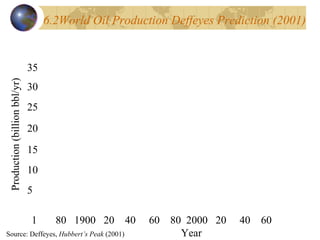
6.2World Oil Production Deffeyes Prediction (2001) 35 30 25 20 15 10 5 Production (billion bbl/yr) 80  1900  20  40  60  80  2000  20  40  60 Year Source: Deffeyes,  Hubbert’s Peak  (2001)
6.3   Consumable Energy (Nuclear) i) Fission power plants exist, fusion plants not yet.  ii) Brings 10 billion people up to top 20% lifestyle Need 8,000 additional uranium plants Exhaust all uranium fuel in 10 years iii) If we use breeder reactors  Uranium then adds plutonium and thorium to fuel cycle Uranium will last 700 years (2x life of coal)
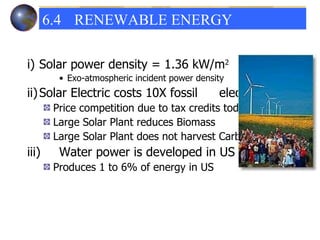
i) Solar power density = 1.36 kW/m 2 Exo-atmospheric incident power density ii) Solar Electric costs 10X fossil  electric Price competition due to tax credits today Large Solar Plant reduces Biomass Large Solar Plant does not harvest Carbon iii) Water power is developed in US Produces 1 to 6% of energy in US 6.4 RENEWABLE ENERGY
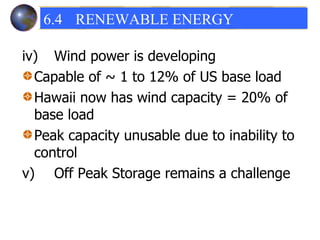
iv) Wind power is developing  Capable of ~ 1 to 12% of US base load Hawaii now has wind capacity = 20% of base load Peak capacity unusable due to inability to control  v) Off Peak Storage remains a challenge 6.4 RENEWABLE ENERGY
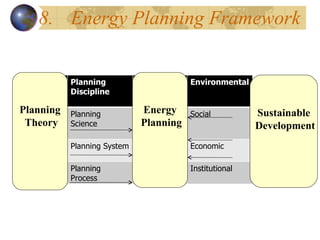
7. Energy planning  7.1 Energy planning is known as a means  to manage community energy systems.  It has been(and still is)applied in many  countries as a tool for setting up future  energy policies ranging from national  to local levels. 7.2 Energy planning and sustainability  aspects has two theoretical pillars: Planning Theory Principles of Sustainable Development
8. Energy Planning Framework Planning Theory Energy Planning Sustainable Development Planning Discipline Environmental Planning Science Social Planning System Economic Planning Process Institutional
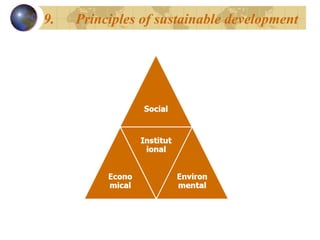
9. Principles of sustainable development
10. Sustainability dimensions in relationship with energy 10.1 Energy and the environmental dimension 10.2 Energy and economic dimension  10.3 Energy and the social dimension  10.4 Energy and the institutional dimension
11. Sustainable energy planning 11.1 The energy crisis of the 1970s has increased the need for  application of energy planning as a tool for better  management of community energy systems. 11.2 Adding the term ‘sustainable development’ into the  political  agenda in 1980s has increasingly engaged  environmental,  economic and social issues in decision-making and has also  influenced planning processes. 11.3 These changes, together with technological developments,  have added to the complexity of community energy  systems. 11.4  New approaches to existing  energy planning methods  have been taken to be able to deal with the new  circumstances (or in order to adapt them for the new  sustainability paradigm) by, e.g., increasing the share of  renewable energy resources in energy supply systems,  focusing on more efficient energy production i.e.  co-generation and CHP utilization, etc.
12.Characteristics of sustainable energy planning  12.1 Integration of the sustainability  dimensions in energy planning  12.2 Institutional guidelines  12.3 Sufficient public private participation  12.4 Long-term planning perspectives  12.5 Flexibility against unexpected changes
13. Energy and the Millennium Development Goals 13.1 Many of the LDCs are off-track in meeting  the Millennium Development Goals(MDGs).  The crisis is most severe in sub-Saharan  Africa where there is continuing food  insecurity, disturbingly high child and  maternal mortality, growing numbers of  people living in  slums and an overall rise  in extreme poverty. In South Asia there  has been  little progress in meeting the  MDGs and a majority of the population is  living below the poverty line.
13.2 The energy challenges that underlie MDG achievement  are best illustrated by the number of people who do  not have access to modern energy services. It is  estimated that worldwide there are 2.5 billion people  who rely on traditional fuels such as wood, charcoal,  and dung as their principal source of energy for  cooking and heating. 13.3 Almost 1.6 billion people have no access to electricity.  In light of these daunting figures, energy’s important  role in underpinning MDG achievement is now being  recognized by the international development  community. This is due to the fact that energy is a  prerequisite for meeting all of the MDGs because of its  inherent linkage with poverty alleviation, education,  gender equity, health, and the protection of the  environment
14. Recommendations for LDC Recommendations for LDC to Overcome the energy crises are: Integrate energy considerations into MDG-based national development strategies Mobilization of investments Develop institutional capacity
15.1 Energy Security 15.2 Reasonable Tariff Policy 15.3 Attendance Services for Entire Population 15.4 Minimum Cost Expansion considering Social-environmental Constraints 15.5 Strengthening of Planning 15.6 Matrix Diversification 15.7 National Integration 15.8 National Energy Sources Fostering, Renewable and Competitive 15.9 National Technology Development 15. PRINCIPLES AND GOALS  OF ENERGY POLICY
16.1 The world is changing. There is no denying this reality  because we come face to face with it every day—every time  we swipe our debit cards at the grocery store or at the  gasoline pump and especially as we sit back in the comfort  and confines of our homes and watch the evening news in a  state of constant apprehension. 16.2 As the world transforms before our eyes, global trepidation  over climate change and our energy use grows. 16.3  Energy consumption is of particular concern because energy  supports our economies and lifestyles; we need energy to  enjoy all the benefits and conveniences of modern life  especially in developed nations. 16.4  Everything we consume and produce requires energy. It is  inevitable to search for Sustainable Energy to continue the  rhythm of life in the world. 16. Conclusion
Thank you

Energy planning & sustainability(L8)

  • 1.
    LECTURE:08 Energy Planning& Sustainability M. A. Kamal, Ph.D Director General National Academy for Planning and Development
  • 2.
  • 3.
    Outline: Introduction Sustainableenergy Energy Sources Pillars of sustainable energy Sustainable energy sources Consumable Energy Energy planning Energy Planning Framework Principles of sustainable development Sustainability dimensions in relationship with energy Sustainable energy planning Characteristics of sustainable energy planning Energy and the Millennium Development Goals Recommendations for LDC PRINCIPLES AND GOALS OF ENERGY POLICY Conclusion
  • 4.
    1.1 Energy iscentral to sustainable development and poverty reduction efforts. 1.2 It affects all aspects of development --social, economic, and environmental-- including livelihoods, access to water, agricultural productivity, health, population levels, education, and gender-related issues. 1.3 None of the Millennium Development Goals (MDGs) can be met without major improvement in the quality and quantity of energy services in developing countries. 1.4 Provision of energy services, from the supply side to transmission/distribution and use, must include management, and good management requires tools. Energy planning is a tool for managing the community energy system through assessing and balancing supply and demand. 1. Introduction
  • 5.
    1.5 Energy hasstrong relationships with all the three main dimensions of sustainable development. 1.6 Human well-being and improvement of social welfare greatly depend upon affordable access to energy services. 1.7 Almost all the goods and services that are necessary for communities’ development are linked to the provision of sufficient energy supply. 1.8 Energy is also among the important driving forces that can affect the environment both by extraction of energy from natural resources and by energy use.
  • 6.
    2. Sustainable Energy2.1 Right from the beginning in the 1980s, when the term ‘sustainable development’ came into global consideration, energy was seen as an important aspect. 2.2 The key role of energy in future development is emphasized in the book ‘Our Common Future’ (1987), reflecting its relationship with environmental, economic, social and institutional aspects, as well as the dilemmas associated with its contribution to a sustainable future. 2.3 Sustainable energy is the provision of energy that meets the needs of the present without compromising the ability of future generations to meet their needs .
  • 7.
    3.1 The primaryenergy sources that are used for providing these services are mainly non-renewable (oil, natural gas, coal, peat). Utilization of renewable energy sources (wind, solar, geothermal, hydro power, wood, tidal, etc.) has also been developed over the last decades; however, their share in total primary energy supply is still low. 3. ENERGY SOURCES
  • 8.
    Hydropower Uranium CoalNatural Gas Oil Biomass Wind Source: MME / BEN, 2007 3.2 ENERGY RESOURCES
  • 9.
    Natural Gas 20,9%*Other 0,7% Combustable Renewables & waste 9,8% Hydro 2,2% Nuclear 5,9% Coal/ peat 26,5% Coal/peat 26,5% 3.3 According to the International Energy Agency, the total share of renewable energy sources was about 12.7% in 2007.
  • 10.
    4. Pillars ofsustainable energy 4.1 The twin pillars of sustainable energy are: Energy efficiency : "Any energy generation, efficiency & conservation source where: Resources are available to enable massive scaling to become a significant portion of energy generation, long term, preferably 100 years.." – Invest, a green technology non-profit organization. Energy Intensity is the amount of energy consumed per unit of service or activity. Embodied energy may be reduced by designing durable, adaptable products and buildings which are made from local, renewable materials. Renewable energy: naturally replenished
  • 11.
    5.1 Sustainable energysources are most often regarded as all renewable energy sources, such as hydroelectricity, solar energy, wind energy, wave power, geothermal energy, bio-energy, and tidal power. 5.2 It usually also includes technologies that improve energy efficiency. 5. SUSTAINABLE ENERGY SOURCES
  • 12.
    6.1 Fossil Fuel6. Consumable Energy
  • 13.
    6.2World Oil ProductionDeffeyes Prediction (2001) 35 30 25 20 15 10 5 Production (billion bbl/yr) 80 1900 20 40 60 80 2000 20 40 60 Year Source: Deffeyes, Hubbert’s Peak (2001)
  • 14.
    6.3 Consumable Energy (Nuclear) i) Fission power plants exist, fusion plants not yet. ii) Brings 10 billion people up to top 20% lifestyle Need 8,000 additional uranium plants Exhaust all uranium fuel in 10 years iii) If we use breeder reactors Uranium then adds plutonium and thorium to fuel cycle Uranium will last 700 years (2x life of coal)
  • 15.
    i) Solar powerdensity = 1.36 kW/m 2 Exo-atmospheric incident power density ii) Solar Electric costs 10X fossil electric Price competition due to tax credits today Large Solar Plant reduces Biomass Large Solar Plant does not harvest Carbon iii) Water power is developed in US Produces 1 to 6% of energy in US 6.4 RENEWABLE ENERGY
  • 16.
    iv) Wind poweris developing Capable of ~ 1 to 12% of US base load Hawaii now has wind capacity = 20% of base load Peak capacity unusable due to inability to control v) Off Peak Storage remains a challenge 6.4 RENEWABLE ENERGY
  • 17.
    7. Energy planning 7.1 Energy planning is known as a means to manage community energy systems. It has been(and still is)applied in many countries as a tool for setting up future energy policies ranging from national to local levels. 7.2 Energy planning and sustainability aspects has two theoretical pillars: Planning Theory Principles of Sustainable Development
  • 18.
    8. Energy PlanningFramework Planning Theory Energy Planning Sustainable Development Planning Discipline Environmental Planning Science Social Planning System Economic Planning Process Institutional
  • 19.
    9. Principles ofsustainable development
  • 20.
    10. Sustainability dimensionsin relationship with energy 10.1 Energy and the environmental dimension 10.2 Energy and economic dimension 10.3 Energy and the social dimension 10.4 Energy and the institutional dimension
  • 21.
    11. Sustainable energyplanning 11.1 The energy crisis of the 1970s has increased the need for application of energy planning as a tool for better management of community energy systems. 11.2 Adding the term ‘sustainable development’ into the political agenda in 1980s has increasingly engaged environmental, economic and social issues in decision-making and has also influenced planning processes. 11.3 These changes, together with technological developments, have added to the complexity of community energy systems. 11.4 New approaches to existing energy planning methods have been taken to be able to deal with the new circumstances (or in order to adapt them for the new sustainability paradigm) by, e.g., increasing the share of renewable energy resources in energy supply systems, focusing on more efficient energy production i.e. co-generation and CHP utilization, etc.
  • 22.
    12.Characteristics of sustainableenergy planning 12.1 Integration of the sustainability dimensions in energy planning 12.2 Institutional guidelines 12.3 Sufficient public private participation 12.4 Long-term planning perspectives 12.5 Flexibility against unexpected changes
  • 23.
    13. Energy andthe Millennium Development Goals 13.1 Many of the LDCs are off-track in meeting the Millennium Development Goals(MDGs). The crisis is most severe in sub-Saharan Africa where there is continuing food insecurity, disturbingly high child and maternal mortality, growing numbers of people living in slums and an overall rise in extreme poverty. In South Asia there has been little progress in meeting the MDGs and a majority of the population is living below the poverty line.
  • 24.
    13.2 The energychallenges that underlie MDG achievement are best illustrated by the number of people who do not have access to modern energy services. It is estimated that worldwide there are 2.5 billion people who rely on traditional fuels such as wood, charcoal, and dung as their principal source of energy for cooking and heating. 13.3 Almost 1.6 billion people have no access to electricity. In light of these daunting figures, energy’s important role in underpinning MDG achievement is now being recognized by the international development community. This is due to the fact that energy is a prerequisite for meeting all of the MDGs because of its inherent linkage with poverty alleviation, education, gender equity, health, and the protection of the environment
  • 25.
    14. Recommendations forLDC Recommendations for LDC to Overcome the energy crises are: Integrate energy considerations into MDG-based national development strategies Mobilization of investments Develop institutional capacity
  • 26.
    15.1 Energy Security15.2 Reasonable Tariff Policy 15.3 Attendance Services for Entire Population 15.4 Minimum Cost Expansion considering Social-environmental Constraints 15.5 Strengthening of Planning 15.6 Matrix Diversification 15.7 National Integration 15.8 National Energy Sources Fostering, Renewable and Competitive 15.9 National Technology Development 15. PRINCIPLES AND GOALS OF ENERGY POLICY
  • 27.
    16.1 The worldis changing. There is no denying this reality because we come face to face with it every day—every time we swipe our debit cards at the grocery store or at the gasoline pump and especially as we sit back in the comfort and confines of our homes and watch the evening news in a state of constant apprehension. 16.2 As the world transforms before our eyes, global trepidation over climate change and our energy use grows. 16.3 Energy consumption is of particular concern because energy supports our economies and lifestyles; we need energy to enjoy all the benefits and conveniences of modern life especially in developed nations. 16.4 Everything we consume and produce requires energy. It is inevitable to search for Sustainable Energy to continue the rhythm of life in the world. 16. Conclusion
  • 28.