GOVERNMENT ENGINEERING COLLEGE VALSAD
Subject
CHEMISTRY (2110001)
Topic: Green Chemistry Introduction and
First Five Rule with Example
Name: Moradiya Milan L
Enrollment No. 160190105043
Guidance By: Prof. Bhadresh Sudani
Green Chemistry is about Reducing
 Waste
 Materials
 Hazards
 Risks
 Energy
 Cost
Definition
 Green Chemistry is the utilization of set of principle that
reduces or eliminates the use or generation of hazardous
substances in the design, manufacture and application of
chemical products.
 The Green Chemistry program supports the invention of
more environmentally friendly chemical process which
reduce or even eliminate the generation of hazardous
substances
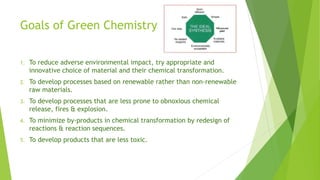
Goals of Green Chemistry
1. To reduce adverse environmental impact, try appropriate and
innovative choice of material and their chemical transformation.
2. To develop processes based on renewable rather than non-renewable
raw materials.
3. To develop processes that are less prone to obnoxious chemical
release, fires & explosion.
4. To minimize by-products in chemical transformation by redesign of
reactions & reaction sequences.
5. To develop products that are less toxic.
Goals of Green Chemistry
6. To develop products that degrade more rapidly in the environment
than the current products.
7. To reduce the requirements for hazardous persistent solvents &
extractants in chemical processes.
8. To improve energy efficiency by developing low temperature & low
pressure processes using new catalysts.
9. To develop efficient & reliable methods to monitor the processes for
better & improved controls
Principles of
Green Chemistry
The 5 Principles of Green Chemistry
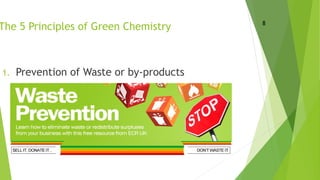
1. Prevention of Waste or by-products
8
Prevention of Waste or by-products
“It is better to prevent waste than to treat or clean up waste
after it is formed”
Example
Acetanilide is prepared from aniline by acetylating it with acetic
anhydride in the presence of glacial acetic acid. Aniline or
phenylamine is a primary amine with molecular formula C6H5NH2.
The byproduct is obtained as Acetic Acid (CH3COOH)
Prevention of Waste or by-products
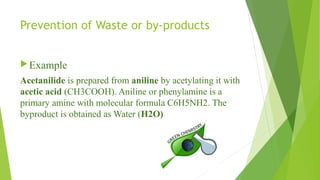
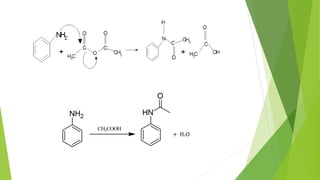
Example
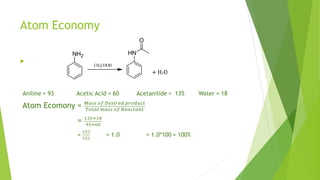
Acetanilide is prepared from aniline by acetylating it with
acetic acid (CH3COOH). Aniline or phenylamine is a
primary amine with molecular formula C6H5NH2. The
byproduct is obtained as Water (H2O)
+ H2O
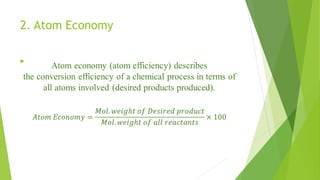
2. Atom Economy
Atom economy (atom efficiency) describes
the conversion efficiency of a chemical process in terms of
all atoms involved (desired products produced).
  
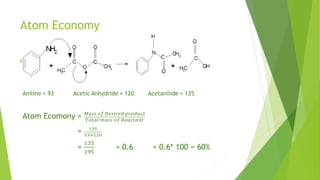
Atom Economy
Aniline = 93 Acetic Anhydride = 120 Acetanilide = 135
Atom Ecomony =
=
= = 0.6 = 0.6* 100 = 60%
  
Atom Economy
Aniline = 93 Acetic Acid = 60 Acetanilide = 135 Water = 18
Atom Ecomony =
=
= = 1.0 = 1.0*100 = 100%
  
+ H2O
3. Minimization of hazardous products
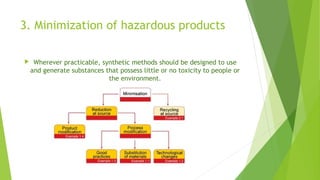
 Wherever practicable, synthetic methods should be designed to use
and generate substances that possess little or no toxicity to people or
the environment.
4. Designing Safer Chemicals
 Chemical products should be designed to effect their
desired function while minimising their toxicity.
5. Safer Solvents & Auxiliaries
 “The use of auxiliary substances (e.g. solvents, separation
agents, etc.) should be made unnecessary wherever
possible, and innocuous when used”

Green chemistry

  • 1.
    GOVERNMENT ENGINEERING COLLEGEVALSAD Subject CHEMISTRY (2110001)
  • 2.
    Topic: Green ChemistryIntroduction and First Five Rule with Example Name: Moradiya Milan L Enrollment No. 160190105043 Guidance By: Prof. Bhadresh Sudani
  • 3.
    Green Chemistry isabout Reducing  Waste  Materials  Hazards  Risks  Energy  Cost
  • 4.
    Definition  Green Chemistryis the utilization of set of principle that reduces or eliminates the use or generation of hazardous substances in the design, manufacture and application of chemical products.  The Green Chemistry program supports the invention of more environmentally friendly chemical process which reduce or even eliminate the generation of hazardous substances
  • 5.
    Goals of GreenChemistry 1. To reduce adverse environmental impact, try appropriate and innovative choice of material and their chemical transformation. 2. To develop processes based on renewable rather than non-renewable raw materials. 3. To develop processes that are less prone to obnoxious chemical release, fires & explosion. 4. To minimize by-products in chemical transformation by redesign of reactions & reaction sequences. 5. To develop products that are less toxic.
  • 6.
    Goals of GreenChemistry 6. To develop products that degrade more rapidly in the environment than the current products. 7. To reduce the requirements for hazardous persistent solvents & extractants in chemical processes. 8. To improve energy efficiency by developing low temperature & low pressure processes using new catalysts. 9. To develop efficient & reliable methods to monitor the processes for better & improved controls
  • 7.
  • 8.
    The 5 Principlesof Green Chemistry 1. Prevention of Waste or by-products 8
  • 9.
    Prevention of Wasteor by-products “It is better to prevent waste than to treat or clean up waste after it is formed” Example Acetanilide is prepared from aniline by acetylating it with acetic anhydride in the presence of glacial acetic acid. Aniline or phenylamine is a primary amine with molecular formula C6H5NH2. The byproduct is obtained as Acetic Acid (CH3COOH)
  • 10.
    Prevention of Wasteor by-products Example Acetanilide is prepared from aniline by acetylating it with acetic acid (CH3COOH). Aniline or phenylamine is a primary amine with molecular formula C6H5NH2. The byproduct is obtained as Water (H2O)
  • 11.
  • 12.
    2. Atom Economy Atomeconomy (atom efficiency) describes the conversion efficiency of a chemical process in terms of all atoms involved (desired products produced).   
  • 13.
    Atom Economy Aniline =93 Acetic Anhydride = 120 Acetanilide = 135 Atom Ecomony = = = = 0.6 = 0.6* 100 = 60%   
  • 14.
    Atom Economy Aniline =93 Acetic Acid = 60 Acetanilide = 135 Water = 18 Atom Ecomony = = = = 1.0 = 1.0*100 = 100%    + H2O
  • 15.
    3. Minimization ofhazardous products  Wherever practicable, synthetic methods should be designed to use and generate substances that possess little or no toxicity to people or the environment.
  • 16.
    4. Designing SaferChemicals  Chemical products should be designed to effect their desired function while minimising their toxicity.
  • 17.
    5. Safer Solvents& Auxiliaries  “The use of auxiliary substances (e.g. solvents, separation agents, etc.) should be made unnecessary wherever possible, and innocuous when used”