GREEN CHEMISTRY 
Submitted by, 
AKHILA CHANDRAN .A 
Reg.No.13971003 
PHYSICAL SCIENCE 
KUCTE Kumarapuram
Green chemistry also called sustainable chemistry, is a philosophy 
of chemical research and engineering that encourages the design of 
products and process that minimize the use and generation of 
hazardous substances. The aim of green chemistry is to reduce 
chemical related impact on human health and virtually eliminate 
contamination of the environment through dedicated, sustainable 
prevention programs.
 Paul Anastas an organic chemist working in the Office of Pollution 
Prevention and Toxins at the EPA, and John C. Warner developed the 
Twelve Principles of Green Chemistry in 1991. They are , 
 Prevention; It is better to prevent waste than to treat or clean up waste 
after it has been created 
 Atom Economy; Synthetic methods should be designed to use and 
generate substances that possess litle or no toxicity to human health and 
the envirornment.
 Less Hazardous Chemical Syntheses; Wherever practicable, synthetic 
methods should be designed to use and generate substances that possess little or 
no toxicity to human health and the environment. 
 Designing Safer Chemicals; Chemicals products should be designed to affect 
their desired function while minimizing their toxicity. 
 Safer Solvents and Auxiliaries; The use of auxiliary substances (e.g., solvents, 
separation agents, etc. ) should be made unnecessary wherever possible and 
innocuous when used. 
 Design for Energy Efficiency; Energy requirements of chemical processes
 should be recognized for their environment and economic impacts and should 
be minimized. 
 Use of Renewable Feedstock; A raw material or feedstock should be 
renewable rather than depleting whenever technically and economically 
practicable. 
 Reduce Derivatives; Unnecessary derivatization (use of blocking groups, 
protection/ deprotection, temporary modification of physical /chemical 
process) should be minimized or avoided if possible, because such 
steps require additional reagents and can generate waste.
Catalysis ; Catalytic reagents are superior to stoichiometric reagents. 
Design for Degradation; Chemical products should be designed so that at the end of their 
function they break down into innocuous degradation products and do not persist in the 
environment. 
 Real –time analysis for Pollution Prevention ;Analytical methodologies need to 
be further developed to allow for real time, in program in-process monitoring and 
control prior to the formation of hazardous substances. 
 Inherently Safer Chemistry for Accident Prevention; 
Substances and the form of a substance used in a chemical process 
should be chosen to minimize the potential for chemical accidents 
,including
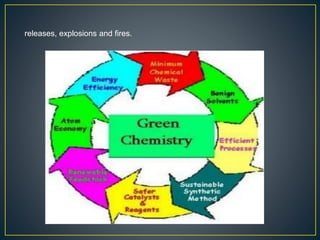
releases, explosions and fires.
Examples 
 Medicine 
The pharmaceutical industry is continually seeking ways to develop medicines 
with less harmful side-effects and using processes that produce less toxic 
waste. 
 Biodegradable Plastics 
Several companies have been working to develop plastics that are made from 
renewable, biodegradable sources.
 Paint 
Oil-based "alkyd" paints give off large amounts of volatile organic compounds 
(VOCs). These volatile compounds evaporate from the paint as it dries and 
cures and many have one or more environmental impacts.
THANK YOU

Green chemistry

  • 1.
    GREEN CHEMISTRY Submittedby, AKHILA CHANDRAN .A Reg.No.13971003 PHYSICAL SCIENCE KUCTE Kumarapuram
  • 2.
    Green chemistry alsocalled sustainable chemistry, is a philosophy of chemical research and engineering that encourages the design of products and process that minimize the use and generation of hazardous substances. The aim of green chemistry is to reduce chemical related impact on human health and virtually eliminate contamination of the environment through dedicated, sustainable prevention programs.
  • 3.
     Paul Anastasan organic chemist working in the Office of Pollution Prevention and Toxins at the EPA, and John C. Warner developed the Twelve Principles of Green Chemistry in 1991. They are ,  Prevention; It is better to prevent waste than to treat or clean up waste after it has been created  Atom Economy; Synthetic methods should be designed to use and generate substances that possess litle or no toxicity to human health and the envirornment.
  • 4.
     Less HazardousChemical Syntheses; Wherever practicable, synthetic methods should be designed to use and generate substances that possess little or no toxicity to human health and the environment.  Designing Safer Chemicals; Chemicals products should be designed to affect their desired function while minimizing their toxicity.  Safer Solvents and Auxiliaries; The use of auxiliary substances (e.g., solvents, separation agents, etc. ) should be made unnecessary wherever possible and innocuous when used.  Design for Energy Efficiency; Energy requirements of chemical processes
  • 5.
     should berecognized for their environment and economic impacts and should be minimized.  Use of Renewable Feedstock; A raw material or feedstock should be renewable rather than depleting whenever technically and economically practicable.  Reduce Derivatives; Unnecessary derivatization (use of blocking groups, protection/ deprotection, temporary modification of physical /chemical process) should be minimized or avoided if possible, because such steps require additional reagents and can generate waste.
  • 6.
    Catalysis ; Catalyticreagents are superior to stoichiometric reagents. Design for Degradation; Chemical products should be designed so that at the end of their function they break down into innocuous degradation products and do not persist in the environment.  Real –time analysis for Pollution Prevention ;Analytical methodologies need to be further developed to allow for real time, in program in-process monitoring and control prior to the formation of hazardous substances.  Inherently Safer Chemistry for Accident Prevention; Substances and the form of a substance used in a chemical process should be chosen to minimize the potential for chemical accidents ,including
  • 7.
  • 8.
    Examples  Medicine The pharmaceutical industry is continually seeking ways to develop medicines with less harmful side-effects and using processes that produce less toxic waste.  Biodegradable Plastics Several companies have been working to develop plastics that are made from renewable, biodegradable sources.
  • 9.
     Paint Oil-based"alkyd" paints give off large amounts of volatile organic compounds (VOCs). These volatile compounds evaporate from the paint as it dries and cures and many have one or more environmental impacts.
  • 10.

Editor's Notes