Green Chemistry
Outline
• Definition
• Introduction
• History
• Principles
• Examples
• Conclusion
Definition:
“The design of chemical products and processes that are more
environmentally friendly and reduce negative impacts to
human health and the environment”
Introduction:
• It is pollution prevention on the molecular scale and is an
extremely important area of Chemistry due to the importance
of Chemistry in our life
• It supports the invention of more environmentally friendly
chemical processes which reduce or even eliminate the
generation of hazardous substances
History
• The concept of green chemistry was formally established at
the “Environmental Protection Agency ” in response to the
Pollution Prevention Act of 1990
• concept was originated by Trevor Kletzin his 1978 paper
where he proposed that chemists should seek processes for
environment
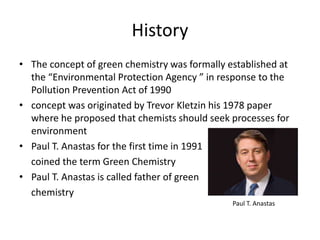
• Paul T. Anastas for the first time in 1991
coined the term Green Chemistry
• Paul T. Anastas is called father of green
chemistry
Paul T. Anastas
Principles of Green Chemistry
There are 12 principles of Green Chemistry
• Prevention
• Atom Economy
• Less Hazardous Chemical Synthesis
• Designing Safer Chemicals
• Safer Solvents and Auxiliaries
• Design for Energy Efficiency
• Use of Renewable Feedstock
• Reduce Derivatives
• Catalysis
• Design for Degradation
• Real-time Analysis for Pollution Prevention.
• Inherently Safer Chemistry for Accident Prevention
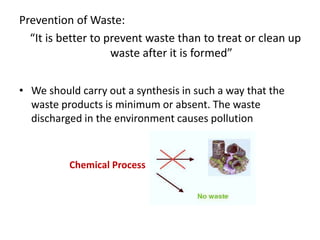
Prevention of Waste:
“It is better to prevent waste than to treat or clean up
waste after it is formed”
• We should carry out a synthesis in such a way that the
waste products is minimum or absent. The waste
discharged in the environment causes pollution
Chemical Process
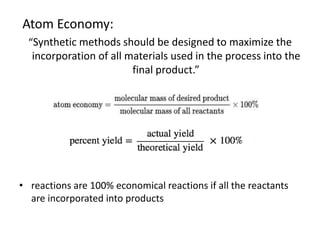
Atom Economy:
“Synthetic methods should be designed to maximize the
incorporation of all materials used in the process into the
final product.”
• reactions are 100% economical reactions if all the reactants
are incorporated into products
Less Hazardous Chemical Synthesis:
“ Wherever practicable, synthetic methods should be
designed to use and generate substances that
possess little or no toxicity to people or the
environment. ”
Designing Safer Chemicals:
“ Chemical products should be designed to effect their
desired function while minimising their toxicity. ”
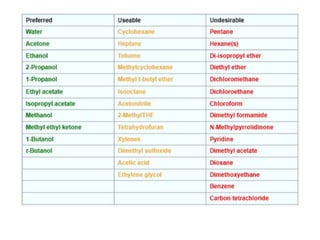
Safer Solvents and Auxiliaries:
“The use of auxiliary substances (e.g. solvents,
separation agents, etc.) should be made unnecessary
wherever possible, and innocuous when used”
• The solvent selected for a particular reaction shouldn't
cause any environmental pollution or hazard (e.g.
benzene, alcohol).
• One major problem with many solvents is their volatility
that may damage environment and human health
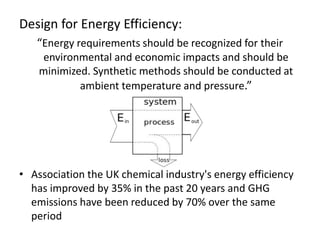
Design for Energy Efficiency:
“Energy requirements should be recognized for their
environmental and economic impacts and should be
minimized. Synthetic methods should be conducted at
ambient temperature and pressure.”
• Association the UK chemical industry's energy efficiency
has improved by 35% in the past 20 years and GHG
emissions have been reduced by 70% over the same
period
Use of Renewable Raw Material:
“A raw material or feedstock should be renewable
rather than depleting wherever technically and
economically practicable.”
For example :
• Substances like CO2(generated from natural sources)
and methane gas (marsh gas) are considered as
renewable starting materials
• Solar energy
• Biomass energy
Reduce Derivatives:
“Unnecessary derivatization (use of blocking groups,
protection/de-protection, and temporary modification of
physical/chemical processes) should be minimised or
avoided if possible, because such steps require additional
reagents and can generate waste. ”
More derivatives involve
• Additional Reagents
• Generate more waste products
• More Time
• Higher Cost of Products
Hence, it requires to reduce derivatives
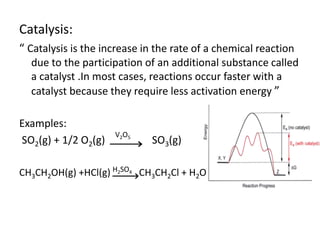
Catalysis:
“ Catalysis is the increase in the rate of a chemical reaction
due to the participation of an additional substance called
a catalyst .In most cases, reactions occur faster with a
catalyst because they require less activation energy ”
Examples:
SO2(g) + 1/2 O2(g) SO3(g)
CH3CH2OH(g) +HCl(g) CH3CH2Cl + H2O
V2O5
H2SO4
Designing of degradable products:
“ Chemical products should be designed so that at the
end of their function they break down into
innocuous degradation products and do not persist
in the environment ”
Real-time Analysis:
“Analytical methodologies need to be further
developed to allow for real-time, in-process
monitoring and control prior to the formation of
hazardous substances.”
Safer Chemicals For Accident Prevention:
“Analytical Substances and the form of a substance
used in a chemical process should be chosen to
minimize the potential for chemical accidents,
including releases, explosions, and fires.”
Example : An incident due to lack of such
measures December 3, 1984 –poison gas
leaked from a Union Carbide factory, killing
hundreds instantly and injuring many more
(many of who died later of exposure)
Examples
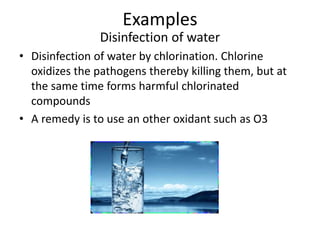
Disinfection of water
• Disinfection of water by chlorination. Chlorine
oxidizes the pathogens thereby killing them, but at
the same time forms harmful chlorinated
compounds
• A remedy is to use an other oxidant such as O3
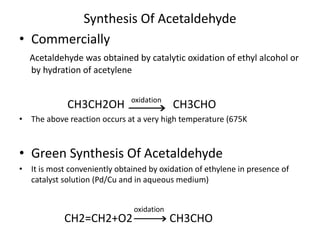
Synthesis Of Acetaldehyde
• Commercially
Acetaldehyde was obtained by catalytic oxidation of ethyl alcohol or
by hydration of acetylene
CH3CH2OH CH3CHO
• The above reaction occurs at a very high temperature (675K
• Green Synthesis Of Acetaldehyde
• It is most conveniently obtained by oxidation of ethylene in presence of
catalyst solution (Pd/Cu and in aqueous medium)
CH2=CH2+O2 CH3CHO
oxidation
oxidation
Conclusion
Green Chemistry is about reducing:
• Waste
• Materials
• Hazards
• Risks
• Energy
• Cost
Remember:
Green chemistry is NOT a solution to all environmental
problems BUT the most fundamental approach to
preventing pollution

Green Chemistry

  • 1.
  • 2.
    Outline • Definition • Introduction •History • Principles • Examples • Conclusion
  • 3.
    Definition: “The design ofchemical products and processes that are more environmentally friendly and reduce negative impacts to human health and the environment” Introduction: • It is pollution prevention on the molecular scale and is an extremely important area of Chemistry due to the importance of Chemistry in our life • It supports the invention of more environmentally friendly chemical processes which reduce or even eliminate the generation of hazardous substances
  • 4.
    History • The conceptof green chemistry was formally established at the “Environmental Protection Agency ” in response to the Pollution Prevention Act of 1990 • concept was originated by Trevor Kletzin his 1978 paper where he proposed that chemists should seek processes for environment • Paul T. Anastas for the first time in 1991 coined the term Green Chemistry • Paul T. Anastas is called father of green chemistry Paul T. Anastas
  • 5.
    Principles of GreenChemistry There are 12 principles of Green Chemistry • Prevention • Atom Economy • Less Hazardous Chemical Synthesis • Designing Safer Chemicals • Safer Solvents and Auxiliaries • Design for Energy Efficiency • Use of Renewable Feedstock • Reduce Derivatives • Catalysis • Design for Degradation • Real-time Analysis for Pollution Prevention. • Inherently Safer Chemistry for Accident Prevention
  • 6.
    Prevention of Waste: “Itis better to prevent waste than to treat or clean up waste after it is formed” • We should carry out a synthesis in such a way that the waste products is minimum or absent. The waste discharged in the environment causes pollution Chemical Process
  • 7.
    Atom Economy: “Synthetic methodsshould be designed to maximize the incorporation of all materials used in the process into the final product.” • reactions are 100% economical reactions if all the reactants are incorporated into products
  • 8.
    Less Hazardous ChemicalSynthesis: “ Wherever practicable, synthetic methods should be designed to use and generate substances that possess little or no toxicity to people or the environment. ” Designing Safer Chemicals: “ Chemical products should be designed to effect their desired function while minimising their toxicity. ”
  • 9.
    Safer Solvents andAuxiliaries: “The use of auxiliary substances (e.g. solvents, separation agents, etc.) should be made unnecessary wherever possible, and innocuous when used” • The solvent selected for a particular reaction shouldn't cause any environmental pollution or hazard (e.g. benzene, alcohol). • One major problem with many solvents is their volatility that may damage environment and human health
  • 11.
    Design for EnergyEfficiency: “Energy requirements should be recognized for their environmental and economic impacts and should be minimized. Synthetic methods should be conducted at ambient temperature and pressure.” • Association the UK chemical industry's energy efficiency has improved by 35% in the past 20 years and GHG emissions have been reduced by 70% over the same period
  • 12.
    Use of RenewableRaw Material: “A raw material or feedstock should be renewable rather than depleting wherever technically and economically practicable.” For example : • Substances like CO2(generated from natural sources) and methane gas (marsh gas) are considered as renewable starting materials • Solar energy • Biomass energy
  • 13.
    Reduce Derivatives: “Unnecessary derivatization(use of blocking groups, protection/de-protection, and temporary modification of physical/chemical processes) should be minimised or avoided if possible, because such steps require additional reagents and can generate waste. ” More derivatives involve • Additional Reagents • Generate more waste products • More Time • Higher Cost of Products Hence, it requires to reduce derivatives
  • 14.
    Catalysis: “ Catalysis isthe increase in the rate of a chemical reaction due to the participation of an additional substance called a catalyst .In most cases, reactions occur faster with a catalyst because they require less activation energy ” Examples: SO2(g) + 1/2 O2(g) SO3(g) CH3CH2OH(g) +HCl(g) CH3CH2Cl + H2O V2O5 H2SO4
  • 15.
    Designing of degradableproducts: “ Chemical products should be designed so that at the end of their function they break down into innocuous degradation products and do not persist in the environment ” Real-time Analysis: “Analytical methodologies need to be further developed to allow for real-time, in-process monitoring and control prior to the formation of hazardous substances.”
  • 16.
    Safer Chemicals ForAccident Prevention: “Analytical Substances and the form of a substance used in a chemical process should be chosen to minimize the potential for chemical accidents, including releases, explosions, and fires.” Example : An incident due to lack of such measures December 3, 1984 –poison gas leaked from a Union Carbide factory, killing hundreds instantly and injuring many more (many of who died later of exposure)
  • 17.
    Examples Disinfection of water •Disinfection of water by chlorination. Chlorine oxidizes the pathogens thereby killing them, but at the same time forms harmful chlorinated compounds • A remedy is to use an other oxidant such as O3
  • 18.
    Synthesis Of Acetaldehyde •Commercially Acetaldehyde was obtained by catalytic oxidation of ethyl alcohol or by hydration of acetylene CH3CH2OH CH3CHO • The above reaction occurs at a very high temperature (675K • Green Synthesis Of Acetaldehyde • It is most conveniently obtained by oxidation of ethylene in presence of catalyst solution (Pd/Cu and in aqueous medium) CH2=CH2+O2 CH3CHO oxidation oxidation
  • 19.
    Conclusion Green Chemistry isabout reducing: • Waste • Materials • Hazards • Risks • Energy • Cost Remember: Green chemistry is NOT a solution to all environmental problems BUT the most fundamental approach to preventing pollution