GREEN CHEMISTRY
PREVENTING POLLUTION
SUSTAINING THE EARTH
WHAT IS A SUSTAINABLE
   CIVILIZATION?
WE SHOULD CONSIDER
                THIS QUESTION FROM
               SEVERAL VIEWPOINTS:
The environment and human health.

A stable economy that uses energy and
resources efficiently.

Social and political systems
that lead to a just society.
TO UNDERSTAND THE ROLE
 OF CHEMISTRY IN SUSTAINABILITY,
            WE WILL LOOK AT THE
             FIRST TWO POINTS…

• The environment and
  human health.

• A stable economy that
  uses energy and
  resources efficiently.
IN A SUSTAINABLE
                       CIVILIZATION…
• Technologies used for
  production of needed goods
  are not harmful to the
  environment or to human
  health.

• Renewable resources (such as
  plant-based substances or
  solar energy) are used rather
  than those, like
  fossil fuels, that will
  eventually run out.
IN A SUSTAINABLE
                        CIVILIZATION…
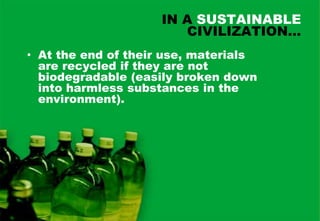
• At the end of their use, materials
  are recycled if they are not
  biodegradable (easily broken down
  into harmless substances in the
  environment).
IN A SUSTAINABLE
                       CIVILIZATION…
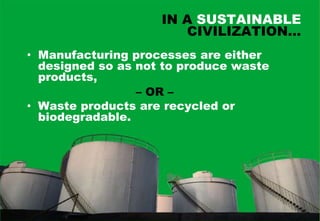
• Manufacturing processes are either
  designed so as not to produce waste
  products,
                 – OR –
• Waste products are recycled or
  biodegradable.
BUT HOW CAN
CHEMISTRY HELP US
    TO ACHIEVE
  A SUSTAINABLE
   CIVILIZATION?
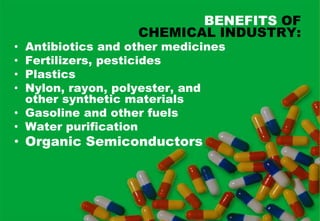
BENEFITS OF
                   CHEMICAL INDUSTRY:
• Antibiotics and other medicines
• Fertilizers, pesticides
• Plastics
• Nylon, rayon, polyester, and
  other synthetic materials
• Gasoline and other fuels
• Water purification
• Organic Semiconductors
THE POLLUTION
             PREVENTION ACT OF 1990
• This was the U.S. environmental
  law stating that the first choice
  for preventing pollution is to
  design industrial processes that
  do not lead to waste production.
• This is the approach of green
  chemistry.
GREEN CHEMISTRY
                      WORKS TOWARD
                   SUSTAINABILITY BY:

• Making chemical products that do not
  harm either our health or the
  environment,
• Using industrial processes that reduce
  or eliminate hazardous chemicals, and
GREEN CHEMISTRY
                      WORKS TOWARD
                   SUSTAINABILITY BY:

• Designing more efficient processes that
  minimize the production of waste
  materials.
GREEN CHEMISTRY
                           MEANS…


• Preventing pollution before it
  happens rather than cleaning up the
  mess later.
GREEN CHEMISTRY
                            MEANS…


• Saving companies money by
  using less energy and fewer/safer
  chemicals, thus reducing the
  costs of pollution control and
  waste disposal.
EXAMPLES OF
                       GREEN CHEMISTRY

•   Reducing lead pollution
•   Putting out fires the green
    way
•   Safer dry cleaning
IN SUMMARY,
                GREEN CHEMISTRY IS…
•   Scientifically sound,
•   Cost effective, and
•   Leads toward a sustainable
    civilization.
Is Green Chemistry only applied modern chemistry?


An academic chemist may contribute by making focused
fundamental research to:

- identify novel processes efficient from both the chemical and
environmental point of views.

- Study how a novel medium influences the reactivity of organic
molecules and discover new synthetic tools by exploiting the
properties of novel reaction media.

- Define easily scalable and automatizable procedure.

- Eliminate the use of unacceptable organic solvents.

    The use of unconventional media does NOT turn a process GREEN…
Is Green Chemistry only applied modern chemistry?


An academic chemist may contribute by making focused
fundamental research to:

- identify novel processes efficient from both the chemical and
environmental point of views.

- Study how a novel medium influences the reactivity of organic
molecules and discover new synthetic tools by exploiting the
properties of novel reaction media.

- Define easily scalable and automatizable procedure.

- Eliminate the use of unacceptable organic solvents.

    The use of unconventional media does NOT turn a process GREEN…
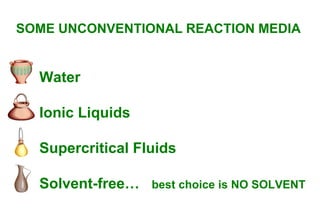
SOME UNCONVENTIONAL REACTION MEDIA


  Water

  Ionic Liquids

  Supercritical Fluids

  Solvent-free…   best choice is NO SOLVENT
Why do we need a solvent/reaction medium?


• To dissolve reactants
• To stabilize a transition state
• To promote a reaction path
• To control the thermal exchange during the
  reactive event
• To purify the product
• To analyze the reaction mixture and run purity
  tests
Main properties of solvents


• Solubility “power”
• Polarity
• Density and viscosity
• Boiling point
• Toxicity, explosivity
• Influence on Ozone depletion
• Greenhouse effect
How Green is a solvent?

First of all a solvent should be non-toxic for human
  beings, animals and plants.
In addition it should be considered:
• Energy (evaporation, pressurization, etc.)
• Recovery and Recycle of the solvent
• Toxicity of the related by-product
• Influence of the solvent on the final product

       Does the solvent comes from
          renewable resources?
WATER AS REACTION MEDIUM


 WHY?


Water is a high-boiling liquid.


Organic reaction mixtures are generally heterogenous in water.


The evaporation of water to recover the species dissolved in, is
costly and tedious.

Is it worth to perform organic reactions in water?
ADVANTAGES in the use of WATER AS REACTION MEDIUM


 • Water actively participates to the process.

 • In Water it is often unnecessary the protection-deprotection
   of functional groups (-OH, -COOH).

 • IN WATER it is possible to influence the reactivity and
   the selectivity of a process by controlling/modifying
   the pH.

 • It allows to isolate solid products by simple filtration.


 • WATER IS NOT TOXIC.

Notes On Green Chemistry

  • 1.
  • 2.
    WHAT IS ASUSTAINABLE CIVILIZATION?
  • 3.
    WE SHOULD CONSIDER THIS QUESTION FROM SEVERAL VIEWPOINTS: The environment and human health. A stable economy that uses energy and resources efficiently. Social and political systems that lead to a just society.
  • 4.
    TO UNDERSTAND THEROLE OF CHEMISTRY IN SUSTAINABILITY, WE WILL LOOK AT THE FIRST TWO POINTS… • The environment and human health. • A stable economy that uses energy and resources efficiently.
  • 5.
    IN A SUSTAINABLE CIVILIZATION… • Technologies used for production of needed goods are not harmful to the environment or to human health. • Renewable resources (such as plant-based substances or solar energy) are used rather than those, like fossil fuels, that will eventually run out.
  • 6.
    IN A SUSTAINABLE CIVILIZATION… • At the end of their use, materials are recycled if they are not biodegradable (easily broken down into harmless substances in the environment).
  • 7.
    IN A SUSTAINABLE CIVILIZATION… • Manufacturing processes are either designed so as not to produce waste products, – OR – • Waste products are recycled or biodegradable.
  • 8.
    BUT HOW CAN CHEMISTRYHELP US TO ACHIEVE A SUSTAINABLE CIVILIZATION?
  • 9.
    BENEFITS OF CHEMICAL INDUSTRY: • Antibiotics and other medicines • Fertilizers, pesticides • Plastics • Nylon, rayon, polyester, and other synthetic materials • Gasoline and other fuels • Water purification • Organic Semiconductors
  • 10.
    THE POLLUTION PREVENTION ACT OF 1990 • This was the U.S. environmental law stating that the first choice for preventing pollution is to design industrial processes that do not lead to waste production. • This is the approach of green chemistry.
  • 11.
    GREEN CHEMISTRY WORKS TOWARD SUSTAINABILITY BY: • Making chemical products that do not harm either our health or the environment, • Using industrial processes that reduce or eliminate hazardous chemicals, and
  • 12.
    GREEN CHEMISTRY WORKS TOWARD SUSTAINABILITY BY: • Designing more efficient processes that minimize the production of waste materials.
  • 13.
    GREEN CHEMISTRY MEANS… • Preventing pollution before it happens rather than cleaning up the mess later.
  • 14.
    GREEN CHEMISTRY MEANS… • Saving companies money by using less energy and fewer/safer chemicals, thus reducing the costs of pollution control and waste disposal.
  • 15.
    EXAMPLES OF GREEN CHEMISTRY • Reducing lead pollution • Putting out fires the green way • Safer dry cleaning
  • 16.
    IN SUMMARY, GREEN CHEMISTRY IS… • Scientifically sound, • Cost effective, and • Leads toward a sustainable civilization.
  • 17.
    Is Green Chemistryonly applied modern chemistry? An academic chemist may contribute by making focused fundamental research to: - identify novel processes efficient from both the chemical and environmental point of views. - Study how a novel medium influences the reactivity of organic molecules and discover new synthetic tools by exploiting the properties of novel reaction media. - Define easily scalable and automatizable procedure. - Eliminate the use of unacceptable organic solvents. The use of unconventional media does NOT turn a process GREEN…
  • 18.
    Is Green Chemistryonly applied modern chemistry? An academic chemist may contribute by making focused fundamental research to: - identify novel processes efficient from both the chemical and environmental point of views. - Study how a novel medium influences the reactivity of organic molecules and discover new synthetic tools by exploiting the properties of novel reaction media. - Define easily scalable and automatizable procedure. - Eliminate the use of unacceptable organic solvents. The use of unconventional media does NOT turn a process GREEN…
  • 19.
    SOME UNCONVENTIONAL REACTIONMEDIA Water Ionic Liquids Supercritical Fluids Solvent-free… best choice is NO SOLVENT
  • 20.
    Why do weneed a solvent/reaction medium? • To dissolve reactants • To stabilize a transition state • To promote a reaction path • To control the thermal exchange during the reactive event • To purify the product • To analyze the reaction mixture and run purity tests
  • 21.
    Main properties ofsolvents • Solubility “power” • Polarity • Density and viscosity • Boiling point • Toxicity, explosivity • Influence on Ozone depletion • Greenhouse effect
  • 22.
    How Green isa solvent? First of all a solvent should be non-toxic for human beings, animals and plants. In addition it should be considered: • Energy (evaporation, pressurization, etc.) • Recovery and Recycle of the solvent • Toxicity of the related by-product • Influence of the solvent on the final product Does the solvent comes from renewable resources?
  • 24.
    WATER AS REACTIONMEDIUM WHY? Water is a high-boiling liquid. Organic reaction mixtures are generally heterogenous in water. The evaporation of water to recover the species dissolved in, is costly and tedious. Is it worth to perform organic reactions in water?
  • 25.
    ADVANTAGES in theuse of WATER AS REACTION MEDIUM • Water actively participates to the process. • In Water it is often unnecessary the protection-deprotection of functional groups (-OH, -COOH). • IN WATER it is possible to influence the reactivity and the selectivity of a process by controlling/modifying the pH. • It allows to isolate solid products by simple filtration. • WATER IS NOT TOXIC.